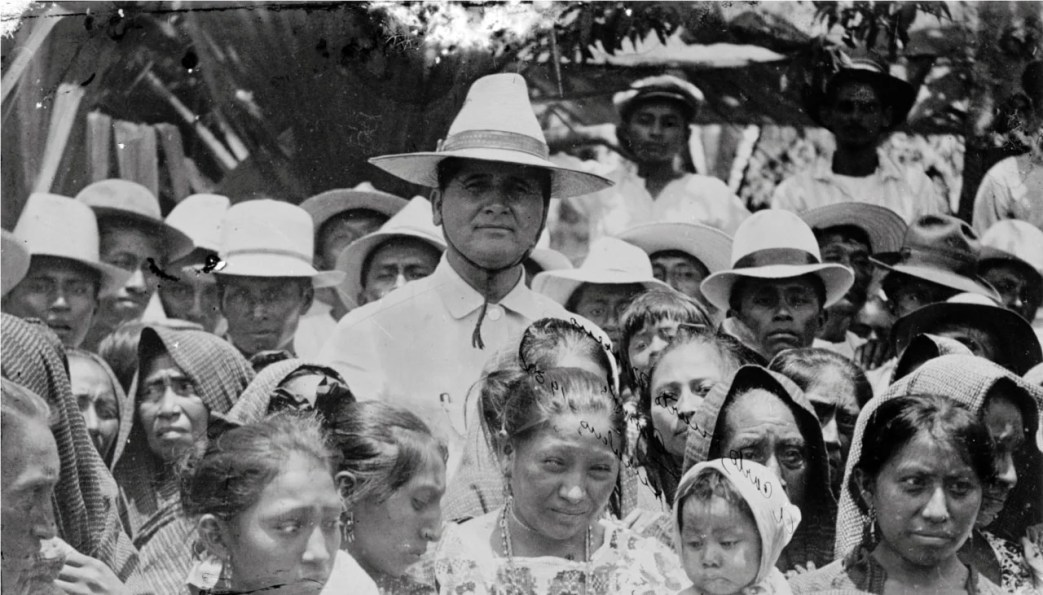
Arnold Roller (Siegfried Nacht) reports from Yucatan on the area’s ancien regime, the fall and murder of its left-wing governor Felipe Carrillo and the specific Mayan socialism that was practiced there.
‘Yucatan—Yesterday and Today’ by Arnold Roller from The Daily Worker. Vol. 1 No. 347. February 23, 1924.
YUCATAN, a peninsula actuated on the extreme south of Mexico, inhabited by 350,000 Maya Indians, has been a thorn in the flesh of the reactionaries and capitalists of the world for the last ten years. It is not surprising, therefore, that they are unable to hide their satisfaction over the news that Yucatan has been conquered and subdued by the counter-revolutionary army of Adolfo de la Huerta. Its Governor, Felipe Carillo, was taken prisoner with thirteen of his friends and according to the latest fashion of all the reactionary powers all over the world, was shot when “trying to escape.”
The Maya People.
With the murder of Filipe Carillo an important chapter of a little nation was closed,—of a whole people, because Yucatan is historically, racially, linguistically and geographically completely different and separated from the rest of Mexico. While the Indian population of the rest of Mexico descend from Aztecs, Yaquia, Zapotecas, etc., and crossing of these Indians with the whites, the inhabitants of Yucatan are, almost exclusively, pure Mayas, of whom very few understand Spanish. They speak a language which is quite different from the languages spoken by the other Mexican Indians. Their civilization seems to have been much older and higher than that of the other Mexican aborigines.
Geographically, Yucatan is separated from the rest of Mexico by impassable jungles and swamps, so that it can only be reached by sea.
Slavery Legalized.
Here, the landed aristocracy succeeded in establishing complete slavery and perpetuating it legally. In spite of all decrees of the various older constitutions, which awarded land to the peasants and in spite of the former quite extensive communal lands (the “ejidas” which corresponds to the Russian “Mir”) which were worked by the peasants in common, the whole land was up to ten years ago in the hands of a few families.
Even the Spanish Conquistadors confirmed by Royal Decree the title of the peasants to these communal lands. But under the rule of the landed aristocracy under the perpetual “president.” Diaz, particularly, it was declared illegal to hold land in common ownership and the authorities proceeded to distribute the land to the peasants, out of these “ejidas.”
This “distribution,” of course, was handled by the big land owners and their tools.
Mayas Tricked.
For awarding or registering the lots such fees were charged that very few of the Mayas were able to raise the required amounts—and consequently the land sharks bought the land from the state or the village authorities at a price of $2 to $3 per acre. Then they farmed out the land to the Indians on the terms of the old serfdom, or they employed them directly as hired laborers. But no laborer or tenant farmer was allowed to produce anything else on his land than the main product of the country, namely, henequen (sisal), a kind of hemp, used largely in the United States for the manufacture of binder twine cords. All foodstuffs were consequently imported by the big landowners and sold to the peasants and agricultural laborers “on credit” at fantastic prices.
Always In Debt.
Thus, the Indians remained permanently in the debt of their masters and another law declared it a crime to leave one’s working place or village, before the debts were paid. At the death of the debtor, his family or nearest relatives were liable and the debt slavery was passed on from father to son. The whipping of men for insufficient production was a daily occurrence, but was, of course, np legal reason to leave the place. The whole district of 70,000 square miles, with its 350,000 inhabitants, was the private property of about 2,000 owners.
According to other estimates, 80 per cent of the soil belonged to twenty-seven families. And this whole district paid under Diaz only $50,000 in taxes to the Central Government. There were no schools in Yucatan and except for religious teaching, it was illegal to teach the Mayas Spanish.
Carrillo’s Early Career.
This changed, however, around 1915. For many years Felipe Carrillo, at that time a railroad employe and a Maya by birth, started an energetic propaganda among the Mayas, whom he organized. The Constitution, according to which slavery and every system of peonage was expressly prohibited, was translated by him into the Maya language in order to inform the slaves of their rights. For this Carrillo was arrested; he escaped, however, and continued his propaganda secretly. By prearranged signals and whistles he called the peons at night, first in small groups of from six to ten men, later however, rocket signals were given for larger meetings with arms.
Effect of Madero Victory.
Madero’s successful revolution against the tyrant, Porfirio Diaz, and later the second victorious revolution of Pancho Villa and Carranza against the counter-revolution of Victoriano Huerta, had naturally an immense influence on the fortunes of Yucatan. Under the new Constitution a socialist administration was elected, but another revolution, this time a workmen’s and peasants’ revolution, against Carranza was necessary, in order to frustrate the reactionary plans of the “liberator” Carranza, who, though being a liberal constitutionalist, could not suffer to see that the land of the big land owners, to which clan he belonged, being subdivided, not only by decrees and in theory but also in fact, and that social reforms were being actually realized. In 1915 we see the socialist general Salvador Alvarado as governor of Yucatan, which he became after defeating in March the same year the army of the governor appointed by Carranza. Peonage was finally actually abolished.
Debts Voided.
All debts of the peons were declared void. Everyone who wanted to work the land by himself received forty acres each, which were cut out from the properties of the big owners. This land was partly confiscated wherever it could be proved that the “owners” or their ancestors appropriated it unduly from the communal lands, or the land was purchased forcibly from the big owners at the values given by them for income tax purposes, which, obviously, were none too high. The amounts due to them accordingly were paid in bonds, maturing in fifty years’, and bearing 4 per cent interest.
Every big landowner was compelled to reserve on his property a building for a school, so that 2,000 schools were opened, where there were formerly almost none, and the teachers, mostly socialists, were imported from all parts of Mexico. Next Alvarado undertook an energetic struggle against the church. From the few schools which formerly existed all priests were expelled and instead of the religious slogans he placed everywhere revolutionary and atheistic mottos, such as, “Flee from religion as from the plague”; “Whether God wills it or not, the revolution shall go on”; “Without God or without masters, here is the supreme aspiration of free men.”
The former marriage laws were abolished and marriage declared a private contract, entered into by the common wish of both parties and dissolved by the will of one party, after due provisions for the care of the children, if any.
Publishes Daily Paper.
One of the first things which Alvarado did was to take over the largest daily of Merida, the capital of Yucatan, which was the organ of the blackest reaction, renamed it the “Voice of the Revolution” and handed it over to the labor unions.
It is certainly tragic that this same Alvarado now turned traitor to the proletariat, as co many other ex-socialists. Mussolini, Noske et tutti quanti—and he is now one of the generals fighting for De la Huerta.
During his administration, Felipe Carillo organized all over the country innumerable “Ligas de resistencia,” which were at the same time a combination of co-operative, trade union, club, educational center and socialist and political organization.
Labor Laws.
Among the laws promulgated under Alvarado, for the protection of the workmen, article 79 provides that women are not allowed to work thirty days before and thirty days after confinement, but must receive their full salary during the entire time, and their jobs must be kept open for them. According to article 80, every establishment, in which women were employed, had to have a specially reserved room, in perfect sanitary condition, in which mothers could nurse their children, every two hours for fifteen without this time being deducted from their wages or rest periods. The eight-hour working day was introduced and whenever a workman was dismissed, the employer had to pay him three months’ wages. In the whole country, co-operative stores and co-operative purchasing organizations were established.
Co-operate For Markets.
In addition to the happy combination of co-operatives and trade unions, for the purpose of improving the living conditions of the people, another important economic institution must be mentioned, which was originally founded in 1912 by the big land owners. This is the “Comision Reguladora de Henequen” (the sisal regulating commission), the purpose of which was to prevent the under-bidding of prices and to form a united front against American buyers.
In other words, it was the Sisal Trust of Yucatan, formed to keep up the price of sisal against the American Harvester Corporation. With the victory of the revolution, Alvarado became also president of the “Comision Reguladora,” which was then organized on a co-operative basis and administered in the interests of the whole people.
Carillo Becomes President.
After the eliminating of Carranza in 1920, who, up to his very ed was fighting against rebellious Yucatan, Felipe Carillo was elected Governor in 1921 with the enormous majority of 60,765 votes against 4,085 for the reactionary candidate. He continued the social legislation started by Alvarado and proved himself an excellent administrator in every field. Rent laws promulgated by him limited the rent to 7 per cent of the declared value of the property. Tho taxes were such that the owner of one house, living in it, paid practically no taxes, the owner of five houses felt already the sting of the taxation, while the owners of more than twenty houses had to pay such taxes that they were in the greatest hurry to dispose of them at almost any price, which, consequently, considerably reduced rentals. All kept out of use had also to pay taxes, which is one of the principal tenants of the single taxers.
Carillo the Financier.
When, by a capitalist conspiracy, in order to destroy Yucatan economically, the price of sisal was depressed from 18c per pound to 3c per pound, while the actual cost of production is 4c, Carillo borrowed from the Federal Government in Mexico enough money, to buy the floating supply of 800,000 bales of sisal in the United States, which was need for depressing the price. By limiting production and by organization of co-operative warehouses he succeeded in a short time in raising the price above the pre-war value. In this way the “uneducated railroad shop hand,” Felipe Carillo, saved Yucatan from economic ruin, while a capitalist government did not succeed in a similar case—namely, at the time of the sugar crisis in Cuba, which sent Cuba into bankruptcy.
Carillo’s Mistake.
Now Carillo and his work have been destroyed, but Carillo himself is not without blame. His mistake, for which he paid with his life, was his pacifism. In spite of the urgent request of many of his friends he refused to arm the Maya people against a possible counter-revolution and so he and his peacefully organized people fell victims to the first armed reactionary gang of murderers.
If Yucatan had had a red army, the red flag would still be flying from all trade union and government buildings of the country. But this reaction can only be temporary. The people, who have tasted freedom and the first beginnings of economic improvements, will not submit again meekly to the ancient slavery.
Though all trade unions and co-operatives have been destroyed, and title to the land given to the peons is being returned to the big landowners, this will not assure the continuation of the old slavery but will contribute to the success of the next revolution.
The Daily Worker began in 1924 and was published in New York City by the Communist Party US and its predecessor organizations. Among the most long-lasting and important left publications in US history, it had a circulation of 35,000 at its peak. The Daily Worker came from The Ohio Socialist, published by the Left Wing-dominated Socialist Party of Ohio in Cleveland from 1917 to November 1919, when it became became The Toiler, paper of the Communist Labor Party. In December 1921 the above-ground Workers Party of America merged the Toiler with the paper Workers Council to found The Worker, which became The Daily Worker beginning January 13, 1924.
PDF of full issue: https://www.marxists.org/history/usa/pubs/dailyworker/1924/v01-n347-supplement-feb-23-1924-DW-LOC.pdf
 Revolution's Newsstand