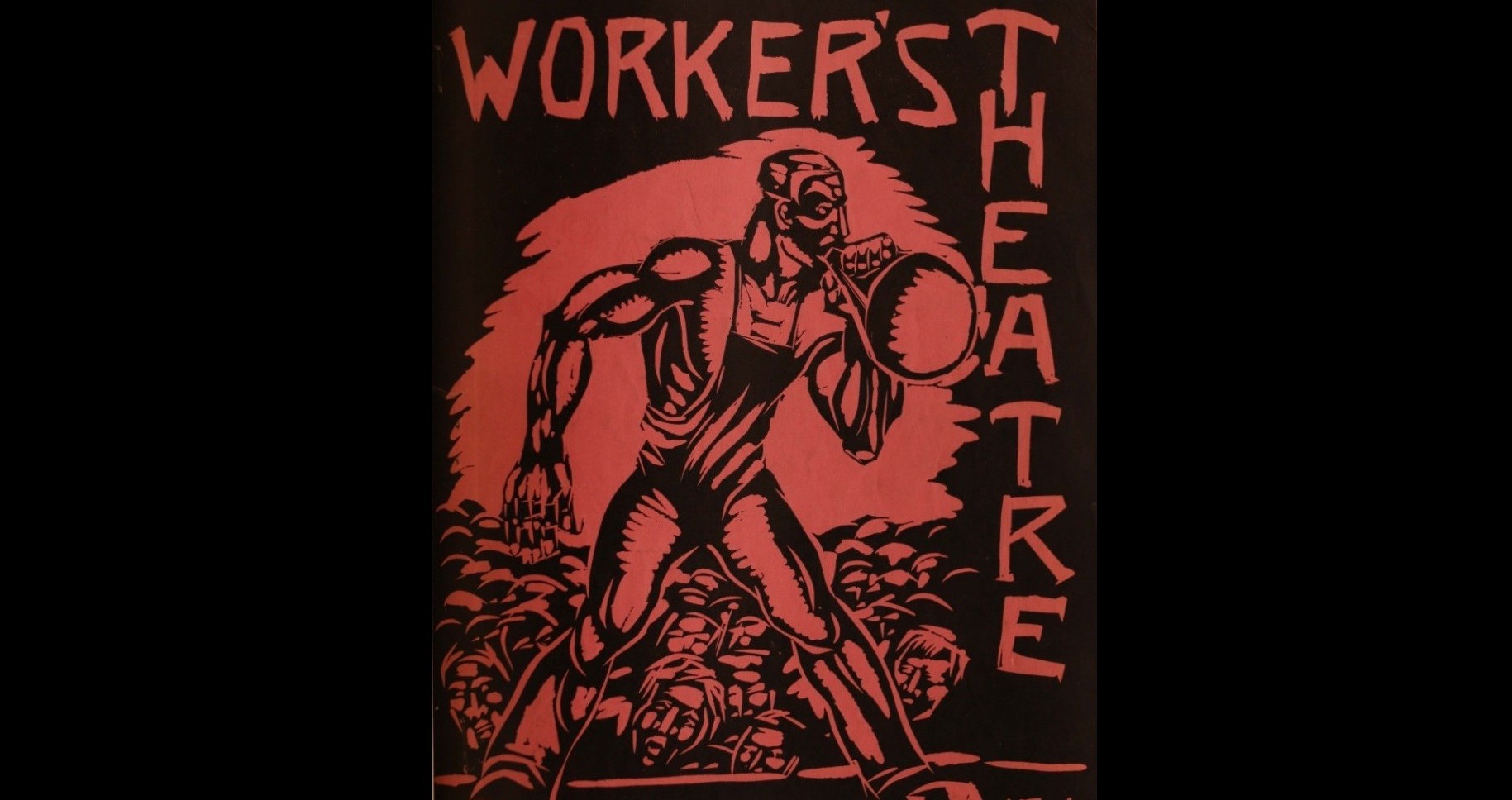
The main report given at the First National Workers Theatre Conference held in New York on April 17, 1932. The conference brought together representatives of over 200 theater collective around the country and coincided with the Spartakiade, a judged competition of performances from local and regional troupes.
‘Situation and Tasks of the Workers Theatre’ by John E Bonn from Workers Theatre. Vol. 2 Nos. 2-5. May-August, 1932.
A report to the First National Workers Theatre Conference held in New York, April 17
COMRADES:
Two weeks ago the Agitprop Department of the Communist Party called upon the workers theatres in New York for active participation in the coming election campaign. A week ago the Unemployed Council of the Harlem Section New York asked for an Agitprop group to give regularly street performances at open air meetings. Yesterday’s Spartakiade in which 14 workers theatres of New York, Newark, Philadelphia, and Chicago participated proved that the political and artistic quality of our groups stands well in comparison with the best workers theatres of other countries.
The simultaneity of all these events shows that it is not just an accident that this conference takes place at this time. This conference was necessary at this moment, in order to conclude a certain period in our development and to begin a new phase in the history of the workers theatres of this country. This is the moment when the “splendid isolation” of the workers theatres of “splendid isolation” of the workers theatres of this country, from each other, from the masses, and from the political events, has been definitely canceled, when the American workers theatres finally abandoned that “minority complex” willingness to be a second hand means of amateur entertainment by and for workers, when we are conscious of our political task and responsibility towards the working class. And this is the moment, when the workers and the working class organizations, instead of ignoring us or smiling at our attempts as they used to do, recognize us as an important factor in the revolutionary movement of the working class.
We have passed the period of clarification of action. Between these two phases of development this conference had to take place in order to resume the experiences and achievements of the first period and to prepare for the next period by organizing and consolidating the forces for action.
THE POLITICAL BACKGROUND
This turn in the history of the workers theatre movement of the U.S.A. coincides with a most important event in world history: the crisis of the capitalist system and the rise of Soviet System, the transition of the political and crisis of the capitalist system and the rise of the economic dictatorship from the capitalists to the workers. While in one sixth of the world the rule of the proletariat has been established, in the other part of the world the capitalists are still strong enough to defend their lost position at the expense of the toiling masses. And we, the workers of this country of prosperity, feel this burden no less than our brothers in the other capitalist countries.
Twelve million workers are unemployed in the richest country in the world. Those of us who are still working are exploited by a reckless system of the speed up and wage cuts…At the same time, capitalists, encouraged by the treacherous role of the so-called Socialists, have created an unheard of system of terror against all militant attempts by the workers to struggle for their rights. The Hunger March of Washington, the battles in the Kentucky Strike, the clashes in Detroit and Chicago, the Scottsboro case, are only a few example of the growing militancy of the workers and the desperate terror of the bosses who use jail, murder, lynching, electric chair, and deportation against protesting, demonstrating, and striking workers. In a time like this all means must be used to defend ourselves against and to attack and defeat our enemy. In a time like this we cannot afford to renounce the aid of a strong and militant front of the workers theatre.
THE BOURGEOIS THEATRE
All the culture is determined by and is the expression of the economic situation. The capitalist decay must find its reaction in the capitalist, i.e. bourgeois theatre.
The bourgeois theatre takes an active part in covers the facts of capitalist decay. Just think the class struggle on the side of the capitalists. It broadcasts the bourgeois-capitalist ideology. It of all the plays and movies demonstrating, explicitly or implicitly, that money does not make happy homes, that every worker in this country has a chance to become a millionaire when he starts as an obedient wage slave and rises to exploit others, that millionaires are often unhappy and always charitable, that we have to defend and to die for “our country” etc., etc. The erroneous conception of many of us that the bourgeois theatre is a matter of “art for art’s sake” while the workers theatre is a weapon in the class struggle, must be revised. The slogan, “art for art’s sake”, is nothing but a cover for the political reactionary character of the bourgeois theatre. The bourgeois theatre is also a weapon in the class struggle on the side of the bosses.
On the other hand, the bourgeois theatre reacts passively, as a victim of the capitalist crisis. More and more theatres are forced to close. The remaining theatres reduce the wages of the employed actors, directors, and workers to a minimum. The number of the unemployed theatre artists and workers is growing from day to day. The artistically highest form of the bourgeois theatre, the “Little Theatre”, has practically disappeared. And even the cinema and the most popular American form, the “vaudeville”, are in the same critical situation.
OUR ATTITUDE TOWARD THE BOURGEOIS THEATRE
Our attitude toward the bourgeois theatre was up to now incorrect. I in particular had taken a wrong leftist standpoint in my report at the Workers Cultural Conference on June 14, 1931, when I stated that there is no relation between bourgeois theatre and workers theatre, as the bourgeois theatre approaches the rich while the workers theatre approaches the workers. This attitude led to a dangerous neglect of the bourgeois theatre. But after a closer study and wider experience I now agree fully with my critics who urged a more active attitude toward the bourgeois theatre. The bourgeois theatre, as an instrument of our class enemy, must be fought by exposing its class character to the workers, by replacing it by a qualified workers theatre art. As a victim of capitalist decay the bourgeois theatre must be attacked by approaching those who are affected by the crisis, in order to win them over into the ranks of the class conscious militant into the ranks of the class conscious militant workers.
THE AIMS OF THE WORKERS THEATRE
In contrast to the bourgeois theatre, the workers theatre shows openly its political character: it is the theatre of the revolution, it is a weapon for the workers in the class struggle. We expose the whole capitalist system with all its tools. We expose the class character of the bourgeois press, of the police, of the army, of the courts, of the church, of the schools, and of all capitalist institutions. We must propagandize the campaigns for Unemployment Insurance, for liberation of political prisoners, for strike relief. We must report and analyze the day-to-day events. We must prove that the revolution is the only way out. And we have to broadcast the truth about the Soviet Union, and the necessity for all workers to defend their only fatherland.
But it is not enough to propagandize and to dramatize the class struggle. The workers theatre must take an active part in the class struggle. We must support and build up the revolutionary mass organizations by raising money and by winning over the workers. We must help the revolutionary press by collecting money, by winning new readers and subscribers. The workers theatre must stand in the front of the class struggle, reflecting it and carrying it out.
While almost everybody working in and for the workers theatre is clear on our general political aims and the specific tasks, we are still engaged in the search for the right method of work and the most appropriate form of expression to carry out our tasks. When we look over the articles in our magazine, Workers Theatre, and the correspondence among the various groups or between the Dram Buro and the groups, we find that these organizational and artistic problems have been taken up very seriously and dealt with thoroughly by the workers theatres of this country. The limited time for this report allows me but to touch the main problems, which it seems to me are these: 1. which method of work should we apply? 2. which is the most efficient artistic form for workers theatre production?
METHOD OF WORK
As agitation and propaganda groups, we have to convince the masses of workers of the necessity of the class struggle and to arouse them to action. But how can we propagandize the class struggle if we are not clear about it ourselves? How can we inspire our fellow-workers to action if the spirit of action is not in ourselves? That means: that basic prerequisite for a successful work is
POLITICAL TRAINING
of each member and political orientation of our itself as a shock brigade and each group member entire work. Not before each group considers feels as a soldier in the class struggle can we expect to fulfill the other prerequisite of our work:
PROLETARIAN DISCIPLINE
I do not have to explain here why workers theatres have to expect more discipline and more responsibility from each individual member than other organizations. Everyone of us is convinced of this necessity. However, for many of us the question is still open, how to accomplish the necessary group discipline. One thing we know by experience: we cannot and will not enforce this discipline. It must be a voluntary discipline, which can only be the result of political education. A group member who does not understand the political importance of his group cannot keep a strict proletarian discipline. A group member who is convinced of the political necessity of our work cannot act undisciplined and irresponsible. Not before we understand the importance of thorough and continuous political education of the group will we be able to find the correct method of work. The problem is to find the right balance between leadership and collectivism. Here we failed in either direction. On account of a wrong understanding of collectivism on one hand, and an absolute lack of leadership on the other hand, we find some groups in the state of anarchism which is sometimes camouflaged by a bureaucratic organizational formalism. Nothing is more able to kill the revolutionary spirit of a group than a too complicated apparatus of committees, subcommittees, functionaries, and functionary-bodies. At least there is no more task for which the group as a whole could be responsible and no problems which could not be given over to the “proper” committee of functionary. On the other hand we find often a dangerous overconcentration of all activity and responsibility on one comrade while the rest of the membership has nothing to do except to carry out the plans and the orders of this single “leader”. Imagine what would happen if this single comrade has to leave the group, and you recognize immediately the dangerous shortcomings of this method.
The organizational basis of our work must be such that the special talent of an individual member can be used as far as possible. The group as a whole, however, has alone the power to decide on all political, organizational, and artistic questions. The leader has the function to lay out ‘he plans and to direct the activities, in order to carry out the decisions of the whole group. In this case each member of the group feels much more responsible, as he has to carry out not the order of a single comrade but a collective decision in which he took part. We know from experience that this
COLLECTIVE METHOD
based on political education and on voluntary discipline guarantees the best results.
THE PROBLEM OF FORM
What should the Workers Theatre look like? Which is the proper form for our plays, for our staging, for our acting? When we compare Workers Theatre with the Workers Theatre magazines of other countries we find that we in this country are more concerned with these problems than our comrades elsewhere. Again and again we meet articles, speeches, discussions, letters dealing with the following problems: Shall we learn from the bourgeois theatre or not? Do we need a stationary theatre or an Agitprop Theatre? Shall we write and perform naturalistic or symbolistic plays? Shall we use scenery, costumes, and make-up or not? The way these questions are put shows that most of us have a purely formalistic therefore wrong approach toward the problem of form. We understand that aims, working conditions, players, directors, writers, audience of the workers theatre are different from those of the bourgeois theatre, and at the same time, we try to find the appropriate form for our theatre among the forms existing in the bourgeois theatre! This is an obvious contradiction.
We cannot wait or look for a ready made style for our new theatre; we have to develop the style of the workers theatre by bringing it in conformity with its tasks and its means of expression.
MOBILITY
Our task is to bring the message of the class struggle to as many workers as possible. When we want to reach the masses it is not enough to wait until they come to us or call for us. We have to go there where the masses are: in meetings, in workers affairs, on the streets, at factory gates, in parades, at picnics, in working-class neighborhoods. That means we must be mobile.
Our organizational structure, our plays, the form of our production must be such that we are able to travel with our production from one place to another, that we are able to give the same effective performance on a stage, on a bare platform, on the streets.
PROPAGANDA AND ENTERTAINMENT
It is not enough to bring our message to the masses. It is necessary that the masses accept our message. Our production must be such that the workers like them. We have to consider the expectations of the audience. And a theatre audience expects in the first place entertainment. A production with the best political content is worthless if this content is not presented in a form which is interesting for a workers audience. But we do not achieve this entertainment value by adding certain entertaining elements–like a dance, a song, a special stage effect–to the political content. The form in which we express our propaganda must contain the entertainment value. Both elements–propaganda and entertainment–must be interwoven in a workers theatre performance.
SIMPLICITY AND ART
The organizers, players, writers, and directors of workers theatres are workers, the audiences are workers. Both are not prepared by a long literary and cultural education, which is only available to the members of the bourgeois class who have the leisure and the money for it. Worker players are not able to express, and worker audiences are not able to understand, complicated structures of ideas and refined intellectual language. The workers theatre plays must be simple, so that workers can produce them and workers can understand them. Simplicity, however, does not mean crudity, does not mean absence of art. On the contrary: the more artistic our productions are, the more effective they are, and the more efficient is the political education and propaganda we carry. The art of workers theatre will be an art using the simplest elements, according to creative elements at our disposal, according to our economic situation and according to our audience.
It was not accidentally that I dealt mostly with the organizational and artistic form of the Agitprop theatre. For this is finally the form of the great majority of the workers theatres and then it is the form most adequate to the political and economic conditions of the proletariat in capitalist countries. However, the other form of theatre, the stationary theatre, should not be neglected or condemned. There is no doubt that only in a workers country a stationary workers theatre has the opportunity to develop all its possibilities to a full extent. But there is also a place for a stationary workers theatre in a capitalist country. If it had no other function than to detract the workers audience from the bourgeois stationary theatre, we had reason enough for building up a stationary workers theatre. But there are many other reasons, which not only justify the existence of a stationary theatre in a capitalist country but also show obviously that it is necessary to build it up. First of all the stationary professional theatre has many means and ways of expression which are not at the disposal of the agitprop theatre. Of course, these means must be exploited for our political propaganda purposes. Then, there exists a demand for the stationary workers theatre with its more elaborate technical means, with its more emotional approach toward the audience.
The stationary workers theatres in Japan, in Germany, (Piscator) and here (Artef) show us the possibility of professional theatres in capitalist countries, but at the same time they show us many organizational, political and economic mistakes which we have to avoid when we, in the capitalist U.S.A., start to build up an English speaking stationary workers theatre. And this, comrades, it seems to me, is one of our main future tasks.
Comrades, I hope the situation is clear to you. The question is not: Agitprop theatre or stationary theatre. Our task is to develop both types. For: we need both types as weapons in the class struggle the flashlight effect of the mobile up-to-date agit-prop theatre as well as the impetus of the slower but broad attack of the more complicated stationary theatre.
HISTORY OF OUR WORKERS THEATRE
The Workers Theatre movement of this country is very young. Not more than about three years separate us from our “prehistoric” period, where we had quite a few workers theatres which worked with more or less success, in an isolated manner with no clear idea of their task, with no constructive program. The first attempt to organize the workers theatres in this country, made in 1929, did not achieve more than a complicated and bureaucratic constitution.
A second attempt was stimulated by the International Workers Dramatic Union, which asked the Workers International Relief to undertake the first step toward an organization of the various groups. The Workers Laboratory Theatre, at that time already affiliated with the W.I.R., was too busy with its own organizational problems. But with the strengthening of its organizational, political, and artistic foundation, it became more and more conscious of the responsibility toward the whole movement, handed over to it by the I.W.D.U.
But the group only half understood its task. Instead of building the foundation for central organization by preparing and mobilizing the various groups, it established itself as a kind of clearing house and information center, for all workers theatres in this country. Though these activities did not and could not result in the necessary centralization and organization of the workers theatres, its achievements should not be underestimated. By establishing contacts on a national and international scale, by spreading the idea of the political importance of the Workers Theatre, it laid the foundation for the coming move successful attempts.
About one year ago, March, 1931, another step was undertaken by the German Workers Theatre, the Prolet-Buehne, which was the most disciplined, and politically and artistically most advanced workers theatre in the U.S.A. The Prolet-Buehne invited representatives of various Workers Theatres to a conference, where it recommended the formation of a central organization of Workers Theatres, first of New York, and later of all the states. A provisional committee started the preparatory work, when the Workers Cultural Conference was announced for June 14, 1931. The committee interrupted its activities in order to wait for the decisions of the conference. However, these attempts had also one very important concrete result: the cooperation of the two most developed Workers Theatres: the Workers Laboratory and the Prolet-Buehne as “United Workers Theatres of N.Y.” This found its most efficient expression in the joint editorship of the Magazine “Workers Theatre”, which had been started by the Workers Laboratory Theatre.
DRAM BURO AND DRAM COUNCILS
At the Workers Cultural Conference, on June 14, the Workers Cultural Federation was organized. The Dramatic Section of the Executive Committee of the new federation constituted itself as Dram Buro. The program of the Dram Buro included the following main points:
1.) To prepare a National organization of ail Workers Theatres of the U.S.A.
2.) to coordinate the activities of the various groups.
3.) to give the groups advice and assistance
4.) to establish an exchange of experiences and forces between the groups.
Though the Dram Buro, as a section of the New York Cultural Federation was only a district body, its program was laid out on a national scale.
This twofold task, to prepare a national organization and to act as temporary central body, could only be carried out in close contact with and through the full cooperation of all groups. The first organizational step of the Dram Buro was therefore, to recommend the organization of local Dram Councils.
New York, which had the first and most active Dram Council, proved what can be achieved through permanent cooperation of all groups. I cite only the various mass performances which became an important entertainment and propaganda feature of the New York mass meetings. the first street performances in the last election campaign; the joint activities of the N.Y. groups to raise money for the striking Kentucky miners.
The groups in N.Y. as well as all over the country received plays and organizational assistance from the Dram Buro. A Workers Theatre Training Course was held in New York.
During all the day to day tasks and all the routine work, the Dram Buro did not forget the main task: the preparation of the National Conference. Independent of the success of yesterday’s Spartakiade, and of this conference, the preparatory work for our First National Workers Theatre Conference and Sptartakiaae can be considered as one of the most important achievements in the history of our movement. An event of which each group member, each functionary, and the Dram Buro can be proud.
For more than two months the workers theatres of this country were in a state of mobilization, concentrated on the task to prepare the conference financially, organizationally, ideologically and artistically. It was a splendid example of solidarity and collective spirit. It was the final proof that the workers theatres of this country are a power. It was the last dress rehearsal for our political activities in the near future. It was a promise to the working class of this country and of the world which we have to make good.
The best way to recognize our achievements during the last year is to compare today’s situation with that at the time of the N.Y. Cultural Conference in June, 1931. A year ago each of the 200 workers theatres of this country was isolated, not knowing about the work, the difficulties, the problems, or even about the existence of the other groups. Today at least 150 groups in all parts of the country belonging to the different language groups are in permanent contact through the Dram Buro and the local Dramatic Councils. We know about the activities of the other groups. We can learn from each other. We can avoid mistakes which others have made. Our plays can be distributed and translated. The different organizational, technical, and artistic problems can be discussed among the groups.
The consequence of this permanent contact between the various groups is a remarkable improvement of the quality of our work. We have not only more but also better plays. We are abandoning more and more the petty bourgeois tendency of imitating the bourgeois professional theatre, in favor of a real revolutionary theatre of propaganda and agitation. The contents of our productions correspond better with the major political questions of our class and react faster on the day-to-day events. Important events as the Scottsboro Case, the Miners Strike, last year’s election campaign, and others became subjects of our plays.
SHORTCOMINGS
Our considerable progress during the last months should not make us blind to for shortcomings and mistakes in our work. The consciousness of our achievements gives us the impetus and the courage to proceed and to improve, while the recognition of our shortcomings will show us the direction in which we must travel in order to develop. Constructive criticism and self-criticism are the bases of the revolutionary movement, also of this special section of the revolutionary movement. The time at my disposal does not allow me to give a complete enumeration and a thorough analysis of our shortcomings. All I can do at present is to point out the main weaknesses, in order to lay the basis for further critical discussion in the groups, or for contributions by the individuals concerned with our work.
The first and most obvious shortcoming is the lack of forces. We have not even enough groups available to answer the demand for dramatic entertainment at affairs of workers organizations. And where are the groups to be activized for special political tasks; to prepare or to sup- port special political campaigns; to perform at open-air meetings; to approach neutral or misled workers? New York, for instance, has no more than 5 English speaking agit-prop groups, of which only 1 or 2 are absolutely reliable. There is no Negro agit-prop group in the country. There is no group to propagandize the farm workers and the poor farmers. Which mass organizations used dramatic activities for that twofold purpose–to activize the membership and to recruit new forces at the same time? The W.I.R. is the only mass organization with its own agit-prop group: the Workers’ Laboratory Theatre. Much must be done and can be done in this direction.
Does the quality of our work make up for the shortage of forces? Not at all! Although a considerable improvement took place during the last year, it cannot be denied that our actual efficiency is far from what we would call real revolutionary energy and power. Too many of us are not yet convinced of the seriousness and importance of our task, do not realize the role which the workers theatres play in the class struggle. There is still a drastic lack of political education, a drastic lack of responsibility and discipline, a drastic lack of revolutionary militancy and activity in our movement. All these find reaction in the quality of the single performance as well as in our major political events. Each group, each functionary, each group member should check up on these shortcomings and remedy them. Our future theoretical and practical work should take a special interest in an organizational and political strengthening of our movement.
If we look backwards at last year’s production of plays we can state that we have quite a good repertory. There are quite a number of comrades, all non-professional who, on account of their day to day experience with the practical work in groups acquired a fine sense and knowledge of the technique, sometimes too obvious and too conscious a technique of agit-prop plays. The next step in our development is to build upon that foundation, a correct structure of real, live art. Our future plays will have more variety in content and form. They will deal more with facts, figures and events than our former plays which mostly reflected ideas, principles and abstract contrasts. Numerically, however, our production of plays is not yet satisfactory. The reasons for these shortcomings are the following:
1) individual comrades do not get enough encouragement and help
2) too few attempts are made in collective playwriting
3) absolute passivity of our professional revolutionary writers.
The isolation of the professional writers from the workers theatre in this country is an especially impermissible shortcoming. A little more interest on the part of the writers and more serious attempts on our part to attract our professional comrades will lead to cooperation which can be of greatest advantage for both parts. The workers theatre will gain in color, life, and ideas, while the professional playwrights will find demand for and response to their revolutionary art for which they are looking, without success, in the bourgeois theatre.
NEED FOR A NATIONAL WORKERS THEATRE ORGANIZATION IN THE U.S.A.
Comrades, there are many shortcomings in our movement. More than I can mention in this report. However, this fact cannot discourage us. We look at our mistakes and failures in a revolutionary spirit, that means in a constructive spirit. The statement of our shortcomings is at the same time the expression of our willingness to correct them. In order to accomplish this task we must utilize, coordinate, and collect all available forces. The only organizational basis for a collective and cooperative work of this kind is a national organization of all workers theatres in this country.
The experience of the workers theatres in the European countries as well as the rapid development of our own movement since the establishment of the Dram Buro, as a provisional coordinating body, prove the necessity for such a national organization. At the beginning of my report I said that this conference takes place between We look two periods of the history of our movement back at the period of clarification and preparation. And we look forward to the period of action. We can and must do more than just deal theoretically with this turn. It is our revolutionary duty to materialize our conclusions into facts, by laying the concrete foundations for the important and immense political tasks we have to carry out in the future. Comrades, let us, today, form the national organization of all workers theatres of this country. Let us make this day the first day of our period of action. Let us make this conference an historical event, not only in the development of the workers theatre movement, but also in the history of the revolutionary movement of this country.
The New Theater continued Workers Theater. Workers Theater began in New York City in 1931 as the publication of The Workers Laboratory Theater collective, an agitprop group associated with Workers International Relief, becoming the League of Workers Theaters, section of the International Union of Revolutionary Theater of the Comintern. The rough production values of the first years were replaced by a color magazine as it became primarily associated with the New Theater. It contains a wealth of left cultural history and ideas. Published roughly monthly were Workers Theater from April 1931-July/Aug 1933, New Theater from Sept/Oct 1933-November 1937, New Theater and Film from April and March of 1937, (only two issues).
PDF of full issue: https://www.marxists.org/history/usa/pubs/workers-theatre/v2n2-may-1932-Workers-Theatre-NYPL-mfilm.pdf
PDF of issue 2: https://www.marxists.org/history/usa/pubs/workers-theatre/v2n3-4-june-july-1932-Workers-Theatre-NYPL-mfilm.pdf
PDF of issue 3: https://www.marxists.org/history/usa/pubs/workers-theatre/v2n5-aug-1932-Workers-Theatre-NYPL-mfilm.pdf
 Revolution's Newsstand