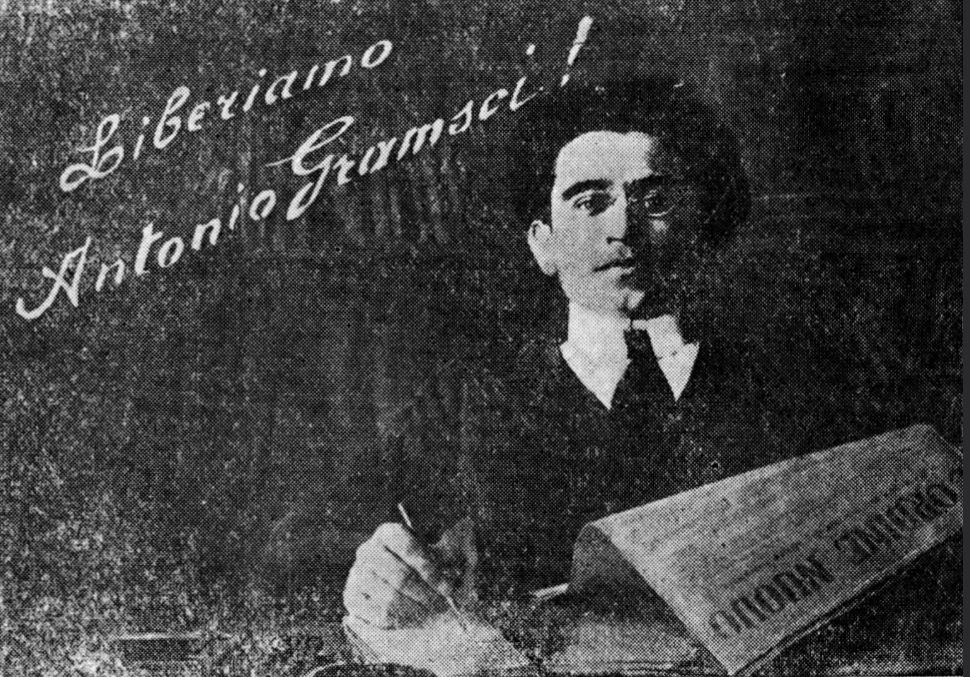
Rolland on the condition suffered by the prisoners of Fascist Italy, particularly Antonio Gramsci, who would die on April 27, 1937 from the effects.
‘Whom Mussolini Murders’ by Romain Rolland from Labor Defender. Vol. 10 No. 11. December, 1934.
Antonio Gramsci, Italy’s Thaelmann
One of the crimes that Hitler committed was to put Mussolini in the shade. The extravagance of his incendiarism, of his orgies of burning books, of tortures and massacres, have far outshone the glories of the heroes of the bludgeon and castor oil. In comparison with Adolph, Benito has become almost a saint, benign like his name. Growing older, the devil has become respectable. He has grown fat. In his most recent portraits he is represented with a smile of grave and indulgent irony on his lips. He is a great man and comforting to the bourgeoise. And his history is recounted to the children like the dull and virtuous story of the lives of the saints.
But we shall have to upset the idylls. There is another side to the question that we have to look at. We are not the kind of people who forget Matteoti on account of the murders in Germany. We are not the kind of people in whose eyes the eighteen months of Thaelmann’s imprisonment eclipses the eight years of the slow agony of GRAMSCI…Make way for the DUCE! His place is ahead of the FUERRER, as he deserves. He was the leader, the other but a disciple.
To be sure, I shall not insult him by putting both of them on the same plane! Mussolini knows what he is doing. He is not like the raver whose fixed ideas lead him by the nose.
Ideas have never led Mussolini, but he leads them. He does not serve them, but they serve him; he knows them, he knows very well what ideas he preaches; but still better does he know the ideas that he combats because he himself betrayed them; he was one of those whom he now persecutes. No, he cannot be accused of not understanding! Is that why he is so relentless against those who remain faithful to these ideas even unto death? In any case there can be no question of his ignoring them or of not bearing full and complete responsibility for his acts. His very intelligence gives him a superiority that no mere Hitler could claim.
Let us, therefore, go to these victims! Let us ask them to give us an account of their sufferings, of these acts of vengeance for which an intelligent tyrant can never be excused. For he leaves nothing to chance which the weak call destiny; and what he has done, he has done deliberately.
In Italy up to 1932, the total number of citizens brought before the Special Tribunal was 3,500 and the number convicted was 2,000. The number deported (since 1926) was 3,000 and the total number of years in prison amounted to 12,000.
In 1932 the record was: 276 people brought before the Special Tribunal.
220 convicted, two being shot. 700 sentenced to deportation.
About 10,000 arrested and acquitted after imprisonment.
In 1933 we have the following: 61 new convictions. About 600 deportations 500 awaiting sentence.
The number of those arrested and acquitted after imprisonment increased to 13,000.
Thousands of women were arrested for political reasons since November 1926 when the fascist Exceptional Laws for the defense of the state were promulgated. They were sentenced to 17 and 18 years imprisonment and most of them are concentrated in the terrible penitentiary of Trani (Pouilles) and on the Island of Ponza. The hygienic conditions are frightful. Many of them are dying of tuberculosis of the lungs and the bones, for instance, CAMILA RAVERA, a teacher from Turin, LEA GIACCAGLIA, a teacher from Bologna. Many are kept in solitary confinement, a punishment which is always used at Trani despite the fascist Penal Code, and are in danger of losing their reason, like GEORGINA ROSSETTI, a young textile worker from Mongrande whose chief crime was that her fiancé was in prison. The children of the prisoners are detained at Perouse, at Rome, at Milan and at Trieste.
In the latter, the lawyer Umberto Terracini, sentenced to 20 years and nine months, suffers from tuberculosis; Professor Girolamo Le Causi, sentenced to 20 years and nine months is in a grave condition. At Pianesa, the lawyer Bandro Pertini, a friend of Turati’s, sentenced to ten years is dying of tuberculosis; the lawyer Rosolino Ferragni of Cramine, sentenced to 23 years imprisonment, has contracted tuberculosis; Gino Lucetti, the stone-cutter of Carrara, sentenced to 30 years, has gone blind; Dr. Marue Scoccimarro, sentenced to 20 years has a serious disease of the eyes; the station-master Isadore Azzario, sentenced to 10 years, has become insane and is at present interned in an insane asylum; the metal worker Battista Santhia, sentenced to 17 years, and the former Communist Deputy Domenico Marchiero, sentenced to 17 years, are wasting away from a serious stomach ailment, etc.
But let us come to the greatest one of those who are dying, to the man whom the false Caesar is dragging behind his chariot–ANTONIO GRAMSCI.
He is the leader. The very severity of his jailer gives his prominence. His name will be inscribed in history alongside of that of Matteoti. Like the latter, he was great in heart and perhaps still greater in mind. For, in Italy he was the protagonist of a new social order. Let us try to show who he is and to outline his life.
A little hunchback with large eyes that look profoundly and directly at you, a high forehead framed with a wealth of straight hair. A soul of steel in a weak body. Since his ailing childhood which prevented him from sharing the games of his companions, he had a passion for study and thought.
Born in Sardinia and studying in Turin where he early came into contact with the vigorous proletariat of Piedmont, he was destined to become the exceptional man who will succeed in bringing about the union between the workers and peasants of Italy. In himself he united the feelings of Sardinia, oppressed by the Italian state, and the feeling of the revolutionary workers of the North of Italy. He had a weak voice and did not like declamation and oratorical gestures; he distrusted and despised them. But he had a sharp, precise, biting and corrosive pen.
He became the teacher of the proletarian revolution, but his lessons were transcribed into action, into bold deeds. In 1918-20 the Factory Council Movement surged around him in Turin, and from this he intended to make the cadres of the revolutionary army during the struggle and the cadres of the workers’ state after the victory.
Gramsci was a member of the first Central Committee of the Communist Party of Italy. Within two years his “L’ORDINE NEUVE” became a daily and it fought for the realization of the united front of the working class. Having been appointed a representative of the Communist Party of Italy to the Communist International in July 1922, he represented the latter effectively at Vienna in 1923-24.
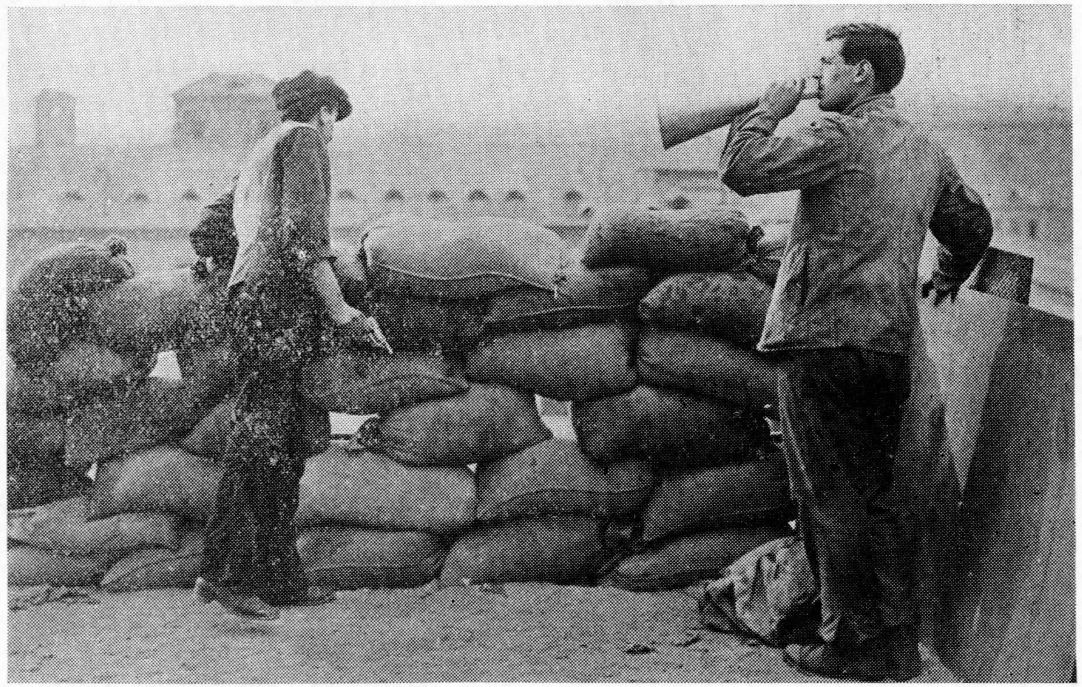
Gramsci did not escape the rancor of the Duce, but at least he was taken in the open struggle. At the beginning of November 1926 he was arrested at Rome, although he was a Deputy, and deported to Uztica. Then he was again arrested on this island a few months later and, together with the Central Committee of the Communist Party, illegally brought before the Special Tribunal for his activity BEFORE the Exceptional Laws were promulgated. They did him the honor as leader, of sentencing him to 20 years imprisonment.
This was equivalent to a death sentence for a man suffering from Pott’s disease, from tubercular lesions, from arterio-sclerosis with hypertension of the arteries, who, in his prison tomb of Turi di Bari where there is no possibility of getting serious care has had a number of hemorrhages and fainting spells lasting several days with continuous fever. (Depositions of two fellow prisoners of Gramsci who have since been released–Athes Lisa and Carlo Reggiani, who left him at Turi di Bari in October 1932). The fascist professor Umberto Arcangeli, at the Hospital of Rome, who visited him in May 1933 acknowledged in his report that “He cannot survive long in such conditions and it is imperative that he be transferred to a civil hospital or to a clinic, if it is not possible to release him conditionally.”
This liberty was offered to him at the price of a request for pardon–a disavowal which he serenely rejected as “A form of suicide.” And we would not ask such a pardon for him. He who fought loyally for his cause all his life will not ask for mercy.
Labor Defender was published monthly from 1926 until 1937 by the International Labor Defense (ILD), a Workers Party of America, and later Communist Party-led, non-partisan defense organization founded by James Cannon and William Haywood while in Moscow, 1925 to support prisoners of the class war, victims of racism and imperialism, and the struggle against fascism. It included, poetry, letters from prisoners, and was heavily illustrated with photos, images, and cartoons. Labor Defender was the central organ of the Scottsboro and Sacco and Vanzetti defense campaigns. Not only were these among the most successful campaigns by Communists, they were among the most important of the period and the urgency and activity is duly reflected in its pages. Editors included T. J. O’ Flaherty, Max Shactman, Karl Reeve, J. Louis Engdahl, William L. Patterson, Sasha Small, and Sender Garlin.
PDF of full issue: https://www.marxists.org/history/usa/pubs/labordefender/1934/v10n11-dec-1934-orig-LD.pdf
 Revolution's Newsstand