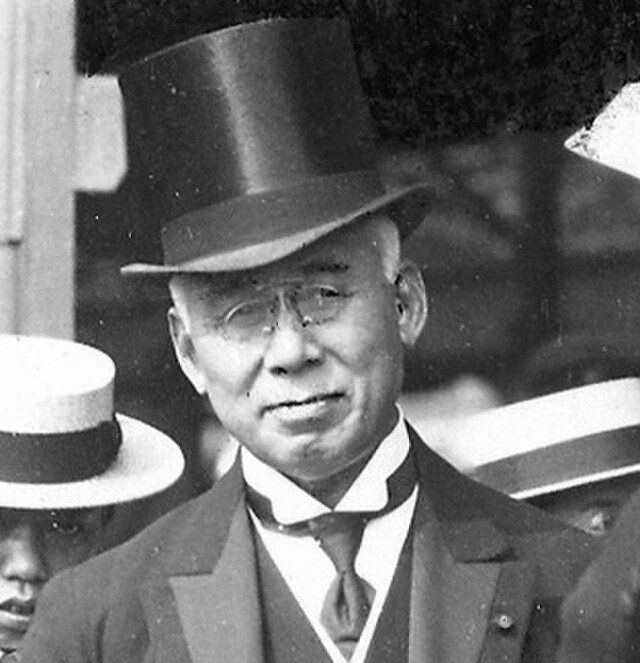
Hara Takashi was both a Christian and a commoner who served as Japanese Prime Minister from 1918, overseeing the anti-Soviet intervention in Siberia and the violent suppression of Korean nationalism, until his 1921 assassination by a right-wing activist.
‘Politics in Japan and the Premier’s Assassination’ by Kako Oba from International Press Correspondence. Vol. 1 No. 14. December 9, 1921.
The assassination of Premier Hara will undoubtedly effect a change in the political situation of Japan. Before we go any further into this matter, we must understand the following points: 1. What were the relations between the late premier and the “Hendro”, the political group which always retained good relations with the imperial palace.
2. The present situation in the “Seiju-Kai”, the political party whose leader was Hara, a highly intelligent and capable man who pursued a very clever policy.
The most important political leaders in Japan were Hara (leader of the “Seiju-Kai “), and Viscount Kato (leader of the “Ken-Sei-Kai”); then there is Osaki who sought to play a part similar to the one adopted by Kerensky in Russia. But in political ability Hara surpassed all the others.
During the last decade it became a tradition in Japan to appoint to the prime ministry only such men as had the protection of “Henro”. So for instance, Kato, the leader of the opposition party “Ken-Sei-Kai”, had the Marquis Okuma as his “Henro”; Hara, however, had two “Henro”, the Marquis Saionsi and Prince Yamagata, with whose aid Hara was active in the militarist group.
For three years Hara was at the head of the Japanese cabinet. More than two thirds of all the members of the Japanese Parliament now belong to the “Seiju-Kai” party of which Hara was the leader, and in recent years the dictator. Hara represented the following political views:
1. Against universal suffrage, because it is disadvantageous to the “Seiju-Kai ” Party, which represents the interests of the large land-owners.
2. For an intensification of Japan’s colonial policy in Korea, and the postponement of the time set for the evacuation of Siberia by Japanese troops, which was to take place in the spring of this year. These two points in Hara’s program show that he was on the side of the militarists.
3. Laws forbidding the meeting and organization of a legal Socialist or Labor Party.
It is understood that the Japanese proletariat did not at all sympathize with these points. Even political parties like “Ken-Sei-Kai” and “Kok-Min-To” took up the fight for suffrage in recent years, and in the last session of Parliament, they insisted upon the evacuation of Siberia by Japanese troops.
A still greater hatred was roused among the Japanese workers against the “Seiju-Kai” Party by the Southern Manchuria railway scandal; it was shown that the most prominent members of the “Seiju-Kai” embezzled large sums of money from the Southern Manchuria Railway Company, and paid them into the treasury of the ” Seiju-Kai” Party.
Under such circumstances the “Seiju-Kai” cannot retain the cabinet in its hands, in spite of the fact that it has a majority in Parliament.
How will the cabinet be made up then?
There are two possibilities: first, that the cabinet will be made up of the militarist group in conjunction with the “Kok-Min-To” (National Party). Of course, the militarists do not enjoy the confidence of the people, but so long as the leader of the militarists, Prince Yamagata, is alive, this group will continue to have a strong influence in political circles, because of the support given them by the big capitalists. At the present moment, however, they lack a capable politician, who could be appointed to the premiership. The former minister of war, Tanaka, is not fitted for this office, in spite of the fact that he is the favorite of Prince Yamagata.
Moved by these considerations, the militarist group has decided to construct a coalition cabinet, and for this reason two candidates were proposed by them: Baron Goto, who is now commander of Tokio and who formerly worked together with the late Premier Gene Teraouchi, and the old politician Inukai, the leader of the “Kok-Min-To” (The National Party). Should the proposed cabinet come into existence, its program would be as follows:
1. At the Washington Conference this cabinet would insist upon naval disarmament; the “naval group “will oppose such a move because the military group recently showed a tendency towards assuming friendly relations with America and giving up the Island of Yap.
2. The relations between the new cabinet and Soviet Russia will necessarily take a turn for the worse; it is possible that it will not recognize the Far East Republic at all.
3. As far as Korea is concerned, Japanese militarism will continue to press forward; the development of the labor movement however, will have to overcome many new obstacles.
The second possibility I am thinking of is that Marquis Okuma and Count Kato, the leader of the “Ken-Sei-Kai” (Constitutional Party) will try to form the new cabinet. This would lead to the dissolution of the next Parliament. Should the new cabinet be formed by the “Ken-Sei-Kai” Party, the political situation would be improved, although it would not exceed the bounds of the “democratic program”, which would consist of the following:
1. The actual application of universal suffrage.
2. The practical recognition of the government of the Far-Eastern Republic.
3. No friendly relations with America however. The watchword of the “Ken-Sei-Kai” is: “On to the South” (Ocean Policy). The “Ken-Sei-Kai” is on friendly terms with the naval group which is against yielding the Island of Yap to America. The cabinet which may thus possibly be formed by the “Ken-Sai-Kai”, would therefore take an antagonistic stand at the Washington Conference, in the question of naval disarmament.
Of the two possibilities considered, the first one is the more probable one. In this case the change of cabinet will not take place so soon, because there are negotiations going on between the members of Hara’s cabinet, the members of the Seiju-Kai”, and the proposed new cabinet. The “Seiju-Kai ” Party will put the condition that two-thirds of the Cabinet members should be chosen from its representatives. The change of cabinet may be expected to take place at the end of December 1921.
The dissolution of Hara’s cabinet due to his death will effect no great sudden changes in the political life of Japan. On the contrary a reactionary cabinet may create the illusion of a transition phenomenon. This will of course rouse a strong opposition, and the cabinet will not last more than half a year.
It is therefore to be hoped that the coalition cabinet of the militaristic group will be the last reactionary occurrence in Japan.
After that the political currents of Japan will quickly take a radical turn. This will be the first link in the chain of victory of the Japanese proletariat.
International Press Correspondence, widely known as”Inprecorr” was published by the Executive Committee of the Communist International (ECCI) regularly in German and English, occasionally in many other languages, beginning in 1921 and lasting in English until 1938. Inprecorr’s role was to supply translated articles to the English-speaking press of the International from the Comintern’s different sections, as well as news and statements from the ECCI. Many ‘Daily Worker’ and ‘Communist’ articles originated in Inprecorr, and it also published articles by American comrades for use in other countries. It was published at least weekly, and often thrice weekly.
PDF of full issue: https://www.marxists.org/history/international/comintern/inprecor/1921/v01n14-dec-06-1921-inprecor.pdf
 Revolution's Newsstand