Elizabeth Noble finds a place for John Marin, modernist landscape painter, in an American tradition and the larger development of art.
‘John Marin—1936’ by Elizabeth Noble from Art Front. Vol. 2 No. 11. December, 1936.
THE case of John Marin may be taken as the whole case of contemporary native art, which in turn may be defined as the whole struggle of the artist to survive. in a hostile and unresponsive environment. That today many artists are turning away from their former belief in a single-handed struggle against philistine society and seeking instead to find ways and means of identifying themselves with the people does not invalidate the historical significance of Marin’s life and work. (Certain factors and a given age produced Marin; the result could not have been otherwise.)
It is customary to speak of Marin as the great undiscovered genius of American painting. The “best known unknown painter” is the popular statement of the truth that Marin has not been acclaimed and honored as lesser talents have been. Yet as the leading light of the Stieglitz group, of whom O’Keefe and Dove are but slightly less brilliant luminaries, Marin has had his succès d’estime among the cognoscenti; a success recorded not in columns of newspaper publicity but subtly suggested in the beautiful privately printed Letters (published by An American Place in 1931) and in E.M. Benson’s John Marin: The Man and His Work (published last year by the American Federation of Art.)
However it took the retrospective exhibition of water colors, oils and etchings at the Museum of Modern Art last month to put the official cachet of approval on this New Jersey-born American who speaks an almost Yankee twang. Max Weber, Maurice Sterne, Edward Hopper, and Gaston Lachaise all have been previously singled out by the museum and given one-man exhibitions as American artists. It is no disparagement of them to remark that Marin should have headed the list as being the most authentic product of an indigenous tradition in which Winslow Homer and Whistler play a leading part. Belatedly now the museum makes handsome amends when its director, Alfred H. Barr, Jr., writes in the catalog, “with his paintings hung on the neutral walls of the museum, Marin must fight his own battle. Will he win? The writer, if he may be pardoned for taking sides in an official preface, believes positively that he will, and that the museum’s hospitality will be more than justified.”
As far as seasoned followers of exhibitions are concerned and as far as the metropolitan press is concerned, this optimism was justified by results. Moreover, thousands of people flocked into the portals of the West 53rd Street museum, made familiar to them by the van Gogh exhibition, who had never heard of Stieglitz or his “291,” “Intimate Gallery” or “An American Place.” Here indeed with the layman Marin did have to fight his battle. Now is it possible that from this unequal combat, between the esoteric and abstruse mysteries of Marin’s brush and the blunt, in some ways unlettered mind of the man in the street, new definitions of Marin’s meaning will emerge? Certainly no new statement was made in the exhibition’s catalog, lavishly gotten up though it was. Here was the old metaphysical, cult-like adoration, which has often served in the past to estrange would be friends.
BUT criticism and appreciation today have turned away from adoration and mysteries. It is a stern and bitter external world the artist faces. He will find no aid or comfort by retreating into the depths of his own awareness; he must confront reality. Therefore neither the artist nor the critic nor the layman will be satisfied to be told that Marin is a great artist, that he has immeasurably extended the horizons of water color, that his art is a perfect expression of his living, that “no one else has ever done anything like that.” Everyone who is deeply alive to the currents of life in these times has got to be from Missouri; he must demand to be shown.
That is the baffling thing about Marin’s work. It is almost impossible to show wherein his greatness lies. And yet after a number of years of seeing and studying his pictures, the writer continues to believe that Marin is a great artist, despite the fact that an opposite opinion exists in some quarters. To say this does not imply that there may not be intellectual and emotional errors in his position, nor is it to insist all artists in the future shall be little Marins. On the contrary, it seems very probable that there will not be any more Marins, and indeed that the thing Marin has created may end with him, or at least that it will not be reborn for a long time.
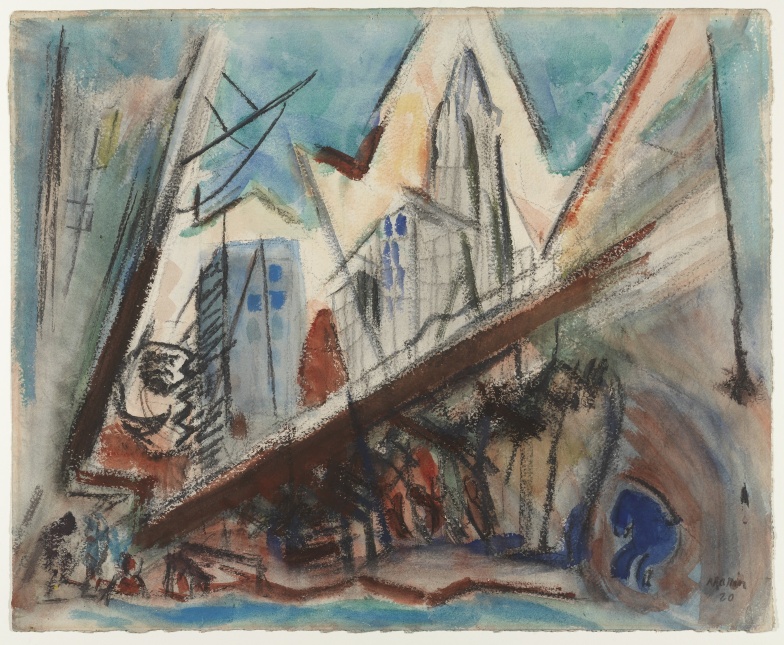
Now the thing that Marin has created seems to this observer to be an almost perfect cryptogram of man’s observation and reaction to nature. In his water colors we have an architect’s shorthand statement of terrain; and whether the subject is Maine, the Tyrol, New York City, the White Mountains, Lake Champlain or New Mexico, there is the most concise and economical expression of the artist’s vision of the world. Marin’s world happens to be for the most part waves and rocks and trees; skyscrapers and city bridges also obey his anthropomorphic will. Only in recent years have human figures crept into his compositions, as in the large oil of a circus scene or the water color, “Young Man of the Sea.” This is highly significant if we are to take as a thesis that the ruling idea of 19th century American art was the expression in personal terms of personal experience and that this experience was often, or usually, concentrated on a romantic and transcendental nature-worship.
THIS point could surely be sustained by calling on a number of witnesses, the Hudson River artists, Thoreau and Walden, Emily Dickinson, to mention but a few. In painting, Winslow Homer, to whose (unappreciated) water colors Marin seems closer than is generally admitted, and Whistler, to whom Marin acknowledges an early allegiance, brought this nostalgic, romantic love of the earth and sea and sky down to our times. In the 20th century Marin has developed this theme to consummate terms. We believe this is unquestionable and that in the development of an American tradition (if the existence and validity of such a thing is admitted) this sequence was inevitable. Where the sequence leads, or if it leads anywhere, is another question.
Undoubtedly the emphasis today is very much on man, in contradistinction to nature (if we may crib the old headings used in the first series of Emily Dickinson’s poems; and if we may go farther and split one of her headings) and much more on time than on eternity. These are not days of apocalypse or revelation; they are days of the sternest and most disciplined objectivity–days, moreover, in which the artist seeks frantically to ally himself with society, lest he be left isolated in a universe where there is no salvation except collectively. When concepts such as these rule men’s minds and lives, it is no wonder that Marin seems a very long way off.
In fact, in some ways he seems as far away as Chinese painting, in which nature occupied a central place and man was but an incident in the occult and aloof hierarchy of endless and indivisible being. And it may be that all periods of art called “great” today achieve this sense of effortlessness and abstractness only because they are removed in time from us. To the generation that preceded them, they may have seemed lawlessly turbulent; to the generation that followed them–meaninglessly pallid.
These paradoxes are set down, because although Marin in some ways seems far removed from the turmoil of the world in which younger artists today live and struggle, actually he is not far enough away so that we can look back impersonally and justly on his work. Of a generation already mature and hard at work when the 20th century was born, Marin is rooted in the 19th century. If one is permitted to speak allegorically, as though one century were as sharply marked off from another state on a colored map, that 19th century zeitgeist was ruled by a splendid individualism, whose cognate in our nation’s foreign policy was to be a splendid isolation surviving into the 20th century like vestigial structure.
BUT the 20th century time-spirit is more and more coming under the sway of collectivism, of the identification of the individual with the group. Here are two attitudes drastically opposed, even though the one grew out of the other. Since this is so, it is almost impossible for a man of the 20th century to look at a man of the 19th century with real understanding and magnanimity. The 21st century no doubt will be able to look tolerantly at the 19th, as we do at the 18th. Perhaps till then there will be no real appraisement of the esthetic and social meaning of John Marin’s art.
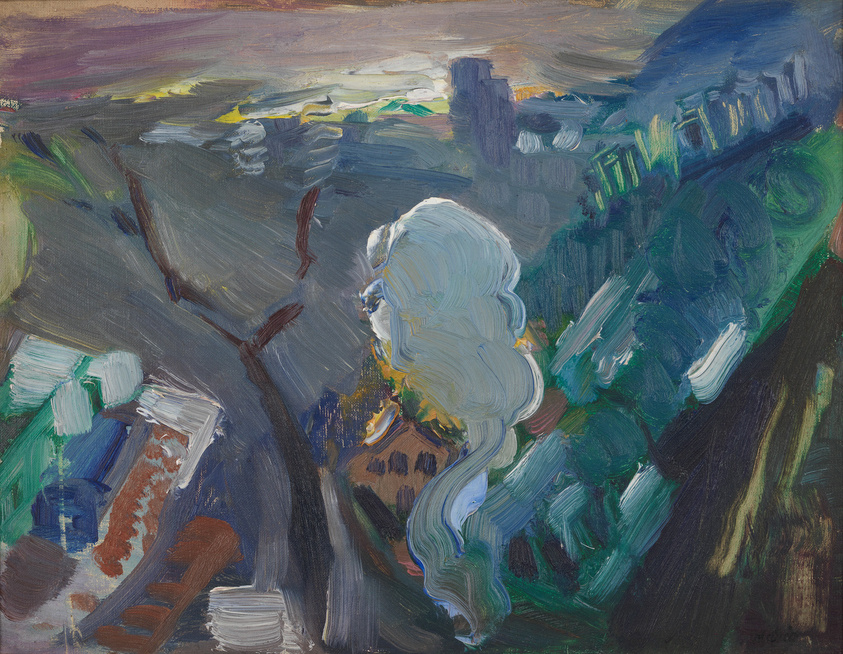
We hope this will not be wholly true, however. The beauty of the natural world he has seen and recorded is part of our tradition today, even though the circumstances of life do not permit most men and women to possess that beauty. The waves which Winslow Homer and Ryder also painted with great beauty will not always whisper with the diminuendo note of Matthew Arnold’s “Dover Beach.” New Mexico’s fang-shaped mountain ranges will not always speak only of the austere loneliness of existence, nor will Manhattan’s skyscrapers always seem about to destroy the human midgets who created them. When order and a nobly classic life have been built in the world, it will be possible to observe that this was the order and the form Marin in his water colors and oils was seeking to impose single-handed on nature. Meanwhile we should value this work as an organic part of the historical evolution of American art.
Art Front was published by the Artists Union in New York between November 1934 and December 1937. Its roots were with the Artists Committee of Action formed to defend Diego Rivera’s Man at the Crossroads mural soon to be destroyed by Nelson Rockefeller. Herman Baron, director of the American Contemporary Art gallery, was managing editor in collaboration with the Artists Union in a project largely politically aligned with the Communist Party USA.. An editorial committee of sixteen with eight from each group serving. Those from the Artists Committee of Action were Hugo Gellert, Stuart Davis, Zoltan Hecht, Lionel S. Reiss, Hilda Abel, Harold Baumbach, Abraham Harriton, Rosa Pringle and Jennings Tofel, while those from the Artists Union were Boris Gorelick, Katherine Gridley, Ethel Olenikov, Robert Jonas, Kruckman, Michael Loew, C. Mactarian and Max Spivak.
PDF of full issue: https://www.marxists.org/history/usa/parties/cpusa/art-front/v2n11-dec-1936-Art-Front.pdf
 Revolution's Newsstand