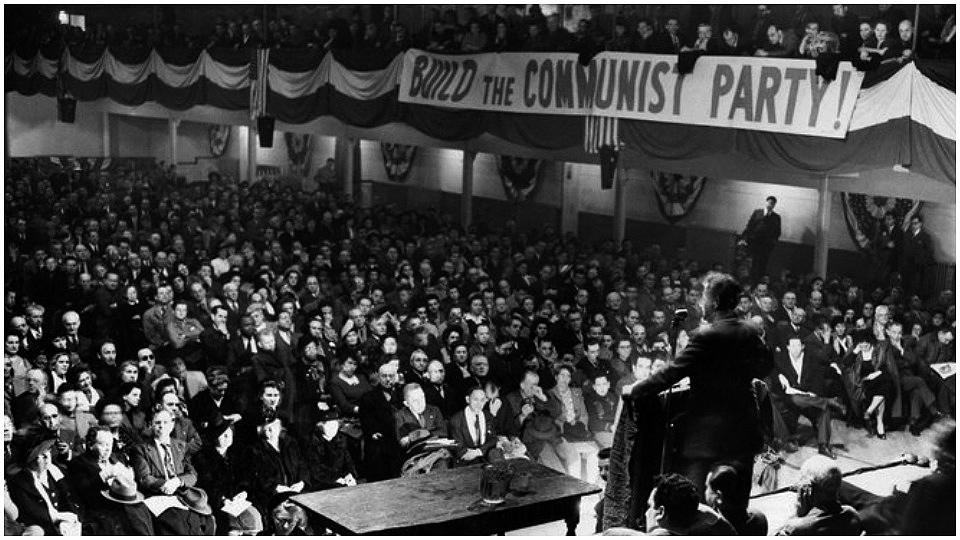
Coming as he did relatively recently from the anarchist movement, Robert Minor’s contributions as a leading voice in the early Communist Party still trying to coalesce are some of his most valuable, nuanced and searching, contributions to discussion. Here, as the early movement faces down the last of the formal opposition to above-ground activity (the Legal Political Party, L.P.P., mentioned below), Minor takes aim at some still very recognizable sectarian traits in the revolutionary left in one of his best polemics.
‘The Blight of Purity’ by James Ballister (Robert Minor) from The Communist (Unified Communist Party). Vol. 1 No. 9. July, 1922.
1. We are Descended from the Theological Apes
Every social movement has in it many of the properties inherited from older social movements. The form is only partially revolutionized by changing conditions, no matter how sharply the new movement may fight against the older. This is hard to realize in its full meaning.
If I write that the Communist movement has carried along with it automatically and blindly many of the foolish traits of our deceased Aunty, the Socialist Party, many comrades would readily admit that this is true. But I am going to make a more extreme claim. I am going further back than the Socialist Party, and will say that the Communist Party has in it today many of the outworn and stupid thought-forms of the old religious movements.
Some of the qualities of religious faith necessarily enter into any revolutionary movement and are not harmful. The self-sacrificing ardor for the cause, the emotional stimulation in action, the dogged rejection of everything contrary to the program agreed upon, and the refusal to waste time listening to enemy arguments while in action, rise to a higher pitch and spread over wider masses in a revolution than even in a religious wave. But all of this gets us nowhere unless the revolutionary organization is based upon the coolest, clearest-headed weighing of values; and unless the tactics, before being adopted, are subjected to a careful, objective search in connection with all surrounding social factors. With all the admitted similarities to religious movements, the philosophical and practical fundaments of the revolutionary proletarian movement are the exact reverse. When a Communist begins (or continues) to use the thought processes of the religious sects, disaster is ahead.
The reader considers himself a “class conscious member of the vanguard of the revolution.” You will be irritated if I say that in your thought processes you are only partly a Communist and partly a morbid, hysterical, shallow-witted and self-righteous Christian Baptist or synagogue Jew or Catholic. Yet that is exactly what I say.
Look into yourself and see if you don’t find some of the distinctive qualities of those outworn religious movements. What is the typical way of reasoning of religious sects?
“We have found the Truth. We know the Truth and others don’t–therefore we are right and they are wrong. We are the baptized, and they are heretics. We don’t have to learn, because we know. We will teach them, and they must learn. We are the Chosen People. Our Truth will prevail, so all we have to do is to remain Pure and unchangeable, teaching our True Faith.”
This way of thinking has been the basis on which thousands of sects have grouped themselves during many hundreds of years. The habit of mind did not stop suddenly on the day that Marx wrote the Communist Manifesto. On the contrary, if we read the history of the various groups that made up the First International, we have to recognize that such thought processes were carried far into the beginning of the modern proletarian revolutionary movement. And it persists today. Those of us that know the Socialist Party, the Socialist Labor Party and the Anarchist and Syndicalist movements, are aware that such a habit of mind persists in those movements and is a dead barrier to the development of the revolutionary movement. Is it not reasonable to suspect that some vestige of it has survived in us?
We get a curious result in comparing our own processes of thinking with those of the old religious sects. For instance, when we say, “we are the vanguard of the proletariat,” is it not somewhat similar to “we are the Chosen People”.
If we say that “we are the vanguard of the proletariat”, it may not be perfectly untrue, but to reason from that basis is perfect rot. It is in violent contradiction to the whole process of Marxian thought and action. To build with that process of thought is to build a sect. Many sects call themselves “Marxian”, but nothing that is a sect can be Marxian. Marx found England and France teeming with sects, and he spent half of his life’s energies breaking them up. His whole philosophy is a cold blast of insistence upon never-ending change and never-completed truth.
Instead of saying “we have the Truth,” the proletarian revolutionary movement must say “we have learned some partial truth well enough to act upon it; now let us learn more.” Instead of saying “we are right,” it says “up to a certain point we are right; now let us find out where we are wrong and correct our mistakes.” A Marxian revolutionary organization cannot tell itself “we are the vanguard of the proletariat” until it sees a proletariat following it. Before that time it tells itself “we must learn how to become the vanguard of the proletariat; by careful judgement of experience we must find out how and for what reasons the proletariat will accept our leadership.”
A philosophical sect, on the other hand, decides once and for all that it has the Truth, and then seals itself up with a sort of hymenal obstruction against the vulgar, changing world. By this process it seeks to remain Pure. But it rots in its “purity.” It rots until it stinks, and dies. The philosophical cemetery is full of grave-stones inscribed “We Died Pure–and childless.”
The soul of Marxian revolutionary philosophy is receptivity and contact. If the virgin party is pure, then marry her quick to the Mass Man. Purity is no good unless it is preparation to give life.
What is the matter with the Socialist Labor Party, for instance? It is “Pure,” or at least it was more or less pure until it began fooling with itself in maiden-lady fright before the Russian vision of armed workmen. The S.L.P. has guarded its virginity against Mankind and against the changes of experience these forty-odd years, and is now carrying its hymen to a celibate grave.
Young Communist Party, beware of “Purity”!
2. Inherited Habits
How does this “Purity” work in our Party? Some comrades feel that their main duty is to keep the faithful at the task of repeating psalms from Theses, awaiting the Red Resurrection. They are willing to issue a leaflet now and then, as a sort of defiance to the other world, and they would faithfully publish the underground organ regularly to be circulated exclusively among the faithful except for the few dozen copies that go on file in the Department of Justice. They would even force themselves to show their loyalty to the inscrutable will of Moscow by publishing a legal press and by allowing some of the heathen to gather around them in the form of a legal political party, where the heathen can admire and obey them and receive their rebukes. But they feel that their own status is fixed for all time as the Chosen People. God or somebody has promised them that they are the Vanguard of the Proletariat, and the proletariat will perforce follow them when the great day comes.
This is the psychology of the Baptist Church or the Synagogue. It spells death to the Communist movement. It is the direct reverse of the Communist philosophy. I do not believe that the workers will follow these people in their present beatific state of mind, nor follow our Party if it operates on such a point of view.
It is astonishing to see how many sub-district organizers we have in our Party that are better Communists than Comrade Lenin is–from the point of view of the Pure. Take, for instance, Comrade…of Subdistrict…He’s got the light of Pure Truth in his soul. He has always been exactly right, ever since he quit the S.P. thirty seven months ago. You can judge that he is absolutely right from the tone of his voice when he orders the mere cattle around. The mere cattle are getting less and less appreciative, but that does not matter; he’s the Vanguard of the Proletariat, according to the Theses, isn’t he?
Comrades, the leaders of Communism in Russia and in the International are not so pure as that. How many comrades in America remember that the Russian Communist papers very frequently carry announcements, signed by one or another leader of the Party, publicly acknowledging that he was mistaken in his view on a certain occasion? Comrade Trotzky, or Zinoviev, or Lenin, or Bukharin, considers this a matter of plain duty to the Party.
A Communist Party has not only a different purpose and a different structure from all other parties–but it also has different mental process.
If Communists let themselves sink into the emotional drunkenness of being “absolutely right,” it results in a contagious form of mental stagnation and the reintroduction into the C.P. of all the old diseases of the individualist movements. For instance, if you have got the “Pure Truth” in your soul, you don’t have to listen to what the other fellow says, but only have to make your point against him. If there are weaknesses in your reasoning, you obscure them and turn the argument in another direction. Unconsciously you begin to use the old tricks of debate which are a part of the individualistic culture. In non-Communist parties the tricks of debate are legitimate. Arguments are used in order to baffle an adversary. Your object is to win your point. This process is deliberately taught as a “science” in bourgeois universities, where the ideal is the advancement of superior individuals and the baffling of the masses. It is the ethics of the poker game in a Society that is a poker game.
I think that many comrades will think it is a childlike innocence on my part when I say that the trickery of debate has no place inside of a Communist Party. If so, that means that they have not yet learned what the essence of the Communist movement is. Within a Communist Party, the use of any trick of confusion is treachery. Your purpose is never to “win a point.” You do not try to baffle an adversary, but always to explain to an adversary and to your hearers. You try, further, to understand your adversary. You do not try to confuse your adversary’s meaning, but to help him bring his meaning out as clearly as possible. You try, not only to find where your adversary is wrong, but also to find where he is right. Further still, you try constantly to find out where you are wrong. Immediately upon discovering where you are wrong, it is your business to say so and to explain how you were wrong. In a Communist Party there is no room for personal triumph. The function of a Communist Party is different. Your purpose in discussion is, not to win a point, but to bring the best collective result in the decision. Not the individual, but the collective body is the unit of expression.
In the Russian Communist Party, this is considered as the most elementary principle. Political trickery and competition for position are practically unknown in the Russian Party. Time and again you hear a comrade of world-wide fame in the midst of a debate say that he has been shaken in his opinion by the opposite argument and wants to acknowledge that he may be mistaken in a certain point. When a petty egotist rises in the Russian Party and begins to act on the motive of proving himself always right, he stands out in ridiculous contrast and is soon scraped off like a barnacle from a ship.
Such diseases result from “Purity,” from the habit of looking upon ourselves, first collectively, and then individually, as the Chosen People. They are diseases of the past of the religious and political movements of individualism.
3. A Step Out of the Morass
In this number of THE COMMUNIST is published a Thesis on Relations between the Communist Party and an L.P.P., adopted by the Central Executive Committee of the Communist Party in its last session, which will be a shock to the Pure. The fundamental idea of the Thesis, as I interpret it, is that we will take advantage of every opportunity to approach, and as soon as possible to attain, the objective of establishing the Communist Party in the open, under its own name, with the full Communist program and public announcement of affiliation with the Communist International.
The announcement of this as the point of view of the Central Executive Committee, will disturb all of those comrades whose instincts are sectarian. All of those to whom unconsciously it has become a dogma that the Communist Party of America must exist only in the underground, will be angry and yet will not know exactly what to complain of. I would suggest that the best course of action for them would be to file with the Communist International a demand that the Communist Party of Germany and those of Czekho-Slovakia, Bulgaria, France, Italy, England, etc., shall be expelled for existing in the open.
A careful analysis of the Thesis of the C.E.C. I will show that the Central Executive Committee regards that the Communist’s entire organized movement, including a legal political party organized out of Communist sympathisers, shall have the quality of ONE STRUCTURE. Those who have been looking upon the C.P. and an L.P.P. as two parallel but organically separate bodies, will find this Thesis to the contrary. The position of the C.E.C. calls simply for organizational centralization for making such L.P.P. truly responsive to the central authority. How can such an instrument respond to the authority of the C.P. unless the C.P. is the organic center of a single structure? The idea of the C.E.C. is that the Communist Party together with a political organization of its sympathisers shall be organically one structure. But within a legal political party, the C.P. shall have its own structure, complete and so thoroughly protected with the underground system that none of the Capitalist State’s attacks can destroy it, even though they may destroy all of the open structure.
When the Communist Party can maintain itself in the open as a “legal” party, the principle of the inner structure will have to be maintained, though perhaps in a less mechanically distinct form. If we play with abstract theory, we might say that even when there exists a large open Communist Party of many thousands of members, every member must be equally tested and equally dependable for underground work. But in concrete reality, we know that it is not physically possible to realize this principle in regard to a large body of many thousands of members. Therefore, the principle of maintaining an inner structure of the best-tested and more dependable membership, will have to continue even after we shall have an open Communist Party taking into its membership all of the membership of an L.P.P. that may at that time be prepared to enter the open Communist Party.
In order to make the entire Communist movement a growing thing, it is necessary to have a vital, intimate connection at all points between the inner structure and the outer structure. The Communist Party cannot be a closed corporation in respect to such L.P.P.
The conception of the Communist Party as a closed corporation exercising mechanical, arbitrary control over a surrounding body of men and women permanently excluded from the Communist Party, has never been the expressed theory, but has too often been the practiced fact. It has been strangling the vitality of both elements.
The sectarian conception in the Party has brought about the practice of enrolling sympathetic elements into a legal organization and then leaving them there without the slightest effort to bring them further. This is a dangerous stupidity. Our purpose is not to make semi-Communists of those whom we organize in sympathetic bodies, but to make them Communists. Hereafter the Official Organ of the Communist Party will be circulated among all whom we may organize into a legal political party. Beginning with those who show the most capability and Communist understanding, systematic efforts must be made to fit the members of such a legal organization for membership in the Communist Party and to bring them in when fit. Conversely, it may be assumed that inactive members of the Communist Party will have to change their ways or be dropped out. The principle is that all active members that are fit to be Communists, and only the active members, of the entire political structure controlled by Communists, shall be within the inner, controlling structure.
The door must be open between the Communist Party and such a legal political party which is an extension of the same structure; that is, the door must be open for all especially active members of clear Communist understanding to pass into the Communist Party, and for all of the inactive type to pass out.
4. The Necessity of a Communist Party
It is absolutely necessary to make the members of an L.P.P. understand the function, purpose and indispensability of the Communist Party.
Every sharpening of the class struggle–the Paris Commune, the Russian Revolution of 1905 and the great revolution of 1917–has proven the necessity of a highly disciplined, centralized and clear-principled party of the most advanced workers, a Communist Party. The necessity that comes before all others is to build such a party and to make it the undisputed leader of the revolutionary workers. We are bound, before everything else, to cause all of the most intelligent revolutionary workers voluntarily to come within the discipline and centralized authority of such an organ of revolution. In order to accomplish that first task of mobilization of the vanguard, it is necessary to make our existing organization the most flexible and responsive instrument of all of the most intelligent revolutionary workers. It must be the executive of their will, the clearing-house of their thought, the boldest leader and the soundest tactician. Until our Party is all of that, it will not become the most important factor, even among the most sincerely revolutionary workers.
Are we successfully impressing the sympathetic workers that we have organized around us, with the necessity of the Communist Party? I fear that we are not. The picture that they get of the Communist Party is not impressive. If we have a legal political party under our leadership, we must not give it the impression that we are a haughty little clique of egotists, a sort of rival faction to the rest of such legal party. We must show them that the Communist Party is the very heart, the core of such legal party, and that they are expected and wanted to enter it as soon as they can and will take up the duties and responsibilities in the more intensified form.
5. Mass Acton in the Program
It will be noticed that the Thesis of the C.E.C., while saying “we seek to have an open Communist Party as soon as this can possibly be attained,” at the same time lays down the test of this possibility, as follows:
“As to whether a ‘legal’ Communist Party is possible, the test is whether the full Communist program (including the principle of mass action and the violent overthrow of the capitalist State), together with affiliation with the Communist International, can publicly be maintained without the Party being suppressed.”
As I understand the Thesis, this means that the full Communist program must make clear beyond question that the final act of taking the State power from the Capitalist class by the Working class cannot be accomplished within the “democratic parliamentary” forms provided by the Capitalist State, but will necessarily be accomplished by direct action of the masses outside of, and in conflict with, the Capitalist parliamentary forms which will be destroyed and replaced with the typical and natural working class form of State, the Soviet form. It is necessary to establish this principle in any program claiming to be a full Communist program, or we have gained nothing from the terrific history of the past five years in Russia, Germany, Hungary and Italy–or even from the history of Seattle and Winnipeg. To omit to state this principle, and yet to claim to be stating the Communist program, would be a cheap deception and betrayal.
If this principle is not stated, the assumption is that we mean that the “revolution” we advocate will be accomplished within the previously existing forms; and the essential difference between the Communist Party and the Socialist reform party is lost; the whole reason for our existence disappears.
But the necessity, so far as a written program is concerned, involves only the clarifying of the principle. It does not mean that a Communist program must call for an immediate armed insurrection. Furthermore, it does not mean that the program must call for an armed insurrection at all, in the sense that would supply prosecutors with evidence of direct incitement to violence. It is not necessary to write our program in language best suited to prosecutors. The object must be to make clear to those who join our Party, that such will be the inevitable development of the struggle and that the working class must be prepared to engage in the struggle accordingly. To establish the historical-political principle in the minds of the workers is the task of the program on this point. We don’t have to use bucket-of-blood rhetoric just to show how brave we are.
6. Armed Insurrection vs. Armed Phrases.
While I am writing this article, the newspapers announce a battle in the State of Illinois. It is a battle in which several thousand armed coal miners marched against a scab coal mine, laid siege to it and after a terrific rifle fight, defeated the scab army, and closed the mine down.
This is not the first time that the coal miners of this country have resorted to armed mass action. In fact, it is typical of the American proletariat. A few months ago thousands of armed workers marching against the forces of the State of West Virginia (so the employers claim), and now the same thing in Illinois. Are the active spirits in these operations organized as Communists? In the great strikes that are going on, are the foremost rank-and-file leaders organized in a Communist Party? In most cases they are not.
Let’s quit calling ourselves the “Vanguard of the Proletariat” long enough to look around at reality. The workers are engaged in actions in this country which in several cases have revolutionary significance. The facts prove that the Communist Party does not contain all, nor even a large proportion of the intelligent rank-and-file leaders of the working class that are moving toward revolutionary action. The workers who will take the natural leadership of their class in the revolution are NOT at the present time in the Communist Party in this country.
Then, are we the “Vanguard of the Proletariat?” We are not. To call ourselves the “Vanguard of the Proletariat” is the petty self-worship of sectarianism.
What is the trouble? I think that the trouble is that we have allowed false thought processes to lead us into mistaking armed phrases for armed insurrection. I think that our primary duty is, not to issue aimless leaflets and proclamations about armed insurrection, but to pursue a course that will put us in the actual leadership of the struggle which inevitably leads to armed insurrection.
If we come out of our haze of dream-clouds, I think that we will see that our unconsidered, dogmatically repeated phrases about armed insurrection, are one of the things that PREVENT our getting on any working basis with those workers who don’t talk about “armed mass action” but take their guns and close down the scab mine and paralyse the State machinery by military action.
Let’s see if it isn’t words that interfere with us.
The capitalist press claims (though it may not be true) that leaders of the West Virginia miners’ regiments sent telegrams to the armed men ordering them to disperse and to do nothing unlawful, but then hastened to the front in automobiles and told the workers not to mind the telegrams, but to go ahead and fight. This may not be true, but let’s assume that it is, for illustration.
How does our Pure comrade look at this? the leaders of these miners are yellow traitors.
Why, they denied their principles. They sent counter-revolutionary telegrams ordering the workers to obey the law. That cuts them off. The are not Pure; they publicly disowned their principles.
But how does it work out? Who is leading the proletariat in its advance toward revolutionary action the men who distribute “armed leaflets” in a sleepy Brooklyn streetcar strike, or the men who distribute armed coal diggers in the strategic points of West Virginia?
It’s a queer case of choosing between armed phrases and armed action. It is a curious fact that all of the talk about armed insurrection in West Virginia is to be found in the mouths of witnesses for the prosecutor. The action happened to require some degree of reticence. (That is, assuming for illustration that the State’s witnesses were not lying, though they probably were.)
I do not mean to say that armed insurrection does not have to be talked about by Communists. Most emphatically, it does have to be discussed, explained and endorsed. But how? And why? Before we can do a thing in the right way, we have to know for what purpose we do it. The purpose is not to show how fierce we are, we can only do that with actions, not with words.
What, then, is the purpose of the Thesis of the C.E.C. in stipulating that the full Communist program must include “the principle of mass action and the violent overthrow of the Capitalist State”? Does it mean that we must pursue the old left-sick policy of pouring a bucket of blood into every utterance of the Party? Does it mean that we cannot advance a Communist Program without including a direct incitement to armed insurrection? I say, most emphatically no.
What is the purpose of a program in respect to “mass action and the violent overthrow of the Capitalist State”?
As far as the Program is concerned, the PRINCIPLE must be established, and nothing more. In addition to establishing the principle, the Party propaganda must persistently and systematically familiarize applied knowledge that Capitalism can be overthrown the workers with the concrete knowledge. But the only by armed mass action destroying the Capitalist State, can be supplied by life and action, and CANNOT handbills talk more like a witness for the State than be taught by handbills. Especially this is true if the like a coal digger.
7. Purity in the Trade Unions
Purity is Hell in the Trade Unions. It has blighted our Trade Union work from the beginning. First, we had to be so Pure that we couldn’t stay inside of the trade unions; and after we learned what foolishness that as; we had to suppress a lot of infantile notions in our Party to the effect that our business in the Unions is what Gompers says it is to break them up. And then a notion went the rounds of the Party to the effect that we must agitate for strikes at all times without distinction, even at times when we know that a strike would result in crushing defeat.
Another notion is that we must fight at all times against all union officials that are not members of the Party, even if such officials offer to co-operate with the Party on all immediately practicable points of our program. Some comrades seem to think that refusing to co-operate with a non-Communist administration of a union is like refusing to co-operate with the government of a Capitalist State. The Comrades forget that while we deny the right of the Capitalist State to function or to exist at all, we recognize a union as a legitimate and highly valuable organization, and we recognize the right of a union administration to function. We only dispute the way in which it functions. When it begins to function even partly, in our way, then there is no contamination of our party in having dealings with it. Throughout the entire activities of the Red Trade Union International we see no refusal to co-operate with union official heads that want to co-operate. In fact, quite the reverse. Delegates to the Red Trade Union Congress are not asked, “are you a Communist?” They are asked, “do you want to co-operate?” They are not even asked to affiliate officially, if their doing so would greatly endanger their movement. In short, the whole spirit of the Red International of Labor Unions (the trade-union phase of the Communist movement) is, the spirit of co-operation and coalition with non-Communist, but friendly, working class organizations. And this extends to union official heads that take a pro-Russian attitude and an attitude of co-operation with the general Communist movement. Of course the mere fact that such union heads were not Communists would indicate the extreme likelihood of clashes with them later; but if we were to refuse to co-operate with them where they accept the substance of our program, our comrades in Moscow would think we were crazy. In my opinion, one of the most urgent needs of the Communist Party is to stamp out the last traces of that left sick Purity that wants to treat a labor organization in the same way as a Capitalist State.
8. Condition of the Party
What is the condition of our Party? The Party seems to be given to the continuous yelling of general slogans.

There is an old school of revolutionary literature which consists entirely of shouting defiance to the bourgeoise. There was some excuse for this in its time: History had not yet developed the definite means of accomplishing the revolution, or at least had not proven the definite means clearly enough for the mind of any great number of men. General defiance was about the only expression that the revolution could have. It was a sort of glorified curse at the police. You will notice that such literature is in spirit addressed to the Capitalist class. That is its weakness; it is really based upon the theory of present helplessness.
But this is not the day of hopelessness. History has at last proven that certain specific forms of action are effective up to a certain point. It is now our business to quit the general yelling at the Capitalist class. In the light of this day, we want to talk to the WORKING class, and to talk fight and victory. Not just general fight, but specific fight, because the specific fight is before us.
Only a dead sect can now content itself with yelling general slogans, and with blindly trying to apply them to all things regardless of whether they fit or not. This sort of thing soon sinks to the level of dry formality and loses the interest of intelligent workers.
In a surprising number of cases, both in the C.P. of A. and in the Minority Opposition, whole Party groups and even branches have simply dried up with useless formality. Comrades that came into the Party full of enthusiasm and willingness to work endless hours at Communist work, have found their days and nights piled up with tedious routine having no apparent connection with the revolutionary movement which is teeming in development in the world outside of their stale, dry meetings. Time and again, young, enthusiastic workers whom I personally know have come into the Party and then dropped out. When I ask them why they dropped out, they invariably mention being forced to listen to long-winded, mimeographed reports and to eternal petty squabbles of little bureaucrats.
The effect of this is, what? To drive out of our party everyone whose character demands action, everyone who values his time. It results in making the Party a receptacle for all of the mummified type of man or woman who simply sit in the Party because of having no use for his time. The result is sectarian decay.
The Thesis of the Central Executive Committee is a clear-headed proposal to clean the whole structure of its stagnation, as well as to comply with the Communist International’s demand that we:
“Try all ways and means to get out of the illegalized condition into the open, among the wide masses.”
Emulating the Bolsheviks who changed the name of their party in 1918 to the Communist Party, there were up to a dozen papers in the US named ‘The Communist’ in the splintered landscape of the US Left as it responded to World War One and the Russian Revolution. This ‘The Communist’ began in July 1921 after the “Unity Convention” in Woodstock, New York which created the Communist Party of America, Section of the Communist International uniting the old CPA with the CLP-CPA party. With Ruthenberg mostly as editor the paper acted as the Party’s underground voice, reporting official party business and discussion. The Toiler served as the mass English-language paper. This ‘The Communist’ was laid to rest in December, 1922 with the creation of the above-ground Workers Party. An invaluable resource for students of the formation of the Communist Party in the US.
PDF of full issue: https://www.marxists.org/history/usa/pubs/thecommunist/thecommunist6/v1n09-jul-1922-com-CPA.pdf
 Revolution's Newsstand