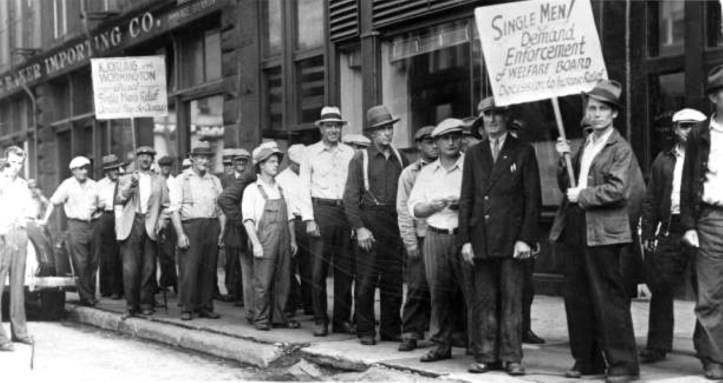
Thousands demand relief during the first years of the Great Depression in Minneapolis.
‘Hunger Marchers Resist Police Attack in Minneapolis’ from the Daily Worker. Vol. 8 No. 281. November 23, 1931.
5,000 Resist Attack Upon the Marchers
MINNEAPOLIS, Minn.. Nov. 22. Five thousand jobless from the city here with 55 National Hunger Marchers from all over Minnesota and 35 from Oregon, Washington, Idaho, Montana and North Dakota, were attacked by the police at the courthouse here yesterday. The jobless and their delegates fought for half an hour with bare fists and the light sticks on which their banners were attacked, against repeated charges by the whole of the police reserves armed with clubs and blackjacks. Many workers were Injured by the police, including some of the National Hunger Marchers. Eighteen workers were arrested, including some of the National Marchers. Twelve policemen were injured by the self-defense of the workers. One patrolman. Beryl Baker, was knocked senseless in the fight.
Back March Demands
This demonstration was called to welcome the National Marchers, and present demands to the city government for relief. It started at a parade from three sections of the city, which converged on Bridge Square, and then marched in orderly manner to the court house. At the entrance to the court house, a squad of police suddenly Punched an attack, clubbing and punching with their fists, against the marchers. Police reserves were inside, and charged madly out of the court house doors, clubbing down all in their road.
This seems to be the Minneapolis mayor’s Idea of “discouraging the marchers” as ordered by the Federal government in telegrams sent out over a week ago.
But it has not discouraged either the marchers nor the Minneapolis jobless who wholeheartedly support them. It has infuriated the workers here. A meeting of 500 in Humboldt Hall took place within a few hours after the court house attack. The meeting filled the hall to capacity. Resolutions denouncing the attack were adopted unanimously, and throughout the city workers are seething with indignation against this brutality.
The National Hunger March (this is Column 1) went out of Minneapolis on schedule, to stop over tonight at La Crosse, except for the injured and arrested marchers. These will follow and overtake the column as soon as possible. Seven have been bailed out by the International Labor Defense.
Denounce Forced Labor
The demonstrators in their march through the city carried banners denouncing forced labor, demanding more relief, both cash and food, opposing discrimination against Negroes and foreign-born workers, and endorsing the National Hunger March demands. A delegation was prepared to present these demands to the city government but the savage police action prevented this.
Monday morning, 1,000 jobless and the National Marchers paraded the streets of St. Paul, protesting the forced labor schemes and the opposition to the National Hunger March of the Farmer Labor Mayor, Mahoney.
‘8,000 Demonstrate tor Relief in Minneapolis Hunger March’ from The Daily Worker. Vol. 8 No. 282. November 24, 1931.
Farmer-Labor Party Mayor Who Ran On Promise to Support Unemployment Insurance Turns Down Jobless Demand for Insurance
MINNEAPOLIS. Minn., Nov. 23. Eight thousand workers participated in one of the largest and most impressive demonstration ever held here, on Friday afternoon, in spite of the rain, in the City Hunger March and Anti-War demonstration.
Five thousand workers gathered at one o’clock at Bridge Square, in a downpour. They jammed the streets and overflowed into Gateway Park, where speakers addressed the massed workers for the first time since the meetings were prohibited there.
Over two thousand workers formed in the line of march with banners through the streets, while thousands gathered on the sidewalks and streets and were waiting at the City Hall, cheering them on. On the demand of the Unemployed Council, police had been withdrawn from the line of march and workers directed traffic and maintained order and discipline. The Court house, however was heavily guarded with police, deputy sheriffs, and troops were held in reserve. Two army trucks from Fort Snelling were parked close to the Court house.
Mayor Exposed.
A delegation of eleven workers was elected to present the demands of Minneapolis’ 70,000 unemployed workers and their families to the Mayor. The City Council had refused to call a special session to hear the demands. Mayor Anderson, the farmer-labor faker, was forced to receive the delegation, but rejected all the main demands of the Unemployed Council.
He promised to take “under advisement” some of them, claimed he was “powerless” to do anything more, and declared himself openly against unemployment Insurance, in spite of the fact that the farmer-labor platform on which he ran claimed to “endorse” unemployment insurance. He also threatened that all workers who resisted evictions would be jailed. He claimed to be against wage-cuts, at the same moment when his police thugs were arresting and beating up pickets at the Ford Dam strike.
While the thousands of workers were waiting outside the Court house, other speakers addressed them and resolutions were adopted in support of the National Hunger March, denouncing the Hoover-Laval secret war pact and pledging to defend the Soviet Union, and pledging support to the Ford Dam strikers and demanding withdrawal of police from the strike area. When the delegation returned and reported the Mayor’s refusal to grant any of the demands, there was tremendous indignation in the crowd, and a pledge was taken to continue the struggle for relief. A collection was taken for the National Hunger March delegation.
March to Halls.
After standing and marching in the rain for two years, the enthusiasm and militancy of the crowd was still at a high pitch, and two marches were organized to two halls, where crowded organizational meetings were held. Eighty applications were received for the Unemployed Council. Long after the meetings, hundreds of workers stood around in groups discussing the demonstration, which was one of the best ever held here.
Four workers were arrested the day before the Hunger March, after the battle with police and scabs at the Ford Dam strike, and one worker was beaten up so badly he is now in the hospital. Their trial is set for Tuesday. Two of them are members of the Unemployed Council, one of the International Labor Defense and one of the Lathers Union. The Trade Union Unity League Is giving active support to the strike, which is made up of A.F. of L. and unorganized worker.
The Daily Worker began in 1924 and was published in New York City by the Communist Party US and its predecessor organizations. Among the most long-lasting and important left publications in US history, it had a circulation of 35,000 at its peak. The Daily Worker came from The Ohio Socialist, published by the Left Wing-dominated Socialist Party of Ohio in Cleveland from 1917 to November 1919, when it became became The Toiler, paper of the Communist Labor Party. In December 1921 the above-ground Workers Party of America merged the Toiler with the paper Workers Council to found The Worker, which became The Daily Worker beginning January 13, 1924.
PDF of full issue: https://www.marxists.org/history/usa/pubs/dailyworker/1931/v08-n281-NY-nov-23-1931-DW-LOC.pdf
 Revolution's Newsstand