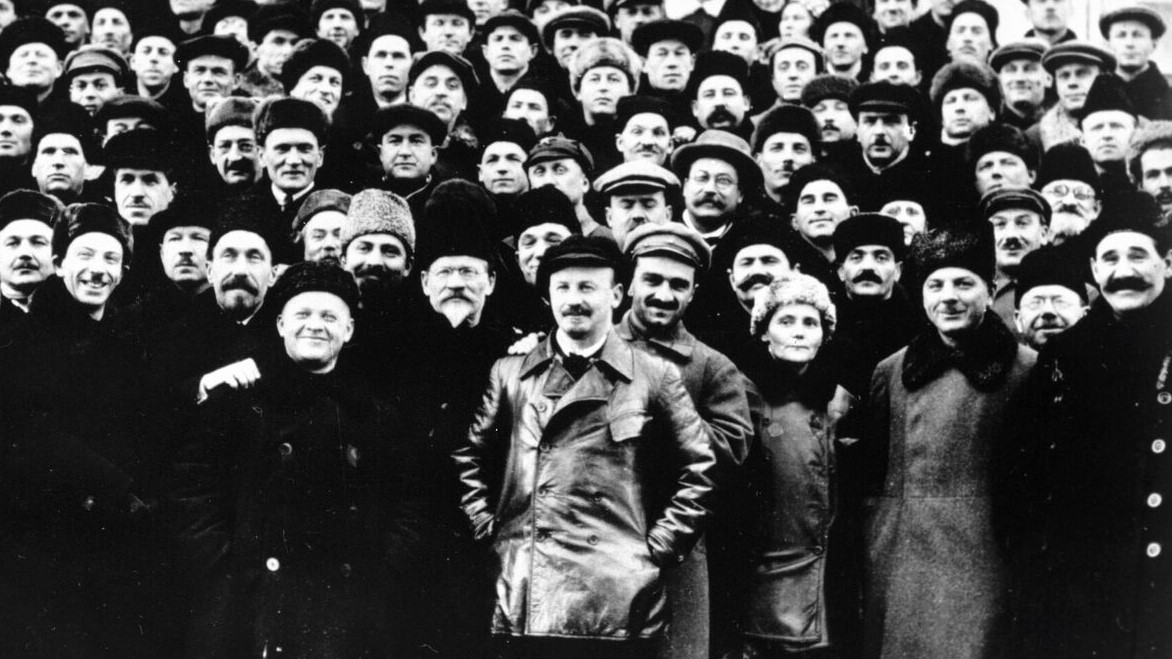
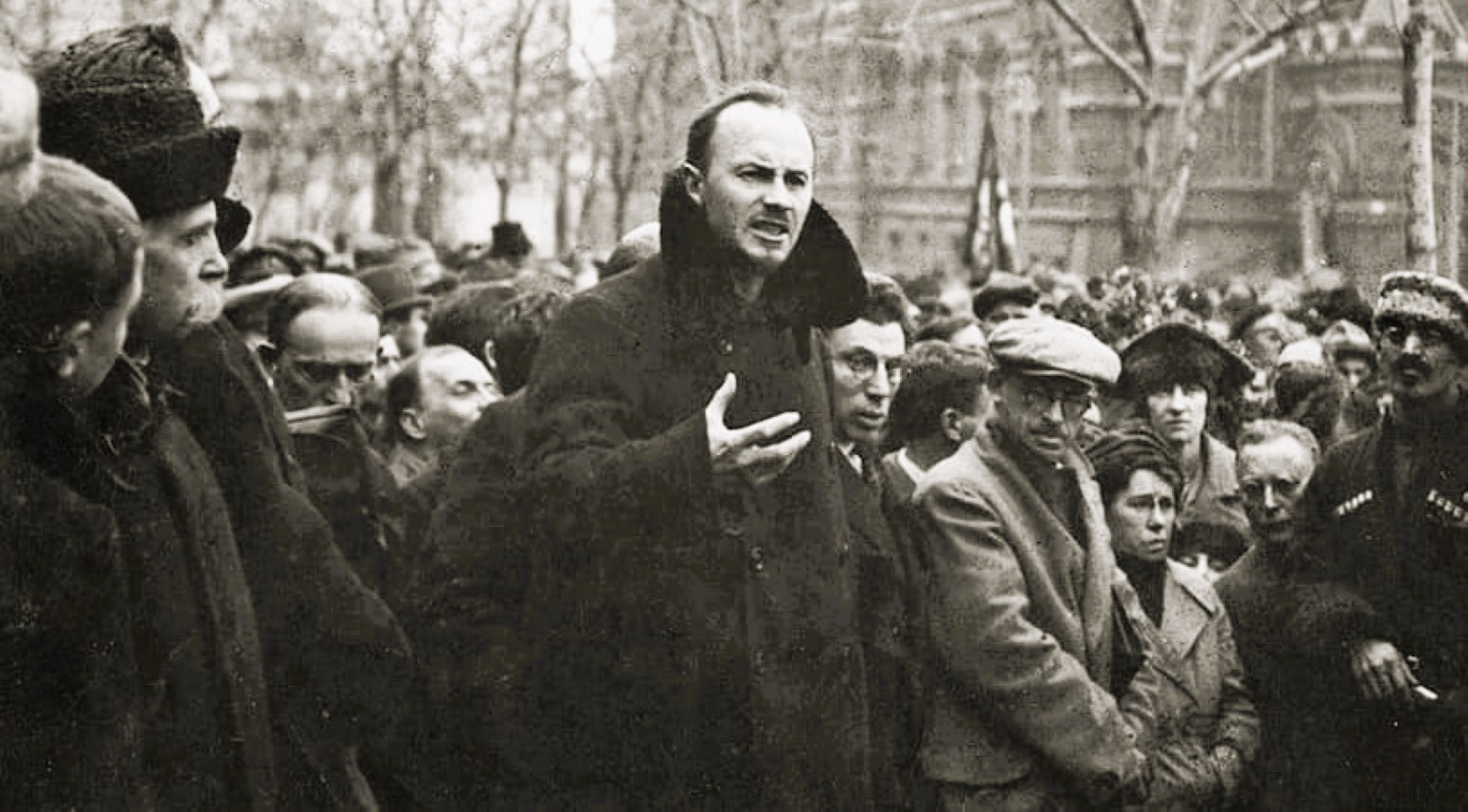
A major speech by Bukharin, who would soon take over for a deposed Zinoviev as the Comintern’s leading figure, mainly focused on an analysis of the recent British General Strike and the role of the Communist Party, along with a look at Pilsudski’s rise to power in Poland.
‘Questions of the International Revolutionary Struggle’ by Nikolai Bukharin from International Press Correspondence. Vol. 6 Nos. 51 & 51. July 8 & 15, 1926.
(From his Speech at the Meeting of Functionaries of the Moscow Organisation of the C.P.S.U. on June 8th 1926.)
The Lessons of the English Strike.
Three Points of the Descending Curve of Capitalism.
If we approach the question from a general point of view, we must state that the international situation at present is chiefly determined by three great events.
1. The general strike and, after it came to an end, the miners’ struggle in Great Britain.
2. The continued national revolutionary fight in China which is passing through various stages but persists.
3. The events in Poland which include some phenomena which may be described by the word “civil war”.
It is not difficult to grasp the fact that England and China on the whole represent the two chief poles of capitalist relations in world economics. Even though America–at present at any rate–shows an ascending line of capitalist conditions, even though our Soviet Union shows an ascending line on a new foundation, i.e. on the foundation of the proletarian dictatorship, the British Empire is nevertheless the classical representative, the classical incorporation of the old capitalism with its monopolies of highly developed industry, with its whole amount of various colonial, semi-colonial and dependent countries, among which China does not come last.
Although China is not in the direct sense a colony of England, it is nevertheless an object of the colonial exploitation of English imperialism. And this immense British Empire is now being shaken on two sides, from the Chinese side and also from the side of the metropolis which is the heart of the Empire.
As regards Poland, it also deserves interest as the classical type of the newly formed States since the war, i.e. of those States which have come into being as the result of the war and post-war crises. Out of sheer habit we are sometimes inclined to think of Poland as the old Czarist Poland, as a comparatively small country under foreign influence. We need only glance at the politico-geographical map of Poland in order to realise at once that the Poland of today is a vast country which has come into being as a result of the war crisis and of various post-war events, a State which has a fairly important part to play, which, thanks to its situation, forms one of the points of junction of present-day politics.
Looked at from this point of view, one can say without hesitation that the events in England, China and Poland are of enormous significance. It is absolutely essential for our policy that we should rightly estimate these events.
By the events in England we understand in this case the strike of the English working class. England has always been the classical country of the most conservative working class in the world; for a long time the English working class was the pillar of the bourgeoisie. This was closely connected England’s unique monopoly in the world market. The undermining of this monopoly has caused a regrouping within the country and a regrouping of the English working class.
English capitalism is an expression, perhaps the most telling illustration, of the inclined plane down which capitalism as a whole is sliding. In connection with this are the permanent crisis in England, the continued unemployment, the collapse of the chief branches of English industry, above all the decline of the metal and coal industry. It was on this basis that the fight broke out.
The Bourgeoisie Mobilised, the Reformist Leaders Betrayed.
The bourgeoisie and the Government were excellently prepared for the anticipated fight, they had concentrated all the military forces and means of suppression, the organs of propaganda, the bourgeois press, under one uniform, centralised control, they had thoroughly drilled the apparatus of Government and its systematic working and arranged a division of labour between the individual organs in which, on the one hand, Baldwin appears as the “reconciler”, as the “benevolent grandfather” who stands above the classes and, on the other hand, guarantees a unanimous will on the part of the Government, directed against the working class. Thereupon the Government and the bourgeoisie forced their way into the camp of their class enemies, providing themselves with an extremely widespread service of espionage and, not satisfied with that, secured themselves an alliance with the upper stratum of the General Council. Thus we see that the Government had built up its strategy and, on the basis of that, its tactics, in such a way that all means from the purely mechanical, military means of compulsion to the organisation of a direct conspiracy against the working class within the working class were mobilised, prepared and taken into calculation.
The leading upper stratum of the working class, above all the General Council, had on the contrary hardly made any preparations for a real fight. There was no question of a mobilisation of the forces in the General Council which could in the least be compared with the mobilisation of the forces in the camp of the bourgeoisie, and a mobilisation of the proletarian forces was only undertaken by the Communist Party and the “Minority Movement”, i.e. the Left–the real Left–opposition within the trade unions which, taken as a whole, goes hand in hand with the Communist Party. As regards the overwhelming mass of the English workers who are organised in trade unions, their forces were simply not mobilised. Furthermore, some of the leading group of these trade unions, in the persons of Thomas and MacDonald and of all those privy councillors and previous ministers of His Majesty, were, as has already been mentioned, in direct connection with the bourgeoisie and, at the decisive moment, went over to its side. The whole tactics of the General Council, the nature of which can only be described as treacherous, arose out of this strategic situation.
The Political Character of the Fight.
The masses joined in the fight, the masses developed unusual energy, the masses rose like one man to defend the miners. This general strike which was proclaimed by the trade union leaders, on the one hand under the pressure of the masses and on the other hand in the hope that it would be impossible to carry it out, immediately created a new situation. If in a country like England, almost five millions enter the fight–this figure was mentioned by the English bourgeois journal “The Economist”, which has no interest in exaggerating the greatness of the labour assault–it means that class stands against class. When however class marches against class, it is an important stage in the political fight for the action of a gigantic mass numbering millions, of a whole class is no longer the problem of a fight against an individual capitalist nor even against individual groups of capitalists, but it threatens the power of the State itself. The situation created by the fact of the general strike could not be anything else. What should have been done from the point of view of the Government and of the bourgeoisie? The only thing to be done was to bring into action the whole apparatus of the mobilised forces of the bourgeois regime, and this is what the Government did by proclaiming a state of emergency and mobilising the army, the police reserves and the strike-breaking machinery.
From the standpoint of the working class, the energy of the masses had to be brought into play, the fight intensified and carried forward. An advance in this fight meant guiding it into political lines, issuing more challenging slogans, not being afraid of a collision with the mechanism of Government nor of even raising the question of the seizure of power.
The following situation arose: the General Council was faced by the necessity of entering into this fight with the masses, and that implied entering on the revolutionary path, for a collision with the Government, a fight against the Government, in the circumstances which prevailed at that time, involved turning the fight on to political lines which, sooner or later, would inevitably have led to the question of power. The General Council which of course did not desire this, resisted the onrush of the masses in every way, but was nevertheless compelled to tread this path of a political fight. When for instance, it began to call into being a department for the distribution of food and of electricity, for information etc., it was going almost as far as the position taken by the Petrograd Soviet in the first half of the summer of 1917, when it practically organised a “double government” by creating these departments; on the one hand, the Government organises its information service, distributes food, rules over the masses, on the other hand, side by side with it, grows up a mass organisation which gradually begins to take over these functions.
Two Forms of Treachery.
The more clearly and distinctly the contours of a transition to the political fight and to the raising of the most acute question in the class war became visible, the more headlong the retreat of those persons was bound to be who are not such good revolutionaries as, let us say, our present chairman, Comrade Uglanov. (Laughter.) It was from this situation that the fact of the treachery of the “leaders” arose, this treachery finding expression in two forms. We must look at these two forms of treachery without any illusions.
In the General Council there were at first two wings; the Right wing with Thomas at its head and the Left wing with Purcell at its head.
Thomas, as a Privy Councillor of the King, has sworn an oath in which he pledges himself to use all his powers to suppress and annihilate anything which is injurious to his Majesty’s interests. Thomas has more than once betrayed the working class and, after the so-called “Black Friday” in 1921, he stated before the court that he was prepared to frustrate any strike which could serve the cause of revolution. This group, in my opinion, quite deliberately worked for a defeat; it betrayed the strike quite consciously at the moment when it had reached its highest point and quite deliberately joined with the class enemies of the strikers, liquidating the strike through an order of the General Council.
It is hardly probable that the “Left” wing was in direct touch with the Government or that it was bought by the Government (even politically and not financially), nevertheless, through its fundamental attitude “against revolution”, with its dread of a fight and of revolutionary measures, this “Left” brought things so far that, although it could have had the majority in the General Council and could have exercised a decisive influence on the resolutions of the General Council, it was actually in the power of Thomas and his followers, and carried out his policy, while some of these “Lefts” arrived at a very interesting position, as for example Hicks, who spoke of the “damned Russian money”.
What are we to think of the tactics and of the behaviour generally of these Reformist leaders? In my opinion, we have in the case in question to do with two peculiarities. One of them is deliberately treacherous and the other is a matter of capitulation. If however judgment is passed as to the political responsibility of these different groups, it can by no means be said that the “Left” wing is politically any less responsible than the Right.
The Left wing indeed bears a greater responsibility, firstly because, thanks to its “Left” position, it had more influence on the revolutionary workers, and secondly, because it might, had it so desired, have had the majority in the General Council. We must therefore, in exposing their treachery, aim our blow with no less force at the “Left” leaders of the General Council than against the Right. We must not start from the subjective views of the persons in question, as in many other cases but from their objective activities. The objective action of the Leftwing however, which had the majority in the General Council, was much more injurious because it submitted to the Right minority; its responsibility is a greater one than that of Mr. Thomas, the great shareholder.
Mobilisation on the Home and Foreign Fronts.
It can be said that two pronounced features characterise the treachery of these people: firstly their refusal to direct the fight on to political lines and secondly their refusal to accept financial help from the international proletariat. Whilst the Government sent troops against the strikers, mobilised the fleet, called up the police reserves; whilst arrests and threats to confiscate property were being made, i.e. whilst the Government openly emphasised the political character of the strike, these “Lefts” declared: “It is out of the question for us to direct the fight into political lines.” Its encouragement of the rejection of a political tight was as good as a capitulation, implied complete disarming of the proletarian forces, as the bourgeoisie very well understood what to do in such a situation. It declared the strike to be illegal, concentrated all its forces in one fist, aimed a blow with this fist at the working classes and made no effort to conceal the political character of its action. On the part of the trade union leaders, the procedure was quite different; the bourgeoisie developed an attack, but the General Council issued the order: “Not a step further!” The former mobilised all its forces, the latter disarmed. This was the one line of capitulation and demobilisation of the proletariat within the country.
At the same time the General Council carried out a demobilisation of the proletarian forces on the outer front. When it refused help from abroad, this rejection, which expressed the dread of “disloyalty” to the bourgeois State, meant nothing more nor less than demobilisation of the proletarian forces in the international sphere.
When the bourgeoisie was deprived of the printing works in London, it had its papers printed in Paris, as it was clever enough to understand that the international solidarity of one’s own class can be made use of. When, however, the international proletariat came to the leaders of the trade unions to offer help, the latter said: “You have come to the wrong shop.”
A communication published in the Press reveals the internal mechanism of this refusal. After the publication of the facts, there is no longer any doubt that they declared that it was “inconvenient” to accept our help for the simple reason that the Government had forbidden them to accept it.
The leaders, however, preferred to conceal these facts from the workers. They might openly have said: “Our best thanks to the workers of the Soviet Union for their help, but the Government refuses to allow the money to come into the country.” Instead of this, they screened their imperialist, bourgeois Government and took all the blame on themselves, concealing from the working class the fact that the Government had forbidden the banks to pay out to the General Council the money sent them by the Central Council of the Soviet trade unions.
These two lines of treachery, the lines of internal and of external treachery, have, in essentials, decided the fate of the general strike.
The Miners’ Fight.
It would however be quite wrong to regard all the events in England as a defeat and nothing more. Above all we must not for a moment forget that the magnificent fight of the miners is still going on. The prospect of this fight developing further is by no means out of the question and it is not impossible that the masses of workers will again join in on a new basis in support of the miners. We have received a telegram today to the effect that the International Miners’ Secretariat has resolved to give help to the fighting English miners. If the Reformist brutes who are at the head of the Secretariat, have resolved to help the miners, it is a sign that the cause of the miners is on a fairly solid basis. If there were any clear signs that the strike was doomed to failure, the Reformist leaders would abandon it, as rats abandon a sinking ship. We must not for a moment imagine that the fight in England has come to an end, that the wind has dropped. The miners’ strike is still shaking the economic life of the whole country to its foundations, it is still a revolver pointed at the head of the bourgeoisie. The miners remain and will continue to remain steadfast. The chief task, not only of the Communist International as a whole, but of every single functionary of the revolutionary movement, of both the political and the economic functionaries and, in the Erst place, of every single Communist, is now to help the miners with all means in their power.
The development of the miners’ strike, the efforts to enlist other troops of the working class in support of the miners, this is the practical, the immediate task of the day, this is the conclusion which we must, in the first place, draw from the analysis of events in England.
The General Strike as a Means of Struggle.
I pass on to the analysis of some problems which are bound up with the lessons of the British strike, of some problems which in recent times have been matters of dispute in our Party and in the Communist International, which, in view of the resolutions of the C.C. of our Party and of the resolution of the Communist International, have lost their character of matters of dispute. In the theses which were passed unanimously by the Executive of the Comintern, these questions were answered clearly and unequivocally.
First of all a few words on the strike as a method of fighting. A campaign is at present being carried on in England with full steam, not only on the part of the bourgeois Press but also on the part of the Reformist Press and of the General Council etc., a campaign which can best be described as a concentrated assault on the idea of the general strike. Not only big guns, but medium-sized and small guns are being employed, but the aim remains the same: that of destroying the idea of the general strike and of discrediting it in the eyes of the workers.
A whole number of “arguments” of all shades could be mentioned, with which the attempt is made to discredit the general strike. These considerations are based on a weak-kneed fear of a revolutionary fight on the part of the Philistines. Some of them point out with justification, that the general strike places the masses of workers in opposition to the Government. The Philistine conclusion which they draw, is that none but a madman would dream of a victory of the masses over the Government. Such a Philistine, such a narrow-minded point of view is of course by no means binding for us. We say, it is not the general strike which is bankrupt but the Reformist methods of carrying on the general strike. What has always been an axiom for every Communist, is now once more confirmed by the course taken by the English strike.
One of the lessons of the English strike is that, thanks to the specific conditions of the fight which prevail among the working class in England, the general strike has, just in that country, far greater significance than in any other country. This, in my opinion, is the result of two circumstances which were fairly clearly expressed in the recent fight.
The first circumstance is connected with the social-economic structure of England: an enormous proletariat which represents the overwhelming majority of the population, an extremely low percentage of peasants, a high percentage of workers organised in trade unions, and a Communist Party which is still comparatively weak.
The second circumstance relates to the military. In England the centre of gravity of the armed forces is not in the army but in the navy. In a civil war or in decisive conflicts, the navy cannot take a large immediate share, as civil war does not so much take place at sea but rather on land and, to the regret of the English Government, the navy is anything but mobile on land. (Laughter.)
This of course does not mean that the strike should not be carried on in higher forms of struggle. I will only say that if we regard the relations between the general strike and other previous methods of fighting, more weight must be attached to the general strike in England than in any other country. In England more than in any other country, the general strike is a necessary preliminary to a victorious fight of the working class. This, I believe, is the first conclusion we must draw, and it is explained by the special peculiarities of the English Labour movement and by the specific conditions of the fight.
The Part Played by the Trade Unions in England.
The second problem concerns the trade unions. Lenin taught us to devote the greatest attention to the trade unions just in England. When he insisted on our studying the significance of the trade unions from all sides, when he pointed to the enormous part played by these organisations in the whole Labour movement of Western Europe etc., he underlined these instructions with regard to England three times. The facts are as follows: the general strike was carried on by the trade unions, it was carried on though in a treacherous way by the General Council of the trade unions; in the provinces the great majority of the committees of action and of the strike committees were organs of the trade unions. The organising power of the working class has shown itself particularly on these lines. No other organisation could enter into competition with the trade unions either in extent or in significance.
And now, in connection with this conclusion, we must point to a third lesson of the strike. This is that the English working class approaches the question of the power of the State, i.e. of the revolution, in an original form, not in that form in which it was approached in our country or in Germany but, as I have said, in a peculiar form which is due to the peculiarities of the English Labour movement. I have already pointed out that the whole strike was carried on by the trade unions. In those cases where the movement has already outgrown the limited framework of an economic fight, the framework into which it was pressed during the whole time by the leaders of the General Council, this fact of outgrowing its limitations, has found expression in a number of truly interesting facts, slogans, actions etc. In several localities the organs of the trade-unions actually had the leadership of the smaller towns, i.e., the power was in their hands.
Let us consider the slogans! In several districts the slogan was proclaimed: “All power to the local Committees of Action!” This slogan brought the trade-union organisations, as far as their function was concerned, near to the Soviet organisations 25 they were during the period immediately preceding the fight for power. Our Communist brother-party issued the slogan: “Down with the Baldwin Government that supports the capitalists!” And then: “All power to the General Council!” Without doubt, this slogan was in the beginning intended to mean that the movement should be centralised and the leadership of the movement be concentrated in the hands of the General Council in order that isolated disorganising actions might be avoided. The more, however, the developments exceeded the bounds of the economic fight and the more the trade-union, movement in the course of the strike took on the character of a political fight on the part of the workers against the State machinery of the bourgeoisie, this slogan developed even objectively into one which resembled the slogan “All power to the Soviets!” For, insofar as the elements of a double government were created, and insofar as the General Council was, against its own will, surrounded by organisations which resembled our Soviet organisations at the moment immediately preceding the fight for Power, the slogan “All power to the General Council!” grew into a political slogan.
Why, however, were no Soviets formed in England, but only Committees of Action? Why was the slogan “Ali power to the Soviets” not issued? For this reason; because the working class in England, in contrast to other countries, had taken a path which was in a certain measure peculiar. As a consequence of its whole history, as a result of the tremendous importance of its Trade-Union organisation, and on account of its historic traditions the English proletariat did not take up the question of power by circumventing the Trade-Unions but through the Trade-Unions themselves. I believe this is a very unique fact. Lenin always demanded from us the analysis of the special traits, of the peculiar characteristics of every individual period and every country, and not merely the constant repetition of the stereotyped formula valid for all times and for all circumstances. When we put the question, what are these specific and peculiar features of the English Labour Movement, then we must draw the conclusions which at the same time constitute one of the greatest lessons of the English general strike, i.e. that the English working class will approach the question of power through the Trade Unions.
This of course does not mean that it would be binding for time, nor yet, let us say, if the labour movement in England suddenly came to a halt to revive again in ten years time, that it would repeat its present experience.
We must record this lesson, because it has a bearing upon several conclusions which I shall mention later. A number of Comrades fail to appreciate this question of the peculiarities of the English labour movement. I believe however that we must not underestimate them if we wish to understand the English labour movement and the peculiar and special lessons of the General Strike. From the standpoint of a Leninist and Marxist analysis we are obliged to treat the question in this manner.
The Communist Party of Great Britain and its Critics.
I now proceed to the question of the Communist Party, its part in the fight and the conclusions which we must draw from its activity.
In an article published in the “Pravda” it was maintained that the English labour movement has an over-developed organisatory apparatus and that this over-developed apparatus in its various forms in the trade unions and in the parties, including the Communist Party has proved itself to be a “brake on revolution”. In simple language this idea may be expressed as follows: there is an English working class which is treading the path of revolutionary development: it has various organisations: trade unions, a Labour Party, an Independent Labour Party, a Communist Party, etc.: all this is “apparatus”. That is altogether the standpoint of “universal apparatus” every thing is apparatus. From the standpoint of such a mechanical conception that small part of the machinery represented by the English Communist Party is, along with the other parts, a portion of the brake on revolution. I believe that this standpoint is absolutely false and that it is refuted by the facts of the case. This is not a question of theoretic considerations which can be conjured up out of nothing, but a matter of analysis of facts. The facts contradict this theory. The theory is also contradicted by the earlier and the present resolutions of the Communist International.
First of all, is it right to assume that the Labour Party, the trade unions, the Independent Labour Party and the Communists are all in the same boat? I believe that this is by no means true. And this view cannot be maintained by anybody.
Our Communist Party in England is conducting a correct policy on the whole. While still a young Party it encountered serious difficulties; it was confronted by gigantic tasks and it stood the test with honour. For this reason we are prepared to defend the Party against anybody who maintains that it forms a portion of the “apparatus of the brake on revolution”.
Has the Party made any serious blunder? I do not think so. It deliberately made preparation for the Miners’ Strike; in conjunction with the Minority Movement it mobilised all its available forces in support of the strike; it issued at the right time the slogan of a General Strike in support of the miners; it issued the slogan for an immediate transition from the defensive to the offensive, because “a general strike which merely defends itself and does not attack is doomed to defeat”; it also issued the slogan: “Down with the Baldwin government which supports the capitalists!”; it issued the call for “All power to the General Council!” Is that not a correct line?
I must admit that I personally was somewhat surprised at the immense political tact with which our English brother-party acted. Let us take, for example, the slogan: “Down with the Baldwin-Government that supports the capitalists”. That is a very clever slogan. It does not simply confine itself to the utterance: “Down with the Baldwin government”, because great numbers of the English working class entered this fight with strong prejudices concerning the classes and because many of them still regarded the government as something great, standing above the classes. Whether consciously or unconsciously, I cannot say, but the English Communist Party certainly successfully repeated our Bolshevist tactics employed at the time of the development of the events following upon the February revolution. As Lenin said, it was with great caution that we at that time approached the “honestly mistaken masses”. For some time we did not merely say: “Down with the whole provisional government”, but we said: “Down with the capitalist Ministers!” The English Communist Party adopted a similar line of action. Subsequently the Party went further and issued such slogans as: “All power to the Committees of Action!” “All power to the General Council!” etc.
The slogan: “All power to the General Council” arose, as we have already mentioned, out of the need for a centralised movement. “Power” in this case means the leadership of all organised proletarians. The more this fight became a political fight the more significant became this slogan. More and more it came to resemble the cry: “All power to the Soviets!”
On the economic side of this fight the Party rightly advocated the nationalisation of the mines without compensation. It was right in its judgement that the report of the Coal Commission was a “declaration of war on the working class”. It called for a desperate fight against this report; it exposed the traitors of the Right as well as the “Left” traitors and muddleheads; it called for the organisation of a proletarian united front with a concrete fighting programme. These tactics were entirely based upon the principle of transition “from defensive to offensive”. This was the proper line to take.
The Minority Movement was under the leadership of the Party and fought alongside it. The reports and communications which we have received show that the Communists, despite their small numerical strength, were represented on practically every committee of action, that every one of these committees in which the Communist element was stronger followed a correct policy, that in every case where an active fight arose the Communists were in the forefront, that the number of Communists arrested was considerable, etc.
I must dwell for a moment upon that criticism of our English Party emanating from several ultra-Left sources and from persons expelled from the German Communist Party.
The group formed by Katz, Korsch and others excluded from the German Party is now issuing leaflets in which it is stated that the strike has failed on account of betrayal on the part of the Communist Party and of the Comintern. In the platform of our ultra-Left comrade Urbahns, one of the leaders of the opposition inside the German Communist Party, it is stated that in the strike period the Communist Party completely disappeared and was nowhere to be found. We should very much like to prescribe spectacles for these dear friends of ours, although in general people who are totally blind do not use glasses. This same comrade Urbahns accuses the English Party of being in agreement with the proposal of the bourgeois Coal Commission. Such an accusation is a stupid calumny, for as a matter fact, the Communist Party has consistently and repeatedly declared that the proposal of this Commission, which could only result in an aggravation of the miners’ position, amounts to a declaration of war on the working class. What can the object be of this intentionally dishonest criticism? Its aim is to open the attack against the activity of the Comintern and directly against our Party. In order to hit this “institution” it is necessary to shoot from the side, and in order to be able to shoot from the side it is necessary to invent arguments if none are otherwise available. To regard the Communist Party of Great Britain as a revolutionary skid-pan, is to fly in the face of the facts apart from a great number of other considerations. This in itself is sufficient to damn the criticism.
The ignoring of the Trade Unions in the search for “new revolutionary organisations” outside and in opposition to the Trade Unions leads us to a fresh question in connection with the lessons of the General Strike.
The following view has been put forward in our Press: If ever the present forms of the English Labour Movement should constitute a revolutionary brake it would be necessary to seek “new revolutionary forms”. This means that we should have to create some new kind of organisation to take the place of the Trade Unions.
Among the people who are developing this ingenuous idea are the leaders of the opportunist Independent Labour Party of England.
One of them, Wheatley, writes, for instance, in an article, entitled “Survey of the Great Capitulation”:
“Now, that the Trade Unions are letting themselves be bound by their enemies it is possible that the creation of a new form of organisation may prove necessary”.
The leadership of the Trade Unions showed itself to be bankrupt: let us therefore create in the place of the Trade Unions real revolutionary Trade Unions and real revolutionary organisations! How beautifully simple it all seems!
There are two fundamentally different lines of conduct, two completely different kinds of tactics: the one which aims at the entry of fresh masses of workers into the Trade Unions, the reorganisation of the Trade Unions, and their capture by the revolutionary elements; and another which advocates the policy of forsaking the Trade Unions, which attempts to replace the Trade Unions by fresh organisations etc. One can choose either of these two lines of tactics, but one cannot vacillate between the two. A definite choice must be made. This question has now been raised in its entirety after the liquidation of the General Strike and we must deal with it thoroughly and give to it a definite answer which shall clearly mark out the line we intend to take, so that every worker may know our attitude towards this question.
First of all a few preliminary remarks. The heroes of the Independent Labour Party have brought forward the problem of the search for new forms of organisations. It would appear as though they took up a revolutionary standpoint. But what is the actually case? In reality they are making a common attack upon the idea of the General Strike. There is the article by Brailsford, who discovered ten days after the capitulation of the General Council that one of the General Councils greatest mistakes was its interference with the freedom of the Press, which antagonised the bourgeois journalists; a consequence which, in Brailsford’s opinion, was bound to have fateful effect upon the result of the strike. I might also quote the words of other similar troubadours of the new revolutionary organisations. Their conduct, in reality is merely a running away from the problem of the fight, as well as from the solution of the extremely difficult task of attracting fresh millions of workers into the Trade Unions, and of capturing the Trade Unions in the interests of a successful execution of real actions. These big talkers of the Left will expatiate upon new forms and thereby get out of touch with the main current of the movement, but the movement in thus remaining a captive of the Right will inevitably suffer a serious defeat.
It is of interest to observe that after the defeat of the General Strike, which was undoubtedly caused by the treachery of the leaders, a tendency to withdraw from the Trade Unions was noticeable in all the disappointed sections of the working class. It is not a difficult matter to understand the arguments of these workers: “Those scoundrels, the leaders of the General Council. have let us down; it’s no use trying to get them to do anything; let’s leave the Union!” Such simple psychology has often been met with in the history of the International Movement; it is nothing new. A similar tendency to leave the Trade Unions was particularly strong in Germany after 1923 and you, comrades who follow the work of the Comintern, can appreciate the tremendous effort it cost us to put a stop to the danger. You are aware that even the former Central Committee of the German Communist Party was obliged to expel from the Party a considerable number of comrades, because they refused to work in the reformist Trade Unions and advocated quitting the Trade Unions. We believe that this otsovist boycott movement isolates us from the main body of the working class; it isolates us from that environment into which we should do our best to penetrate, in which we should get a footing at any cost and attack position after position and from which we should under no circumstances retire in order to set out after any “new” organisations.
II.
The British Communist Party has published in one of the recent numbers of its newspaper the “Workers’ Weekly” an article by Comrade Mac Manus directed against this tendency and pointing out that it is a mistaken and suicidal policy. The tendency expresses the feeling of certain revolutionaries or pseudo-revolutionaries who do not posses sufficient backbone and who are afraid to face the difficulties to be encountered in capturing the Trade Unions. Though it might be possible in some other country to bring up this question with a certain hope of some sort of success, in the case of England, with its huge Trade Union machinery, with its strong hold on the masses through the Trade Unions and with a Labour Movement which is relatively slow in its development despite the magnitude of the events, such a putting of the question is absolutely incorrect. Such an attitude must be combated with determination.
In this connection, Comrades, I must touch upon the following subject in order to make the situation clearer. It is maintained that the General Council met its 4th of August at the time of the capitulation; in other words, it has become quite as bankrupt as was International Social Democracy on August 4th, 1914.
Wherein lies the similarity of the one event to the other? In the fact that in the one case as in the other the leadership had become bankrupt. And wherein lies the chief difference? In the fact that in the former case it was a question of a political party, while in the second it was a question of Trade Unions. Why must this difference not be overlooked? Because, if this difference is not appreciated, absolutely false conclusions may be drawn.
When the bankruptcy of International Social Democracy came about what action did the future Communists take? They not only demanded the exposure of the treachery, but they went as far as withdrawing from the Social Democratic Party; in short they issued the slogan of a split. In this manner we brought the matter to a head and our action was an absolutely correct one. At that time we had to face the task of gathering the progressive section of the workers under the banner of the Communist Party. This is the elementary prerequisite for the development of the Labour Movement upon relatively right lines, right in the sense that it follows the revolutionary path at the smallest cost.
Let us look at the second case, the bankruptcy of the leaders of the Trade Union Movement and their treachery. Can one mechanically transfer the slogan of the split from the political party to the Trade Unions? Let anybody in our circle venture to make the following recommendation: “We must now issue the slogan of the split of the Trade Unions.” Such a man would be out of his senses, for this is just the aim of the bourgeoisie and of the reformist leaders. They themselves have not the power to throw us out, for the masses, despite the fact that they are under the influence of the reformist tradition would protest: “Even if they are Communists, they are decent fellows who belong essentially to the working class and they must not be thrown out of the Trade Unions.” If, however, the Communists—5000 Communists among 5 million strikers–were to leave the Trade Unions they would be very foolish. It is as clear as day that we should be cutting ourselves off from those masses among whom and upon whom Communists must work in order to bring them up to their level. The withdrawal of the Communists from the ranks of Social Democracy was a necessary step which has been completely justified, for it meant the creation of an entirely independent lever and the segregation of a vanguard with a clear-cut political physiognomy and with its own organising machinery. The creation of an independent revolutionary party is the first condition of a successful fight on the part of the International Proletariat. But if this lever is removed from the position in which it is designed to work, it immediately becomes scrap-iron. In Lenin’s book on “Left Wing Communism” we are reminded that one must even employ every sort of wile and strategy in order to penetrate into this citadel of reformism, their Trade Unions, and capture them.
Do not withdraw from the Trade Unions but capture them.
The trade unions, embracing as they do huge numbers of workers with diverse political aims, form that sphere, that basic organisation, within which a revolutionary party, i.e. the Communist Party, must capture the masses. For this reason, we must not react to the bankruptcy of the trade Union leaders with a policy of withdrawal from the trade Unions but rather with the advocacy of more intensive work within the trade unions and for their capture.
The question of our tactics in regard to the trade unions may be approached from a different angle. One may ask oneself the question, what is the phenomenon, known in Leninist strategy and tactics as that link in the chain which must be grasped in England at the proper moment in order to gain control of the whole chain? When the question is surveyed in its broadest aspect, it is clear that this link is nothing more or less than the capture of the working masses. If a more exact description of this link is demanded, without doubt the answer is that under the conditions at present obtaining in England the link is to be found in the trade unions. That we should grasp this link, i.e. proceed to the capture of the trade unions and make this task the focus of our endeavours this is demanded of us by the present situation of affairs. All the other extremely important tasks which face our English brother-party are closely connected with this aim. It is, for instance, quite clear that they will never capture the trade unions without exposing the leaders. It is quite incorrect to regard the question, as many do, as being whether the leaders should be exposed but the trade unions not captured, or whether the trade unions should be captured and then the criticism of the leaders be rendered more mild.
On the contrary, in order that the Communist Party may capture the trade unions, i.e. in order that the revolutionary element may secure the leadership of the trade unions, it is necessary that the revolutionary vanguard of the English working-class should at all costs destroy opportunism in the ranks of the English labour movement. The most ruthless, the strictest, the most devasting criticism can in no case be regarded as ballast, or as a brake, or as a hindrance, from the standpoint of the capture of the trade unions, for the Communists have no desire to capture the trade unions “in general” but as revolutionaries.
In order to be able to capture the trade unions the revolutionaries must discredit the reformist leaders and drive them out of the trade unions,
It is quite clear that through such a conception of the question of the capture of the trade unions and of the exposure of the reformist leaders all the other tasks of the communists are prescribed. Most important of all, it is necessary to combat every tendency to quit the trade unions as well as the tendency towards slackness in regard to the trade union movement, irrespective of the origin of these tendencies. The Communists must declare war upon both of these tendencies, otherwise they will not be able to seize the most important link in the whole chain: the problem of the removal of the reformist leaders, of the shunting of the trade union movement on to a fresh line, of the capture of the trade unions by the Communists, of the transforming of the trade unions into a powerful, effective revolutionary lever in the hands of the working-class.
The Anglo-Russian Unity Committee.
In this connection there is a concrete question concerning which a certain difference of opinion exists among us. This difference of opinion has already been settled by the resolutions of the Central Committee of our Party and of the executive of the Communist International.
The question is as follows: what should we do with regard to the Anglo-Russian Unity Committee in view of the situation which has arisen? Some comrades hold the view that the present revolutionary line consists in our taking the initiative for withdrawing from the Anglo-Russian Committee, i.e. we should undertake the dissolution of the Committee. The chief arguments of these comrades run roughly as follows:
The leadership of the trade unions is bankrupt, we call the leaders of the General Council “traitors”, “capitulators”, allies of the bourgeoisie” and other designations which are even less flattering. Furthermore, these people have refused to accept the brotherly help of the Soviet Union. After this, how can we possibly sit with them in a common institution such as the Anglo-Russian Committee?
Or another variation of the same false argumentation: the English working-class must be convinced of the necessity for an abrupt change of direction. This should find expression not merely in words. We say that this man and that man are traitors. That is not enough. It is necessary not only to expose and to criticise; definite action must be taken in order that a deeper impression may be made. If we emphasize the exposure and criticism of the leaders by the demonstrative action of withdrawal from the Anglo-Russian Committee, and fully justify the withdrawal, we shall thereby show to the English working-class the necessity for a real change; if we neglect to do this, our criticism amounts to nothing more than words. That is roughly the argumentation developed by those comrades who take the line of withdrawal from the Anglo-Russian Committee. This standpoint has been rejected by the Central Committee of our Party. The E.C.C.I. has also rejected it.
I am of the opinion that this practical difference rests upon a certain difference in the evaluation of the trade union movement. Will the argument about treachery stand criticism under the present case? Does it suffice to say that the leaders of the General Council are traitors in order to draw the conclusion that it is incumbent upon us to withdraw from the Anglo-Russian Committee? For my part, this appears totally inadequate, for there is absolutely no contradiction between our judgement of the leaders of the General Council and of the English portion of the Anglo-Russian Committee, on the one hand, and, on the other, the refusal to take the initiative in dissolving this Committee. And why? Permit me, Comrades, to answer this question in conjunction with my statements in the first portion of this article.
What is the Anglo-Russian Committee? It is an institution of the English trade union movement and the English General Council, on the one hand, and, on the other, of the trade union movement of the Union of Socialist Soviet Republics. And if I am right in my contention that we cannot, on the basis of a simple analogy, mechanically transfer the principle of our withdrawal from the Social Democratic Party to our tactics in the trade union movement, I believe that we must also draw a similar conclusion in regard to the Anglo-Russian Committee. If a simple conviction of treachery sufficed to induce us to adopt the policy of withdrawal from the Anglo-Russian Committee, a similar argument would be valid in relation to the trade unions. It might be said: You maintain that both wings of the General Council are composed of traitors and capitulators, and then declare: “No withdrawal from the trade unions.” How are we to reconcile these two things? In my belief we can and must reconcile them. As I have repeatedly stated, the Communists must react to the treacherous tactics of the leading groups in the trade unions not with the cry for withdrawal from the unions, but with the slogan “Depose the leaders and capture the trade unions”.
What sort of institution is this Anglo-Russian Committee? I have repeatedly put the following questions to a number of comrades: Suppose for a moment that there is a single English Communist on the English side of the Anglo-Russian Committee, a thing which is by no means impossible–what would now be his duty? Should he retire from the Committee? I think that he should not do so. If such is the case for him, is it possible to imagine a situation in which our Party would say to its members “Withdraw”! and the English Party would say to its members “Remain on the Committee”! Let us assume that the English Communist would be compelled to retire from the Committee. If he withdrew from the Anglo-Russian Committee, could he possibly remain a member of the General Council? It would indeed be nonsensical to retire from the Anglo-Russian Committee and remain on the General Council. There would be no logic at all in such action. We must adopt a clear and logical view: If you retire from the Anglo-Russian Committee, then withdraw too, from all the leading organisations because their leaders are dastardly. This would mean withdrawal from the General Council; also from the local executives of the trade unions which are also tainted with the treachery. What would be the necessary consequence? And what would then become of the policy of capturing the trade unions? From this point of view, the slogan of withdrawal from the Anglo-Russian Committee would in reality be whether we wish it or not objectively nothing but a signal, which would promote the present harmful tendency of withdrawal from the trade unions.
The “Apparatus” Point of View and the Leninist Point of View.
In the above-mentioned differences of opinion lie concealed the differences in the fundamental attitude towards the Anglo-Russian Committee. I will try to give in quite sharp outlines the points of view which are possible in this respect.
One point of view is that the Anglo-Russian Committee is really an “apparatus”. It is a leading organisation, a bloc between two small groups of leaders, the trade unions of the Soviet brand and the trade unions of the trade unionist brand. Why was this “Bloc” organised? Because from this point of view the English Reformists are said to be, better than the German and French. On the other hand it is said that they were better up to a certain time, until these or those events, and then, they had become not better, but worse. For this reason the whole game has lost its significance, for this reason it is desirable to secede from the Anglo-Russian Committee.
We do not share this point of view. It is wrong, it is contrary to facts, it is based on an estimate of the subjective virtues of Purcell, it is based on the conception that there was a Bloc between the leaders of the Russian trade unions and the “better” part of the Reformists.
I maintain that we did not approach the question in this way when we formed the Anglo-Russian Committee. We were guided by entirely different considerations in solving this problem. We did not adopt the point of view that Purcell was better than the French or German Reformists. We were guided by quite different considerations, namely, that since the English capitalists have got into a tight corner, since English capitalism has entered on a period of steady and uninterrupted decline, there will be, in accordance with the iron law of history, now and in the future, an inevitable trend towards the Left of the masses of workers and, under the pressure of these masses of workers, the Reformists in England who are subjectively neither better nor worse than all other Reformists, will be compelled to take a different point of view from that of all other Reformists.
This was the other standpoint which we held and continue to hold. It is not based on the subjective estimate of individual leaders but of the objective estimate of the circumstances under which the mass movement of the English working-class is developing. For the sake of this mass with its trend to the Left and in order that it might grow, there was tied that knot which is known as the Anglo-Russian Committee. There existed a deep connection with the whole Communist tactics of the united front, with our endeavours to win over the trade unions in the fight for trade union unity etc. If we thus start from the point of view of the processes which are taking place in the class movement and not from the valuation of persons, it is impossible for us to maintain that there were previously no traitors in the Anglo-Russian Committee but that they have now been guilty of treachery and that for this reason must secede from the Anglo-Russian Committee. We must link up our concrete tactics in the question of the Anglo-Russian Committee with the general estimate of the English mass movement, with the chief task of the Communists, which is to win over the trade unions of England.
The Communists are replying to the slogan of withdrawal from the trade unions, that otsovist boycott slogan, with the slogan of the greatest possible intensification of work in the trade unions, with the object of winning over the trade unions, of replacing the present trade union leaders by others. They are sticking firmly to this line on all fronts of the trade union fight, particularly with regard to the Anglo-Russian Committee. The Communists say to the English workers: “We believe that it is your duty to depose this General Council and to elect another one, it is your duty to change the composition of the Anglo-Russian Committee by choosing other representatives. The Communists must call upon the workers to change the composition of the General Council and the representatives of the General Council in the Anglo-Russian Committee.
Can this point of view be described as wrong opportunist tactics? No, they are truly Marxist, truly Leninist tactics, the only ones that are possible in the present circumstances. Those comrades who do not agree with this, forget a number of lessons that we ought to learn from the international Labour movement.
If the Communists were now to give the signal for secession from the Anglo-Russian Committee, we cannot doubt for a moment that it would objectively be a signal for secession from the trade unions. We cannot advocate this course being taken. We believe that the tendency to secede from the trade unions is, in the present circumstances, the most obnoxious tendency.
There is not the least contradiction in the fact that the Communists propose unmasking the leaders. This contradiction is just as vital a contradiction as the contradiction implied by the Communists describing the upper stratum of the Gener Council in the strongest language but on the other hand opposing a split in the trade union movement. Thus it is a very relative contradiction, which is necessary for the further winning of the masses by the Communists, for unmasking the Reformist leaders.
For this reason we can in no circumstances consent to secession from the Anglo-Russian Committee being the path chosen. I repeat: the Communists would be opportunists of the deepest dye, were they to remain in the Anglo-Russian Committee at the cost of limiting the extent of their campaign. If then we call a spade a spade, if this was even done by such an organisation as the Central Council of the Soviet trade unions, which has otherwise always been careful in its choice of words, if it has employed this whole arsenal traitors, strike-breakers, Opportunists how can we, in view of this situation, express a fear that the English working class would fail to understand our valuation and our tactics.
Trade Union and Soviet.
There is another argument which is brought up by some Comrades as their whole heavy artillery. “By remaining in the Committee”, they say, “you are helping to maintain the authority of the bankrupt leaders”. This argument was brought up against us by the Otsovists, when we raised the question as to whether we should or should not secede from the National Duma. The Otsovists said at that time: “You are supporting the authority of the National Duma.” When Comrade Lenin maintained that we must work in the reactionary trade unions, the reply was made: “In doing so, you are supporting the authority of the reactionary trade unions. Possibly I cannot tell we did support them, but just about in the way that a rope supports the person hanged by it. I do not believe that this support agreed with them particularly well, but if anyone choses to describe the process of “driving out” as a process of “support”, let him do so. I believe that the policy which we defend is, in the present circumstances, the only right one.
In the theses adopted by the Communist International, there is a passage which calls forth from some comrades a certain doubt and ironical smiles. Among others, the theses quote the following analogy: in the middle of the summer of 1917 the situation in Russian was such that the Soviets disarmed us and forbade us to demonstrate; the Petrograd Soviet was even in direct alliance with the counter-revolutionaries. Things went so far that, as we correctly judged at that time the Soviets turned into a mere appendage of the counter-revolutionary State. That was at the time when Comrade Lenin proposed to withdraw for the time being the slogan: All Power to the Soviets! But did we ever preach or raise the question of seceding from the Soviets? Never! At the time in question we regarded them as a counter-revolutionary organisation, as an appendage of the counter-revolutionary State, and that is what they actually were. Perhaps there are some comrades present who can remember what happened in Moscow in the July days when the Moscow Soviet forbade our demonstrations, when we nevertheless appeared in the Red Square and the bourgeois public nearly lynched us, while the soldiers from the Chodinka field came to our help. Remember these fights with the Menshevist leaders of the Executive Committee, they would gladly have turned us out of the Executive and out of the Soviets altogether. We however, did not encourage secession from the Soviets, but, thanks to this campaign of exposure, we wormed our way into the Soviets and finally captured them by aiming powerful blows against the Menshevists and the S.R. The same must be done with regard to the English trade unions, among other reasons, because in the critical moment the trade unions play the part of the Soviet, as I have been trying, and I believe not quite in vain to prove. It follows from this that our line of action is confirmed more than ever by our own experience.
We did the right thing when we used our campaign of exposure as an instrument for capturing the Soviets. We must behave in just the same way towards the trade unions. If we are to proceed in this way, we must refrain from every signal, every gesture which though when looked at from without may seem very heroic, brilliant and even monumental, turns in reality into a phrase which may indeed be brilliant but is harmful, because it would objectively support the tendency which is most obnoxious in the present situation, i.e. the tendency to secede from the trade unions.
With this, comrades, I can conclude the analysis of the lessons to be learnt from events in England. Finally, allow ime to mention that in Moscow various rumours are in circulation with regard to the so-called incorrect point of view of the Central Council of the trade unions of the Soviet Union etc. Thanks to the Communists God, we have a document of the Central Council of the trade unions before us, a document which was passed at yesterday’s plenary session of the Trade Union Council. Anyone who has eyes and can read and understand documents, will find in it the standpoint of the Trade Union Council clearly and exactly formulated. On the whole it amounts to the standpoint which I have defended here, and contains a sharp criticism of the “Left”. It proposes to the English workers that they remove these Reformist leaders from their posts, calls on the revolutionary elements to capture the English trade unions and calls for a reconstruction of all trade union bodies, among them the Anglo-Russian Committee.
At the conclusion of this part of my report I will venture to emphasise once more that one of the most important of our central tasks is to support the struggle of the British miners, and that it is necessary to take a number of measures in this connection. We must emphasise this particularly because the Comintern is of the opinion that our Communist brother parties have not done everything that could have been done in support of the miners, and that a definite change must be made in the form of a greater extension of the campaign in support of the miners.
EVENTS IN POLAND.
A Crisis which Borders on Disintegration.
I believe all of you are all well acquainted with the economic, political and international crisis through which Poland is passing. To put it briefly: Poland, as a State organisation is writhing under the enormous burden of the unproductive outlay for the army and police and for the maintenance of the apparatus of State, which is out of proportion to its powers which arises from the tasks resulting from the ambition of the Polish bourgeoisie to act as a Great Power and from the difficulty of solving the problems which are connected with the existence of the working class and of national minorities. This is why the crisis, which might even be described as a definite condition of disintegration of the Polish State, its economics and its apparatus, has become extremely acute in recent times. This economic situation has also led to chaos in social conditions; we see large numbers of persons who have become declassed and of unemployed, numbers who have lost their sharply defined class character, numbers who have become socially separated from their own class, as is usually the case when there is a permanent crisis which accompanies the condition of ruin in any country whatever.
In such a situation there are objectively two possible paths of development: either the dictatorship gets into the hands of the working class, or a “firm power” of the bourgeoisie “arrives” in that position. The Polish bourgeoisie, in the greatest variety of combinations, has more than once tried to overcome the crisis which has taken on the form of a creeping decay, but no single one of these combinations has proved reliable and permanent, not one of them has appeared as an organisation of the Power of the State, which would enable Poland to get over the crisis, to lead it into a definite channel and to organise the national and political life of the country. This vast social fermentation resulted in extraordinary and remarkable attempts being made to find an issue. I refer to the coup d’etat, which was conducted by Pilsudski.
Who is Pilsudski? In my opinion, Pilsudski is by no means a clown, by no means a fool, but a very clever politician. I am not sure whether he determines his own tactics or whether he has English advisers behind him to inspire his tactics; what is of objective importance however, is not this but the political significance of the steps and the manoeuvres he undertakes. It seems to me that the latter are far from being the tricks of a clown, and that, up to the present, Pilsudski has fooled everybody, to a certain degree even some of the leaders of our Communist party. It seems to me that it has now become strikingly clear that we should regard Pilsudski as something closely resembling a Polish Mussolini.
We must recall how Mussolini came into power. Italy was in a condition of extreme decay. The attempt of the Communists and the workers with communist views to take possession of the factories and the works had suffered a severe defeat. In view of these chaotic conditions and this semi-decay, there was vast discontent in the depths of society, among the peasants, the working class, the urban petty bourgeoisie and the intelligentsia. How did Mussolini proceed at that time? What was the programme with which he appeared on the scenes? Did he ride to Rome on a pure-bred bourgeois horse? Nothing of the kind. He put up a national-radical programme and issued a number of very attractive slogans. In this way he allured the petty bourgeoisie, a section of the workers and a section of the peasants; this was all the easier because of the mistakes of the Communists who had not grasped the great importance of the peasant question; he carried with him part of the rural and urban petty bourgeoisie, some of the many who had got adrift in consequence of the social collapse, the declassed, the slum proletariat etc.
He was in a position to organise a few shock troops and with them he marched on Rome. This is one of the characteristic features of Fascism. After he had seized power, he organised the peasants and carried on his game with a section of the workers for a time, and then gradually slid down the slope to become what he is now.
What is Pilsudski doing? He is relying on a wide diversity of elements, he is trying to make use of all these elements. He is turning to account the discontent of the soldiers and non-commissioned officers; he is turning to account the strength of the cadre of Polish officers and of Polish generals who are in danger of being turned out of the army, he is turning especially to account the fermentation among the peasants and the discontent of the working-class, he is making use of the various dissensions within the Right parties and groups, he issued “general national” slogans, which at first glance appear only too “elementary”. He knows that Poland is suffering from waste of time, robbery etc., and he cries: “Long live the unity of the nation! Down with the talkativeness which prevails in Parliament!” At the first glance, such slogans may appear stupid, but as a matter of fact they are by no means stupid from the point of view of ensuring success, of gaining influence over as large numbers as possible in order to get into power.
Why was the coup d’etat necessary for him? As a preliminary to gaining power. Why did he have to appeal to the Sejm? In order to prove that he was not a revolutionary. Further, what does he do in order to put an end to this democratic system of talkativeness. He “plays the fool”, but in such a way that he fools many people, while retaining his own shrewdness.
We need only take the question of the presidential election. In this respect, he staged a farce of vast dimensions, he forced the people to elect him as President, he forced the official institutions, against which he had fought, to recognise his authority. Having accomplished this, he said: “Thank you very much for electing me as President but I have no time to concern myself with such superfluous matters”. This means that he has climbed up to the next step. Thereupon begins the bargaining as to the new presidential election. He says straight out: “This post requires no sage, it only remains therefore to elect Moscicki”. The consequence was that he got what he wanted and Mosicki occupies the Presidential chair. Then came the oath allegiance to the Constitution. As a rule, the President must go to the Sejm to take his oath, but Pilsudski said: “Why should I? Kindly come to me, to the Royal Palace.” And they actually all went to him.
Have you forgotten which party groups had helped him to aim a blow at the old government? Hardly however had he consolidated his power than he kicked the S.P.P. out of his way. In this way he becomes more and more acceptable to the Right groups; he is a “strong personality”, he has declared war on all idle talk etc. But what is he really doing? He has made himself a dictator on Mussolini’s lines, he is forming a Bloc with the Right. He is putting workers under lock and key.
These facts cannot be explained by Pilsudski having at some time or other done time in a Czarist prison. Exactly the same happened with Mussolini; he also was a Socialist at one time, he was even in the Left wing of the Socialist party of Italy.
The Tactics of the Communist Party of Poland.
Let us now discuss the tactics of the Communist party of Poland. Pilsudski takes action against the counter-revolutionary Government of Witos and is supported by the S.P.P. and by a large section of the Polish workers and peasants. What should the Polish party do in these circumstances? In my opinion, it should act somewhat as we did in the Kornilov days. Kerenski also was “ripening” into a kind of Mussolini, but he did not quite reach maturity. We broke the brunt of his attack. He had, it is true, Bonapartist tendencies, but he did not possess just those personal qualities which are necessary for a character of this kind.
What were our tactics at that time? At that time we solved the question by saying that we could not remain neutral in the fight; we said that we would fight against Kornilov, that we would act on parallel lines with the Mensheviki and the S.R., but that we would do this not in support of Kerensky, not in support of the Mensheviki and the S.R., not in support of their armed fight, but that we would do it in order to destroy Kornilov, in order to achieve our revolutionary aims. In doing so, we unmasked all who stood in our way. These were our tactics. I know that I myself made such a statement in the name of the fraction of the Moscow Soviet shortly before the Kornilov days, when it had become necessary to take steps to that effect.

The present situation demanded that our Polish comrades should take a similar attitude. The situation was, of course. extremely complicated in their case because they had to proceed against an openly revolutionary clique, side by side with individuals, with tendencies, with groups, which themselves were ripening into Bonapartist “circles”. This complicated situation contributed towards the Polish Party making the worst political mistakes. They adopted the right idea, that it is impossible to remain neutral in this fight, i.e. they adopted the idea that it is essential to fight against the openly counter-revolutionary Government, but they did not grasp the real essence of this whole manoeuvre, i.e.: stretch out your hand and seize as many rifles as possible, take possession of the chief positions, but do not for a moment lose your own physiognomy, be prepared at any moment, supported by the capture of a new position, to turn the assault against those with whom you have so far fought side by side. They however declared: “We cannot remain neutral and that is why we support Pilsudski’s revolutionary soldiers.”
This is the chief law, according to which neutrality is rightly condemned, but in which the factor which determined the further line of action of the Party was the absolutely wrong, monstrously wrong talk of supporting the “revolutionary troops of Pilsudski.”
It is quite natural that in such a situation various steps were taken which would lead to still greater mistakes. Sometimes the Polish comrades realised that they were making mistakes and tried to put them right, but they only drifted into the same channel again.
Whilst recognising their faults (even though not completely) they repeated them at once in that they proposed to vote for Pilsudski in the presidential election, justifying this proposal with the following arguments: if we do not vote for Pilsudski, we shall detach ourselves from the masses, for the masses “will not understand us”. But when did we propose to vote for Kerensky? When did we propose to make Kerensky President of the Russian Republic? Had we proposed anything of the sort, it would have indicated that we had simply gone mad.
Mistakes in the Application of the Tactics of the United Front.
We see then that the most a glaring errors were made in the application of the tactics of the united front in Poland. The tactics of the united front by no means consist in our Party having to abandon its own point of view when applying them. On the contrary, in all stages of the revolutionary tactics of the united front, the first thing to be considered must always be the peculiar revolutionary physiognomy of the Communist Party.
With a situation such as prevailed and still prevails in Poland, we must take into consideration that supporting Pilsudski, who is maturing into a Mussolini, the slogan of such support and the tendency to support him is a ruinous line of action for the Communist Party. The hope may be expressed that our Polish comrades will learn to correct this line of action much more thoroughly than they have done up to the present. The objective prerequisites which are necessary for a decisive change in their attitude exist, since Pilsudski’s physiognomy becomes more clearly distinguishable every day. Though there has until recently been some excuse for illusions now that Pilsudski has openly formed a Bloc with the Right elements of “ordered society”, as he has released all Fascists and thrown Communists into prison, it is not even necessary to possess one eye in order to see the “turn in the path” at which he has arrived and how he is maturing into a Polish Mussolini. The correction of the most serious mistakes by the C.P. of Poland will mean a certain revolution in the whole Labour movement in Poland, for it is indispensable for the correct development of the whole Labour movement in that country that the leading staffs of the Polish proletariat should be on the right path. We have no reason to conceal our own line of action, we need not be afraid to expose it clearly, for our line of action is the correct one and for a correct line of action we must fight at any movement and against any opponent. This is the only way in which we can lead our whole Party, the only way in which we can lead the Communist International. (Loud applause.)
International Press Correspondence, widely known as”Inprecorr” was published by the Executive Committee of the Communist International (ECCI) regularly in German and English, occasionally in many other languages, beginning in 1921 and lasting in English until 1938. Inprecorr’s role was to supply translated articles to the English-speaking press of the International from the Comintern’s different sections, as well as news and statements from the ECCI. Many ‘Daily Worker’ and ‘Communist’ articles originated in Inprecorr, and it also published articles by American comrades for use in other countries. It was published at least weekly, and often thrice weekly.
PDF of full issue: https://www.marxists.org/history/international/comintern/inprecor/1926/v06n51-jul-08-1926-Inprecor.pdf
PDF of issue 2: https://www.marxists.org/history/international/comintern/inprecor/1926/v06n52-jul-15-1926-Inprecor.pdf
 Revolution's Newsstand