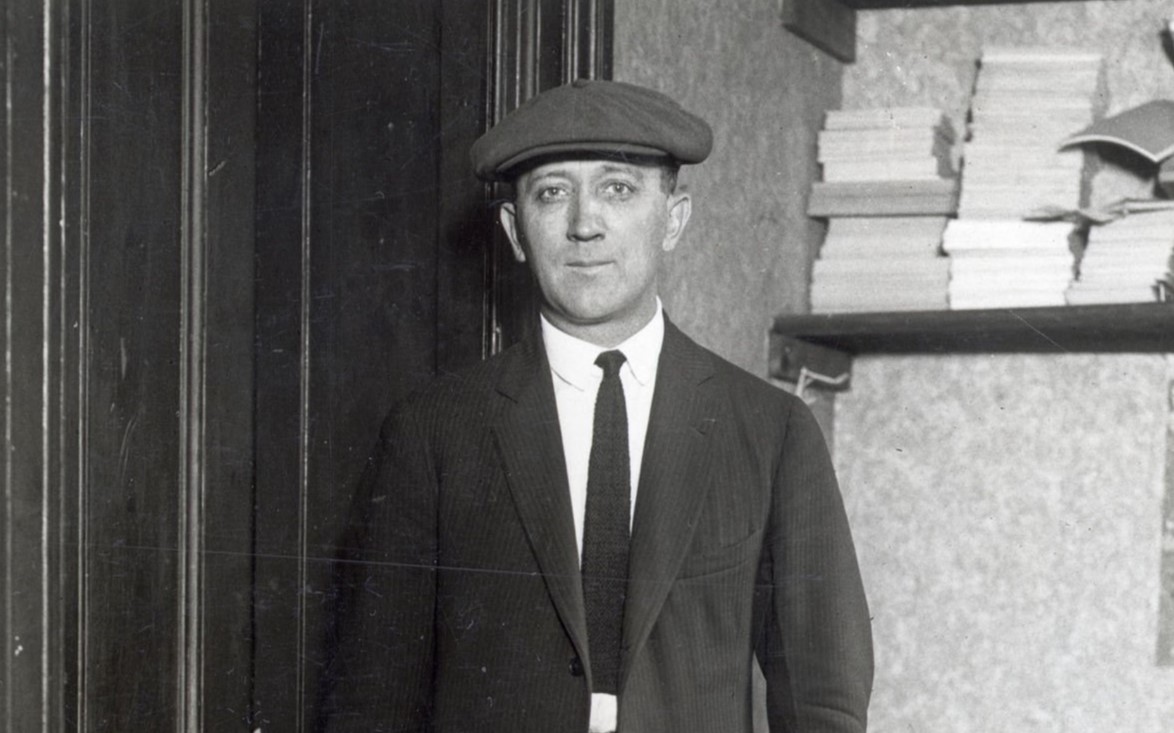
Either banal or dangerously reactionary, or both, William Z. Foster on the capitalist ‘news’ in the United States and the welcome entry of labor’s Federated Press onto the scene.
‘The Press in the United States’ by William Z. Foster from Moscow. No. 7. June 1, 1921.
The time was in the United States when the capitalist press had a trace of liberalism. In every city there could be found at least one powerful journal that would say a word in favor of Labor, especially during strikes. But this epoch has passed. Every semblance of liberalism has disappeared. Now all the big journals everywhere are violently against Labor. The whole newsgathering and distributing agency of America has become subservient to the interests of the most labor-crushing capitalists. It is entirely without independence and amounts in sum to a gigantic machine for poisoning public opinion with employers, propaganda.
Of course, in practically all countries the capitalists have a firm grip upon the large daily press. But in none of them is this control anywhere near so complete and deadly as it is in the United States. Visitors from European countries gasp with astonishment when they come to learn close-up of the utter degradation of American newspaper men and the shameless way they prostitute themselves to the service of the exploiters. Truth and they have completely parted company. Now nothing remains but capitalist propaganda.
The great capitalists of America control the press in devious ways. To begin with newspapers in the United States, being much larger as a rule than those of other Countries, require considerable financial power behind them. This fact in itself makes them strictly capitalistic-minded. But the industrial kings of America do not rely upon this. They have set up a thoroughgoing, vertical and horizontal control in addition.
The vertical control is secured through the great news gathering agencies of which the Associated Press is the chief one. This big organisation, which has thousands of offices and reporters, furnishes “news” to about 1000 daily newspapers, with 15,000,000 circulation and at least 30,000,000 readers-or practically all of the United States. Ostensibly the Associated Press is a co-operative, non-profit making concern which furnishes news to its member papers at cost. But in reality is controlled by a very few papers which own the bulk of its stock and which consequently dictate its policy. These controlling papers are the most reactionary in America and are all owned by big financial concerns. Through this enormous organisation, the equal of which is to be found nowhere on earth, the great capitalists are enabled to our the news of the world to their own King, and to poison the minds of the whole people just as they see fit. And they exercise their power in this respect with unparalleled effrontery.
The horizontal control of the press is exercised through powerful local organisations of employers and advertisers. Much more so than in Europe, American papers draw their sustenance from advertising. In fact without the support of advertising from the great shops, banks, etc., they cannot survive, Hence, these big advertisers, realising their position of advantage, proceed to dictate the local and editorial policies of the papers. And sad is the fate of any newspaper that attempts to defy them and to venture upon a course of liberalism. It is usually not long until it is either made subservient again, or driven out of business.
An incident will indicate how drastic this local control is. During a campaign to organise the workers in the Steel industry a daily paper in the city of Gari, Indiana, ventured to speak in a friendly manner of the unions. Immediately the editor of the paper was summoned to the office of a leading banker and peremptorily ordered to join the fight against the unions. In case of refusal his credit was to be stopped and his paper killed within a week. Like so many others have done in similar circumstances, he submitted, and at once joined the other papers in the most violent and slanderous: attacks against the trade unions. And so it goes on constantly all over the country; the employers hold the press in an iron leash.
To defend itself against the lying attacks of the great capitalists Labor has but a poor press indeed. The few liberal journals have only a small circulation, and but slight influence. Nor is the revolutionary movement much better equipped. Its papers are comparatively few in number and have limited power. Among the trade unions there is a considerable press, such as it is. Each of the big organisations has its journal, going to all of its members at least once a month. But the stuff contained in such journals is thin gruel, being mostly articles dealing with technical matters and the usual trade union demands.
In most of the large cities and towns there are local trade union papers, of poor quality, small circulation and inconsiderable influence. Some of these local papers are parasitic in nature. While pretending to be labor papers they are actually supported by the employers to fight the unions. Such usually start out as genuine labor papers, backed by the trade unions. But after awhile, in their incessant search for advertising (without which even labor papers can hardly live in America), they find that the employers will pay them heavily if they agree to carry on a sort of right wing agitation in the movement. This many of them do. In the city of Pittsburgh alone there are three if such papers, all of which began as real labor papers, were bribed by the employers and finally were repudiated by the labor movement–but they all still continue to call themselves labor journals and lose no occasion to fight everything in the unions that is progressive.
The need for a great labor press is a burning one in America. Of late years much has been done in this direction, including the launching of several dailies in various cities. But the most important achievement was the founding a couple of years ago of the Federated Press. This organisation is a federation of labor papers for the purpose of gathering and distributing labor news. About 150 of the leading labor papers of America are affiliated to it and take its new service. It has correspondents in all the large industrial and political centers, which furnish a constant stream of reliable labor news to the labor press.
The Federated Press is non-partisan in character, confining itself so far as possible to news and special articles, with which its affiliated journals (mostly all of progressive or revolutionary tendencies), can agree. Since the Federated Press’ appearance the general tone and quality of American labor papers has greatly improved. Its founders are planning to build it into an organisation capable of competing with its great capitalistic rival, the Associated Press and of breaking the capitalist class ironclad control of American news service and public opinion.
Moscow was the English-language newspapers of the Communist International’s Third Congress held in Moscow during 1921. Edited by T. L. Axelrod, the paper began on May 25, a month before the Congress, to July 12.
PDF of full issue: https://www.marxists.org/history/international/comintern/3rd-congress/moscow/Moscow%20issue%206.pdf
 Revolution's Newsstand