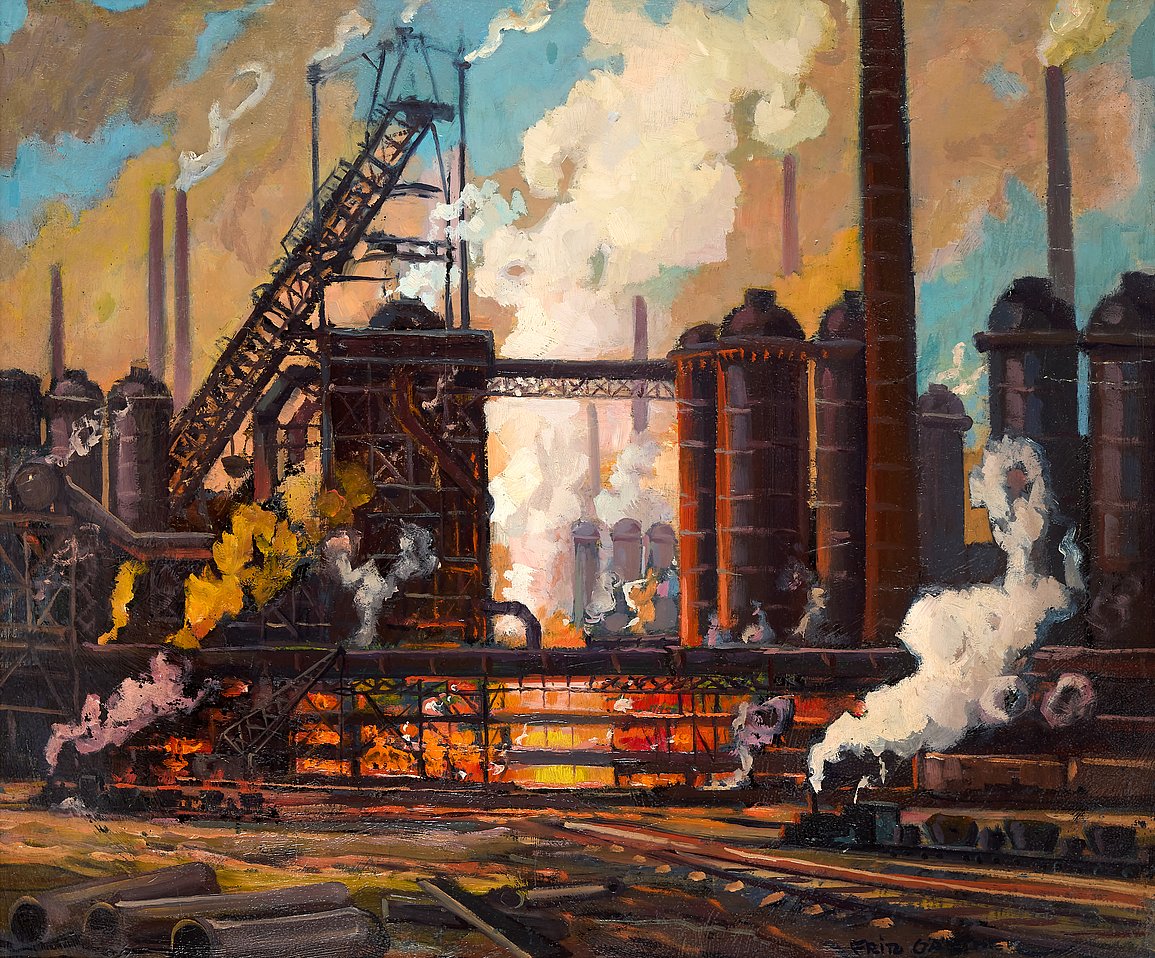
Another of Pennsylvania miner-writer Ed Falkowski’s marvelous observations of working-class Weimar Germany sees him describe the steel towns of the Ruhr. Falkowski went into the mines of Shenandoah, Pennsylvania as a teenager and quickly became a radical activist in the UMWA. Always an intellectual, he attended Brookwood Labor College in the 1920s and began writing. In 1928 Falkowski, traveled to Germany as an exchange student and immersed himself in Berlin’s left life reporting of his experiences in the U.S. radical press. He would spend most of the 30s in Moscow editing an English-language paper before returning to the States in 1937 where he worked at a factory and helped to found the UAW. He died in 1984.
‘The Ruhr Steel Mills’ by Ed Falkowski from New Masses. Vol. 5 No. 12. May, 1930.
I. THE FLAME ETERNAL.
The Ruhr skies are restless with the quivering dance of fires that warm up the cold night with a ruddy glow. The stars seem ashen cinders flying through the waves of flame that toss themselves against the heavens. Daylight reduces these fires to writhing yellow husks of heat, with tassels of smoke. It is the darkness that brings out the weird beauty of the torches—everlasting fires of steel mills.
Year in, year out, the flames dance on. They are as permanent as the mills which brood in a surly immortality of smoke and dust. The fires throw paths of scarlet across the Ruhr, across the Rhine. Rebellious flames seeking release, like the thousands of slaves closed within those dingy walls whose only escape lies in the dream of final rebellion.
When once the Ruhr nightskies are unlighted by these torches, you may be sure something momentous is afoot. A revolution, a catastrophe, a world being shattered. They went dark during the Kapp Putsch. When the tremendous lockout took place in November, 1928, again the heavens were black—a sign that the ovens were cold. And steel ovens dare not get cold except when they must—
These are flamy banners announcing the stability of a capitalist universe.
But the flames have already gone out a few times. They may even go out once more. For history has not yet reached its last chapter.
II. A SONGLESS OCCUPATION.
There is something time-clocky about the steel mill. Everything moves strictly to minute. Two buckets of coke, and one of ore make a “tour,” and 32 tours make a shift. Every two and one half hours the ores are cooked and are now ready to gush down into waiting sandforms. Between the tappings is barely enough time to shape things for the next gush—if you hurry. There is no comradely leisure, no time for the men to drink coffee together, and talk over things as men do in the mines, or at sea.
Men accept one another as one prisoner may greet another—with no words, but plenty of understanding. But words have their place in life. The dramatic curses of miners—crisp snapshots of smothered discontent—the big-chested songs of Kumpels singing of sex and rebellion, with weepy, beer-soaked ballads thrown between for good measure—the gusty, hearty friendship of Kumpel for Kumpel, born of a pit where danger wields men of opposite temperaments into common loyalty—this, the steel worker lacks.
The steel worker lacks the dark dangers that haunt the coal pit. The silences, the pauses compelled by exhaustion, the bread and coffee pause, these things do not cross the steel worker’s eight hours of exerting toil.
His face is softer, as though melted down by the furious heat.
It suggests patience, holding out against the clock, rather than dangers defied, and overcome.
The German miner has a background of tradition and balladry. It is true that the dignity of his trade has gone the way of rationalized things, that today he is a serf belonging to the pit, and his dangerous profession has the mark of public contempt upon it. It is the “last trade,” in the eyes of the community. The dirtiest, meanest, cheapest—something one instinctively reserves for the “foreigner.”
But the songs survive, and the miner out on a payday spree, still voices the heroics of his trade in a manly brawl. Some glamor still clings to his trade. For him the poetry of the pit is not altogether dead.
But the steel worker never had any songs to sing. Maybe because his trade is comparatively speaking, too modern, and workers have lost the habit of timing their work to the beats of song. The timeclock has replaced the balladry of the days of slower pace; it has robbed men of companionship at work…
Only the hiss of gas, the drone of huge motors, the hum of electricity streaming through heavy-laden wires, the pop of the furnace as it is tapped, and the flood of hot gold bursting in a tearing, irresistible tide, hissing, roaring, sputtering—this is the only song the steel worker knows.
III. THE UNBUTTERED SIDE.
The shadows of the lords of steel move across the industry with the ironic fatality of the machines themselves. In Germany, the metal industry suffers more lockouts than strikes, and more layoffs than days off.
Long rows of grim, smoky houses in crestfallen alleys throw a wall around the misery of the workers. Oberhausen, Duisburg, Dusseldorf, Bochum, the great steel cities of the Ruhr submerge the toilers in weary, sunless lanes, not included in Baedeker!
It is a heartless struggle between semistarvation at work, and practically the same fate when a jobless season comes around, and one’s face haunts the windows of welfare offices.
Sudden cuts in the “bonus,” reductions of the force, compulsory holidays, or complete shutdowns thrill the steel worker’s life with unexpected happenings. Small plant meetings are held, many fiery things are uttered, but what is done remains done. The gods ask no questions, consider no demands. Theirs is the last authority, and they have spoken.
Margerine, the “proletarian butter,” and barley coffee repeat themselves at each mealtime with tireless monotony. Horsemeat is often resorted to because of its cheapness. Fruit, and the finer temptations to which even the appetite of a worker is sometimes susceptible, fly from the table to the paradise of apparently unbought edibles which grace the windows of fine food shops along the main street.
On top of that the grinding monotony of a job whose leading excitement is putting the hours in. A clock-watching job, with everything occurring on schedule, that you could set your watch by observing the operations of the worker at any given moment. No Sundays, no holidays…except when inflicted…
Nor does the steel worker want a Sunday off. Sunday means 50% extra. Holidays mean more money. He has lost the sense of freedom, of strolling in the country, or visiting a theatre or concert. He becomes a toneless work-animal, with all the finer senses dead within him, with no further desire stirring him than to get the shift in, and tomorrow it will be the same all over again.
But perhaps there is something deep inside the steel worker yet unkilled by the days that rotate like wheels crushing him under their rims…a fire that will one day burst out like hot steel from the oven that flames inside of him, sending a mountainous proclamation of fire over the world, that the steel slave claims his freedom at last…and when hot steel bursts from the pot, there is nothing can stand in its way…
Berlin, Germany
The New Masses was the continuation of Workers Monthly which began publishing in 1924 as a merger of the ‘Liberator’, the Trade Union Educational League magazine ‘Labor Herald’, and Friends of Soviet Russia’s monthly ‘Soviet Russia Pictorial’ as an explicitly Communist Party publication, but drawing in a wide range of contributors and sympathizers. In 1927 Workers Monthly ceased and The New Masses began. A major left cultural magazine of the late 1920s and early 1940s, the early editors of The New Masses included Hugo Gellert, John F. Sloan, Max Eastman, Mike Gold, and Joseph Freeman. Writers included William Carlos Williams, Theodore Dreiser, John Dos Passos, Upton Sinclair, Richard Wright, Ralph Ellison, Dorothy Parker, Dorothy Day, John Breecher, Langston Hughes, Eugene O’Neill, Rex Stout and Ernest Hemingway. Artists included Hugo Gellert, Stuart Davis, Boardman Robinson, Wanda Gag, William Gropper and Otto Soglow. Over time, the New Masses became narrower politically and the articles more commentary than comment. However, particularly in it first years, New Masses was the epitome of the era’s finest revolutionary cultural and artistic traditions.
PDF of full issue: https://www.marxists.org/history/usa/pubs/new-masses/1930/v05n12-may-1930-New-Masses.pdf
 Revolution's Newsstand