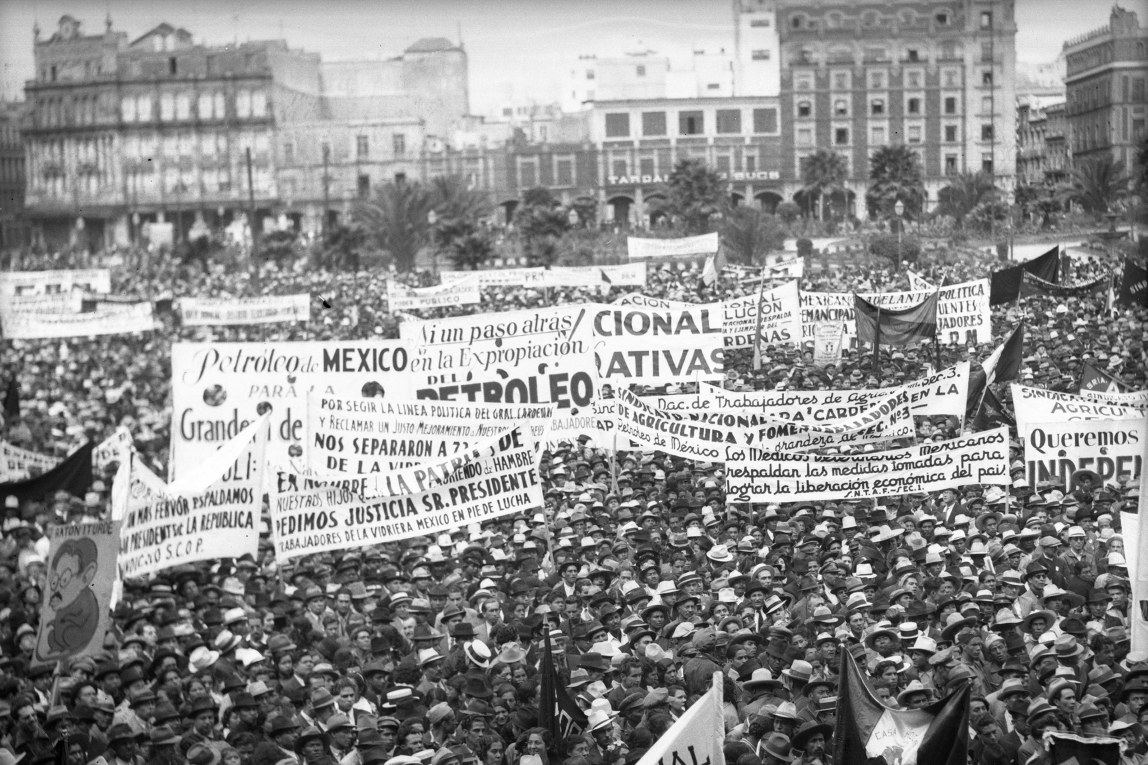
An informative overview of U.S., and others, capital investments in Mexican oil extraction before 1938’s expropriation of private oil interests and the creation of PEMEX.
‘American Oilmen in Mexico’ from The Daily Worker. Vol. 4 No. 25. February 11, 1927.
FOREIGN publicity during the last few months quotes American capital investment in Mexico as follows: Mining, approximately $300,000,000 American dollars; Oil industry and oil lands, approximately $478,000,000 American dollars while the entire amount of American investments in Mexico is quoted at some one and one half billion American dollars or three billion Mexican pesos.
These figures are circulated abroad, not in Mexico. They are given unofficially and no attempt is made to prove them. They are meant to strengthen the fallacy prevailing in foreign countries that all commercial activities in Mexico find their basis in American capital and that once having dealt with oil and mining industries all is said and done with that country’s commercial activities. These figures are not only borne out but are absolutely denied by the official figures of the National Statistical offices of the Mexican government.
Amount Of Capital.
The figures of the National Statistical Bureau show the full amount of capital (including Mexican owned capital) invested in all the industries of the country at $1,447,043,010.00 pesos. Of this amount 46.4% is American, a high figure indeed when it is considered that only one nation is involved but not, however, the preponderant percentage which the layman is led to believe because of the influence these American investors in Mexico have due to their small number and their concentration in one particular field–that of oil.
American capital in Mexico divides is 46.4% of the whole amount approximately in this wise: Oil 92%, mining 6% and various small industries 2%. $614,487,263.00 pesos of the entire amount of the $671,399,63.00 pesos which are North American capital’s interest in all industries in Mexico is devoted to oil exploitation.
And according to the records of the Department of Industry, Commerce and Labor of the Mexican government, only twenty American oil companies are interested in Mexico. The Complete figures for all companies and private individuals exploiting oil fields in Mexico (foreign and Mexican) amounts to 120. Some half dozen of the twenty American companies are subsidiaries of the Standard Oil company thereby reducing the number ultimately interested to about fourteen. It is the high concentration of this compact nucleus and their ability therefore to act practically as a single unit which makes for their power with the State Department at Washington and gives them the possibility of standing out against the laws passed by the Mexican government for the best regulation of Mexico’s oil industry for all concerned. The American State Department in pressing its policy of protection for American interests abroad is actually n the present difference with Mexico lighting the interests of the whole American people against their neighbors for the benefit of twenty companies at the most.
England has followed the same policy of concentration. English capital invested in all Mexican industry is approximately 377,614,199.00 pesos or 26% of the whole, with 356, 776,199.00 pesos or 95% of this going into the exploitation of oil, the remaining $20,838,000.00 or 5% being left for mining and small industries.
Capital Invested In Oil.
Capital invested in oil in Mexico amounts to $1,065.548,110 pesos or approximately 73% of the total capital invested in industry in the Republic. Of these oil investments, American capital controls about 60% and British capital about 34%. North American capital’s interest in all mining activities averages about 37%. England about 10%; these countries’ interest in all other varied industrial activities are approximately 8% for North American capital and 4% for British capital.
Over against oil and the mere handful of companies interested, there is all Mexican commerce with hundreds of importers and exporters of all nations involved. The present difficulties between the United States and Mexico arising out of different interpretations of the oil and land law regulations and the resulting uncertainty which the strained situation draws in its wake depresses all economic activities throughout the Mexican Republic–not only oil but all commerce–and even with a solution entirely in favor of the oil companies but a few would benefit.
While, as a matter of fact, under the most strict legal enforcement of the law, the Mexican legislation on oil and land does not in any way menace or endanger the existence of the big oil companies, on the other hand, smaller commercial activities in Mexico stand to be ruined by the present crisis provoked by and for the oil interests. The home governments of these entrepreneurs which feel so strongly the responsibility of protecting the few powerful companies and talk loudly about acting in the interests of their nationals abroad permit the ways and means of the oil companies to precipitate the ruin of hundreds of manufacturing importers and small holders caught in the maelstrom but who are in no way interested in the outcome of the legal discussion about the supposed menace to the oil interests.
Government Trust Controlled.
American manufacturers who are just beginning to work up an appreciable import trade into Mexico cannot permit that the State Department at Washington consider the matter as one concerning exclusively the oilmen and the Mexican government. By this attitude, they play directly into the hands of a few Americans interested in oil.
Mexico is only in the beginning of the development of its small industries. Even a cursory glance into the history of the country will explain the situation. Up to the time and during the first part of Porfirio Diaz’ regime, foreign capital in any appreciable amount was not encouraged and was not interested to come to Mexico. With the discovery of oil in 1901, the rush began. And, unfortunately, practically since the country has been conscious of the vastness of its oil deposits, internal political revolution has held Mexico in its throes, harassed one government after the other. Only under the last two administrations, those of General Obregon and President Calles has there been opportunity to think at all of economic development to undo the wrongs the country has suffered for four hundred years.
Helped Very Little.
And American and English capital have really helped very little toward the real commercial and economic development of Mexico, the United States giving today–over and above her enormous investments in oil–only a scant 8%, of which 6% goes into mining, and England only 5% to mining and varied small industries which affect the daily life and standard of living of the Mexican people.
The distribution of all capital invested in industry in Mexico today is: 73% oil exploitation with Mexican capital proper having only 1% in this 73%; 7% foodstuffs; 6% textile industry; 6% mining; and 8% other industries. However, of all capital invested in foodstuffs, 60% is Mexican, in the textile industry 13% is Mexican, in mining 45% is Mexican and in the various small industries 65% is Mexican. meaning that Mexican capital is really invested in all general industries from which the public at large must live.
In imports into Mexico, the United States leads, having imported during the first half of 1925 about 71% of all goods brought in–foodstuffs, livestock, building material, machinery and so forth–all figures for oil being excluded. Manufactured iron goods, implements of all kinds, machinery for which Mexico’s need is very great at present came from the United States in the amount of 80% during that same period with notable increase since. Motorcars made in the United States, and tires outrule all competition, the use of autos, auto-busses and tractors having increased enormously. While during the first six months of 1924, 3,157 motor cars were imported into Mexico from the United States, the figure covering the same period for 1925 had risen to 11,544–some 300%. Here again later increase has been at the same rate. And while only a few proofs of the trend of the United States import trade into Mexico are mentioned, the premise is true for most every article coming in. American business can ill afford to allow to continue a crisis which will loose for them this trade or be responsible for turning the tide toward European channels which are each day pushing more and more into Latin American markets.
There is at the present no military problem in the republic aside from the Yaqui uprising in the northern state of Sonora and this situation is now entirely controlled by the federal army.
Some persons interested in oil are making propaganda among fanatics in order to stir up revolution with, it is said and apparently with sufficient truth, the backing of the State Department at Washington and especially of U.S. Secretary of State, Mr. Kellogg.
The Daily Worker began in 1924 and was published in New York City by the Communist Party US and its predecessor organizations. Among the most long-lasting and important left publications in US history, it had a circulation of 35,000 at its peak. The Daily Worker came from The Ohio Socialist, published by the Left Wing-dominated Socialist Party of Ohio in Cleveland from 1917 to November 1919, when it became became The Toiler, paper of the Communist Labor Party. In December 1921 the above-ground Workers Party of America merged the Toiler with the paper Workers Council to found The Worker, which became The Daily Worker beginning January 13, 1924.
PDF of full issue: https://www.marxists.org/history/usa/pubs/dailyworker/1927/1927-ny/v04-n025-NY-feb-11-1927-DW-LOC.pdf
 Revolution's Newsstand