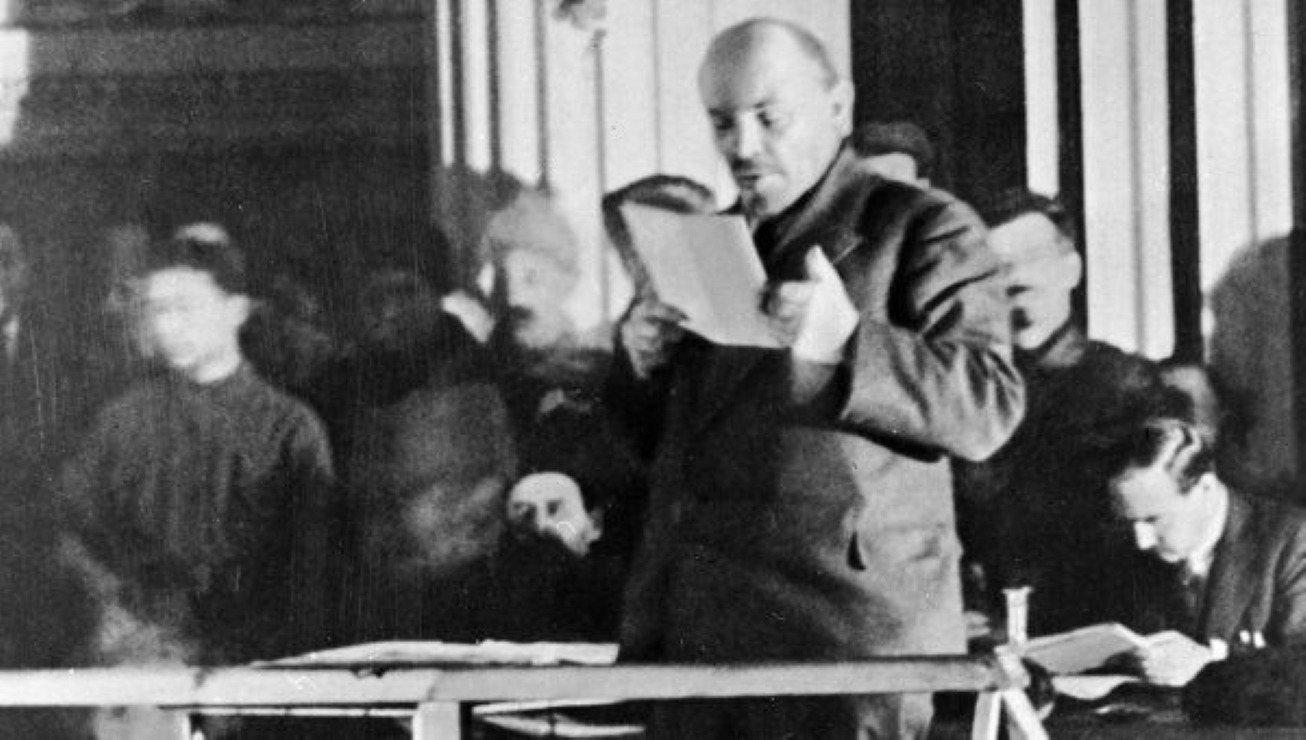
In a polemic with the Bundists, Lenin makes larger points about culture in the class struggle.
‘National Culture’ (1913) by V.I. Lenin from On the Jewish Question. International Publishers, New York. 1934.
As the reader will see, my article in the Northern Pravda makes use of one example, precisely that of a general state language, to explain the inconsistency and opportunism of the liberal bourgeoisie, which on this issue of the national question joins hands with the landowners and the police. Everybody understands that, quite apart from this question of a general state language, the liberal bourgeoisie behaves just as treacherously, hypocritically and stupidly (even from the standpoint of liberalism) in relation to quite a number of similar questions.
What conclusion do we draw from this? The conclusion is that every form of liberal-bourgeois nationalism carries the greatest corruption into the ranks of the workers. It inflicts the greatest damage on the cause of freedom and the proletarian class struggle.
And it is all the more dangerous because it masks its bourgeois (and bourgeois-serf-owning) tendencies with the slogan of “national culture.” In the name of “national culture”—Great Russian, Polish, Jewish, Ukrainian, etc.—the Black Hundreds and priests, and then the bourgeoisie of all nations, do their reactionary and dirty work.
Such are the facts of present-day national life, if we look at the question in a Marxist fashion, i.e., from the standpoint of the class struggle, if we compare slogans with the interests and policies of social classes, and not with empty “general principles,” declamations and phrases.
The slogan of national culture is a bourgeois (and frequently a Black Hundred-clerical) fraud. Our slogan is the international culture of democracy and the world working-class movement…
International culture is not non-national. Nobody ever stated it was so…In every national culture there are, even if undeveloped, the elements of a democratic and Socialist culture, because in every nation there are toilers and exploited masses, whose conditions of life inevitably give rise to a democratic and Socialist ideology.
But in every nation there is also a bourgeois culture (and in the majority still a Black Hundred-clerical culture), which moreover is present not merely in the form of “elements,” but in the form of the dominant culture. Therefore “national culture” generally is the culture of the landowners, priests, and bourgeoisie. This basic truth, which is elementary for a Marxist, the Bundists leave in the shade, and in practice oppose the opening up of the class gulf in society, instead of exposing and explaining it. In practice the Bundists have become like the bourgeoisie, whose interests all demand the spreading of faith in a non-class national culture.
In putting forward the slogan of “the international culture of democracy and the world-wide working-class movement,” we take from every national culture only its democratic and Socialist elements, and only these, and then only in contradistinction to the bourgeois culture, the bourgeois nationalism of every nation. Not a single democrat, and all the more not a single Marxist, denies the equality of language or the necessity of conducting polemics in one’s own language against one’s “own” bourgeoisie, or spreading anti-clerical or anti-bourgeois ideas amongst one’s “own” peasantry and lower middle class, etc. There is no room for argument about these matters, and the Bundists use these indisputable truths to conceal the real question at issue.
The question at issue is, whether it is permissible for a Marxist to put forward directly or indirectly the slogan of national culture, or is it obligatory for him to preach against it in all languages, adapting himself to all local and national peculiarities, advancing the slogan of workers’ internationalism.
The meaning of the slogan of “national culture” is not determined by the promises or good intentions of the intellectual who explains the slogan “in the sense of leading through national culture up to international culture.” To look at the question in this manner would be childish subjectivism. The meaning of the slogan of national culture is determined by the objective relationship between all the classes of a given country and of all the countries of the world.
The national culture of the bourgeoisie is an accomplished fact (moreover, I repeat, the bourgeoisie everywhere strikes bargains with the landowners and priests). Militant bourgeois nationalism stupefies, swindles and disrupts the workers, in order to lead them on a string after the bourgeoisie. That is the outstanding fact to-day.
He who would serve the proletariat must unite the workers of all nations, and struggle unwaveringly against bourgeois nationalism, both his “own” and foreign. He who defends the slogan of national culture has his place among the middle-class nationalists and not among the Marxists.
Take a concrete example. Can a Great-Russian Marxist accept the slogan of a national Great-Russian culture? Of course not! Such a person would need to be placed among the nationalists, and not among the Marxists. Our business is to struggle against the national culture of the Great-Russians, the culture of the ruling Black Hundreds and bourgeoisie. Our task is to develop, in a purely international spirit, and in close alliance with the workers of other countries, those seeds of a democratic and working-class movement which are contained in our history also…
The same applies to the most oppressed and down-trodden nation, the Jews. Jewish national culture is the slogan of the rabbis and the bourgeoisie—the slogan of our enemies. But there are other elements in Jewish culture and in the whole history of Jewry. Out of some ten and a half million Jews in the world, a little more than half live in Galicia and Russia, backward and semi-barbarian countries which keep the Jews by force in the position of an outlawed caste. The other half live in the civilised world, where there is no caste segregation of the Jews. There the great and universally progressive features of Jewish culture have made themselves clearly felt; its internationalism, its responsiveness to the advanced movements of our times (the percentage of Jews in democratic and proletarian movements is everywhere higher than the percentage of Jews in the general population).
Whoever directly or otherwise puts forward the slogan of Jewish national culture (however well intentioned he may be) is the enemy of the proletariat, the defender of the old and caste element in Jewry, the tool of the rabbis and of the bourgeoisie. On the contrary, those Jewish Marxists who join up in the international Marxist organisations with the Russian, Lithuanian, Ukrainian and other workers, adding their mite (both in Russian and in Jewish) to the creation of an international culture of the working class movement, are continuing (in the teeth of Bundist separatism) the best traditions of Jewry, and struggling against the slogan of “national culture.”
Bourgeois nationalism and proletarian internationalism—here are two hostile and irreconcilable slogans, corresponding to the two great class camps throughout the capitalist world and reflecting two distinct policies—and, more than that, two philosophies—in the national question. By defending the slogan of national culture, and building upon it an entire plan and practical programme of so-called “cultural-national autonomy,” the Bundists in practice act as the propagators of bourgeois nationalism in the workers’ ranks.
October-December, 1913
International Publishers was formed in 1923 for the purpose of translating and disseminating international Marxist texts and headed by Alexander Trachtenberg. It quickly outgrew that mission to be the main book publisher, while Workers Library continued to be the pamphlet publisher of the Communist Party.
PDF of full issue: https://archive.org/download/leninonthe-jewish-question/LeninontheJewishQuestion.pdf
 Revolution's Newsstand