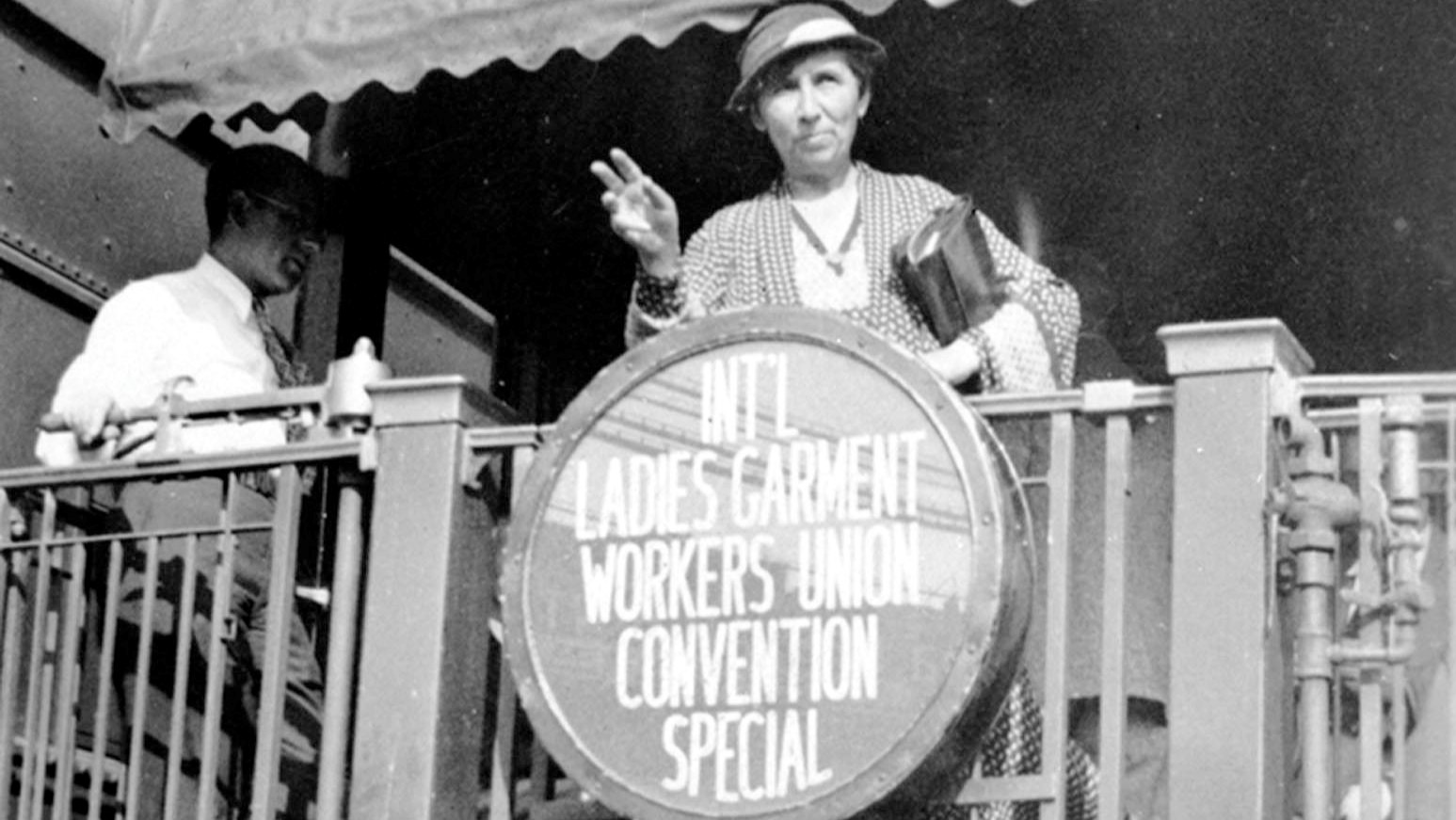
Cohn, who came to national prominence during the breakthrough 1909 New York dress strike organizing Local 24 of the International Ladies Garment Workers Union, reports on 1919’s mass strike, and the changes in the last decade, as women were now a significant and essential force in the city’s labor movement.
‘With the Strikers’ by Fannia M. Cohn from Justice (I.L.G.W.U.). Vol. 1 No. 6. February 22, 1919.
The various scenes which I have witnessed in the halls where the thousands of striking waist and dress makers meet daily are truly interesting and instructive.
These scenes are instructive because they are such a strong denial of the statements made by many, that working women cannot be and are not interested in the future of their trades, as are the men working In the same trades. The reason given for this is that the social position of the woman makes her look upon her job as only temporary.
And for this very reason our brother workers, in the past, regarded with suspicion the masses of women who were entering the various trades. They did everything to halt the “hostile army”, whose competition they feared, and with trembling hearts, they awaited a dark future, a future in which the “unbidden guests,” the working women, for whom the shop was only a stopping-place, would demoralize the trade by working longer hours and for lower wages.
And as for a union–why, how would it be possible to build up and later maintain a union of women?
But what does experience teach us? We see that not only have the women in the women’s dress industry not demoralized the trade and enslaved the men, but on the contrary, the women have begun and are carrying on an untiring fight for the betterment of their conditions: for the shortening of the working hours, for better sanitary conditions, for an increase in wages, and above all, for the recognition of their union.
Anyone who is observant, can learn much from the scenes which take place daily in the halls where the striking women meet. He can learn what a feeling of responsibility the thousands of working women, many of whom are still children, entertain for the future of their union, which was entrusted to them by their brothers and sisters who built it up by the sweat of their brows.
One can learn much at the shop meetings where the workers come to talk things over. At one of these shop meetings I saw a young woman who is the shop chairman, chosen to be the leader of eighty workers, many of them middle-aged men. I saw this charming young girl in the role of a leader, bearing the burden of a general strike. Her cheeks were flushed; her eyes flashing; her face serious with her right hand uplifted and her small hands clenched, and in a firm, determined voice, she explained to the members of her shop the real significance of this strike. She told them that the strike was a very serious one and must be energetically waged against the employers who wish to break the mighty Waist and Dress Makers’ Union. “But”, she exclaimed with pride in her voice, “No one will live to see this done!” But yet she warned er workers: “If all of us, men and women, young and old, will not take this conflict seriously, will not picket conscientiously, and convince our employers that we are determined to emerge from this conflict stronger than we were before entering it, then there is grave danger that our union will have to suffer thereby.” The eighty workers warmly applauded their young leader and all volunteered to join the picket line.
In another hall several shop chairmen were following the district chairman of the organization committee about, asking her to be present at their shop meetings.
The district chairman of the organization committee answers hundreds of questions at the shop meetings, gives advice, issues instructions, encourages the weaker ones, calls upon the frivolous ones to be more serious, and counsels the over-enthusiastic strikers to be a little more practical and the practical ones to be a little more enthusiastic. In a tense and thrilling voice she explains to her listeners the issues of the strike and exclaims: “The bosses want to beat us, but we shall emerge victorious! The International has never lost a strike!” Stormy applause greeted her words.
This district chairman who speaks with so much authority, such earnestness and determination, is a fine, courageous young woman, with a charming face, a pair of laughing eyes, and a constant smile on her lips.
In still another hall the very same scenes were repeated. Young girls, children of the working class, told their listeners of the sufferings of the pioneers of the Waist and Dress Makers’ Union, of those who built up this mighty organization.
In one hall I saw a member of the organization committee standing in the center of the room surrounded by about a hundred and fifty workers, who were listening carefully to what she had to tell them about the first general strike of their union in 1909. And although she, herself, was then too young to be a member of the union, yet she had a sister who had been in that strike and it had made a deep impression upon her.
She told her listeners that in 1909, at the time of the strike, the weather was not as mild as it is now. That winter was one of the coldest ever experienced by this country. The ground was covered with snow two inches deep, and it was dangerous for the pickets to stand in the same place for more than five minutes because their feet would freeze. And she told them that then the waist makers’ had no union and the International only existed on paper. Neither was there a cloak maker’s union at that time. She told them also of the brutality of the police and the gangsters who actually terrorized the strikers because then they were much bolder than they are now, women’s strikes not being popular at that time. And the police at that time would arrest the pickets by the thousands, and since there was no large fund to carry on the strike the strike leaders who were fined by the judges went to the workhouse rather than have the strike committee use its limited funds for paying their fines.
She also told them of a case where a striker paid rent for a corner of a tenement house which contained her bed and invited four other strikers who had no rent money, to deep with her in her bed. There feet rested on chairs placed ear the bed, and in this way they rested after a hard day on the picket line.
She told them of strikers who shared their meager lunch, really not enough to feed one person, with two or three others who had not the money with which to buy food.
She told them that in 1909 the workers were inexperienced and the progressive labor movement was weak and had not the Influence it has today, and that everything combined made the waist manufacturers believe that their enemy was of no account so that at the very beginning they did not take the strike seriously but thought that hunger and cold would force the striking waist makers to return to work in a very short time. And pride shone in the eyes of the speaker as she told how quickly the bosses were convinced that they had been mistaken. They hadn’t taken into account the spirit of the strikers, a spirit which was strong enough to combat hunger and cold. And turning to her listeners, the speaker exclaimed: “Shall we, the strikers of 1919, not be the real followers of our pioneers of 1909?” “Yes,” was the response shouted back by hundreds of strikers.
And she asked again: “Do you want that the waist makers of the future shall be proud of us just as we are proud of our sisters and brothers of 1909?” Then she continued: “Do you want the strike of 1919 to be a source of inspiration in the future conflicts of organized labor just as the strike of 1909 is a source of inspiration to us?” And the audience shouted: “Yes, yes, hurrah, hurrah, for the general strike of the waist and dressmakers’ union!”
With hoarse voices, with eyes moist with joy and enthusiasm, the district chairman continued: “Do you want the waist and dress makers to curse you? Or do you want them to bless you? Do you want our fight to be written down with golden letters in the history of organized labor? If so, go into the trenches, to the picket lines Convince our bosses that we are determined to fight on till we win; and tell those women through whose aid the bosses hope to weaken our strike, that it is disgraceful that working women should be led to their shops by gangsters. Tell them that their daughters will be accompanied by gangsters, by the scum of society.” Inspired and encouraged, shouting “Hurrah” and “Long live the Waist Makers’ Union,” the hundreds of strikers marched out of the hall to the trenches, to the picket line. I witnessed many other scenes where very young girl, who should still be in public school girls who still need sunshine for the development of their bodies and souls, just as a young flower needs sunshine and dew to make it grow, led the workers on by their own enthusiasm and inspiring addresses. Were we living under another and juster social order these children would not be taking part in a general strike. But now these young girls are the leaders of a general strike, and they are forced to fight against the police and gangsters, against hunger and cold, and against everything which money can buy.
It has fallen to the lot of these children to lead the class struggle; they bear the burden of an unjust social system and by their struggle they hope to change this system so that their children shall live in a better world.
But these young children act like grown-up, mature people, and the more I come in touch with the various committees who are carrying on the general strike, the more I am convinced of this.
Fight on! Fight on! Sons and daughters of the working class! By your struggles you will make life more beautiful and more noble.
The weekly newspaper of the International Ladies Garment Workers Union, Justice began in 1909 would sometimes be published in Yiddish, Spanish, Italian, and English, ran until 1995. As one of the most important unions in U.S. labor history, the paper is important. But as the I.L.G.W.U. also had a large left wing membership, and sometimes leadership, with nearly all the Socialist and Communist formations represented, the newspaper, especially in its earlier years, is also an important left paper with editors often coming straight from the ranks radical organizations. Given that the union had a large female membership, and was multi-lingual and multi-racial, the paper also addressed concerns not often raised in other parts of the labor movement, particularly in the American Federation of Labor.
PDF of full issue: https://www.marxists.org/history/usa/pubs/justice/1919/v01n06-feb-22-1919-justice.pdf
 Revolution's Newsstand