
The obituary and funeral report for the pioneering early English-speaking Socialist leader of trade unions and the eight-hour movement, dead in Philadelphia, a member of that city’s Typographical Union No. 2, at age 59.
‘Fred Long Now Rests After Many Years’ from The New York Call. Vol. 4 No. 41. February 9, 1911.
‘Fred Long, Pioneer Socialist and Labor Agitator, is Dead’ from The New York Call. Vol. 4 No. 37. February 6, 1911.
Fred Long of Philadelphia, is dead. This news will come as a shock to many of the older members of the Socialist party and the trade union movement. Fred Long was a pioneer in both the economic and political organization of the working class. He was in the heyday of his life one of the most effective agitators in the labor movement of this country.
For several years Long was a helpless cripple, suffering from tuberculosis of the bones, but despite, the terrible pain which he endured he was marvelously alert and keen. He was until the very last thoroughly abreast of the developments of the working class movement, not only in this country, but the wide world over.
Pneumonia was the immediate cause of his death, which occurred Friday night, but for some unaccountable reason was not reported to The Call until Miss Frances Perkins returned from Philadelphia last night after her lecture.
The funeral will be held Wednesday morning at 10 o’clock. From Oliver Blair’s undertaking establishment, 1820 Chestnut street.
Eugene V. Debs has been wired to come on and deliver the funeral oration. He will be there if he can get there, as he was a great lover of Fred Long.
Fred Long was a member of Typographical Union No. 2, of Philadelphia, and while on his feet was one of the most active and aggressive men in its ranks. He was very popular among his fellow workers.
No one could help loving Fred Long, he was such a wholehearted lover of his fellows. Ben Hanford used to say. And Ben knew Fred Long as intimately as one man can know another. He was a pupil of Fred Long, whom he considered the greatest teacher in the Socialist movement.
Fred Long, of Irish extraction, was one of the hardest fighters in the labor movement, one of its clearest thinkers and one of the ablest agitators on its platform before his health failed.
For at least the past three years he has been hardly able to turn over in his bed unassisted, but despite that he radiated courage and strength, and always greeted his friends with a smile. Long before the last spark of life flickered out of his pain-racked body, he was practically dead up to his head. But his head was alive, his wits alert, and often in the course of conversation he would amaze his friends by making some brilliant comment on some current event.
Dr. Elizabeth Baer, at whose home Fred Long spent the latter part of his life, made him comfortable in every possible way. His death was not unexpected, because of his condition, but nevertheless the news of it will come as a distinct shock to his friends.
With the passing of Fred Long, the labor movement of this country loses one of its most upright, stanch and able pioneers and champions.
The long days of pain and suffering and imprisonment in bed are over for Fred Long. Release has come. He has gone. But Fred Long will live in the hearts of all who knew and loved him, and they are an unnumbered host!
‘Fred Long Will Be Buried Tomorrow’ from The New York Call. Vol. 4 No. 38. February 7, 1911.
The funeral of Fred Long, the beloved tighter of the cause of Socialism and labor, who died Friday night. will be held tomorrow morning at Oliver Bair’s undertaking establishment, 1820 Chestnut street, Philadelphia.
Many persons will be there from other sections of the state and country and several old friends will attend from this city.
Fred Long was born in Detroit, Mich. sixty-one years ago. He was educated in the same school in which practically all great Socialist agita- tors have been reared-that of hard knocks.
He began his activities in the labor movement at the age of eighteen. While still a young man he went to Chicago, where he was in the midst of the terrible fight that ended in the hanging of Spies, Parsons, and their comrades, at the instigation of the capitalists. Chicago then became unsafe for him, and he left there to roam over the West, where he was active in many of labor’s struggles.
He went to Philadelphia about twenty years ago, where he remained as a tireless worker for the cause of economic freedom.
A more extended account of his life and work will appear in The Call later.
Lucien Sanial, the veteran Socialist, journalist and statistician, said last night:
“I remember speaking with Fred Long a number of times. He was wonderfully posted in economics and, was able to present his thoughts in clear, popular language. He was an active worker for the party not only la Philadelphia, but his influence was felt throughout Pennsylvania. At one time Philadelphia had one of our few Socialist papers Fred Long edited it with such ability that it was a credit to the movement. The last time I saw him was two years ago when I called on him in Philadelphia after speaking there. I found him dragging out an existence of terrible pain. but his mind was still keen and alert. The news of his death was not a surprise to me. I know what a blessing death was to him. You can’t put too strongly my appreciation of Fred Long as a self-taught scholar. Our movement needs more men of his type.”
Local Philadelphia has adopted the following resolutions:
Whereas death has taken from among us what was mortal of our veteran Comrade, Fred W. Long: and
Whereas Fred W. Long was one of the pioneers of the labor and Socialist movement in America, having, for more than a quarter of a century, given his magnificent mind, inspired pen and eloquent tongue to our cause with unfailing zeal and loyalty for which he has undergone long years of physical suffering and mental anguish: therefore, be it
Resolved, That we, the Socialist party of Philadelphia express the deep sense of loss we feel in the departure of our dear Comrade, and the equally deep sense of appreciation for the exceptional service he rendered at the forefront of the struggle at a time when such ability and devotion as his counted for more than words can tell. It is with bowed heads and overflowing hearts that we offer our tribute to bis memory.
‘Fred Long Now Rests After Many Years’ from The New York Call. Vol. 4 No. 41. February 9, 1911.
Faithful Socialist and Old Union Worker Buried in Philadelphia.
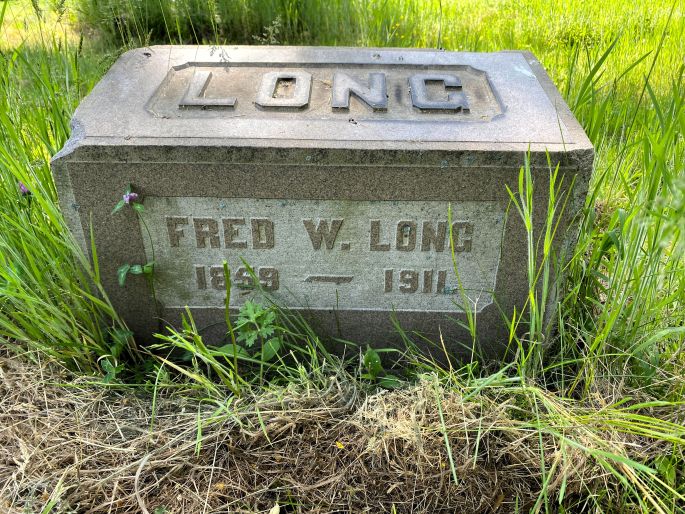
PHILADELPHIA, Feb. 6. Fred W. Long, pioneer of the Socialist and trade union movement, was buried in the printers’ lot in Mount Moriah cemetery this morning, after brief services at the undertaking establishment of Oliver H. Bair, at 1830 Chestnut street.
Long was one of the most active men in the labor movement of this country during the past quarter of a century or more, having become connected with the trade union movement when about eighteen years of age. He was fifty-one years of age when he died.
Word was received from his father and brother, who live in Detroit, that it would be impossible for them to attend the funeral, and the only relative present was his widow, Mrs. Agnes Long.
A brief funeral service was read by Rev. E.M. Frank at the request of Mrs. Long. Frank is a member of Local Philadelphia of the Socialist party, and he paid a generous tribute to the spirit of tolerance and broadmindedness of the dead labor agitator.
Joseph E. Cohen, representing Local Philadelphia, read resolutions expressing the sorrow and deep sense of loss of the local Socialist movement in the death of Long. These resolutions also contained a beautiful appreciation of Long’s untiring devotion to the cause of the working-class.
Harry Parker, one of Long’s associates in the work of building up the labor movement in this city, represented the national executive committee of the Socialist party. He spoke briefly, but feelingly, expressing simply the appreciation felt by all who knew Long.
Comrades His Pallbearers.
The pallbearers were old time unionists and Socialists, men who had in years gone by worked with Long in the Socialist and trade union movement.
Among the mourners were many of the old German members of the Socialist and labor movement who knew and worked with Long almost a quarter of a century ago. Many of these old men laid off for the day in order to pay their respects to the memory of the man who stood forth and championed the cause of the working class in English in the Quaker city in the early days of the labor movement. Several of these gray-headed workers expressed their appreciation of Long’s devotion to the struggle of the workers.
In the group gathered at the graveside were several Socialists and trade union men from out of town, but for the most part the mourners at the grave were those who saw Long suffer and pine away in the past three years. The floral decorations were simple pieces, most of them marked with the word “Comrade.” Among these floral tributes were: One from the national executive committee, another from Local Philadelphia of the Socialist party, another from the German Socialists and one from the Jewish Daily Forward Association In this city. Long’s career in the labor movement, both as a Socialist and a trade unionist, is a long story of undying devotion, of magnificent gifts consecrated to the struggle of the working class for liberation from the bonds of wage slavery.
Old Eight-Hour Agitator.
In 1886, when the famous eight-hour agitation was being pushed in Chicago, he was one of the most active men in that movement, but even then he was a believer in, and an advocate of political action by the workers as a class, being a Socialist. When the infamous Haymarket tragedy shocked the country Fred Long took the platform and fought like a lion to save the lives of the men who were in prison on a trumped-up charge. While the fever of the struggle for the lives of Fisher, Neebe and the others was at its height, Long arranged a mass meeting of protest in Washington and he himself was one of the principal speakers.
When he came to this city a couple of years after the Chicago fight which ended so tragically for a group of advocates of the workers, he immediately became active in the local labor movement.
During the early nineties of the last century Fred Long, Ben Hanford, J. Mahlon Barnes, George Chance, Ernst Kreft, Leonard Fish and a number of others stirred the labor movement into great activity. About 1894 a local Socialist paper called the Liberator was started, of which Leonard Fish was editor and Fred Long one of the most effective contributors.
A Gifted Speaker.
Long was probably the most effective speaker in the labor movement of this city, having the gift of presenting his thoughts, which were exceedingly well arranged, in the simplest language. Because of this, he was in great demand as a speaker. From the day when, at eighteen, he joined the labor movement until the day of his death, he, was keenly interested in every phase of the development of labor’s struggle.
Not only that, he was also one of the best posted men on the various problems confronting the workers today.
Dr. Elizabeth, Baer, at whose home Long was cared for during the greater part of his helpless illness, tells the following story of his interest and enthusiasm:
A year ago when the election of municipal officials was to take place in Milwaukee. Long asked that The Call be sent up to his room just as soon as it came the morning after election. But in the hurry and hustle Dr. Baer forgot about sending the paper up. A servant in the house took it up.
When, a little later, the servant, followed by Dr. Baer, was taking Long’s breakfast up to him, as they entered the door of his room they were startled by a shrill scream which could be heard in the street outside the house. Dr. Baer rushed in, and asked:
“What’s the matter? Have you gone crazy?”
Long’s reply was another warwhoop. When he calmed down, he explained that he had hoped to live to see Socialism begin to triumph in this country, and the victory in Milwaukee was the first step.
Long loved contact with the workers and nothing pleased him more than to talk to an audience of working men and women. Several anecdotes of his wit on the platform were recalled by a group of men gathered in the Socialist party headquarters this afternoon. One of these anecdotes dealt with his last appearance on the soap box.
It was at the close of the municipal campaign of 1906. A big all-day meeting was being held on the plaza of the city hall, on a Saturday. Long was lying on a lounge in the headquarters on Arch street, thinking of the old days when he stood on the soap box. Finally, he got up and made his way on crutches to the meeting.
Just as Long reached the meeting the speaker on the box finished his talk, and Long asked to be introduced. Those who heard him, say that the speech he delivered was a masterly presentation of the Socialist position, replete with wit and stinging sarcasm. He spoke for an hour and a half.
As he was concluding, the chairman touched his coat and asked him to introduce the literature, which he did. When he stepped down from the soap box Long turned to one of the Comrades standing by and said, “Now wasn’t that hell, when my strongest forte is the collection?”
Harry Parker, an old time Socialist and unionist, and one of Long’s intimate friends in the early days of the labor movement in this city had the pleasure of breaking the news of the election of James H. Maurer. Socialist, of Reading, to the state legislature to Long. When he entered Long’s room and told him what had happened Long almost jumped out of bed for joy.
Yes, sir, victory was in sight. Henceforth victory must follow victory speedily. If there was one characteristic of Long the fighter more strongly accentuated, it was his optimism.
The Sunday preceding his death Maurer and William Mailly visited Long at his home, and during the course of his conversation Long offered a number of fragmentary suggestions as to the best course for Maurer to pursue in the legislature. Like his old friend and comrade, Ben Hanford, Long first joined the Typographical Union in Chicago, b coming, as did Hanford, a member of No. 16.
A Tireless Champion.
From the earliest days of his activity in the labor movement until the day he died. Long was an unwavering advocate of class conscious political action by the workers. He always laid strong emphasis on the necessity of the workers obtaining control of the power of government in order that they might accomplish their own emancipation.
All who toiled by his side in the industrial and political wings of the labor movement honored and respected Fred Long as a man true to himself and his fellow workers, a man loyal to his ideals, a man unafraid of anything that might come in the struggle for freedom. The local committee which through the aid of Socialists in all parts of the country, did their best to make his pain-wracked last days as comfortable as might be, wishes to express its thanks to all those who gave of their means to aid the loyal Comrade who is gone.
The New York Call was the first English-language Socialist daily paper in New York City and the second in the US after the Chicago Daily Socialist. The paper was the center of the Socialist Party and under the influence of Morris Hillquit, Charles Ervin, Julius Gerber, and William Butscher. The paper was opposed to World War One, and, unsurprising given the era’s fluidity, ambivalent on the Russian Revolution even after the expulsion of the SP’s Left Wing. The paper is an invaluable resource for information on the city’s workers movement and history and one of the most important papers in the history of US socialism. The paper ran from 1908 until 1923.
PDF of full issue: https://www.marxists.org/history/usa/pubs/the-new-york-call/1911/110209-newyorkcall-v04n040.pdf
 Revolution's Newsstand