Freedom of speech and assembly has never been the reality in this country for whole swathes of its population. To quickly learn the limits of ‘democratic rights,’ go one strike.
‘The Cops Cover the Waterfront’ by Louis Coleman from Labor Defender. Vol 12 No. 6. June, 1936.
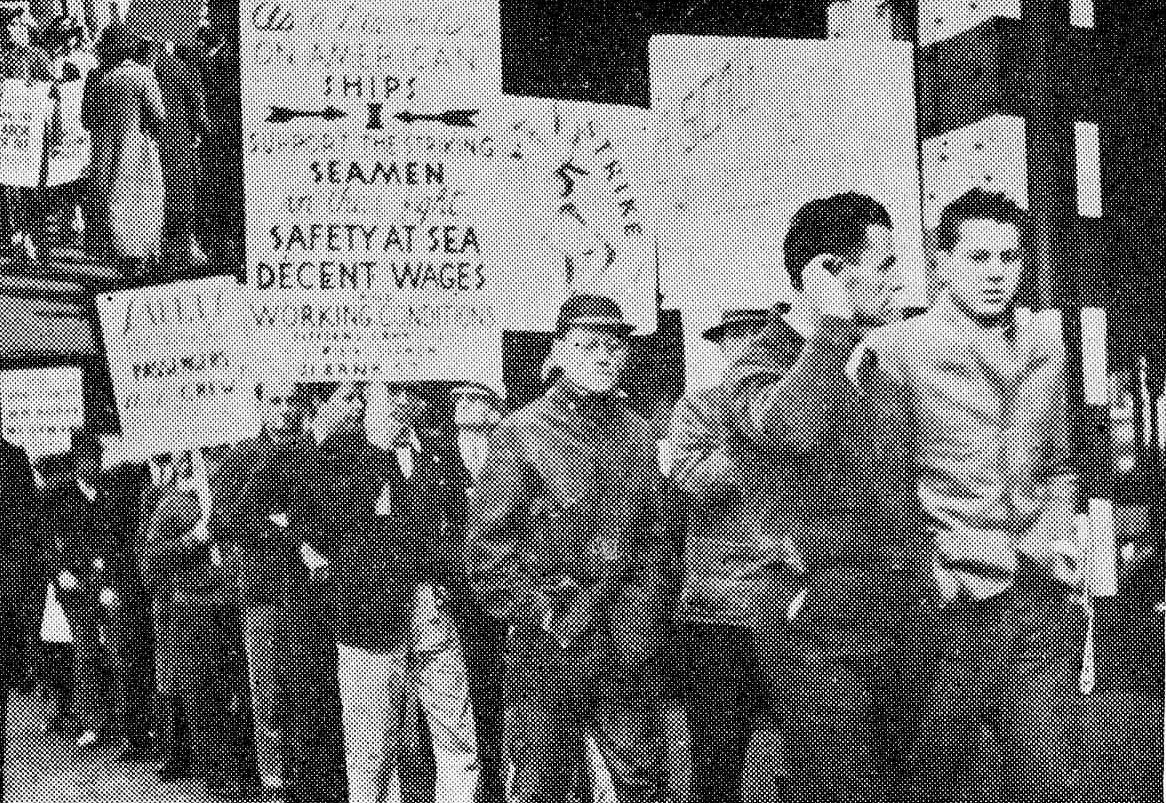
When N.Y. police attack striking seamen the I.L.D. is there beside them on the picket-line helping to defend their rights.
When the cops broke up the first mass picket line of the striking seamen in New York, on May 11, they accidentally slugged a reporter for the New York Times. Result: a fairly accurate story of that attack was published in the Times and in a few other papers. That was the time when after an argument between the cops and the strikers had apparently been settled and the picket-line reformed, a squad of motorcycle men and riot-car club-slingers suddenly swooped down, charged into the line, laid out right and left, and arrested 221 strikers.
The second time, on May 16, the cops were more careful. They watched for the police cards in the reporters’ hats, avoided them, and concentrated their blows on the Women. Result: the facts of the attack weren’t “fit to print” in the New York papers.
Rose Baron, secretary of the Prisoners Relief Department of the I.L.D., was on that second picket-line, together with hundreds of other sympathizers with the strikers protesting against police brutality.
Above: Striking seamen read the “Ten Commandments” of the I.L.D. explaining their rights. Right: First aid at strike headquarters after battle.
“I have seen pogroms in old Russia,” she said when she came back, “but I never saw such viciousness. The Cossacks carried swords, and the New York cops carried clubs. That was the main difference.
“Right in front of me a woman was knocked down by a cop’s horse and trampled. Another woman was knocked down and her arm seemed to be broken. I saw a little old white-haired lady from the Catholic Workers’ organization being slugged across the face with a club.
“Another woman suddenly gave me a push and saved me in the nick of time as a Cossack’s club swished through the space where a moment before my head had been.”
The cops were not so much interested in making arrests in this attack–they couldn’t make charges stick for an hour against 219 out of the 221 strikers they had arrested a few days before. But they made some.
“I saw them come up, before the attack, and pull a man out of the line and pinch him,” Sasha Small, editor of the LABOR DEFENDER, who carried an I.L.D. sign in the picket-line, said. “He was right in front of me, and he was just marching like the rest of us. I don’t know what they charged him with. He hadn’t done a single thing. They were just trying to provoke the seamen.” They made some other arrests, too. William Clay, a one-armed dock-worker, was carried away to hospital bleeding and unconscious. So he was charged with felonious assault. That kind of arrests.
Frank Spector, New York state secretary of the I.L.D., and a member of the strikers’ defense committee, was in the row of three at the head of the line when the attack came. The line had been marching up to a certain stanchion, under the express highway that runs along the docks. It grew bigger and bigger, and it was impossible to manoeuver the turn on the near side of the stanchion. So the head of the line, carrying the American flag, started to go around it. That’s when the horses and the clubs went into play, as a bump the size of an egg on Spector’s head will testify.
At other points the horsemen forced the pickets against a solid row of parked taxi-cabs, against a wall, and went to work.
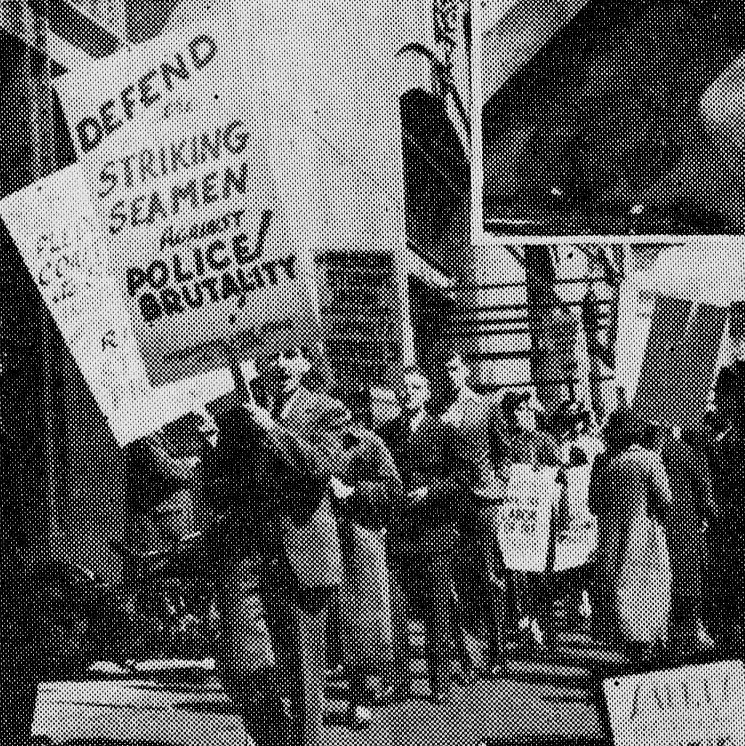
“Take it, sucker,” a cop yelled as he swung his club on the head of a seamen right in front of Sam Dlugin, New York organizational secretary of the I.L.D.
The inspector who supervised this carnage was placed in charge of an “inquiry” into the charges of brutality brought against the cops by the strikers in connection with the first attack!
An official representative of the 6,000 striking New York seamen attended the banquet given to welcome Spector as newly-elected I.L.D. state secretary, and as a testimonial to Mike Walsh, retiring because of ill health. “When we are down on the waterfront the I.L.D. is with us,” he said. “When we come into court, the I.L.D. is there beside us. And we sure do appreciate it. And before I came up here tonight, the boys said to me to tell you all how much they appreciate your letting us come to your dinner and tell you all about our strike.”
In New York and New Jersey, the state I.L.D. organizations have answered the needs of the seamen clubbed and jailed for asking safety at sea and decent wages and working conditions. In Hoboken, New Jersey a striking seaman got 90 days in jail, and was held in $2,500 bond on an assault and battery charge, for picketing. That’s being appealed, to help break down the terror against the strikers. In New York, more than 250 strikers have been arrested on charges ranging from disorderly conduct to felonious assault.
The I.L.D. is fighting to prevent the New York cops–acting on behalf of the shipowners and reactionary International Seamen’s Union officials who have declared this strike of 6,000 an “outlaw”–from staging a repetition of the terror on the West Coast waterfronts in 1934. Huge posters provided by the I.L.D. tell the seamen in every strike-hall what to do to avoid provocation–and what their rights are.
A staff of fifteen I.L.D. attorneys has been constantly on the job since the strike began and the defense committee was set up, assigned to looking after the legal interests of the seamen. They helped break the injunction proceedings brought against the strikers by the I.S.U. leaders–so well that the reactionaries dropped it like a hot potato for fear they would find themselves all in jail as their main witness did.
The New York Prisoners Relief Department has been organizing visits and assistance to the wounded seamen, in hospital.
Labor Defender was published monthly from 1926 until 1937 by the International Labor Defense (ILD), a Workers Party of America, and later Communist Party-led, non-partisan defense organization founded by James Cannon and William Haywood while in Moscow, 1925 to support prisoners of the class war, victims of racism and imperialism, and the struggle against fascism. It included, poetry, letters from prisoners, and was heavily illustrated with photos, images, and cartoons. Labor Defender was the central organ of the Scottsboro and Sacco and Vanzetti defense campaigns. Not only were these among the most successful campaigns by Communists, they were among the most important of the period and the urgency and activity is duly reflected in its pages. Editors included T. J. O’ Flaherty, Max Shactman, Karl Reeve, J. Louis Engdahl, William L. Patterson, Sasha Small, and Sender Garlin.
PDF of full issue: https://www.marxists.org/history/usa/pubs/labordefender/1936/v12-%5B10%5Dn06-jun-1936-orig-LD.pdf
 Revolution's Newsstand