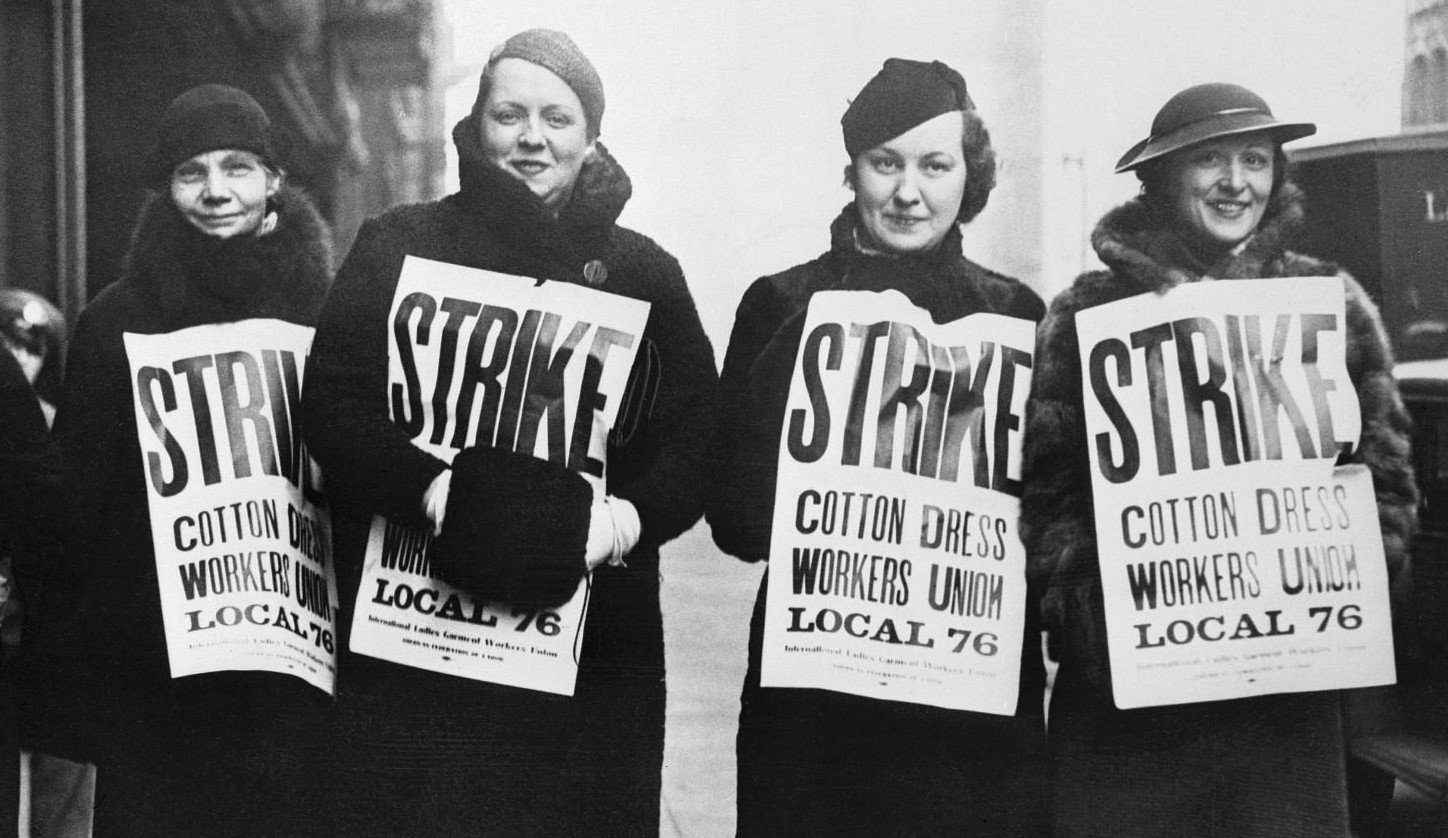
For wage-slaves, living under capitalism requires selling your labor. If the master refuses to buy, you are hungry. Giovannitti on the massive 1919 Ladies Garment Workers strike and the right to work.
‘The Right to Work’ by Arturo Giovannitti from Justice (I.L.G.W.U.). Vol. 1 No. 10. March 22, 1919.
The chief bone of contention in the death grapple now going on between the Ladies’ Waist Makers’ Union and the Dress and Waist Manufacturers’ Association is the insistence on the part of the employers to discharge their employes at will, and the determination of the latter that no such discharges shall take place without the sanction of a mutually selected board of revision. Both sides admit that they are deadlocked on this issue, all other controversial matters, such as the 44-hour week and an equivalent raise in wages, being admittedly adjustable without any further continuation of hostilities.
The question is therefore asked: Is the Union justified in carrying on a struggle that entails so much suffering and hardship on the part of the workers and great financial losses on both sides of the trenches, just to win but a point that seemingly has no bearing whatever on the economic relations between workers and employers? What difference will it make to the Union if the bosses discharge a number of workers, when they are compelled to substitute them with other union men, unless they want to curtail production and, thereby reduce their own profits?
This captious argument is met by asking and answering another question. What is the main purpose and function of a labor union, even such as has no social vision and does not predicate the ultimate control of all industrial processes by the workers?
Function of A Labor Union.
Ask any conservative labor leader and he will answer you at once that the first and foremost aim of a labor organization is to protect the worker in his job. Indeed, the more conservative the leader, the more he will insist that the question of hours and wages, and even that of sanitary conditions, are subordinate to the preservation of the job for each member of the union. There is nothing revolutionary about this, and to raise the cry of Bolshevism in connection with this elementary principle of labor unionism, as the manufacturers have done, Is simply another glaring instance of their notorious bad faith. But let us be more specific. A labor union is primarily and essentially an instrument for the protection of the economic life and welfare of the workers. It has nothing to do with the workers as citizens, for this is the province of the state, nor can it regulate their social, religious and political activities. Its function is purely confined to the economic field, that is, that specific sphere of human activity wherein the means of subsistence are obtained.
Now the first problem of economic life, so far as the worker who has nothing to market save his labor power is concerned, is the steady maintenance of occupation, which is the worker’s only insurance against want and starvation and the sole safeguard of his life. Whatever his original motive in joining a labor union, he assumes and takes for granted that his job will not be lost, but will rather be consolidated by reason of his combining with his fellow workers. Nobody will ever join a labor union on the mere chance of bettering his conditions at the risk of losing his job, for nobody ever stopped to consider conditions when the actual fact of employment was at stake.
If union men ran a greater risk of being driven from their jobs than no-union men, then, with all the burning faith I have in the working class, I doubt whether there would be any labor unions at all. It is self-evident to even the bitterest enemy of unionism that no organization can survive which is not, basically concerned with the preservation of employment, and on this score all unions, whatever their principles and aims, are completely agreed. Indeed the main difference, between conservative unions and radical in this matter is a difference of condition rather than principle–the conservatives want to hold jobs under a mutual agreement with the bosses, the radicals want to own jobs under the sole proprietorship of the unions. Neither of them can exist unless the stable tenure of these jobs is essentially and unequivocally assured. To pretend and demand a different attitude would be tantamount to asking any labor union to commit suicide for the love of the employers and their bewildering conception of justice and fair play.
The First Demand in All Strikes.
Since labor struggles began, the restoration of all strikers to work has been the first term of all treaties of peace–it has been, in fact, the only article of agreement that has never been a matter of debate and never, so far as I know, has been submitted to arbitration. A victorious strike never left a single striker out of the shop; more still, it always took great pains to see to it that no one was discharged afterwards on any specious reason, lest the best and most militant elements of the union be made to pay for the victory of the less combative ones.
As to the question that, provided union men are employed or given preference, the union ought not be concerned as to who is discharged, and why, the iniquity of the theory behind this argument is so appalling as to elicit anger rather than discussion.
A Bona Fide Labor Union.
A bona fide labor union is not a business firm which deals in goods and commodities, nor an employment agency which furnishes help on certain conditions and at a certain fee–but it is a free and voluntary association of human beings who have certain interests and aims in common and are bound to absolute mutual protection. A bona fide labor union (there are others, unfortunately) signs contracts with the employers not in the name of the union, as an impersonal organism, but as the appointed agent and attorney, as it were, of all its members, the moral and material interests of each of whom it is bound to protect and safeguard, singly and individually, much in the same fashion as a corporation is bound to protect the interests of all its stockholders. A union that enters into an agreement with the employers on any other basis would not last a week; it would be a union in name only, and after the first strike even the employers themselves would no longer deal with it, having no solid basis of stability and no means for carrying out its stipulations.
The Ethical Side of It.
But there is also another element involved in this controversy, one of a purely ethical order, although I fully realize that ethical arguments will not change a jot in the attitude of the bosses.
Human beings can only live peacefully together on a contractual basis, that is by giving and taking, yielding and receiving to and from each other what is accepted by both sides as full equivalents. No fair and equitable human relations are compatible otherwise, unless one party is avowedly determined to either subjugate or altogether dispossess the other. This is not today the intention of the Ladies Waist Makers’ Union, which does not yet pretend to drive the Manufacturers’ Association out of business. Whether this is the aim of the Association towards the Union is, of course, a thing that I don’t know, but as they outspokenly disclaim such evil intentions, I shall take them at their own word. It follows therefore, that neither side being out to suppress the other, the only thing that can take place between them is a common ground of agreement.
This agreement must, of course, be mutual in the sense that it must not put either party in a situation of inferiority. It must not be unilateral, or it won’t last a month, for the injured party, feeling duped or defrauded will break it at the first opportunity. Now what is this principle of equity and reciprocity that will insure to both sides the full exercise of their rights? It is simply this: Let the manufacturers realize and admit. that their right to discharge the workers connotes the correlative right of the workers to quit their jobs. If they deny the workers this right and reserve the former to them, the contract would be a fraud–on the other hand if they grant both rights, the contract would be a farce, for no stable agreement would have been reached and both sides would remain in a state of actual belligerency.
Therefore the only solution is for the manufacturers to waive this right and submit all cases of discharge to revision. Any other course would be unfair. Their right to discharge, as they demand it now is morally untenable, for it is absolute. They can throw out any worker for any reason or for no reason. By eliminating by force of the agreement, as they want it, all possibility of reprisal on the part of the union, they could exercise that right ad libitum. Having an iron-bound association of their own, the discharged worker would find himself practically blacklisted, sentenced to involuntary economic servitude. Worse still, after being on strike for months, he would be practically put out of the union, in the sense that he would be denied the fruition of his own union efforts. The union would cease to be an instrument of protection for him a little while he would be a scab. Is that what the Manufacturers mean when they say that they do not discriminate against labor?
Right to Quit Work–A Mere Quibble.
On the other hand the right to quit work is only relative, so far as the workers as individuals are concerned. No worker quits a job because he objects to his boss belonging to the Association, or because he resents his employer’s manners, or dislikes his looks, or is vexed by his English, or disapproves of his politics and theology. The personal element very rarely, if ever, determines the worker to quit his job, for the very substantial reason that the worker functions merely as a force of production in the present social system, whose sole sphere of action is the place of production. Outside of that sphere he is nothing. He is actually much and potentially all only in so far as he remains in it. That is why he sticks to his job, often even at the expense of his very self-respect.
The conclusion is that no worker, no matter how militant, how radical he may be, ever quits his work on purely arbitrary ground, while most employers generally discharge workers on just such ground, unless restrained by a superior force. The right of the individual worker to voluntarily go out is just a legal quibble and academic bunk, while that of the master to discharge him is an absolute prerogative. Therefore any agreement that ignores these facts and does not offer redress against the abuse of power on the part of the only side that possesses that power, is inherently unsocial and immoral.
Submission to A Third Party Or War.
But will the Manufacturers’ Association be swayed by moral reasons? They will not, for morality implies the decision of a third party, and this third party, which the Union has invoked by proposing an impartial umpire in all future controversies, has been disdainfully rejected by the Association. What will the conclusion be?
Eliminate the arbiter, and all values are reduced to the common denominator of power and endurance. Which proves once more that the stronger will subdue and dictate to the weaker, regardless of all principles involved. The ultimate decision now, as ever, on the side that has the most formidable elements of resistance and aggression. The question of right and wrong has nothing to do with it, so far as capital is concerned. Thus are the employers, who deny the class struggle, educating the workers along the lines of class-consciousness, and goading them on, by their own blind stupidity, towards the broader field of implacable social war.
The weekly newspaper of the International Ladies Garment Workers Union, Justice began in 1909 would sometimes be published in Yiddish, Spanish, Italian, and English, ran until 1995. As one of the most important unions in U.S. labor history, the paper is important. But as the I.L.G.W.U. also had a large left wing membership, and sometimes leadership, with nearly all the Socialist and Communist formations represented, the newspaper, especially in its earlier years, is also an important left paper with editors often coming straight from the ranks radical organizations. Given that the union had a large female membership, and was multi-lingual and multi-racial, the paper also addressed concerns not often raised in other parts of the labor movement, particularly in the American Federation of Labor.
PDF of full issue: https://www.marxists.org/history/usa/pubs/justice/1919/v01n10-mar-22-1919-justice.pdf
 Revolution's Newsstand