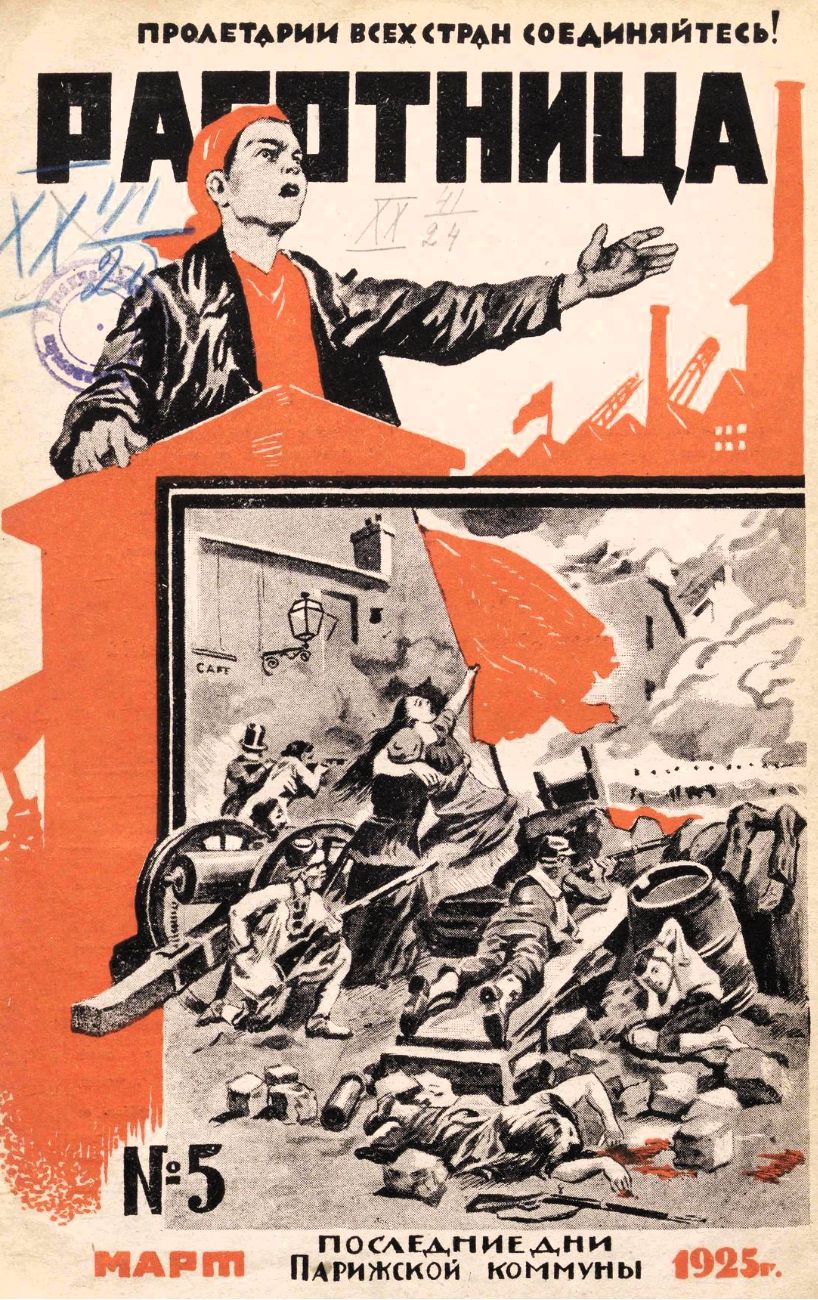
The Conference is closed with the appointment of a new commission, a statement from Zetkin and the text of the final resolution on Communist Work Among Women.
‘Organization Conference on Communist Work Among Women: Closing and Resolution’ from International Press Correspondence. Vol. 5 No. 56. July 15, 1925.
Comrade Kornblum (Secretariat):
I should like to make the following statements as result of the discussion, in order that we may be assured that we are all in agreement.
1. Work is to be carried on in an increased degree among the masses of the women.
2. The whole of the Parties should take more interest in this work.
3. There are no fundamental differences of opinion with regard to the most important question, the delegates’ meetings.
It will thus be an easy task to alter the resolution in accordance with the wishes which have been expressed here. I propose that a commission be formed for this purpose, composed of the following men and women comrades:
Clara Zetkin, Women’s Secretariat; Hertha Sturm, Women’s Secretariat; Nikolayeva, Soviet Union; Mala, Czecho-Slovakia; Suzanne, France; Ullrich, Germany; Mitzkevitch, Organisation Department; Kornblum, Secretariat.
(This commission was appointed.)
After the commission has concluded its work, the resolution will be submitted to the Organisation Bureau of the ECCI. for confirmation, and then sent to all Parties of the Comintern.
Comrades! Our conference is concluded. It seems to me that we have made considerable strides forward in the discussion and working out of the resolution. I hope that we shall soon have evidence that our conference has accomplished much towards converting the work done among the women, up to now left chiefly to the women themselves, into a duty shared by the whole Party. I hope that we shall make as much progress with this in the coming year as we did with the factory nuclei after the V. Congress of the Comintern. All the Sections of the Comintern work on the lines laid down by comrade Zinoviev in his article on the International Women’s Conference.
“May all Communist Parties remember that in the future one of the standards by which their degree of Bolshevisation will be judged by the Comintern, will be the extent to which they can report actual success towards the mass organisation of women.”
Before closing the conference, I call upon comrade Clara Zetkin to speak a few closing words.
Comrade Clara Zetkin:
We are all agreed with the resolution in principle. The Sections are placed under the obligation to work with increased energy and system for the execution of the decisions issued by the V. World Congress and the III. Women’s Conference of the Comintern. We are at one in the firm determination to utilise every practical opportunity enabling the Communist Parties to lead the proletariat to victory. Victory is impossible without the co-operation of the broadest masses of women. We must all exert ourselves to the very utmost to push forward the proletarian revolution by means of practical and ideological work among the women of the proletariat. If the men are found wanting, we women will shame them. We will prove how to be a real Bolshevik in theory and practice. It is with this conviction and this will that we separate.
List of the Participants
in the Organisation Conference of the Enlarged Executive on Work amongst Women:
Nikolayeva–Russia, Nurina–Russia, Boyarskaya–Russia, Bertz–Germany, Suzanne Girault–France, Sauvage–France, Brown–Great Britain, Viola–Italy, Mala–Czecho-Slovakia, Suchardova–Czecho-Slovakia, Grünwald–Czecho-Slovakia, Arvid Hansen–Norway, Mira Hansen–Norway, A.W. Kristiansen–Norway, Hugo Sillén–Sweden, Fredricson–Sweden, Hanna Malm-Manner–Finland, Aino Kuusinen–Finland, A. Petrovsky–Lithuania, Mirovitch–Yugoslavia, Milosevitch–Yugoslavia, A. Sgrudeos–Greece, Canon–America, Rose Carsner–America, Kornblum–Secretariat ECCI., Mitzkevitch–Organisation Dpt. ECCI., Clara Zetkin–IWS., Hertha Sturm–IWS., Kasparova–IWS., Arboré-Ralli–IWS., Lisa Ullrich–IWS., Leonhard (translater), Schiecke (protocol writer).
Resolution passed by the Organisation Conference on Work among the Women.
Confirmed by the Organisation Bureau on 4. May 1925.
The Organisation Conference held at the Session of the Enlarged Executive, after hearing the report of the International Women’s Secretariat on its activity and on the progress of communist work in the Sections among the masses of women since the V. Congress, and after hearing the address of the woman leader of the Central Women’s Department of the Russian CP. on the forms and methods adopted by the Russian CP. for work among the women, and the reports given by the representatives of the Sections (Germany, France, England, Czecho-Slovakia, Italy, and Norway) is able to state that:
The principles carried out by the Russian CP., in agreement with the decisions of the V. World Congress and of the III. International Conference of Women Communists, are not by any means sufficiently followed and practically carried out by all the Sections.
The Organisation Conference again emphasises that the experience gained by the Russian CP. show that the following tested measures are requisite for the Bolshivisation of the Sections and for the extension and firmer establishment of their influence upon the broad masses.
The Organisation of the Party Apparatus for Work among the Women.
I. In all leading Party bodies, from the Central down to the local and municipal district groups, special departments are to be organised for work among the women, the head of this department being a responsible organiser (a man or woman comrade). The department can under some circumstances be substituted by one organiser only.
1. These organisers, commissioned by the whole Party and not merely by the women comrades, are responsible to the whole Party for their work. They are appointed by the general leading bodies of the Party, and not elected by conferences or meetings of women Party members.
2. All work is to be carried on in full agreement with the various departments of Party leadership (Organisation, Agitation and Propaganda, Commissions etc.), and under the leadership of the Party organs. Should advisory corporations (collegiums, commissions etc.) be affiliated to the various departments, it is advisable to request the attendance of representatives of the women’s departments or of, the organiser, at the meetings, according to the subject under discussion.
3. The women’s department or organiser is allotted a commission of three to seven men and women comrades; this commission shares the preparatory outlining of the work, its development and its performance. The members of these commissions should for the most part be women workers from the shops or factories.
II. In order to draw the attention of the whole Party to the work among the women, and to hold the political leadership of this work strictly within the lines of general Party leadership, reports on the work among the women are to be placed periodically on the agenda of the Organisation Bureau of the Central and of the local Party groups. It is advisable that the plenary sessions of central leading bodies of the Party should hear such a report every half year.
III. All reports from subordinate Party organs to higher ones are to deal with work among the women as a necessary factor of the report.
IV. All fundamental questions touching work among the women are to be decided by the competent leading party bodies.
V. The general Party instructors must be made familiar with the work among the women, and must extend their activity into this sphere. All written instructions issued by the leading Party bodies and their departments must take into account the application of these instructions to the work among the women.
VI. In every factory nucleus the nucleus leaders appoint an organiser (man or woman comrade) for work among the women. The work done by this organiser is subordinate to the nucleus. Questions referring to the work among the women are to be dealt with periodically at the meetings oft the nucleus leaders.
VII. Periodical conferences of factory organisers working among the women are to be convocated by the competent Party leaders for the various places, municipal districts and towns, for the purpose of exchanging the results of experience and to enable the control and leadership of the Party to be actuated. Corresponding conferences of the leaders of the women’s departments or of the organisers, are to be called periodically for the districts and for the whole country, by the competent Party leaders.
VIII. Work among the women is to be accorded special consideration in the programme drawn up for the general course of instruction. Women members of the Party are to be induced as far as possible to attend these courses.
Remark: In special cases special circles, courses of instruction, etc. can be organised for the women comrades.
The Forms of Organisation for Work among the Masses of Working Women.
IX. In order to gain influence over the broad masses of the working women and to organise these women, it is necessary to gather cadres of women workers around the factory nuclei, forming the connecting link between the Party and the broad masses. The system of delegates’ meetings is adapted to becoming a real school for the class conscious organisation enlightenment and activity of the working women. The experience gained by the Russia CP. has clearly shown this. Thus all the Sections must begin with the organisation of delegates’ meetings.
1. In cases where it is not yet possible to proceed to the immediate election of delegates in the factories, the following organisations must be formed at once as preliminary stage for the delegates’ meetings:
a) Circles are to be formed in every shop and factory, composed of working women from every branch, workshop and department of the undertaking.
b) The circles formed ‘in the various departments and workshops of a factory, or in various factories, are to be joined together in circle groups as soon as the circle work has advanced far enough to render this possible.
2. When delegates’ meetings are being organised among selected women representatives of the working women in a factory, care is to be taken that broader circles of working women are induced to participate beyond the women who have already been reached by the circles or circle groups.
3. Everywhere where united organs of the working people have sprung into existence in consequence of burning questions of the day, or of conflicts between the workers and their exploiters (control committees, committees of action, etc.), women representatives of the working women must be elected to these organs. The movement for these committees should be utilised at once to its fullest extent for the formation of delegates’ meetings.
X. The circles, circle groups, and delegates are to be called together periodically for local, municipal district, or city conferences, by the competent Party leaders, for the purpose of exchanging the results of the experience won, and to ensure consistent co-operation.
XI. Aided by these active women workers, the competent Party leaders organise mass meetings of the working women within or outside of their place of work; the recruiting powers of these meetings can be enhanced by the combination artistic externals and political import.
XII. Corresponding conferences of the broad masses of the working women are to be held for every quarter of a town, for the town, and for the district.
XIII. The competent Party leaders organise circles for the training of the working women taking an active part, but not belonging to the Party. The object of these circles is to familiarise these women with the fundamental principles of class warfare and communism.
Work in the Trade Unions.
XIV. Every communist trade union fraction appoints a responsible organiser (man or woman comrade) from its midst for trade union work among the women.
XV. The trade union organiser works in closest association with the factory nuclei of the whole of the factories in which working women are employed in the trade represented by the union concerned. The women’s organiser of the trade union fraction carries on his or her work within the factory with the aid of the women’s organiser and of the trade union organiser of the factory nucleus, these two also working hand in hand in the factory.
In those country where there are trade unions affiliated to the Red International of Labour Unions, the trade union organiser must also keep up the closest contact, in his work, with the trade union organisation in question.
XVI. In order to ensure consistency for this work, the competent Party leaders convocate periodical common conferences of the women’s organisers of the factory nuclei, the women’s organisers of the trade unions and the organisers of the factory nuclei conducting the general trade union work in the factory on the instructions of the factory nucleus.
XVII. Where working women’s commissions already exist in the trade unions, the trade union fractions must ensure the delegation of suitable communist members to these commissions. The communist fraction, or the communist member in the working women’s committee, works under the immediate leadership of the trade union fraction, under the control and leadership of the competent Party leaders.
Where working women’s commissions do not yet exist in the trade unions, the fraction has to strive for their formation, and to ensure their containing men or women communists, in order that decisive influence may be gained in them.
XVIII. Where there are works’ councils, the communist factory nuclei and the communist trade union fractions must ensure the candidature and election of working women as shop stewards. The working women are to be interested in the elections and tasks of the works’ councils, and to be induced to take part in them:
Remark: Corresponding principles of organisation and work in the trade unions apply equally to work in the co- operatives, tenants’ organisations, war victims’ associations and all other proletarian and peasant organisations in which women share.
Work among the Housewives.
XIX. The leading Party body of every place, municipal district, or city appoints an organiser (man or woman comrade) for the work among the housewives. This organiser, under the leadership and superintendence of the competent Party leaders, organises in the nuclei circles for more advanced housewives from the broad masses.
XX. Among the housewives, as among the working women, the endeavour must be made to form delegates’ meetings, but with the difference that the delegates are elected in mass meetings in the towns or in the various quarters of the towns.
XXI. In order that the proletarian organisations may form a whole, and to ensure consistency of work, the competent Party leaders call periodical common conferences among the organisers of the housewives and the women’s organisers in the factory nuclei. The competent Party leaders also convocate periodical common mass meetings of working women and housewives in order to strengthen the consciousness of class solidarity among the housewives and the working women.
XXII. In order to bring about a closer association between workmen’s wives and the workers in the shops and factories, common meetings are organised for the workmen and the workmen’s wives, especially in cases calling for special action (wage struggles, strikes, etc.).
Work among the Homeworkers.
XXIII. Special attention is to be devoted to winning over the women homeworkers, and to their organisation. For this purpose systematic house to house agitation is necessary. The aims of the work must be as follows:
1. The women homeworkers are to be organised in trade unions to the utmost possible degree.
2. The women home workers are to be reached by means of the delegate system, and to be brought in contact with the delegates chosen by the working women in the factories.
Work among the Women Agricultural Labourers and Cottagers.
XXIV. Work among the women agricultural labourers and cottagers should be accorded a wide degree of attention. A special organiser is to be appointed in the nuclei in the villages and on the farms for this work.
XXV. The work is carried on by means of:
1. Systematic written and oral agitation, agitation excursions, artistic performances, issue of special literature or utilisation of the existing country press and of the trade union newspapers read by the agricultural labourers, organisation of travelling libraries, etc.
2. The utilisation of the trade unions of the agricultural labourer, of the co-operatives, of the war victims’ organisations, youth organisations, etc.
3. Utilisation of personal relations between the city population and the country population, and the creation of definite connections between the villages and a city nucleus.
4. Besides this, the country co-operative societies are to be utilised for purpose of work among the peasant women, as these arouse the interest of the broad masses of the women. The peasants’ unions and parties are also to be utilised.
5. The women peasants and women agricultural labourers are to be brought together and schooled in delegates’ meetings, in the same manner as the women factory workers.
The Press.
XXVI. All questions of interest to the broad masses of women, as also all fundamental political and organisatory questions dealing with communist work among the masses of the women, are to be dealt with in the general section of the Party press.
XXVII. Women’s pages or women’s columns are to be introduced into all Party newspapers for purposes of agitation among the broad masses of unschooled women.
XXVIII. The special women’s periodicals issued by the Party are to be adapted in form and purport to the purpose of recruiting among the broad masses.
XXIX. Special leaflets, pamphlets, posters, handbills, sticking bills, etc., for the broad masses of women, are to be issued periodically or on special occasions (local or general struggles or campaigns, as strikes, elections, high prices, etc.).
XXX. In order to render the press more effective for purposes of agitation, and to enhance its organisatory association with the masses, women correspondents from the class of working women, peasant women, workmen’s wives, etc., are to be induced to contribute constantly to the general press, to the women’s periodicals, and above all to the factory nucleus papers.
XXXI. The women correspondents are to be instructed and schooled, together with the men correspondents, in circles. Besides this, the men and women correspondents for the women’s press are to be given special opportunity of instruction on the nature of their tasks, in order to enable them to work in the closest possible association with the masses.
XXXII. The women readers of the women’s press are to be brought together in circles friends of the workers’ press and should be entrusted with definite tasks in agitation and organisation.
‘Organization Conference on Communist Work Among Women: Closing and Resolution’ from International Press Correspondence. Vol. 5 No. 56. July 15, 1925.
International Press Correspondence, widely known as”Inprecor” was published by the Executive Committee of the Communist International (ECCI) regularly in German and English, occasionally in many other languages, beginning in 1921 and lasting in English until 1938. Inprecor’s role was to supply translated articles to the English-speaking press of the International from the Comintern’s different sections, as well as news and statements from the ECCI. Many ‘Daily Worker’ and ‘Communist’ articles originated in Inprecor, and it also published articles by American comrades for use in other countries. It was published at least weekly, and often thrice weekly.
PDF of full issue: https://www.marxists.org/history/international/comintern/inprecor/1925/v05n56-jul-15-1925-inprecor.pdf
 Revolution's Newsstand