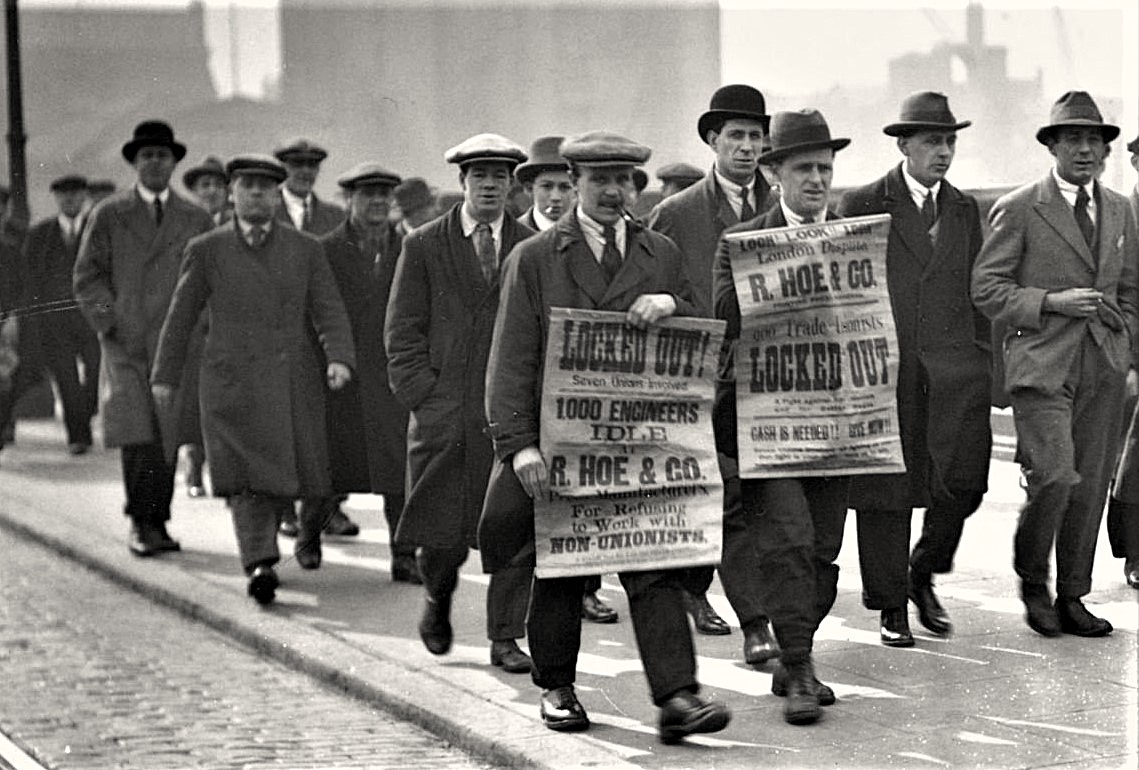
Another from Daily Worker columnist O’Flaherty’s marvelous ‘New Days in Old England’ dispatches as he witnesses and chronicles the 1926 British General Strike.
‘The General Strike’ by T.J. O’Flaherty from the Daily Worker (Saturday Supplement). Vol. 3 No. 158. July 17, 1926.
THERE was little unorganized violence during the general strike. There was none on the side of the trade union forces. And the government was leery about getting too provocative, the Messrs. Churchill and “Galloping Smith,” now Lord Birkenhead, issued “Fee Fi Fo Fum” declarations of war, but their fulminations and threats were received with sardonic grins by those who knew that both gentlemen will never head the list of contributors to an anti-saloon league fund.
The gallant black shirts who had amused themselves occasionally during the previous year by committing depredations on the headquarters of Communist and other working-class organizations, drew in their horns perceptibly. The wise heads in the cabinet evidently gave the anemic imitators of the Italian cutthroats a hint to be seen and heard as little as possible–unless the situation developed more dangerous symptoms.
The British worker has been showered with more contumely than any decent working man could stand for. Fortunately for his peace of mind, he does not read much foreign news or comment. Synthetically speaking, the chief libel uttered against him is to the effect that he is a congenital and hopeless pacifist. The contrary is true. As a matter of fact, he is voraciously hungry for a fight, and it takes a big army of labor privy councillors, labor (land) lords of the admiralty, labor custodians of his majesty’s outhouse, labor protectors of the sacred sepulchre of the virgin queen (who lived almost as complete a life as King Benjamin of the House of David), not to speak of such comparatively untitled plebians as Ramsay MacDonald, who took the biscuit from Sir Alexander Grant (you remember the tale), Philip Snowden and his wife, Ethel, or vice versa, whose knees have developed pads from making obeisances before royalty–it requires several army corps of those horny-handed sons of Belial to prevent their followers from staging a picnic in the cute little spot where the tourists are shown the inscribed stone where the swan-like neck of Ann Boleyn rested on the block while a sharp axe was separating her from this life and from her loving and Christian husband, Henry, who chopped off her head for no other reason than that her presence no longer excited him sufficiently. Divorce was then frowned on by the church, so Henry had to use direct action.
The British worker is not bloodthirsty, but it is no wonder that the male members of the present reigning family are constantly in their cups, so to speak, if there is any liquor in the British Isles sufficiently potent to shut out from their mental vision the ever-present fear that someday the pent-up anger of those British slaves will burst the wall of patience that many factors have built up centuries ago between the downtrodden British proletariat and their arrogant taxmasters.
SOMEWHERE it is written that “still waters run deep.” And one only had to wander around the working class quarters in London during the strike to notice that air of being “ready for anything that might happen” on the faces of British trade unionists.
There was little violence, it is true, but…
Not far from the seat of British government, the Commons, Whitehall, Scotland Yard, Admiralty, and many other government buildings is Blackfriars bridge. At one end of the bridge–the city proper end–is the great building that houses the administration offices of Lever, the soap monarch. This building was used as a concentration point by the government during the strike. A fleet of motor vehicles were parked in front of it ready to shoot across the bridge which separates the heart of the giant city from the teeming multitudes of workers and slum proletarians.
At the other end of the bridge is a big warehouse. During the first few days it was deserted except for pickets with badges who stood guard around it. Those pickets were members of the Transport Workers’ Union. Only those who had what they considered legitimate business passed.
Between this point and a square known as the “Elephant and the Castle” there are a number of union headquarters, chiefly of the printing trades. Practically everybody you met in this section of the city was a staunch supporter of the general strike. At times the streets were black with people for blocks, but only on rare occasions was there any resort to blows.
On the first day of the general strike a few trams had the temerity to invade the Elephant district. They were taken away in charred bits. Police swarmed into the square on horse and foot. It was reported that a policeman struck a woman with a club, killing her. It was also reported that the same policeman passed out of the picture a few minutes afterwards. One heard such stories in that section, provided a satisfactory introduction took place. And those stories were not furtively told with a criminal air. Trade unionists anywhere are not squeamish and the British have only to watch the technique of their masters for suggestions as to what’s what in a quarrel.
Those tales of bloodshed and death could not be verified officially, since the government imposed heavy penalties on anybody caught telling the truth, excepting people of the type of the Archbishop of Canterbury or Lloyd, who might go temporarily insane and make an accidental stab at veracity. But any worker caught revealing information of the true state of affairs which showed the workers standing to their guns, or of disaffection in the army and naval ratings, was given a swift ride to the penitentiary.
SEVERAL Communists were arrested and jailed for publishing what was generally believed to be true, that the Welsh and Irish regiments refused to entrain for strike duty in Scotland. Indeed, some of the recently recruited metropolitan policemen, who are pointed to with pride by the penniless penguins of the British middle class, were rather cold to the government propaganda. I asked a constable who was stationed at the main door of the Morning Post building for information as to how I could secure a copy of the British Gazette, while that rag was humming off the presses. He regarded me with suspicion and asked me if I was from the press. I very wisely–as I thought–told him the truth. I was not. This increased his suspicion rather than allayed it. Why was I interested in the Gazette? Like a typical Yankee, I asked him why not? Was not everybody interested? And I was hungry for news. Sticking his thumbs into that part of his belt which rested over the forward center of his stomach he snorted: “You won’t get much news in the Gazette.” He glanced knowingly at his teammate and I moved on. “Friend or foe. Which?” thought I.
But to return to the Elephant. On the eve of the day during which the rioting occurred I walked across Blackfriars Bridge, accompanied by a friend who knew quite a number of the active trade unionists in that section. Our hike was not in vain.
The streets were jammed with people. Horses with mounted police pranced back and forth between the sidewalks. Motor lorries of constables rushed hither and thither. Special constables, uniformed scabs, were stationed at the danger points. There did not seem to be much love wasted on them by the regular police. Surely the crowds did not like them, as I learned shortly.
A large truck covered with canvas was seen speeding towards the city. It traveled so fast that the pickets were not able to stop it until it got within one hundred yards of the bridgehead. Then, as if by magic, a swarm of humanity surged out of the alleys and the truck stopped. It was labelled “foodstuffs,” but something caused the canvas to separate sufficiently to reveal the presence of chairs and bedding on the inside, no doubt for the strikebreakers or “volunteers,” as they were called. A roar of anger went up from the crowd and the automobile slowly turned over on its side, a dying monster. A roar of triumph went up from the crowd. Then the police came from all directions. The crowd melted away into the alleys from whence they came. The police set the truck on its wheels again and pushed it into a side street.
FOUR “specials” were standing on the corner when this incident took place and became quite officious when police reinforcements arrived. When the police left they remained. What looked a disturbance took place down the side street at the head of which they were standing. They rushed bravely to the fray. But when they got there the “disturbers” belabored them soundly until the police arrived. The four heroes were not seen in that vicinity any more.
This was only one of many similar instances in that sections. An ambitious fellow who saw a prospect of making some money transporting marooned city workers to their homes was trotting along with about a dozen passengers in his wagon. They were seated on empty boxes. The pickets halted the conveyance, asked the driver who gave him permission to go into the transportation business, told the passengers to get a little exercise by using “shank’s mare” and turned the boxes over to a committee on illumination.
Several men with badges reading “Workers’ Defense Corps” were busy recruiting. The right wing labor leaders were opposed to this action, but many local labor bodies saw the necessity for a defense force, and the movement was developing rapidly when the general strike was called off. And this was even more unexpected than the initiation of the strike, which was considered inconceivable with J.H. Thomas and others of his type playing the leading role in the negotiations.
When the die was cast and the strike orders issued there were many who were convinced that the right wing leaders were out to deliberately betray the workers by sabotaging the strike in order to discredit the general strike as a weapon once and for all. And whether they started out with that intention or not, this was what they did. Even during the strike, Thomas, one of its leaders, made public speeches decrying the general strike. Snowden was silent and the Webbs, Shaws and other highbinders whose names have been associated with the British labor movement for generations were silent as the tomb.
Their inspiring messages to labor in its hour of trial were never delivered while the columns of the British Gazette were black with screaming exhortations from the Asquiths, Greys and Samuels of the Liberal wing of British capitalism, as well as from the Churchills, Balfours and Baldwins of the Tory wing.
The strike was called off suddenly on May 12. On the evening of May 11 I walked around Southampton picking conversation with various people, mostly workers. The general attitude was that “we will see the grass growing on the streets of this city before “we surrender.” And they meant it.
Anybody who knows the desperate condition under which the great mass of British workers live would be surprised, not at this determination to “go down with the ship” if need be, but at the marvelous patience they have displayed. But then not so very long ago at that, British workers were sentenced to penal servitude on a convict ship for humbly petitioning for an increase in wages!
Pickets stood sullenly at the gates of the White Star line dock. There were a few policemen there. Anybody could pass by the police by simply saying he had booked a passage on a liner. The docks were deserted, excepting officers and “volunteers,” some with Oxford bags, supposed to be young dukes, lords, etc. They spent more of the time amusing themselves in the first-class cabins of the palatial liners where they were housed and fed. The gentleman with the receding chin that the creator of Andy Gump predicts will be the future 100 per cent Americano would look like a hero in a western moving picture compared to those semi-animate chunks of protoplasm who were sacrificing their beauty sleep to save the empire.
As one of those floating castles that the war for democracy delivered into the hands of the White Star line was trying to leave the docks the Oxford bag dandies with wrist watches and silk handkerchiefs flying from their coat sleeves cut a pretty picture as cameras clicked, going thru the forms of releasing hawsers and other chores connected with this task. They handled the stout cables as gingerly as a Chinaman would fondle his chopsticks. If the husky stevedore who barked angrily at them had halitosis, those parasites would not have been more loath to get within reach of hair breath.
After their pictures were taken, for use in the government propaganda, the dandies spent the rest of the time slicking their glossy hair and smoking cigarettes. The ship carried no freight, except what she carried from the United States on a previous trip. It was a tieup all right, and the bosses knew it.
The Saturday Supplement, later changed to a Sunday Supplement, of the Daily Worker was a place for longer articles with debate, international focus, literature, and documents presented. The Daily Worker began in 1924 and was published in New York City by the Communist Party US and its predecessor organizations. Among the most long-lasting and important left publications in US history, it had a circulation of 35,000 at its peak. The Daily Worker came from The Ohio Socialist, published by the Left Wing-dominated Socialist Party of Ohio in Cleveland from 1917 to November 1919, when it became became The Toiler, paper of the Communist Labor Party. In December 1921 the above-ground Workers Party of America merged the Toiler with the paper Workers Council to found The Worker, which became The Daily Worker beginning January 13, 1924.
PDF of full issue: https://www.marxists.org/history/usa/pubs/dailyworker/1926/1926-ny/v03-n158-supplement-jul-17-1926-DW-LOC.pdf
 Revolution's Newsstand