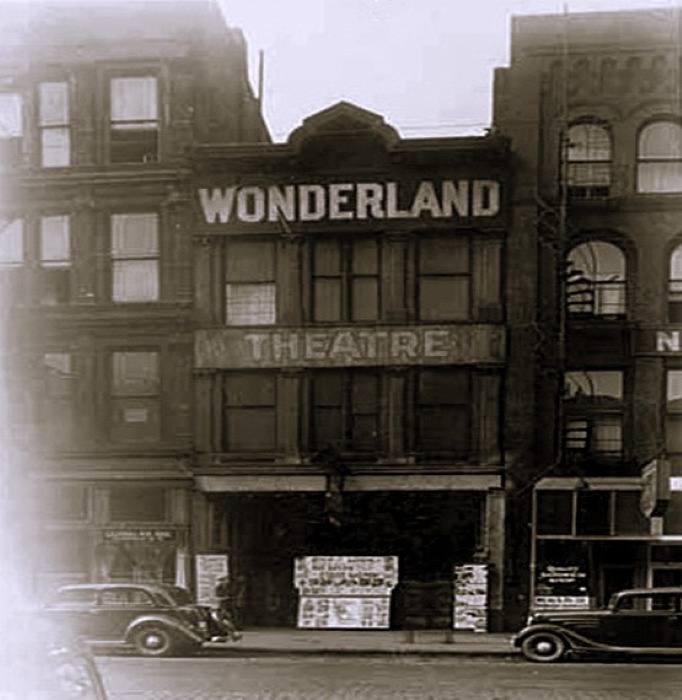
A Minneapolis judge bars workers from exercising the supposed rights to assembly and speech with an injunction on picketing the non-union Wonderland Theater during a labor dispute. Defying the injunction, four unionists are arrested and refuse to pay the fine. Ordered to jail they are accompanied by tens of thousands of their fellow workers in a march of defiance toward the court’s anti-democratic, class-biased, restrictions.
‘The Great Minneapolis Demonstration’ by Harry Stone from The Toiler. No. 136. September 10, 1920.
Over 10,000 men, women, and children, with fully as many more lining the streets, marched Saturday, Aug. 28., as a protest against government by injunction and Judge Bardwell’s decision which forbade picketing the Wonderland movie house, held by unionists to be unfair to organized labor because it employed non-union labor, a decision which is a blow at fundamental labor rights; against the capitalist judge’s sentence lo six months in the county jail of the officials of the Trades and Labor Assembly, Linn Thompson, Leslie Simon, Dan Stevens, and Bob Cramer, editor of the Minneapolis Labor Review, the Assembly organ, for contempt of court.
“We can’t obey judicial prostitution” was the answer of labor to government by injunction. The use to which the State in this instance court is put was again made palpably manifest to the laboring people. The good Judge Bardwell was consistent satisfaction was voiced by the Minneapolis business interests at brother Bardwell’s sweeping ruling against labor and his contempt of court sentences.
A summary of the events leading up to the demonstration last Saturday.
Picketed “Unfair” Movie
Organized labor held that the Wonderland movie house was unfair to it and proceeded to picket the place. Cramer, editor of the Review published the facts and reasons why Wonderland should be boycotted. Stevens, Sinton, and Thompson carried out the wishes of the Assembly in the matter. The owner of Wonderland asked the courts to enjoin the unions from picketing his theatre, etc., and the dear judge proceeded, in a remarkable (sic!) decision, to heed his master’s voice, capital. The obliging judge issued an injunction which forbade labor from picketing the theatre, from combining to interfere with trade of the place, and from publishing anything from which the public might infer that the theatre was unfair to organized labor.
“The right of free speech, free press”
Pardon! For a moment we forgot that we woe in America the land of John D., J.P., Palmer, Wilson, and why mention more?
Defied Court Injunction
Organized labor held that the injunction destroyed the right of boycott and unfair list, struck at fundamental union rights (rights, we believe, which have been rights only so long as labor has had the might to make them rights) and that the injunction was illegal. The men mentioned above, at the instance of the Assembly proceeded to defy the injunction, were arrested and given the named jail sentence, or the alternative of a fine. They declared that they would go to jail first, rather than pay the fine and thus assent to an autocratic court decision. Minneapolis workers were aroused at this high handed act of the court and declared that they would do their utmost to support the convicted men and to prevent their jailing. The men were to be incarcerated on Aug. 28 and for that day the Assembly planned a protest demonstration to manifest their indignation and their feeling of solidarity with the convicted comrades. The paraders were to escort the men to the city hall, the seat of the county jail.
Great Protest Parade.
And on Aug. 28, thousands of workers, organized and unorganized, marched and defied the injunction form of government. Hundreds of members of the World War Veterans, men who had fought for the safety of democracy (for capitalist democracy, they now see) headed the demonstration with placards which declared: “We fought for democracy; now we’re going to get some of it.” Other signs read: “Six months in jail for our leaders. 80,000 others are ready to follow them;” “Freedom for class war prisoners”; “Why jail workers and not profiteers?” “Industrial Unionism Eventually; Why not Now?”! Divided we fall; We’re united”; “We can’t obey judicial prostitution.”
When the marchers and victims of capitalist autocracy reached the city hall, the sheriff we wonder, was it but a mere legal trick or was it the evidence of labor’s unity and solidarity of action informed them that he could not jail the men at this time, as was expected, for the law gave him yet sixty days in which to collect property from the defendant to pay fine. So let capital say. Somehow, one cannot but feel that the authorized lackeys of the plunderbund hesitated to carry out the court’s decision only because labor had sounded a loud warning. The men will never be jailed, is the prevalent opinion. Maybe they will and perhaps they won’t. Only the working class can determine that. Just now there is talk of a strike to prevent the jailing of the union officials.
Used a New Political Weapon.
Saturday’s demonstration was significant. The workers paraded not for wages and hours but for labor’s right as a whole. They felt strongly that organized exploiters were aiming a death blow at every right which the workers had struggled for so many years to obtain. They realized, in a greater or less degree, that the instrument of oppression of the capitalist class the State was being directed, not against these four convicted men, but against the workers as a class. And the workers’ reply was encouraging. The Minneapolis workers last Saturday grasped another political weapon, besides that of the vote, the political street demonstration. To prevent by their protest, the jailing of their comrades and fellow workers that was a forward step. The hazards and necessities of life are teaching the masses the proper tactics to pursue if they would win a wider and broader life. Steadily a consciousness of class grows upon them, a perception of what might be if they would but exercise all the power which is theirs–the power to learn, to know, to organize, to educate, to run production and themselves for themselves.
‘Minneapolis Workers Defy Injunctions’ by Leslie R. Hurt from The Toiler. No. 141. October 16, 1920.
(Author formerly U.S. Marine; member World War Veterans.)
Minneapolis is in the midst of the greatest open shop fight in the history of the state of Minnesota. The kings of Organized Greed have united as one to crash the organized labor movement. Labor in turn has flung back the challenge, and the death struggle is on. The minions of Midas have found it necessary to invoke the assistance of the capitalistic courts and already two judges, hearing the voice of the master, have answered.
Judge Daniel Fish, some few months ago, did some special work for the Citizens’ Alliance, the most despicable labor hating organization in the country, by issuing an injunction restraining organized labor from picketing the Vanstream Meat Market, “unfair to the workers.” Only a few weeks ago, Judge W.W. Bardwell, seeking to ape the methods of the former Czar and the ex-Kaiser, issued a second injunction in which the rights of free speech, free press and assemblage were denied. Rights which are presumed to be guaranteed under the constitution of the U.S.
Restrained From Picketing Movie.
The Trades and Labor Assembly were ordered to discontinue picketing the Wonderland theatre, a low-class moving picture house which has fought organized labor for the past two years. The Labor Review, official organ of the Minneapolis workers, was also restrained from printing the facts of the case. After several mass meetings, held in various parts of the city, the leaders of organized labor decided to disregard the injunctions, and the arrest of four prominent members of the Trades and Labor Assembly promptly followed.
R.D. Cramer, Editor of the Labor Review, Lipinan Thompson, secretary of the local School Board; Dan Stevens, and Leslie Sinton were found “in contempt of court” and fined $125 each. Upon refusal to pay this tribute to the Czar of Judicial Autocracy they were sentenced to spend dix months in the Hennepin County Jail.
22,000 March In Protest.
Escorted to prison by an honor guard of World War Veterans, Post. No. 1, followed, by 22,000 members of the rank and file, marching in protest against the imprisonment of their leaders, the four men surrendered themselves to Earle Brown, Hennepin County ‘s millionaire sheriff.
Finally, finding that even prison walls failed to break the morale of the workers, the vicious industrial autocrats insisted that six more prominent labor leaders be cited for contempt of court. These men are determined that they will go to jail, too, rather than bow to the treachery of the “slave driving” master class.
Labor is beginning to see the dawn of a new day, the birth of a new freedom and the passing of modern capitalistic autocracy. The workers are realizing that industrial organization is absolutely necessary to accomplish the much desired results and to bring happiness and sunshine into the lives of those who toil for their daily bread.
The Toiler was a significant regional, later national, newspaper of the early Communist movement published weekly between 1919 and 1921. It grew out of the Socialist Party’s ‘The Ohio Socialist’, leading paper of the Party’s left wing and northern Ohio’s militant IWW base and became the national voice of the forces that would become The Communist Labor Party. The Toiler was first published in Cleveland, Ohio, its volume number continuing on from The Ohio Socialist, in the fall of 1919 as the paper of the Communist Labor Party of Ohio. The Toiler moved to New York City in early 1920 and with its union focus served as the labor paper of the CLP and the legal Workers Party of America. Editors included Elmer Allison and James P Cannon. The original English language and/or US publication of key texts of the international revolutionary movement are prominent features of the Toiler. In January 1922, The Toiler merged with The Workers Council to form The Worker, becoming the Communist Party’s main paper continuing as The Daily Worker in January, 1924.
PDF of full issue: https://www.marxists.org/history/usa/pubs/thetoiler/136-sep-10-1920.pdf
 Revolution's Newsstand