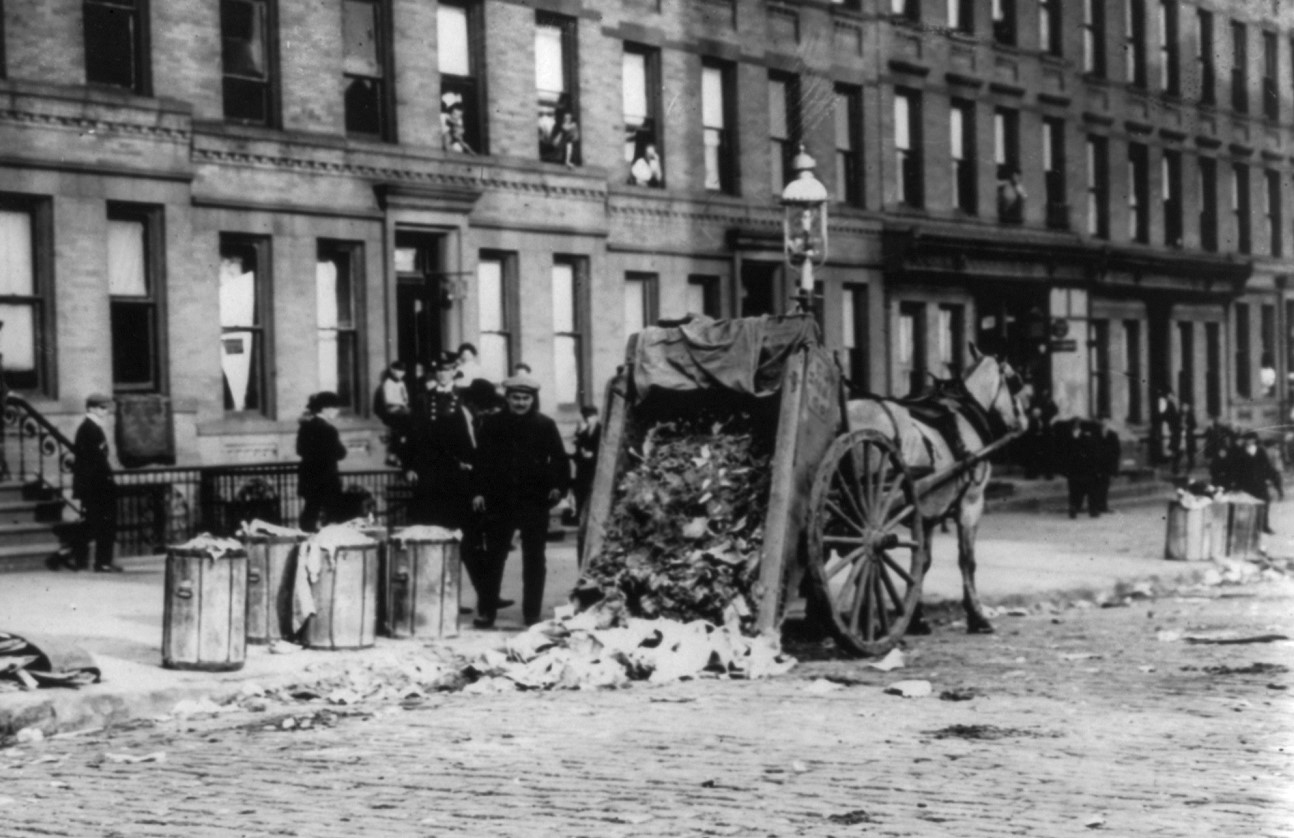
Mailly speaks to the 1911 strike of thousands New York street cleaners, many of them children, and trash collectors, which was broken by strike-breakers brought in by city government and forced through by its police.
‘New York Garbage Workers’ Strike’ by William Mailly from The Coming Nation. No. 65. December 9, 1911.
THE municipal government of New York has again proven itself an efficient strike breaking machine–this time not for a private corporation, but on its own account. At a cost of $35,000 a day, with the active cooperation of the most notorious scab agencies, the use of 3,600 regular policemen and 500 “strong arm” plain clothes men and the unanimous support of the capitalist owned and controlled press, the strike of 2,000 garbage workers, civil service employes, has been smashed without mercy or compassion and with tremendous unction and bravado. The Health, Fire and Water Departments have all joined in the sport to the best of their ability.
And all because the garbage workers, among the poorest paid and hardest worked of the city employes, asked that the system of night work, which had for six months been devastating their ranks with disease and irremediable injuries, should be abolished, and failing even to get consideration of their grievances, revolted.
The strike was only resorted to after three months of fruitless efforts to avoid it. Almost every week during that time committees waited on Street Commissioner “Big Bill” Edwards, ex-Harvard football player, and Mayor Gaynor, but they evaded and procrastinated until the day after election, when a final and irrevocable “if you don’t like night work you can quit” from Edwards was given.
Backing this reply on the same date was Mayor Gaynor’s ukase to Edwards inviting a strike. Refusing even to consult with representatives of the union and declaring the garbage workers “can strike just as soon as they see fit,” that “not one of them would get back into employment again,” that “the city could get along without them,” and scornfully ignoring all propositions for arbitration or mediation from any source, the Mayor once more revealed himself to be as inveterate an enemy of organized labor as ever held office in the United States.
As a result, filth has accumulated and piles of reeking, disease-breeding garbage have heaped up on the streets, emitting the most revolting and intolerable stench, poisoning the air and threatening those in the congested districts, especially the children playing in the streets, with infection and death. And against this condition of things no protest has been made, except by the Socialists, and the strikers have had no press to defend them and state their case other than the Socialist papers, The Call, The Volkszeitung and the Jewish Daily Forward.
The night work system of collecting garbage was established last April, by order of Mayor Gaynor, who got some dust from an ash can on his immaculate Prince Albert that same morning while walking to the City Hall. At first, the garbage workers were given to understand that the new system was to hold only during the summer months. To this they agreed, but specified that it should be changed back to the day system when winter approached. “Winter,” said Commissioner Edwards, “is a long way off, we’ll see then about it.”
They saw about it when the election was over and it was too late to make the men’s grievances a campaign issue, which the men had wanted to do and which Tammany politicians in the union had succeeded in preventing.
The objections to the night system are well grounded. In winter it means working in weather that causes pneumonia and rheumatism. Snow and ice add to the hardships which obtain at all seasons. Slippery streets mean falling horses; during the day three or four men are required to lift a fallen horse; at night one man alone must do it, as it would be impossible to get help.
In the big buildings the ash cans are stored in deep areaways. To find these cans men have to carry lanterns. Frequently the lantern lights are blown out by the wind and men stumble and are injured. At this writing eleven men have been in the hospital some weeks because of injuries received in this way.
There is another danger, one that would hardly be thought of. Homeless cats sequester at night in the ash cans and when the men move the cans, these cats spring at them and scratch their hands and faces. Many men bear these scratches now and have sustained blood poisoning from them.
Carrying the ash cans from the deep areaways means climbing flights of steps with them. The ash cans weigh from 100 to 200 pounds when full. Four hundred men have been ruptured and incapacitated for further service since last April, when the night system was established. The garbage collectors asked for helpers, but were refused.
There goes with this, too, the disorganization of home life which night work always incurs and the inability of the men to sleep amid the ceaseless noise and clamor in the crowded parts of a large city, where the men are compelled to live.
There are other grievances. The men get $2.42 a day. Out of this they have to pay tribute to a swarm of petty bosses–political job holders–day and night foremen, day and night superintendents, assistant foremen, almost all of them favorite of the political bosses of the city. To displease one of these satraps of Tammany often means being laid off two and three weeks and receiving discharge papers at the end of that time.
Then there is the custom of having the men at the several stables at different times present testimonials to Commissioner Edwards in the shape of diamond rings and jewelry, all thoughtfully inspired and arranged by the sub-bosses who want to keep in with the “big fellow,” and to which the men are intimidated into contributing.
But all of these things were waived temporarily for the main issue of the night system. And to maintain this, Mayor Gaynor had prepared to use every means at his command. Some say because of his highly developed ego. When it comes to stubbornness the mule has nothing on him. But there is something else, other people say.
In the Mayor’s ukase already quoted from, he told Commissioner Edwards, “Let the contract system be resorted to if necessary.” Therein probably lies the kernel of the situation. Tammany wants the collection of garbage taken out of the city’s hands. The contract system means more opportunities for graft and graft is the breath of Tammany’s nostrils. So it was quite natural that the day after the strike began the representatives of several contracting companies were haunting the city hall.
To accomplish this end and to discredit the principle of municipal control of municipal enterprises, the most approved method of strike breaking has been resorted to. Advertising through the capitalist papers for scabs and entering into contracts with scab agencies like Waddell and Mahon, Dougherty, Schmittberger and others, are functions which the city government has assumed. In eight days, ten thousand strike breakers have been imported from Chicago, Baltimore, Pittsburg, and other cities. On the whole, they are the most miserable specimens of humanity that are to be seen anywhere. They are housed in barns and stables, sleeping on canvas cots and living on black bread, watery coffee and rotten eggs, instead of the good hotel fare they were promised. There is undoubtedly fine graft in the strike commissaries for the Tammany emissaries.
Of these ten thousand strike breakers, there are now actually 4,436 remaining. Some, brought here under false pretences, have quit when they found what they were wanted for and forfeited their pay in doing so. Others have been unable to do the hard work required or to live under the filthy conditions obtaining in the stables. Others still are hoboes, who welcomed a chance to get to the metropolis free of charge to hibernate here for the winter. All these are food for the city workhouse sooner or later.
But the scab agencies have reaped a harvest. They have drawn on the city treasury until the comptroller has protested against its further depletion. And as citizens are flooding the comptroller’s office with protests against this expensive strike breaking enterprise, he is frightened.
The agencies get $5 a day for each strike breaker and $7 a day for strike breakers’ “chaperones.”
The strike breakers themselves get $3 a day–when they get it. The “chaperones” are common thugs sent along to protect the strike breakers.
Things were warm for the first few days. The women in the working class districts took a hand and bricks were thrown both on the streets and from the housetops. The strike breakers were unable to work because of the aggressiveness of the women. Strike pickets have been arrested wholesale and the magistrates, as usual, promptly “sent them up” for from ten to thirty days. Two men are dead, and hundreds injured on account of riots.
There might have been a general strike, if the union leaders had wanted it. But they discouraged the idea. A large number of sweepers did join the strike, and the transportation workers showed their sympathy in many ways.
Significant has been the attitude of the capitalist daily press. Two weeks ago they were unanimously denouncing Tammany Hall and Gaynor. That was during the campaign. Now, regardless of party, they are unanimously supporting them. “This strike,” we have been told, “is treason to the state.” It appears that employes of the state or city have no rights as individuals. They must submit to whatever rules are imposed upon them by the officials in power. The “courage” of Mayor Gaynor is endorsed in fulsome eulogy. He is praised for teaching “ungrateful and unpatriotic public employes” a needed lesson. From a demagogue and egregious egotist he has become a hero. The blame for the existing menace to the public health is placed entirely upon the men.
The usefulness of the garbage collector to society is not considered, though it has been amply demonstrated by this strike. As Socialist Representative Maurer said at the great sympathy mass meeting held by the Socialist party, “garbage men and street cleaners are greater benefactors to society than the physicians. They prevent disease while physicians only try to cure it.”
At the same meeting, the three chief strike leaders, W.H. Ashton, general organizer of the International Brotherhood of Teamsters, and Edwin Gould and William H. Prescott of the local union, all confessed to having supported and voted for Gaynor in his campaign for mayor, believing him to be a “true friend of labor,” but they would never do it again. If “an open confession is good for the soul,” these leaders probably feel better now. Whether the lesson to be learned from the strike and its destruction will have its effect upon the workers themselves remains to be seen.
Meanwhile the garbage piles still fester on the streets and pollute the air which the people must breathe. Death will reap a rich harvest later.
The Coming Nation was a weekly publication by Appeal to Reason’s Julius Wayland and Fred D. Warren produced in Girard, Kansas. Edited by A.M. Simons and Charles Edward Russell, it was heavily illustrated with a decided focus on women and children.
PDF of full issue: https://www.marxists.org/history/usa/pubs/coming-nation/111209-comingnation-w065.pdf
 Revolution's Newsstand