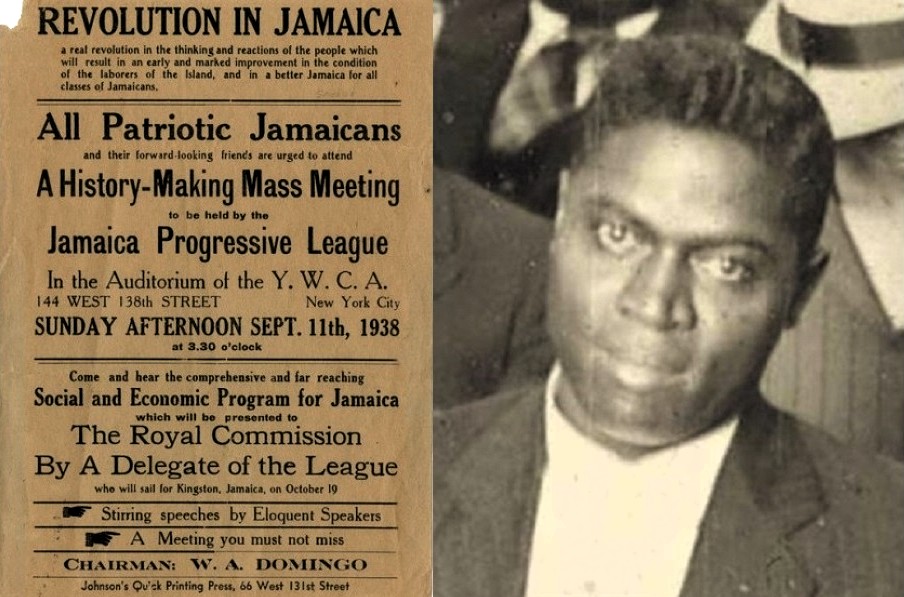
While in obvious ways dated, nevertheless an important essay looking for the origin of modern racism, a discussion that has become a constant of the U.S. left since, but not before, writings such as this, by Black leftists such as Domingo. The activism of Jamaica-born W.A. Domingo (Wilfred Adolphus Domingo) saw him join the Socialist Party in the mid 1910s and work in its Harlem Branch with Messenger editors A. Philip Randolph and Chandler Owen. In 1919 he became the first editor of fellow-Jamaican Marcus Garvey’s Negro World before political differences became insurmountable, whereby he joined the African Blood Brotherhood led by Cyril Briggs. Moving back and forth between the States and Jamaica over his life, his central commitment was Jamaican independence.
‘Private Property as a Pillar of Prejudice’ by W.A. Domingo from The Messenger. Vol. 2 Nos. 4-5 & 8. April-May & August, 1920.
It is a truism of the philosophy of Socialism that the religious and ethical concepts of a people, as well as their general psychology, are mainly shaped by the prevailing economic system; and conversely that analysis of a given psychological attitude will reveal material causes. According to this dictum the ideology of a people, nation or race is but the result of accumulated material influences operating upon their consciousness for generations. So-called innate racial traits and animosities, if traced backward, will be found to be but effects of obscure economic causes. This is as true of race prejudice as it is of any other purely psychic quality of the human make-up. Apologists for racial exclusiveness and arrogance as a rule predicate their intolerance upon the alleged instinctive aversion of one race for another. To prove their contention they point to acknowledged differences of color and physiognomy between, say, the Negro and Caucasian as sufficient justification for their irrational position. However, mere difference is not in itself a cause of physical aversion. Indeed, difference of type in the same species breeds curiosity, and as in the case of the Negro and the Caucasian, and the Hindoo and Caucasian, develops sexual affinity. It is a well-known fact of sexual science that physical repulsion inhibits sexual contact, and physical aversion is the very essence of race prejudice. It is also contended that race prejudice is natural–instinctive. That this is not so, is proven by the fact that race prejudice is not a reciprocal and general trait of humanity. White children and black children play together naturally until they arrive at the age when they react to the influences of their environment. White, black and brown Mohamedans are never concerned about color as they do not live in an atmosphere that is permeated with the tenets of the cult of race superiority. Dogs of various colors and distinctive types manifest no inherent repulsion to each other, but instead, like human beings, mate and produce hybrid types. Even the most rabid upholders of racial intolerance disprove their own theories when they manifest no dislike to wearing black suits, hiring black servants, riding black horses and having mulatto children by black mistresses.
Race prejudice, not being a natural trait of human nature–an instinct–like the desire for food, the fear of death, and the closing of the eyes against a cloud of dust, its cause must be searched for elsewhere. This brings us back to our original proposition: that the psychology of mankind is largely determined by the prevailing economic and physical environments.
Why do the wealth-seeking and more restless types of Caucasians manifest racial intolerance towards peoples of dissimilar racial types? Why do, comparatively, civilized white nations, not bitten by the bug of imperialism, show practically no hatred based upon physical dissimilarities? As most exactly typifying the form, we will take the Anglo-Saxon, and for the other type, the Slav. In the first place, Anglo-Saxons are essentially a trading people. They acquired this trait largely as a consequence of the physiography and geography of their original home–Great Britain. The essence of trade is to buy cheaply and sell dearly–to get the best of a bargain. Trade brings profit to the trader, especially when he has a keener appreciation of the intrinsic value of articles of commerce than the persons with whom he trades. In order that the steady profits derivable from trade might not be jeopardized, trade routes must be protected. Hence, the need of a powerful navy, since the more important trade routes are in water.
Greatest profits can be derived from trade when one group represents a lower civilization or when that group merely trades in order to supply immediate material needs and not for the gross ambition of storing up wealth.
To promote trade, the English realized that it was best for them to have settled countries with which to trade. This would insure uninterrupted profits to the English if they had a keener appreciation of the value of gold, diamonds and other precious articles of commerce than the unsophisticated natives of Africa, the South Seas and other parts of the world during the last century. Settling these lands involved, in many cases, their conquest. The inevitable tendency of a conquering tribe is to hold the conquered people in contempt. The inevitable tendency of the ones who get the best of a bargain in commerce is to hold their opponents at a mental discount. This is accentuated if the conquered and cheated people are of an opposite physical type. It then becomes but an easy step to associate the conquest and cheating with the superiority or inferiority of physical type as the case might be. The mind of the conquering tribe unconsciously reasons: my type is different from the other type; I have conquered the other type; my conquest is due to my superiority, hence, my type is essentially superior! Add to this an egotistic and self-laudatory history and literature, and it is easy to comprehend that that history and that literature, when referring to conquered peoples, will regard them as being inferior. Given a conclusion that inures to one’s benefit and it is a human weakness to have all things and theories conform to the conclusion. Hence, the desperate efforts of theologians and “scientists” in the middle of the nineteenth century who strove to prove the Negro a monkey, not a man. If he could be proven to be a monkey, then, being of the same status as the horse, his labor could be equally exploited to bring wealth, leisure and comfort to the superior animal,–man!
With the Slavs is was different. Because of their land-locked geographical position they were not consumed with a passion for trade, and even what trade they did was unlike that of the Anglo-Saxon in character, for it was carried on over land routes, which made it possible for both parties to the trade to visit each other’s markets and gain a knowledge of respective commercial values. This deprived both traders of any great advantage as to values, which in itself rendered it impossible for Tartars or Chinese to be given beads for diamonds, or Russians shells for furs. This condition deprived the Slavs of the exhilaration of proving their racial superiority over Mongolians because of their ability to exploit them in trade.
Also, in the early days of contact between Slavs and Mongols, there was comparative parity of weapons between the two peoples, and conquests were not confined to either racial type alone. Indeed, the Mongols under Genghis Khan and Tamerlane made for themselves a military reputation that is respectfully enshrined in the literature and history of Eastern Europe. Unlike Western Europeans, Slavs have known the terrors of conquest by a dissimilar race on such a scale as to command their racial respect. Western Europe, spurred on by its quest for wealth, a purely material influence, learned how to navigate the seas and conquer other lands, but was never conquered to any extent except by members of their own race. Of course, Spain was conquered by the Moors, and that, perhaps, partly explains the Spaniard’s freedom from rabid race prejudice, until they have come under the influence of Anglo-Saxon propaganda. The genesis of race prejudice, therefore, was exploitation and conquest of dissimilar races by Caucasians in their quest of wealth.
II.
Other proofs that race prejudice is kept alive by capitalism are afforded by present day conditions.
Two brothers leave France for French colonies. One goes to Martinique, the other to the French Congo. They both received the same training and imbibed the same humanitarian ideals at home. The one who goes to Martinique finds an overwhelming black population with essentially French traditions engaged in every occupation of life. In his search for employment, he is forced to hire out his services to a black mulatto or black business man. In the capacity of an employee, he finds his labor exploited and himself in an inferior economic position to his non-white employer, and after many years of working, returns to France. His brother, on his arrival in Africa becomes part of a system of merciless exploitation. He knows that as a junior official of a commercial house with headquarters in France, he can keep his job only by getting a maximum of wealth out of native labor, and being away from the restraints of exacting French laws, he becomes a party to various atrocities perpetrated upon the defenseless natives. Through his ability to get maximum results, he is promoted, and after years of labor in the Congo, he returns to France where he meets his brother. They have both dealt with Negroes, but one had had his labor exploited by them, whilst the other had been an instrument for their exploitation. Growing out of their different economic relations with “les noirs,” it is only natural for the brother who went to Martinique to maintain the inherent equality of all races, and for the brother who had gone to the Congo to be convinced of essential Negro inferiority!
Or take another example. In the United States, the economic outlook of mulattoes and blacks is essentially alike. In the West Indies they differ, the blacks having inferior and more circumscribed opportunities. Being able equally to exploit mulattoes and blacks, the majority of the whites in the United States concede to mulattoes no higher racial or social status than the blacks, and in some cases, go so far as to assert that mixture of blood produces a type that is inferior to both parents. American mulattoes, finding themselves for the most part in no better economic situation than their black relatives, recognize their community of interests and unite with them for common racial weal. In the West Indies, because the capitalist white minority must have assistance in order that its exploitation might be thorough, mulattoes are made a part of the machinery of exploitation as a sort of junior partner. They are admitted to clerkships and form the major part of the middle class. They have avenues of opportunity open to them, though to a limited extent, which permit a few of their number to become a part of the upper crust of the exploiting class. This situation, born of the economic needs of the white exploiter, creates psychologies that are different to those of American whites and mulattoes. It makes the whites and mixed blood West Indians alike contemptuous of the exploited black man. This, like in other cases, soon becomes crystalized in literature. Efforts are then made to prove that mixture of blood makes for superiority over pure bloodedness in Negroes, and, of course, the whites, the exploiters of both mulattoes and blacks, are superior to both! In America, both types of Negroes are exploited alike and characterized as being equally inferior to their exploiters. In the West Indies, mulattoes are less intensely exploited, and they are regarded as being inferior to the whites, but superior to blacks. In the United States because of common exploitation, hybrids and pure bloods fight together against oppression. In the West Indies, because of difference of economic status, the two types stand divided–at daggers drawn. The last illustration disproves the naturalness, the innateness of race prejudice because of physical differences. American mulattoes intermarry with full blooded Negroes freely, whilst West Indian mulattoes strive desperately to maintain a separate caste through constant infiltrations of white blood. If color repulsion is natural, and if material conditions have nothing to do with it, why is not the attitude of West Indian, South African, and American mulattoes uniform?
Capitalism is based upon the theory of private rights and that theory, imbedded in the organic law of every country except Soviet Russia, is responsible for much of the racial friction in the United States.
Many writers point to the comparative absence of race prejudice in America prior to the abolition of slavery, but few of them seek for an explanation in the institution of private property. During the period between 1619 and 1863, when slavery in the United States was legal, there were thousands of white and black slaves. These slaves had common interests against their masters and manifested little or no race prejudice against each other. This is proven by the fact that there were frequent intermarriages between slaves. An outstanding example of this were the parents of Benjamin Banneker, the black astronomer. Laws were made punishing such marriages, as the masters realized artificial means were necessary to stop certain natural consequences which grow out of common economic status. Gradually as black slaves increased in number, and as white slaves became free homesteaders, the economic cleavage between the races became clearly marked.
Color and economic status became more or less identical. In the past, the masters could not use the fact of their color to assert their race superiority, since some of their own race were in no better economic situation than the despised Negro. But they could easily explain the matter from the stand point of feudal aristocracy. When white slaves became free, they unconsciously imbibed the psychology of the master class. It is even related that free blacks and mulattoes, because of their freedom, regarded the slaves with contempt. With lines of race identical with those of economic status, a psychology of contempt for the race occupying the inferior status was developed. However, this feeling did not actively manifest itself at once, since there was no danger of the inferior race encroaching upon the one whose position was superior.
What is the essence of chattel slavery? It is the forcible denial of the rights of private property in the slave himself or in the products of his toil.
In other words, a slave was not permitted to be the owner of himself or of the product of his toil. This extended even to marital relations. With the abolition of slavery, the right of the master to the legal ownership of the body of the black slave, his wife, his children and the product of his toil, came to an end. Abolition of their right to the private ownership of human flesh brought ruin to the master class, and as is natural, they hated the new owners of their erstwhile property–the slaves themselves! Transference of ownership of the slaves from their masters to themselves, earned for them the hate of the dispossessed owners. Just as contempt for a slave was associated with his color so was hatred of the newly freedmen associated with their color. Of course, only a minority of whites were owners of slaves, but it is a fact of history that the psychology of a country is determined by the dominant class of that country, which in turn derives its ideas from its dominant economic position. It is easy to understand, especially when it is remembered that the psychology is a self-exalting one, why, first, the non-property owning whites of the South, and next, all the whites of the country, have accepted the attitude of the slave owning class toward black men and women.
It is part of human nature, developed in an era of private rights in human flesh, for the dispossessed slave holders to hate those who deprived them of their property.
Nearly every manifestation of race prejudice in the South, Jim-Crowism, lynching, peonage and the farm lien system can be traced to material motives. Even the elaborate propaganda of Southern race prejudice in the North has an economic background, for it is the desire of the South that all America should acquiesce in its Bourbon determination to keep Negroes in an economic situation that makes it possible for their labor to be ruthlessly exploited. By the South is meant that section of the white population, which by origin, tradition, education and material advantages, controls newspapers, writes magazine articles, monographs, books and plays, like the Red Dawn and the Clansman, produces moving pictures like The Birth of a Nation and publishes periodicals like Ka Lamity’s Harpoon, The Pitchfork and Vardaman’s Weekly. By no means must the South be confused with the ignorant deluded and degraded “hillbillies” and “Crackers” who are fed with the manna of race prejudice by the other South. One is the principal, the other the agent; one the mastermind, the other the tool! Private property is also the source of race prejudice in many other ways. Private ownership of railways and public utilities makes it possible to restrict Negroes to porterships and other menial and inferior positions.
The Messenger was founded and published in New York City by A. Phillip Randolph and Chandler Owen in 1917 after they both joined the Socialist Party of America. The Messenger opposed World War I, conscription and supported the Bolshevik Revolution, though it remained loyal to the Socialist Party when the left split in 1919. It sought to promote a labor-orientated Black leadership, “New Crowd Negroes,” as explicitly opposed to the positions of both WEB DuBois and Booker T Washington at the time. Both Owen and Randolph were arrested under the Espionage Act in an attempt to disrupt The Messenger. Eventually, The Messenger became less political and more trade union focused. After the departure of and Owen, the focus again shifted to arts and culture. The Messenger ceased publishing in 1928. Its early issues contain invaluable articles on the early Black left.
PDF of full issue: https://www.marxists.org/history/usa/pubs/messenger/v2nRN-04-05-apr-may-1920-The-Messenger.pdf
PDF of full issue 2: https://www.marxists.org/history/usa/pubs/messenger/v2nRN-07-aug-1920-Messenger.pdf
 Revolution's Newsstand