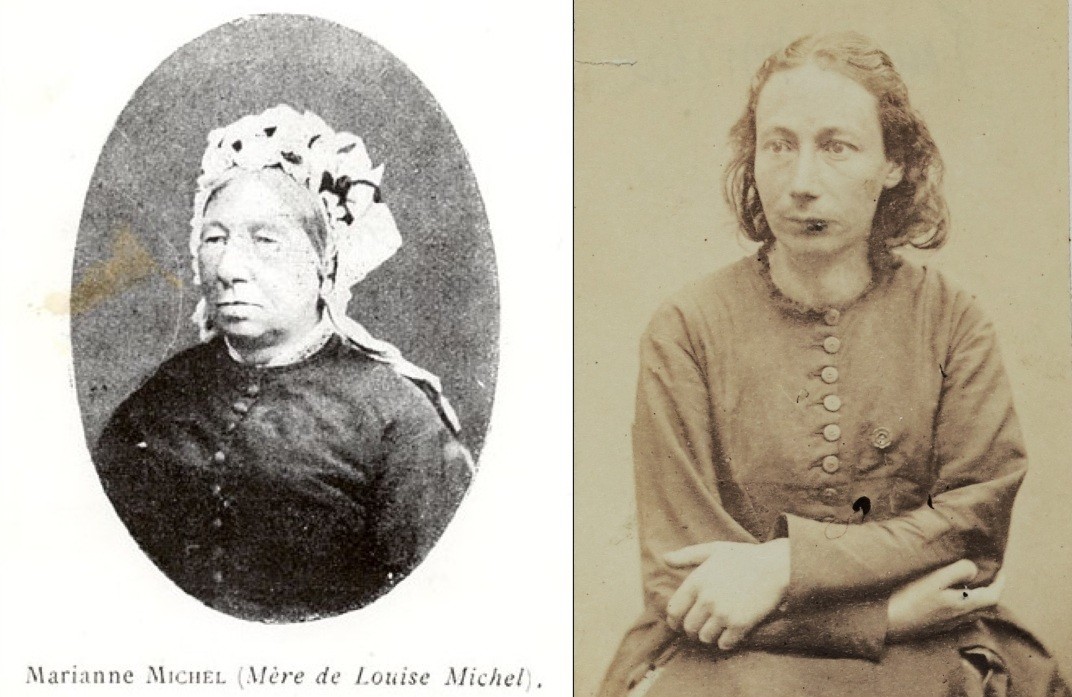
Albert Parsons’ ‘Alarm’ with a report on the funeral of the heroic Communard’s mother, Marianne Michel, in the Paris suburb of Levallois. Still imprisoned, Louise was denied her request to participate in the ceremonies. Very close to her mother, a house-cleaner who was captured and by the Versailles troops and threatened with death in 1871. It was for her life that Louise gave herself over to her potential executioners. On Louise’s own death twenty years later she would be buried next to her mother in the Levallois cemetery, which saw such ‘remarkable scenes’ of revolutionary solidarity in 1885.
‘Remarkable Scenes at the Burial of Louise Michel’s Mother in Paris’ from The Alarm (Chicago). Vol. 1 No. 16. February 7, 1885.
The Social Revolution-Revolutionary Speeches. by French Working People.
Special correspondence of the N.Y. World. PARIS, Jan. 6. Six thousand persons followed the cortege which bore the remains of Louise Michel’s mother to the cemetery yesterday morning, and all along the route other thousands hailed the blood-red banners and the Communistic inscriptions carried in the funeral procession with shouts of applause as they were borne by–As you will know, the government, after much vacillation, finally decided not to allow Louise Michel the poor privilege of dropping a flower on her mother’s coffin before it was lowered into the grave. They were afraid that her presence in the cemetery would lead to a serious outbreak on the part of the Anarchists and Blanquists, who, they knew, would form the major portion of the attendants. She could prepare the body for the casket, they decreed, but this done she was to repair to St. Imzare, the hospital for invalid prisoners, where she is to remain until her health, shattered by her long confinement and this new grief of her mother’s loss, is restored.
She accordingly left her cell the evening before last, and accompanied by a commissary of police went to the house in which her mother died. In the oaken coffin which contained the remains she placed her photograph, some flowers, a lock of her hair, a cluster of red immortelles she had gathered at the burial of Marie Ferre, and the portrait of the latter. With her cousin she passed the night at the side of the dead.
Yesterday morning at 7 o’clock Henri Rochefort and M. Clemenceau, the radical deputy, came to see her.
“My dear friend,” said Rochefort as he entered, “I have the sad mission to lead you to St. Lazare.”
“Oh, it is I who will escort you,” she tranquilly replied. “Only it’s so long since I’ve breathed the free air that I wish to go on foot.”
Accompanied by MM. Rochefort and Clemenceau, and followed by two detectives, she started out for the hospital. On several occasions during the walk she might have made good her escape. They arrived at St. Lazare about 8 o’clock, just at the moment when two women, each with a child on her arms, were mounting a prison van to be taken to court. “Look, Rochefort,” she said, “isn’t it sad to see those infants already in prison? That would alone be sufficient to excuse what they call our madness. And they have no covering the poor, unfortunate babes.” She fumbled in her pocket.
“Do not search,” said Rochefort, “you have nothing.” He then gave the director of St. Lazare twenty francs, with the request to have the infants properly clothed. After Louise Michel had entered her new quarters M. Clemenceau made his excuses for not being able to attend the funeral, while M. Rochefort went to the house of mourning to superintend the last details for the burial, the expenses of which he paid out of his own pocket.
The door of the house was draped in black. The bier was exposed to view and covered with crowns and flowers. A large crown of pearls bore the words, “To my mother.” At a quarter of eleven a group of Anarchists arrived–bearing a huge red flag with the inscription, “The Revolutionary Sentinel, Communist Anarchist Group of the Eighteenth Arrondissement.” The staff was surmounted by a Phrygian cap. On each side were borne two smaller red flags without inscriptions, and the scarlet, gold-fringed banner of the “Group of Atheists of the Thirteenth Arrondissement and of Gentilly.” The procession, headed by the hearse and carriages containing the relatives and friends of the deceased, set itself in motion. On the way it was saluted by cries of “Vive la Revolution Sociale, “Vive la Anarchie.” As it passed a guard house the men shouted: “Down with the army” before a church they cried: “Down with religion.”
It was near two o’clock when the cortege reached the cemetery, already full of people. The remains were to be placed in the vault of the Ferre family, but the hearse could not penetrate the crowd. First the crowns and flowers and then the coffin itself had to be passed over the heads of the people. The orators could not approach the tomb. They were obliged to mount a headstone twenty paces from the bier in order to deliver their speeches.
The first speaker was Citizen Ernest Roche, who said: “All factions of the revolutionary party are represented at this ceremony. If the Socialists differ as to the means to be employed to make the revolution triumph they are in accord as to the end aimed at. Let our corpses and our martyrs serve us as banners. Let us recall that the corpse of Lucrece over-turned the Tarquins, that the corpse of Victor Noir overwhelmed the empire. The corpse of the poor woman which we inter today, assassinated by the hangman and the tyrants, will aid us to throw of the yoke of these robbers of milliards who, after having pillaged France, want to sell her to the highest bidder.”
Citizen Chabert, who followed, recommended the Socialists to be prudent until the day when they would descend together into the street to bear off the victory. This did not meet the views of Citizen Emile Digeon, rabid Anarchist.
“What means these delays, all this temporizing?” he shouted. “A relative of mine recently told me that the Anarchists were impatient. I replied: ‘You have two charming daughters; if you had to sell them to give them bread, what would you do?’ ‘I would take a gun,’ he answered, ‘and rob and murder.’”
Altogether there were eight speeches, all in a strain similar to the above, delivered. The last one was by Citizen Willielm, who declared: “I am no Parisian; I am no Frenchman; I am a citizen of the earth.”
Then the crowd separated and the remains of Mme. Michel were alone in the cemetery…while in the prison of St. Lazare sat her daughter listening sad-eyed, to the words of M. Clemenceau, who was trying to console her grief at not being permitted like any humble mortal to pay the last duties to her mother.
The Alarm was an extremely important paper at a momentous moment in the history of the US and international workers’ movement. The Alarm was the paper of the International Working People’s Association produced weekly in Chicago and edited by Albert Parsons. The IWPA was formed by anarchists and social revolutionists who left the Socialist Labor Party in 1883 led by Johann Most who had recently arrived in the States. The SLP was then dominated by German-speaking Lassalleans focused on electoral work, and a smaller group of Marxists largely focused on craft unions. In the immigrant slums of proletarian Chicago, neither were as appealing as the city’s Lehr-und-Wehr Vereine (Education and Defense Societies) which armed and trained themselves for the class war. With 5000 members by the mid-1880s, the IWPA quickly far outgrew the SLP, and signified the larger dominance of anarchism on radical thought in that decade. The Alarm first appeared on October 4, 1884, one of eight IWPA papers that formed, but the only one in English. Parsons was formerly the assistant-editor of the SLP’s ‘People’ newspaper and a pioneer member of the American Typographical Union. By early 1886 Alarm claimed a run of 3000, while the other Chicago IWPA papers, the daily German Arbeiter-Zeitung (Workers’ Newspaper) edited by August Spies and weeklies Der Vorbote (The Harbinger) had between 7-8000 each, while the weekly Der Fackel (The Torch) ran 12000 copies an issue. A Czech-language weekly Budoucnost (The Future) was also produced. Parsons, assisted by Lizzie Holmes and his wife Lucy Parsons, issued a militant working-class paper. The Alarm was incendiary in its language, literally. Along with openly advocating the use of force, The Alarm published bomb-making instructions. Suppressed immediately after May 4, 1886, the last issue edited by Parson was April 24. On November 5, 1887, one week before Parson’s execution, The Alarm was relaunched by Dyer Lum but only lasted half a year. Restarted again in 1888, The Alarm finally ended in February 1889. The Alarm is a crucial resource to understanding the rise of anarchism in the US and the world of Haymarket and one of the most radical eras in US working class history.
PDF of full issue: https://digitalcollections.crl.edu/record/1117347/files/nd-il-000016-n2.pdf
 Revolution's Newsstand