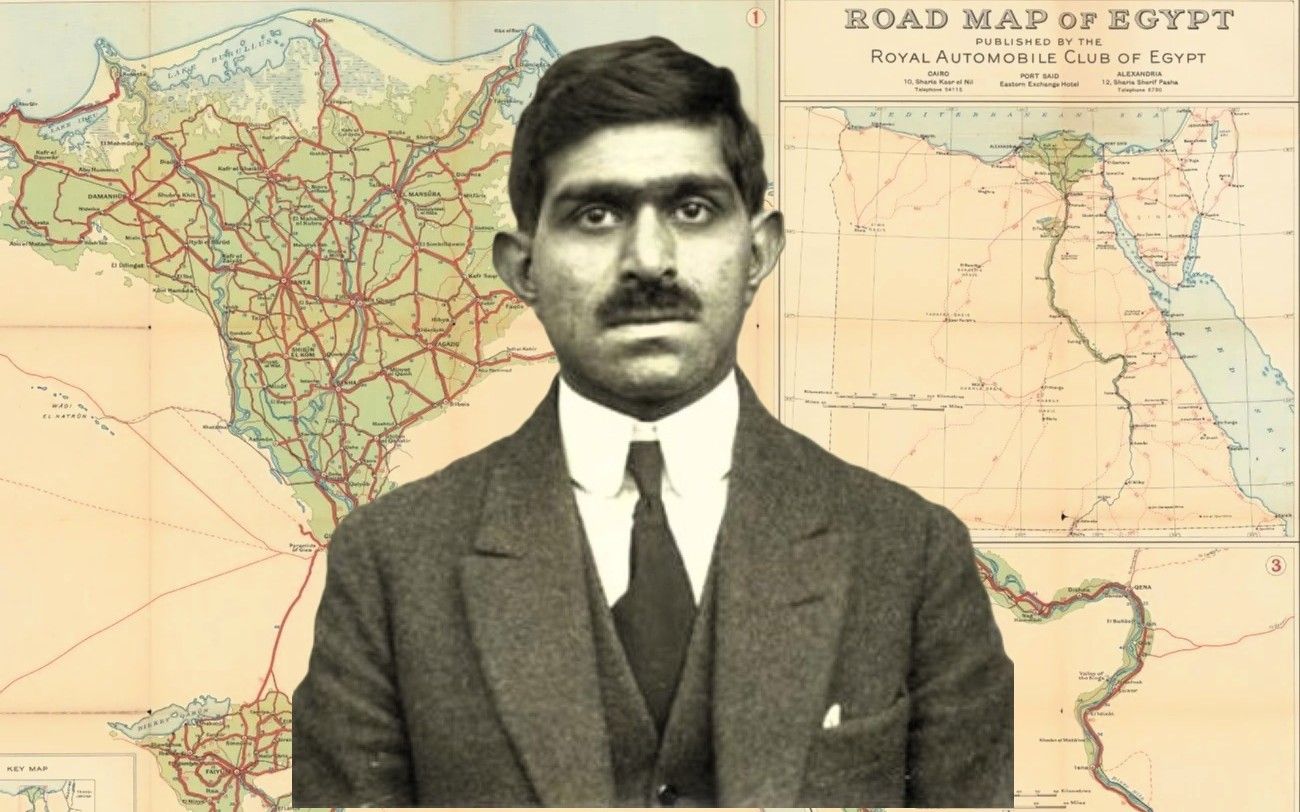
Virendranath Chattopadhyaya, a key figure in the League Against Imperialism, speaks to crisis in Egypt, like India oppressed and exploited by British imperialism. Chattopadhyaya has an extraordinary biography and was a major figure in exiled Indian nationalism and later in formulating the new anti-imperialism of the 1920s. Active in the German Communist Party and the Comintern, he would later move to Moscow and became a victim of the purges, arrested in July, 1937 and executed on September 2, 1937.
‘The Anti-Imperialist Movement in Egypt’ by Virendranath Chattopadhyaya from International Press Correspondence. Vol. 10. No. 34. July 25, 1930.
During the eight weeks that have elapsed since Nahas Pasha and other Wafd leaders broke off negotiations with Henderson on May 8th, the situation in Egypt has developed with considerable rapidity, partly under the influence of the revolutionary mass movement in India, but mainly under the irresistible pressure exercised by the broad masses owing to the conditions created by the acute economic crisis. Once more the whole story is being repeated of negotiations with British imperialism, rupture of negotiations, dissolution of Parliament, suppression of the Constitution, dictatorship, police and military terror on the one side, and anti-imperialist strikes, mass demonstrations, street fights with the police, on the other. Once more it is being clearly demonstrated to the Egyptian people that it is British imperialism that owns and rules the country through the puppet king and his feudal clique; it is being made clear to them for the fourth time that the so-called “sovereignty and independence of Egypt” proclaimed on February 28th, 1922, was a hollow and hypocritical phrase, and that the “Parliament” created on April 19th, 1923, was a mere impotent institution that could be allowed to function only in so far as it carried out “legislation” in protection of the interests of British imperialism. No Government would be allowed to exist that did not accept this fundamental fact as the basis of its negotiations for a treaty.
The Egyptian bourgeoisie represented by the Wafd Party came very near to accepting the terms for legalising the imperialist exploitation of Egypt cunningly drawn up by the MacDonald Cabinet, but there were other factors at home with which they had to reckon in their own interests. They were met at home with falling cotton prices, increasing suffering of the fellaheen, growing rural indebtedness and agrarian discontent. It is the cotton crisis and the agrarian discontent that were the driving forces behind the resistance of the Wafdists to the acceptance of the British regarding the Sudan. For the absolute control of the Sudan by British imperialism would be a serious menace to the economic life of Egypt, and the sacrifice of the Sudan, which is economically inseparable from Egypt, would have swept away the Wafdists as traitors to the cause of the Egyptian people.
The Wafd leaders are, therefore, playing the same role in Egypt as the leaders of the National Congress are playing in India. They are heading the anti-imperialist movement of the masses with slogans of civil disobedience and non-payment of taxes. In spite of an overwhelming parliamentary majority (the Wafdists had 90 per cent of the seats in the Egyptian Parliament), Nahas Pashas Cabinet resigned in June, ostensibly on a constitutional issue against the absolutism and dictatorship of the King, but in reality because it would have found it impossible to solve the growing economic difficulties of the country and did not wish to lose its popularity by the failure that was certain. The odium now falls on the King and his ministerial agents, behind whom stand in reality the guns and warships of British imperialism, while Nahas is now at the head of a popular movement for “freedom and democracy” which has the full support of the broad masses. On June 25th, 500 Wafd leaders signed an oath that, unless the King gave way in the constitutional struggle, they would launch a campaign of civil disobedience on July 21st. The King, that is, British imperialism, has not given way, and the campaign has begun. But, as in India, the masses have begun to move in a way Highly disagreeable to the leaders. Like Gandhi, Nahas Pasha has now declared that the Wafd have nothing to do with the outbursts of violence of the masses in Bilbeis, Mansurali, Cairo or Alexandria. He too is for “non-violence”, that is, against the revolutionary initiative of the masses.
But the masses are showing their teeth. It is true that they are still under the leadership of the Pashas, landowners, and well-to-do bourgeois lawyers that direct the politics of the Wafd Party, but their actions are against the wishes of the latter. The bloody conflicts between the masses of demonstrators in the streets of Alexandria and Cairo, and the police and military under British commanders, are being daily reported in the Press, and need not be recounted here. As in India, the demonstrators resisted the provocations and brutal terror of the police by hurling cart loads of stones and thousands of sand-filled glass bottles at them. Hundreds have been killed and wounded, hundreds have already been arrested. The leading Nationalist papers have been forbidden, the right oi speech and of assembly has been suppressed, the immunity of the Wafdist members of parliament withdrawn, and the country placed under the rule of the military.
In thus assuming the active leadership of the anti-imperialist revolt of the workers, peasants, students and city poor, the Wafd Party under Nahas Pasha’s leadership has the same aim in view as the Gandhi-Nehru leadership in India. They are leading the movement to prevent it from becoming really revolutionary, while at the same time the mass movement of revolt gives them higher popularity at home and enhanced prestige in eventual negotiations with British imperialism. The struggle of the Wafd Party against imperialism is taking the form of a constitutional struggle against the absolutism of the King. The belief, however, that the Wafd is fighting the Monarchy in order to abolish it and establish a republic is erroneous. Nahas Pasha himself made a statement to the Press on July 14th in Alexandria on the eve of the barricade fighting and police shootings in that city–and contradicted any intention of breaking the oath of loyalty to the Constitution, Article I of which provided that Egypt was to be ruled by an hereditary sovereign. Considerable importance must also be attached to the interview given to the correspondent of the “Manchester Guardian” on July 13th by Makram Ebeid, a member of Nahas Pasha’s Cabinet and described as the ablest member of the delegation that discussed the Anglo-Egyptian draft treaty with Henderson in London. Makram Ebeid made it clear that the Waid was anxious to come to a peaceful and honourable settlement with Great Britain. In other words, the Wafd, representing the bourgeoisie and the landowners, must come to a working compromise with British imperialism, but they have to save their faces with the masses and have therefore to strengthen their own position as national heroes and find a suitable anti-British formula to cover the inevitable retreat when the masses threaten to go too far with the agrarian programme. In fact, the weapon of non-payment of taxes which Nahas Pasha threatens to use will prove far more dangerous to the bourgeoisie and landlords themselves than the similar movement in certain parts of India. And it may therefore be stated with certainty that the Wafdists have no intention of creating a situation that must ultimately lead to their own expropriation.
As far as the interests of British imperialists are concerned, the policy of the MacDonald Government has already met with the approval of the other two imperialist parties in Britain. But the British community in Egypt organised in the “British Union” demands stronger measures, just as the so-called European Association in India demand a strong hand Beasley, the President of the Union, has addressed two letters to MacDonald, in one of which he demands that the old offer of a treaty shall no longer hold and that “negotiations must begin with a clean slate”. In his second letter, he repeats the old imperialist argument, so familiar in India and other colonies, that “the vast majority of Egyptians individually no not want British protection to be withdrawn from them, being unable to trust one another”…But the real motive of the letters is contained in his statement that “British trade with Egypt has been steadily declining during the last 10 years”.
But neither the imperialist terror exercised through the King and his immediate satellites, nor the tactics of the Wafd leaders will remove the growing discontent. The workers and revolutionary students in Cairo and Alexandra have already formed anti-imperialist committees with clear revolutionary slogans, including the overthrow of British imperialism and native feudalism, and the carrying out of the agrarian revolution. As in India, so in Egypt, the masses will overthrow imperialism only when they have established their Own organs of struggle and liberated themselves from Nationalist leadership.
International Press Correspondence, widely known as”Inprecorr” was published by the Executive Committee of the Communist International (ECCI) regularly in German and English, occasionally in many other languages, beginning in 1921 and lasting in English until 1938. Inprecorr’s role was to supply translated articles to the English-speaking press of the International from the Comintern’s different sections, as well as news and statements from the ECCI. Many ‘Daily Worker’ and ‘Communist’ articles originated in Inprecorr, and it also published articles by American comrades for use in other countries. It was published at least weekly, and often thrice weekly.
PDF of full issue: https://hdl.handle.net/2027/uva.x002548276?urlappend=%3Bseq=631%3Bownerid=27021597768315325-721
 Revolution's Newsstand