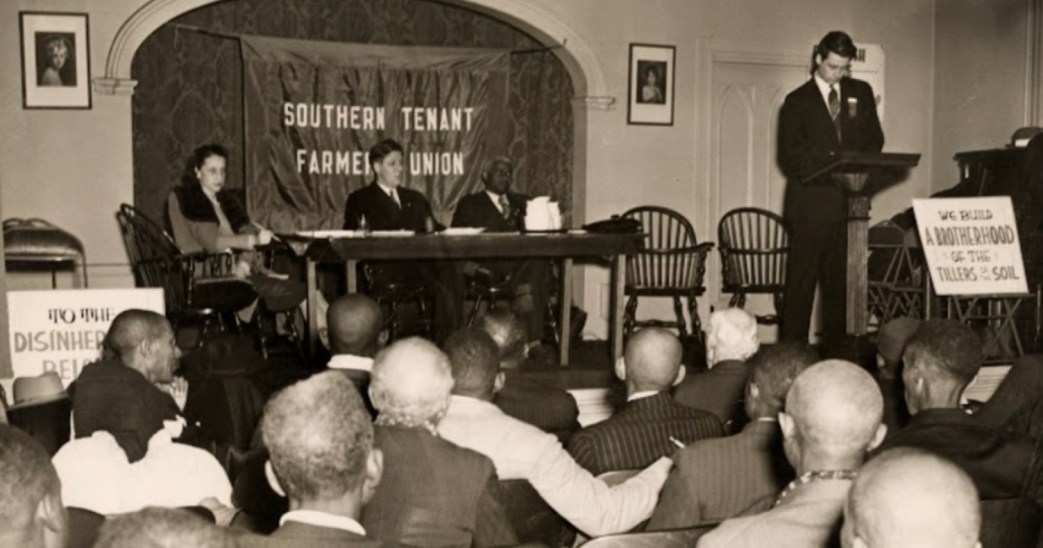
Myra Page with snapshots of the Southern Tenant Farmers Union’s second national convention held at Little Rock’s Labor Temple in January, 1936. The inter-racial union of sharecroppers broke barriers in the dangerous work of jointly organizing Black and white farmer workers in the Jim Crow south.
‘The Croppers Prepare’ by Myra Page from New Masses Vol. 18 No. 7. February 11, 1936.
Report of the Southern Tenant Farmers’ Congress
HERE’S a man from Hell’s Acre,” said Walter Moskop, an Arkansas cropper who himself has reason to know. A “poor white” of the cotton belt and with the union from its inception, he was introducing a fellow-fighter, a Negro cropper, to his brother delegates of the Southern Tenant Farmers’ Union convention which was held in Little Rock’s Labor Temple this past week.
“Brother Ware,” Moskop continued, “comes from Birdson, Arkansas. Here’s a man who lives there and who’s stuck through all the fighting and bullets.”
A little man with iron-gray hair, brown skin and a patient gentleness, stood by Moskop. “Brothers,” he said, “I’m not able to explain exactly what my heart desires to say to you about our union.” He paused, obviously seeking his words. “I figure it’d be nothing to sacrifice my life to break down the justice we got. But us here are in unity…My wife lies home sick. I asked myself, could I leave her? I’d be a poor man if I profess and set home and do nothing. So I come–
“My wife, (she’s the only one I can talk to,) she says, ‘Amos, you go out in the fields, a-talking, you risk your life.’ I say, ‘What is this, if I sit at home, but death? If I go, I adventure and may win life and freedom.” His voice rang deeper. “America, they say, is our country. But it has been taken away from us, reversed in our hands. We must learn the right way to deliver ourselves.”
Otis Sweeden, whom chairman Moskop next introduced, came from the plains of Oklahoma. Son of a Cherokee Indian and Scotch-Irish mother, he described in rapid-fire American lingo how the Cherokee Indians, the Mexicans, Negroes and whites had grown tired of picking spinach, beets and onions for a quarter a day, then having to pay Griffin Manufacturing Company, which owned the plantation, a dime for transportation out of that.
“At first they were leery,” he told the convention. “Over in Oklahoma, plenty of unions’ve been a racket. But we proved our union different. All races together. We won free transportation and a raise on spinach from 3 to 10 cents a bushel basket and in ten months we got seventy-five locals with 9,500 members in our Farmers’ and Farm-Laborers’ Union. Then we heard about the Southern Tenant Farmers’ Union; we decided to line up with you. We had some Christmas. No relief checks at Muskoges for six weeks, not even potatoes in the house, let alone any candy or toys for the kids. Nice day, Christmas. So my wife and me made some stew for the boys and afterwards, six hundred of us went down to the relief. The officer promised us if we’d go home, we’d get our checks the next day. But we ain’t got them yet.” (Relief work in Oklahoma is paid twenty-nine dollars a month.)
“You’ve been doing swell work over here in Arkansas,” the Oklahomian continued, “but we’re only to first base.”
“That’s right!” delegates echoed.
“Each man’s gotta be an organizer unto himself,” this son of a Cherokee went on, “Lean on nobody but yourself. They make us live no better than peons. Conditions are nowhere so bad as for the poor people of the South and Southwest. But we can change things. George Washington secured freedom of this country with a ragged army who left bloodprints in the snow as they marched. We’re in the same position today.”
E.B. MIKINNEY, whom Walter Moskop brought before the convention as “one of our great, a pillar of granite in a land of wilderness,” was a rural Negro minister who had been preaching organization to his people for thirty-five years. Elected vice-president of the union and one of its leading organizers, he called down the planters’ wrath on himself and family. One night his home in Marked Tree, Arkansas, was punctured by more than fifty bullets, his young sons wounded and two men badly shot. Fortunately McKinney was away or he would have been lynched.
“Sometimes people say that race relations are complicated,” he addressed the delegates, “but that ain’t so. If you are mad at me and I’m not mad at you that’s not complicated.”
“No, that’s right,” his hearers agreed.
“The Negro holds no complaint against the white croppers,” he continued. “He just asks that you come along, organize and share the same risks.”
OSCAR F. BLEDSOE, a large plantation owner and President of the Staple b Cotton Growers’ Association, with a membership of 6,700 Southern landowners who control more than half-a-million acres under cotton production, has explained: “The plantation system is a system of paternal guardianship which has existed for generations, and is predicated on the existence of a race which requires management and in turn presents a responsibility.” This is the pre-Civil War language of the South’s former slave-holding aristocracy. “We have cared for our Negroes and mules even when our banks failed and our lands were mortgaged. In the North, in time of stress, factories are shut down and men laid off to shift for themselves.”
“We would just laugh at the idea of a union,” continued the Cotton Growers’ President. “We would not deal with it.”
But economic facts can also speak. In recent months, Mr. Bledsoe’s associates have experienced the bitter taste of swallowing their own words. Many have been forced to deal with the despised Southern Tenant Farmers’ Union.
But there are honest, straight-seeing men in the state of Arkansas. Strange as it may appear, two of them sit in an office at the Commissioner of Labor, and H.C. Malcom, state capitol. E.I. McKinley, Arkansas Deputy Commissioner, are union men of long standing. They have withstood pressure to “fall in line,” but it is doubtful how much longer the plantation interests will allow them to remain at their posts.
In a devastating report of an investigation of some three hundred claims of Arkansas share-croppers against landlords (a report incidentally filed in Washington at Secretary Wallace’s request, but which has brought no action from Washington to aid the cropper), H.C. Malcom records case after case of proven robbery by plantation owners of their tenants who are raising cotton for them on a supposed fifty-fifty basis. Case after case was cited of croppers who were charged 20 to 25 percent interest rates on grocery accounts at the landlord’s commissary, on goods priced 75 to a 100 percent above that in other stores.
Many thousands of the one and one-half million sharecroppers in the South are being driven from the land, converted into day-laborers. Large-scale planters, especially in Texas, Oklahoma and in parts of Arkansas and Alabama are finding wage-labor rather than sharecropping a less costly and more efficient system of exploitation. Both H.L. Mitchell, secretary of the S.T.F.U., and Tom Burke, of the powerful Sharecroppers’ Union of Alabama, are of the opinion that the sharecropping system is doomed and that in the near future cotton will be raised by dispossessed laborers as in Texas and Oklahoma.
The cotton pickers’ and croppers’ answer to their immediate problems is their union and a Farmer-Labor Party, initiated by organized labor. The convention called for the organization of such a “party of workers and farmers,” which would fight child labor, establish adequate schools in the rural sections, abolish the poll tax and other devices for wholesale disenfranchisement of the Negro and all the South’s working people.
The New Masses was the continuation of Workers Monthly which began publishing in 1924 as a merger of the ‘Liberator’, the Trade Union Educational League magazine ‘Labor Herald’, and Friends of Soviet Russia’s monthly ‘Soviet Russia Pictorial’ as an explicitly Communist Party publication, but drawing in a wide range of contributors and sympathizers. In 1927 Workers Monthly ceased and The New Masses began. A major left cultural magazine of the late 1920s to early 1940s, the early editors of The New Masses included Hugo Gellert, John F. Sloan, Max Eastman, Mike Gold, and Joseph Freeman. Writers included William Carlos Williams, Theodore Dreiser, John Dos Passos, Upton Sinclair, Richard Wright, Ralph Ellison, Dorothy Parker, Dorothy Day, John Breecher, Langston Hughes, Eugene O’Neill, Rex Stout and Ernest Hemingway, Artists included Hugo Gellert, Stuart Davis, Boardman Robinson, Wanda Gag, William Gropper and Otto Soglow. Over time, the New Masses became narrower politically and more journalistic in its tone.
PDF of full issue: https://www.marxists.org/history/usa/pubs/new-masses/1936/v18n07-feb-11-1936-NM.pdf
 Revolution's Newsstand