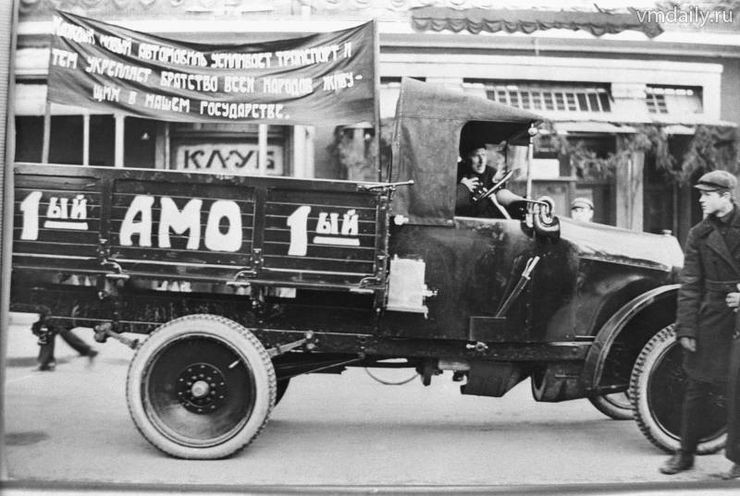
A U.S. factory worker visits the giant AMO car plant south of Moscow. Lever was a tool and die maker, member of Machinists Lodge 159, who participated in the American Rank and File Labor Delegation to the Soviet Union in November, 1927.
‘A Russian Auto Factory’ by E.J. Lever from Labor Age. Vol. 17 No. 7. July, 1928.
How the Union Functions in a Soviet Plant
The workers in the Soviet Union are organized on a voluntary membership basis in 23 national industrial unions. These unions cover all major activities of production, distribution and public service. The basis of each industrial union is the factory local union presided over by a Factory Committee elected annually by the members, to whom it is responsible for the conduct of all union affairs. The Factory Committee is also responsible to the District Council of its Industrial Union, which is a delegated body of all shop locals in a given city or industrial district. Above the District Councils is the Territorial Council, comprising all local organizations in a given industrial territory. Above the Territorial Councils is the Central Executive Committee of the National Industrial Union itself.
The Metal Workers Union
The Metal Workers Union is one of these 23 national industrial unions. It covers jurisdictionally all workers engaged in refining and fabricating iron, steel, brass and all other metals, as well as in their manufacture into mechanical and electrical products. Its membership covers all workers in each industry, from the apprentice boy to the chief engineer and factory manager. On July 1, 1927, this union claimed a membership of 871,000 or 93 per cent of all the metal workers in the country.
The Factory Committee
The Factory Committee in the “Amo” Automobile Works, employing 1829 workers, is composed of 15 delegates, elected by departments, and 4 alternates. The alternates are elected along with the others to give them training in the conduct of union affairs. They have’ a voice but no vote. The Committee elects the officers from its own ranks. They are: the President (or business agent), the Secretary, and the Chairman of the sub-committee for the Protection of Labor, all three of whom in this case are full-time officers. The five sub-committees in this plant are: (1) Protection of Labor; (2) Wage and Grievance; (3) Production and Efficiency; (4) Cultural Educational; (5) Cooperative Stores and Restaurants.
The duties of the President are to supervise all union activities in the plant and to see that the collective agreement is enforced. The Secretary’s duties are to collect membership duties, to keep the minutes of meetings, to keep a complete statistical record of all union activities within the plant, and to be responsible for all ether financial transactions.
Protection of Labor Next to the President in importance is the Chairman of the Protection of Labor sub-committee. He looks after the workers’ health, accident prevention, inspection of safety devices, working clothes, vacation leaves, hospitalization of the sick, and the bi-monthly physical examinations of all young workers and of all others who request medical aid. He tends to sanitation, heating, ventilation and clean towel service. He is aided by his sub-committee elected by the workers.
Wages and Grievances
The Wage and Grievance Committee’s duties include the adjustment of wages for individual workers or groups under the collective agreement and the handling of grievances arising out of their daily work. This subcommittee is composed of an equal number of representatives from union and management, each having an equal number of votes irrespective of number of representatives present. They must thus agree 100 per cent in order to dispose of a case. During the economic year, 1926-27, the sub-committee in the “Amo” plant heard 377 different grievances. Of these 120 were solved in the factory to the satisfaction of the worker, 229 were rejected by the committee, 26 were sent to the District Council for advice and instructions, and 12 went to the Labor Court.
Production
The Production Committee in this plant is composed of 20 members, elected by the workers, 14 of whom are shop workers, 2 are engineers, 2 are foremen and 2 are office workers. This committee is interested primarily in increased production through greater efficiency in the use of plant, tools and equipment. It aims to prevent waste, and to increase punctuality and production in every way consistent with the full protection of the worker’s health and safety. It encourages technical knowledge among the workers as: well as suggestions and inventions. It decides the proper reward for accepted inventions. In this plant half of one year’s savings from any adopted device is paid to the worker inventor.
Cultural Educational
The Cultural Educational sub-committee operates a club-house jointly with those of five other metal factories nearby. The committee supplies education and entertainment of every conceivable sort. It takes the workers and their families for educational and recreational excursions to the country, to other factories, to museums and other places of interest. It also gives lectures during the noon-hour in factory departments. These cover a wide variety of subjects from trade-unionism to the chemistry of metals. A circulating library is kept constantly moving through the shops, the books being brought around in baskets. The club library now has 4,000 volumes, but besides this all other municipal, factory and club libraries in Moscow are at its disposal.
It operates movies and dramatic clubs, football and skating clubs. It runs a school for illiterates. It sends the more ambitious young workers to high and technical schools. It fights for temperance among the workers. It supervises the education of some 160 apprentice boys and girls, as well as of the grown workers many of whom are peasants coming from the countryside to enter industry for the first time.
Co-operation
Finally, the sub-committee on Co-operation functions to enroll members in the Co-operative Society, which operates a store near the factory and a canteen and restaurant where the workers can buy a decent meal for from 10 to 20 cents, each portion being from two to three times larger than the usual American restaurant portion. Russians generally eat more than we do. The restaurant opens an hour before the factory does, so that the worker can get his breakfast without rousing his “old lady” to get it for him. Besides these activities the “Co-op” committee arranges for credit, fuel buying for its members and many other services.
Union Dues
The workers pay 2 per cent of their wages in dues to the volunteer collector in their own department who turns it over to the secretary of the Factory Committee. The entire amount is then turned over to the District Council of the Union which retains usually 25 per cent for its own needs and pays some 10 per cent to the Central Labor Council of the District. The rest goes to the National Union, which pays some 10 per cent on its own account to the Central Council of Trade Unions (corresponding to our A. F. of L.). An indication of “where the money goes” in the National Metal Workers’ Union may be had by glancing at its budget on January 1, 1927.
1. Cultural and Educational Fund–610,804
2. Employment Fund–839,096
3. Strike Fund–171,747
4. Rest Homes—266,276
5. Construction of Club-houses–706,767
6. Reserve Fund–43,804.
7. Traveling Aid Fund–16,703
8. Apprenticeship Training–98,115
9. House Construction–33,269
10. Sanatorium & Health Resort Fund–1,655
These items, however, do not tell the whole story. They merely are given to show the national metal union’s budget on a given date. For nearly every one of these items finds its counterpart in the various locals and district councils, where the individual worker first applied for help. These funds are reserves, in other words, used mostly to help out locals whose funds are too low to care for the needs of their members. For the Russian unions are not only trade unions in our sense of the word, but they also perform services for their members and families which are unhappily left by our unions to private charity agencies. It is practically impossible for a union man or his family in present-day Russia to starve. A book could be devoted to no other subject than the schemes devised by the unions to make it worth his while to be a union man. The union is the “big push” that keeps the worker alive and going. For not only when he is quite able to take care of himself, but when he is most in trouble his union is his greatest friend.
With all these activities the number of full-time officers employed throughout the union is only a little more than one per thousand members. The number of officers grows proportionately smaller as the union gains administrative experience. The secret of the great service the Russian unions are giving their members certainly does not lie in the number of full-time officers employed. It lies rather in the fact that they reach out and interest members in every conceivable kind of activity, so that most of the work is done by volunteers at little expense.
Collective Agreement
The yearly collective agreement under which the relations of union workers and management are regulated is very elaborate and inclusive. It provides not only the basic rates of pay for some 17 major classifications of workers, ranging from the apprentice boy to the factory manager, but it goes into full details as to how much butter workers in the unhealthy trades (such as brass moulding, grinding, etc.) are to receive for their lunch! It even provides for the amount of milk for the apprentices, and for the distribution of hot water for tea at lunch time, and for clean working clothes, clean towel service and soap at factory expense. It details the rest periods in the hot trades, ventilation, accident prevention, enforcement of labor laws and so on. One would think that such things are small details of no particular importance. But the writer sat in with the Factory Committee at “Amo” while it was revising its agreement. From notes handed in by workers to their department delegates, one item after another was seriously discussed and changed.
Wages
The basic rates of wages range from 10 dollars a month for beginner apprentices (whose first year’s work is not considered of productive value) to 82 dollars per month for the chief engineer or manager. In actual practice everybody receives a wage higher than the basic rates, these serving merely as a bargaining point for each of the seventeen classifications. The wages of the higher engineers and managers are set individually by agreement with the trust, their wages varying from, say, 50 per cent above the union rate to several times that amount. There is no top limit for technicians or executives, unless they are members of the Communist Party, in which case $112.50 per month is the limit of their earnings in any capacity. For they are the “shock troops” of the government in setting examples of leadership for all others to emulate. Since about 95 per cent of the factory managers are party members, there are actually many engineers and mechanics who earn more than the “big boss”. But that is the price the boss has to pay in Russia for leadership and the principles for which he stands.
The Factory Committee having drawn up the changes it desires in the revised agreement, the proposal goes to the District Council, in which four other automobile factory locals are represented. Here the various demands are equalized as much as possible. It is then presented to the Board of Directors of the State Automobile Trust, upon which sits one representative of the Metal Workers Union. The other directors are engineers and specialists in the business appointed by the Supreme Council of National Economy. The trust is compelled by law to recognize the union and its books are open at all times. The union is therefore in a position to demand that a certain portion of the budget be set aside for wages. Since production has been on the increase in the past few years there is nearly always some increase coming to the workers when the new agreement is framed. It needs to be decided which group of the workers should receive it. The trust is only too willing to let the union decide that for itself. All the unions have recently been following the practice of giving the increases to the lower paid workers so that their standards of living may be raised to somewhere near the present levels of the skilled. The skilled workers, because of their scarcity, have gained the most in the past few years. But they are now being persuaded by the unions to wait until the level of the unskilled is built up.
The writer agrees with Professor Paul Douglas of Chicago University who accompanied the First American Trade Union Delegation to the Soviet Union in the summer of 1927. He finds that the workers in the Russian industries have bettered their lot by at least 30 per cent and possibly 35 per cent over the conditions prevailing in 1913. Prof. Douglas figures that the increased purchasing power of their money earnings—or what we call real wages—rose about 11 per cent since the revolution, but that counting social insurance, vacations with pay, free or cheaper rents, and various public educational, recreational and health benefits the gains come to well over 30 per cent above pre-war level. It should also be remembered that the length of the working day for which they receive these earnings and services has been reduced by approximately 25 per cent.
They now have the 46-hour week in Russian industry, and in many cases much less, so that the average working day for all industry is now actually 7.5 hours. The 7-hour day is being gradually introduced in the textile industry and also in other industries.
Every machine and improved tool placed in the hands of the Russian worker means more production. And through increased production lies his direct road to economic well-being. The government, and particularly the trade unions, are instruments in the Russian workers hands with which he may increase his income as his productivity rises.
The Russian government is spending hundreds of millions of dollars in plant and equipment. As the workers learn to master the machinery of industry and of their unions they thereby increase the hold over their future. This future seems bright indeed. The Soviet worker is the most hopeful worker in Europe today. In fact, more dejected workers can be found at present unemployed on the streets of our “prosperous” America, than can be found on the streets of any industrial town in Russia.
Labor Age was a left-labor monthly magazine with origins in Socialist Review, journal of the Intercollegiate Socialist Society. Published by the Labor Publication Society from 1921-1933 aligned with the League for Industrial Democracy of left-wing trade unionists across industries. During 1929-33 the magazine was affiliated with the Conference for Progressive Labor Action (CPLA) led by A. J. Muste. James Maurer, Harry W. Laidler, and Louis Budenz were also writers. The orientation of the magazine was industrial unionism, planning, nationalization, and was illustrated with photos and cartoons. With its stress on worker education, social unionism and rank and file activism, it is one of the essential journals of the radical US labor socialist movement of its time.
PDF of full issue: https://www.marxists.org/history/usa/pubs/laborage/v17n07-jul-1928-LA.pdf
 Revolution's Newsstand