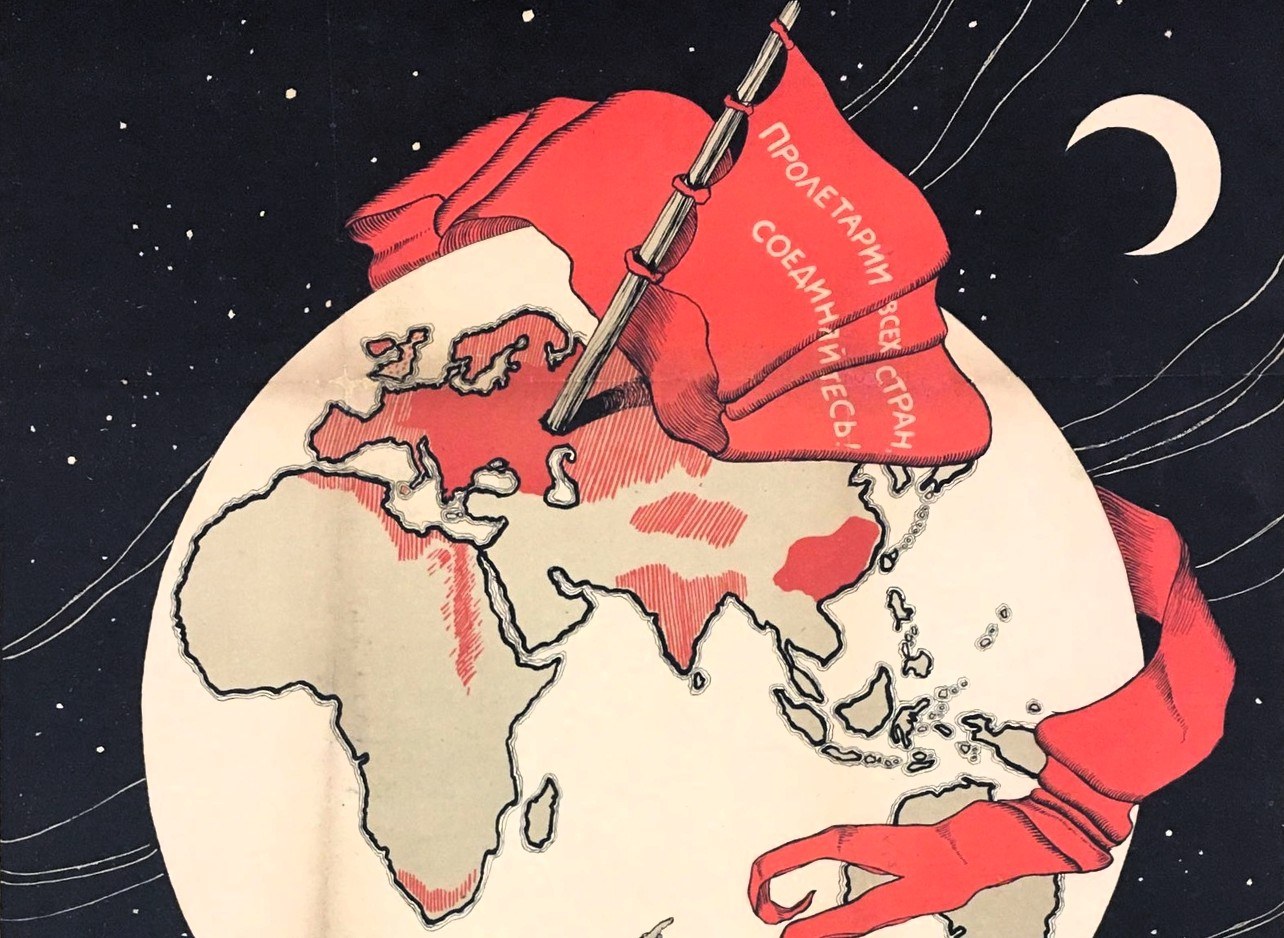
Though this discussion piece from the Comintern’s Western Europe Bureau is admittedly imbued with the heady revolutionary days of the immediate post-war period, it nevertheless confirms the overriding perspective of the early Communist movement that Russia’s social revolution was just the opening shot of a larger, international, revolutionary process.
‘Draft Theses on the Tactics of the International in the Struggle for the Dictatorship of the Proletariat’ from Communist International. Vol. 1 No. 13. September, 1920.
Editor’s Note.—We are inserting this project of the West-European Bureau as a matter for discussion.
I.
As world capital has proved by the imperialistic war that it is not capable of mastering the productive forces created by capitalism, in the same way the capital of the Central Powers, having attained the apogee of its victories, manifested its complete inability to guarantee the requisite conditions for the development of peace, and so in like manner is the capital of the Entente, victor in the world war, now proving its incapacity to reconstruct the ruined world and to guarantee even such an insignificant degree of security and order, as the capitalist regime has given up to now. The capital of the Entente has overthrown the Central Powers, and it is now proceeding to enslave the peoples of Central Europe, thus laying the foundations of a new war. While creating a German “irredenta” in Central Europe, and calling to life a whole series of small States which are fighting one another, the Entente is at the same time subordinating the Balkan countries to the domination of “politicasters” in Serban affairs and Roumanian boyards, between whom it is dividing a subordinate portion of the Bulgarian people. In this way the Balkans remain the same centre of political conflicts, as they have been until now. The dismemberment of Turkey opens an epoch of discord between the countries of the Entente for the Turkish inheritance, as well as conflicts with the Turkish population. In the Far East the Entente has sold 40 millions of “allied” Chinese to the Japanese imperialists, rendering thereby more acute the conflict between the Japanese and American capitalists. The Entente entered the war under the motto of the right of all nationalities to determine their own fate; and now it is leaving the peoples of Ireland, Egypt, and India to suffer under the English yoke, thus assisting in the arousing of these peoples to a revolutionary struggle against English imperialism. The attempt to form a League of Nations has met with a complete downfall; the object of the League has been to submit to the victorious capital of the Entente, and to adapt to a general exploitation, the interests of the vanquished countries and particularly of the small nationalities and the hundreds of millions inhabiting Asia and Africa. And it is quite clear even now that in the camp of the Entente new imperialistic coalitions are arising and acting against one another.
Not being able to preserve the capitalist order in its entirety, the Entente is now striving to strangle the arising Socialist-Communist order at its very birth. With this end in view, it is continuing the war against Soviet Russia, and endeavouring to surround the latter with a circle of small States, whose duty it is to form a deadly loop around the Republic of Soviets, but which themselves are becoming arenas of death and desolation.
This world policy of the victorious capital of the Entente does not allow it to utilise even small possibilities for the re-establishment of the capitalist order which have remained after the world war. The four years’ work of destruction of imperialism might have given way to capitalist constructive work, and the tremendous burden of debts might have been lifted, only if the victorious group of capitalists would have been able to provide the vanquished countries with raw materials and food, and then again place the proletarian masses under the yoke, thus laying the burden of the war upon the proletariat of all the world. By devastating Russia, by endeavouring to deprive Central Europe of the last means of production, the victorious capital of the Entente is not only condemning this greater part of Europe to economic ruin and death by famine, but it is also signing the death warrant of the development of capitalism in its own countries.
Central and Eastern Europe might be the best markets for the products of the industry of the West. They might furnish great quantities of raw material. Their weakening signifies a progressive economic paralysis in the industrial countries of the West, the growth of unemployment, a greater acuteness in social relations, which, as it is, have become very acute in consequence of the terribly high prices, increased taxation, and a growing consciousness of power acquired by the working class during the war. Thus the policy of the Entente is strengthening the revolutionary tendencies; it is driving the workers’ and peasant masses of the vanquished countries into the arms of the revolution; it is accelerating the transformation of the growing class struggle into a civil war; it is showing openly to the popular masses of the whole world that they alone are called upon to bring order into the capitalistic chaos and to reconstruct the world on a new basis. The Communist world revolution, begun in Russia, has in no wise been stopped by the victory of the Entente. On the contrary, during the whole year which has elapsed since the victory, the policy of the victorious capital of the Entente has been working urgently for the revolution and accelerating its development.
II.
The Communist Parties of the countries which still continue to remain capitalistic take this tendency of the world capital working for the world revolution as the starting point of their struggle for the proletarian dictatorship.
Having proved its inability to re-establish the capitalistic order, world capital has at the same time rendered impossible for a long time all policy of reforms. The task of the working class of Central and Western Europe, and also of America, consists in the construction of a Socialist system and not in a reformation of the capitalist world; not in acquiring separate concessions, but in the annihilation of capitalism, which at present means only beggary, chaos, and war. The lessons of all bourgeois revolutions, and also of the Russian proletarian revolution, have shown that a new social order can be realised only by a civil war of the oppressed popular masses against the dying ruling class. At the same time the victorious representatives of the new order must by their dictatorship guarantee the transition from the old order to the new one. The Russian proletarian revolution has shown the international proletariat that the organisations which are absolutely necessary for the realisation of Socialism are the Workers’ Soviets. Socialism can be put into practice, not by means of Parliamentary institutions, uniting all the classes of the population, but only by means of Workers’ Soviets, uniting all the intellectual and manual workers, interested in the establishment of the new order, and retaining all the legislative and executive power in their hands. The Russian proletarian revolution has shown how the capitalist classes are not sparing their forces in resisting the attempt of the working class to liberate itself, not stopping even before treason, entering into coalitions with foreign capital for the struggle against popular masses of their own countries. Therefore the working class is compelled to oppose the counter-revolution with all the means of revolutionary violence, and to defend, sword in hand, the growing edifice of Socialism. The course of political development in Central and Western Europe, as well as in America, during the year elapsed since the moment of the ending of the world war, has confirmed these lessons of the Russian revolution. This year has proved that the idea of realising Socialism by means of a compromise with the bourgeoisie on the ground of bourgeois democracy is absolute Utopianism, the propagation of which weakens the proletariat and is only of advantage to the bourgeoisie. Notwithstanding all its fear of the revolutionary movement, the bourgeoisie is not only sabotaging socialisation, but also any policy which gives the working class the slightest right to share in the administration of the production. Not by social concessions, but by a union with blackest reaction, does the bourgeoisie answer the revolutionary movement, not hesitating to use most brutal force against the proletariat. Therefore the Communist International must refute most energetically as a deceiving of the proletariat any attempt to gloss over by means of a compromise the inconsistency between the striving of the proletariat for liberation and the dictatorship of the capitalists, fighting against such a tendency, represented in Germany by the Social-Patriots and leaders of the Right Wing of the Independent Socialists; in Austria, by the Left Social Democrats; in Holland, by the opportunist Troelstra; and in Sweden by the Social-Reformist Branting, who are all defending the project of forming Labour Chambers alongside of the bourgeois Parliaments. The task of the Communist Parties in the countries which still continue to be capitalist consists first of all in bringing the proletariat to the consciousness that for the workers there is no other issue besides a revolutionary struggle up to the establishment of a dictatorship of the proletariat in the form of Soviet Republics, their unification and joint defence by all the means in their power against the forces of capitalism.
III.
The acuteness, depth, and breadth of the revolutionary struggle for the proletarian dictatorship will grow together with the progress of the decay of capitalism. The rule of capital will become ever more unbearable for the proletariat, and the working class will become ever more and more convinced by experience of the necessity of a struggle for the dictatorship. However, the development of the struggle will not unfailingly take the form of a stormy attack; in the highly cultured capitalistic countries of the West it may acquire the nature of a prolonged period of sustained struggle, demanding ever more and more victims. Only by combating all illusions that the struggle must inevitably move onward at a quick pace, and taking as a starting point for ats tactics a thorough understanding of the slowness and difficulty of the proletarian struggle for its liberation, can the Communist Parties of the West restrain the proletariat from thoughtless attempts to seize power by means of the insufficient forces of small, impatient groups constituting the minority, and instill into the minds of the proletariat the knowledge of what measures should be applied in the struggle. The victory will be achieved by the proletariat only when the wider masses of the workers, including also the intellectual workers, and also the more important stratifications of the working class, as the miners, metal workers, railwaymen, and agricultural labourers will have become adherents of Communism, and have at their disposal sufficient forces to break the resistance of the excellently organised and well-armed reaction, supported by the considerable group of wealthy peasantry, and to lay the solid foundation for the establishment of a Soviet dictatorship whose existence depends wholly on the class-conscious will to power of the proletarian masses.
IV.
These masses are assembled in the Trade Unions which have been formed during the peaceful epoch of the Labour movement; they assembled in such Unions in order to carry on the struggle, both at present as well as in the past, for the improvement of their conditions of life. The Communists are bound to enter these mass organisations of the proletariat, notwithstanding that the bureaucracy of the Trade Unions is trying to transform them from fighting organisations of the proletariat into opportunist and counter-revolutionary organisations of coalition with capitalism. The Communists must contend in the Unions with opportunist and counter-revolutionary policy, not only by means of propaganda, by opposing Communist ideas against Social-Democratic and Social-Reformist ideas, they must also strive to undermine the influence of the Union bureaucracy by taking part in the economic struggle as well. They must not only as propagandists explain to the workers that all collaboration with the class of capitalists leads to their enslavement, that all partial victories, as, for instance, a rise in wages, are nullified by ever-growing prices; but they must call the working class to renew and renew the struggle, when the working class, disenchanted by a defeat or by the fruitlessness of its victory, loses heart and sees no outlet for itself out of the situation. Only again and again returning to the struggle for the improvement of their position, for the increase of pay, for the reduction of working hours, and supporting each other in the struggle, can the workers become welded into a mighty revolutionary class which will be able to carry on, not only a struggle for the improvement of its position—and such a struggle during the period of a collapse of capitalism always proves fruitless in the end—but also a struggle for the transformation of the capitalist society into a Socialist one.
In this struggle the Communists must explain to the working masses that a certain degree of capitalist development once attained, separate demonstrations in the economic struggle are doomed to failure; that each fighting section of the proletariat must hurry to the assistance of the general front; that it is necessary to increase the economic struggle in favour of separate demands, striving to raise it to the stage of a struggle for the acquisition of political power, for the overthrow of the capitalist government.
In this struggle, the Communists working in the Trade Unions must endeavour by degrees, as the conditions of labour and of wages become equalised for the various categories of workers, which must inevitably follow during the process of a further decline of capitalism, to transform the Trade Unions into Industrial Unions, embracing whole industries, which in the struggle against united capitalism dispose of a considerably larger defensive and offensive power than the smaller Unions of the separate trades. The Communists must insist that the centralised counter-revolutionary bureaucracy of the Trade Unions, which is the leader of the masses, should give up its place to the flexible system of Workers’ Deputies. These Deputies, retaining their posts in the enterprises, may, without causing friction, communicate the initiative of the masses to the boards of the Unions, and at the same time spread among the masses economic and political information and enlighten them as to the administration of affairs.
The economic struggle of the proletariat in the epoch of a social revolution consists in unifying and strengthening the pressure of the masses for the purpose of overthrowing the bourgeoisie, but not in destroying or injuring the means of production; although such destruction and injuring are inevitable often in a civil war. Consequently in the economic struggle the Communists must oppose most decisively all idea of sabotage, i.e., of destroying the means of production; and they must explain to the popular masses that the bourgeoisie alone are guilty of the ruin of economic administration, because, not being able to. re-establish it properly, the bourgeois are willing to destroy it utterly rather than allow the means of production to fall into the hands of the working class, which will manage it in the interests of the suffering popular masses.
The struggle for the transformation of the opportunist and counter-revolutionary Trade Unions must be unfailingly carried on also in the countries where there are already revolutionary Trade Unions.
V.
The economic struggle for the improvement of the conditions of life of the working class, growing ever more and more acute, will pass into a struggle for the seizure of power, which is a requisite preliminary condition for the possession of the means of production. One of the stages of this warfare is the struggle for the control over production. The more the lack of different products is felt, which will not even allow the workers enjoying a higher salary to satisfy their most pressing needs, the more the anarchy of production will increase, the more the productive forces, insufficient for the maintenance of the most vitally necessary branches of industry, will become expended in the interests of speculators who profit by the decline of capitalism in the same way as worms feed on a corpse, the more strongly will the working masses experience the need of a control over the production. During a period of increased unemployment, they will desire to determine by means of their deputies whether the closure of certain enterprises is not simply an arbitrary act on the part of the capitalists, desirous of transferring their investments abroad and of weakening the struggling workers by means of unemployment. During a lack of raw materials, the working class will naturally experience the need of controlling by means of its deputies the regular distribution of the raw products. In the struggle for a rise in wages, the working class will be interested in controlling all the conditions of production. This control will deprive the capitalists of the possibility of explaining the rise in the prices, called forth by their own greed of gain, as a consequence of increased wages, and thus instigating the petty bourgeois popular masses, suffering from the ever-growing prices, against the workers.
The endeavour to acquire control over production must become the starting point of a continuous prolonged struggle for the formation of factory councils. Factory councils cannot be organised from above, by means of propaganda only, in the form of a harmonious and complicated system of council. Without counting that the bourgeoisie governments will oppose with all their forces such a general attempt at establishing an economic Soviet organisation, at the present moment the workers are not imbued with the proper consciousness of the need of a control over production; and, in view of the absence of such consciousness, the factory councils will be transformed into representatives only of the class-conscious revolutionary workers, instead of the representatives of whole branches of industry, or representatives of a class. Only by degrees, as the separate groups of the proletariat, in consequence of defeat in the revolutionary struggle, or in consequence of the fruitlessness of their achievements in the progressive decline of capitalism, become penetrated with a lively interest in control over production, will the factory councils arise in certain places, in certain branches of industry, as a result of the struggle against the separate groups of employers, acquiring a more or less extensive right of control, according to the correlation of the forces, and striving for their unification according to the branches of industry. Not as a scheme only pressed on the revolutionary part of the proletariat from above, but in the form of organisations arising and becoming closely welded together in the process of the struggle, can factory councils become developed, and prepare ever larger and larger masses of the working class to undertake the administration of industry which the proletariat will take into its own hands soon after the acquisition of the political power.
Not everywhere will it be possible to obtain immediately the formation of such factory councils. The government will manage, perhaps, in some places to deceive the workers, and to satisfy for a time their demands for control over production, by means of the formation of legal counterfeit factory councils, allowing admission to certain separate proletarians into the antechambers of the capitalist offices, while the real management of production remains in the hands of the directors and secret organisations of the manufacturers. Where the affairs take such a turn, the Communists must see to it that the deceit of the bourgeoisie be turned against the bourgeoisie itself. They must render harmless all attempts at such counterfeit control, denouncing before all the workers, at the factory meetings and in their agitation, all such swindling manoeuvres of the factory administration; and carrying on an obdurate struggle against all steps of the pseudo-controlling institutions, directed against the interests of the working class. The Communists must fight relentlessly against all factory representatives caught in the nets of the capitalists or selling themselves to the same. Without reckoning with the limits established by the laws for the control of the workers, the Communists must call the workers to the struggle for the enlargement of the rights of control of the factory councils, in the interests of public economy and of the popular masses. If, in their struggle against the swindling counterfeit factory councils, the Communists endeavour, step by step, to transform them into real factory councils, then, with the further decline of capitalism, an interest towards control over production will be awakened in the working masses, and the pseudo factory councils will either become transformed into real practical factory councils, or will be replaced by such.
VI.
The victory of a proletarian revolution in any country will be guaranteed only when the working class in its separate demonstrations has attained the degree of resolution and consciousness necessary to enable it, not only to oppose all violence of the bourgeoisie by a resolute refusal to play the part of beasts of burden, but to break the resistance of the bourgeoisie in open fight. The victory of the proletariat may be attained only by means of the complete disorganisation and annihilation of the organs of oppression of the capitalist State. Where that State forms White Guards for the fight against the growing proletarian revolution, the victory will be achieved by a rising of the proletarian masses. All ideas of acquiring political power by roundabout ways, by a sabotage of capitalist production, by the barricading of the working class in separate enterprises, by means of the formation of factory organisations, is the same opportunism as the idea of victory by the help of electioneering bulletins. The proletariat cannot first achieve an economic victory and then only seize the political power. The acquisition of political power, the dictatorship of the proletariat, is a premise to the expropriation of the expropriators. In all the phases of the political and economic struggle, the Communists must propagate among the proletariat the consciousness that all strikes are only a part, a stage in the liberation struggle, which is a struggle for the political power of the State. Against the syndicalist and anarchist illusions regarding the possibility of a proletarian State organisation that must serve as a means for overcoming the resistance of the bourgeoisie, it is necessary to fight in the same way as against the democratic illusions of reformism. All means which the proletariat has used up to now in its liberation struggle must be examined from the point of view of their efficiency, as auxiliary means for the enlightenment of the revolutionary consciousness, for the organisation and mobilisation of the masses; and they must be applied according to the conditions of time and place. In the same way as in the economic struggle the social revolution, up to its culminating point—an armed uprising—must know no other measures than the strengthening, deepening, and combining of the former means of the economic struggle, in a like manner in the political struggle it must not recognise any miracle-working measures and in nowise desist from the application of any means of struggle applied before. Both in the economic and in the political struggles the social revolution signifies only one modification, consisting therein that the working class itself begins to move, and enters the struggle in its entire mass, in consequence of which all other means, occupying the first place during the peaceful epoch, now acquire a secondary importance in respect to the mass movement. Among these measures is the using of the right of suffrage, which, like all other rights, the bourgeoisie accords to the masses with a view to deceiving them, so long as it is not compelled to enter into an open fight against them. When this struggle of class against class enters its last decisive phase, it will annihilate the parliamentary platform, The bourgeoisie will then openly establish its military dictatorship. At the time when the masses are only yet assembling for the fight, when they are only on the way to it, and also in the moments following defeats, the Communists must point out to the revolutionary workers the necessity of utilising all, even the most insignificant agitational and organisational possibilities, which are guaranteed to the members of parliament, and which enable them to reveal in respect of each law and each parliamentary resolution of the slightest importance, the deep difference between the interests of the proletariat and the wealthy minority, and thus to concur in heightening the activity of the masses. A refusal to take part in parliamentary work in such situations is not an act of revolutionary warfare against a bourgeois State, but a facilitation of bourgeois deceit, assisting the calumniatory bourgeois campaign against Communism from the parliamentary platform.
Even before the acquisition of political power by the working class, the rule of the bourgeoisie may be so far weakened that it will be compelled to accord to the working class a wide field for action, and reckon with the existence of political Workers’ Councils. In the struggle for such councils, the growth of the class-consciousness of the working class and the increased decline of the bourgeoisie will manifest themselves. Therefore, the Communists must insist on the formation of strong political Workers’ Councils, as organisations representing the whole working class, in which the will of the working class in its struggle against the bourgeoisie and democratic illusions will become concentrated, united, and directed towards the struggle for the dictatorship.
At all the stages of movement, the duty of the Communists is to form in the organisations of mass movements, and in the mass organisations special Communist groups, carrying on under a special leadership the propaganda of Communist ideas in all proletarian action. In conformity with the forces which they have at their disposal, the Communists must push the mass organisations of the proletariat forward, or must organise the struggle of the proletariat themselves. But even in cases when the Communist Parties are too weak for an independent organisation, when they are compelled during the process of the practical struggle to submit to the actions en masse of the proletariat which is but slowly developing towards Communism, they must, in their propaganda, and in their mottoes purporting to push the masses forward, express in a clear and definite form the Communist point of view. They must be convinced that the more clearly, and the more logically is their agitation carried on, the more fruitful will its influence be in the future, although at the given moment the workers may not even grasp the height of the Communist ideas. The fencing off from the masses on the ground of Communist sectarianism, and also the dissolving of a Communist Party in a general workers’ organisation without a clear understanding of the tasks of the revolution, represents a danger for the development of the world revolution. By isolating themselves from the mass movements and mass organisations of the proletariat, the Communists deprive the masses of their most enlightened and advanced elements. By desisting from an independent existence and from a closely-welded demonstration as a Communist Party, they leave the struggling masses without a solid support and leadership. The Communist Party being a minority, cannot acquire power, but the working masses cannot become liberated without becoming Communists, without consciously following the Communist lead. The dictatorship which is necessary for the realisation of Socialism may be only the dictatorship of closely-welded conscious proletarian masses, but, being the dictatorship of revolutionary workers penetrated by a class consciousness, it is at the same time the dictatorship of Communism.
VII.
The Communist International, born from the struggle of the proletarian advance guard against the imperialist world war, and organised by the initiative of the working class of the first country which has realised the dictatorship of the proletariat under the leadership of the Communist Party, is developing on parallel lines with the decline of the capitalist world and with the strengthening of the world revolution; while the Second International, simultaneously with the development of the revolution, is declining step by step and turning into a union of flunkeys of the bourgeoisie and murderers of the proletariat.
Between the Second and the Third International a compromise can no more be possible than a compromise between the bourgeoisie and the proletariat is possible. The attempt of the fluctuating elements of Socialism to act as intermediaries between the Second and Third International is a fraud on the part of the bankrupt Socialist leaders, who are seeing more clearly every day that the proletarian masses which had backed them in all countries are now passing over in ever greater numbers to the Third International. These attempts at mediation are doomed to failure, as they are not backed by any political idea; between the capitalist and proletarian dictatorship there can be no intermediary group. In all countries where the fluctuating elements of Socialism are still exercising an influence over the workers, the Communist Parties and groups must explain and prove to the masses that, while struggling against their bourgeoisie, they must join the Third International; that the only thing that keeps them from joining it is their own irresolution and loyalty to their leaders, who during the war betrayed the masses, either by their inaction or by their direct support of the bourgeoisie. The Communist Parties must render all assistance, by means of joint demonstrations, to all the working-class masses which are becoming more and more revolutionary, but which have not yet joined the Third International as organisations, and must try to convince them of the necessity of breaking with their opportunist leaders and joining the Third International. A unity among the working masses may be attained, not by a compromise with the bankrupt leaders of social-patriotism and social-pacifism, but only by the conscious resolution of the working masses growing ever stronger in the revolutionary struggle.
The Third International has risen—an International of proletarian action, an International of the joint struggle of the proletariat of the whole world against the world bourgeoisie. Such a unification of the proletariat has up to now been realised only in a very insignificant degree. The support of Soviet Russia by the revolutionary workers of the whole world, and, first of all, by the workers of the Entente, is a practical beginning of the united revolutionary struggle of the world proletariat. At the time when, on the one hand, international capital is uniting in a common attempt to annihilate Russia of the Soviets, on the other hand the support of Soviet Russia is the starting point of the world policy of the proletariat. In so far as the proletariat is uniting for the defence of Soviet Russia, in so far as by its mass actions it is compelling the bourgeoisie to desist from the support of the Russian counter-revolution, from the war against Soviet Russia, the world proletariat is not only helping the Russian working class to defend its achievements from the attacks of the bloodthirsty and greedy international counter-revolution, but at the same time it is guaranteeing the necessary conditions for the victory of the proletarian revolution throughout the whole European continent.
Soviet Russia is a source of raw materials and food products. Soviet Russia with her Red Army, freed from the scourge of war, and after organising her forces, will help the proletariat of other countries to sustain the struggle, in spite of the danger of a blockade on the part of the most powerful capitalist States controlling the import of food supplies. Russia will help the proletariat of the other countries to conquer their bourgeoisie and to reconstruct ruined and devastated Europe on a Socialist basis. Therefore an active defence of Soviet Russia by the proletarian masses of other countries is a duty, which they are bound to fulfil in spite of all sacrifices which the struggle may entail. Every newly-formed proletarian State will be better capable of sustaining its struggle against the capitalist States if Soviet Russia comes out of the war undefeated, opening the first breach in the capitalist government system. Each action of the proletariat directed to the advantage of Soviet Russia will strike a blow at the counterrevolution, acting concretely on entire world policy, and consequently directly undermining the ruling position of the wealthy classes in the given country. The Third Communist International, a union of partisans for a general struggle of the proletariat for the proletarian dictatorship, will thus become transformed into a Union of Soviet Republics, which will arise out of the world revolution as the victorious defenders of the new Socialist order.
The West European SECRETARIAT OF THE COMMUNIST INTERNATIONAL.
January, 1920
The ECCI published the magazine ‘Communist International’ edited by Zinoviev and Karl Radek from 1919 until 1926 irregularly in German, French, Russian, and English. Restarting in 1927 until 1934. Unlike, Inprecorr, CI contained long-form articles by the leading figures of the International as well as proceedings, statements, and notices of the Comintern. No complete run of Communist International is available in English. Both were largely published outside of Soviet territory, with Communist International printed in London, to facilitate distribution and both were major contributors to the Communist press in the U.S. Communist International and Inprecorr are an invaluable English-language source on the history of the Communist International and its sections.
PDF of full issue: https://www.marxists.org/history/international/comintern/ci/old_series/v01-n13-1920-CI-grn-goog-r1.pdf
 Revolution's Newsstand