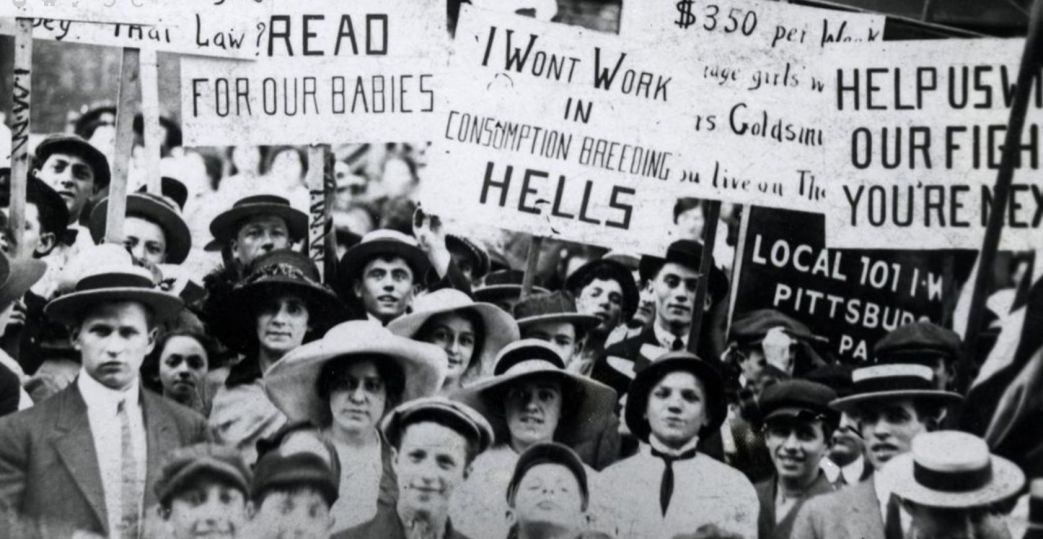
Heroic working class fighters in Pittsburgh are determined to win their strike.
‘The I.W.W. Tobacco Workers’ by Frank H. Goldenberg from Solidarity. Vol. 4 No. 37. September 20, 1913.
Struggle with Unabated Vigor from Better Conditions
Great enthusiasm was displayed by the striking Tobacco Workers of the I.W.W. at their union headquarters last week when they assembled together to discuss the question of remaining out. Speaker after speaker took the floor in appealing to their fellow strikers for industrial solidarity so that they could fight with might against the organized bosses association. Questions were put up to the strikers by one of the speakers who asked them if they were willing to go back to work at the old conditions.
The answer came back like a thunderbolt and wild enthusiasm and applause, “We will rather starve than go back into Goldsmith’s Dry Slitz consumptive breeding hell and those like it.”
The boycott on the “Dry Slitz” stogies one of the brands of stogies made by the Standard Cigar Company in which child labor and the breeding of consumption exists is taking effect, by the weekly cartoons and headlines that appear in Justice. Dealer after dealer are refusing to trade with the Goldsmith’s concern, thus lending the strikers their moral aid. This concern which owns a chain of retail stores in Pittsburgh, is devising some tricky stunts in which to blindfold the public so that they may catch the smoker who is unaware of the strike.
The bosses are beginning to show signs of weakening when a box manufacturer who claims to be a member of the boss association asked for a committee from the strikers last week. A committee was elected by the strikers without power to settle anything but only to learn what this manufacturer has to say and bring back the report to the strike committee. This boss in his statements to the committee stated that the contract that existed among the members of the bosses association expired on September 4th. He also stated that the bosses were willing to grant all demands that appeared in Justice with the exception of the 3 for 5c in which the union asks from twelve to fifteen cents per hundred for making them while the bosses are willing to give from eleven to fourteen cents per hundred. He said that it is his mission to bring the bosses and strikers to a settlement.
Some of the bosses have remarked to strikers on the streets that if the union would agree to have its members make a required amount of stogies out of a pound of tobacco they would settle the strike. (Sabotage.)
To prove this statement, statement, Ruben, owner of the Industrial Cigar Company who makes a brand of stogies that is also well advertised (Gold Flower) and his manager Strauss, last week sat down at a table to see how many stogies they could each make out of a pound of tobacco. Ruben, who is a member of the bosses association told his striking employes that if they would not employ the tactics of the I.W.W. he would settle the strike. He was given the horse laugh by the strikers.
A number of the small bosses who are in no way connected with the bosses association are granting the union demands in wages and better conditions.
The great Labor Day parade held by the strikers in which they marched through the principal streets of Pittsburgh bore fruit to the unorganized workers who are employed in the shops on the north side of the city. A day after the parade an increase of two cents per hundred was announced in the various shops of that district. The aim of the bosses in doing this is to prevent their slaves from being imbued with the spirit of revolt that I.W.W. is now carrying on in that industry.
The craft unions in this city are lending their aid both morally and financially to the cause for which the strikers are fighting.
All strike benefits will be paid on Wednesdays from now on.
A number of bosses are circulating fake reports, among the old men strikers stating that the strike funds are low and it is better to go to work now as the Jewish holidays are coming on in about three weeks and you will need the money. The strike committee issued a warning to all strikers not to pay any attention to the false report that is floating around.
It is already eleven weeks that these militant fighters have been out on strike. Money is needed to keep the strikers and the families from starving. What are you going to do about it?
Must we leave them starve?
Wake up, workers of the I.W.W. and sympathizers show your class interests. Show that the I.W.W. is not dead in Pittsburgh. Remember that principle of industrial solidarity for which the I.W.W. stands for, “An injury to one is an injury to all.” All contributions should be sent to G. Burnstein, 11 Davenport St., Pittsburgh, Pa., Financial secretary of the Strike Committee of the Tobacco Workers Union Local No. 101, I.W.W.
The most widely read of I.W.W. newspapers, Solidarity was published by the Industrial Workers of the World from 1909 until 1917. First produced in New Castle, Pennsylvania, and born during the McKees Rocks strike, Solidarity later moved to Cleveland, Ohio until 1917 then spent its last months in Chicago. With a circulation of around 12,000 and a readership many times that, Solidarity was instrumental in defining the Wobbly world-view at the height of their influence in the working class. It was edited over its life by A.M. Stirton, H.A. Goff, Ben H. Williams, Ralph Chaplin who also provided much of the paper’s color, and others. Like nearly all the left press it fell victim to federal repression in 1917.
PDF of full issue: https://www.marxists.org/history/usa/pubs/solidarity-iww/1913/v04n37-w193-sep-20-1913-solidarity.pdf
 Revolution's Newsstand