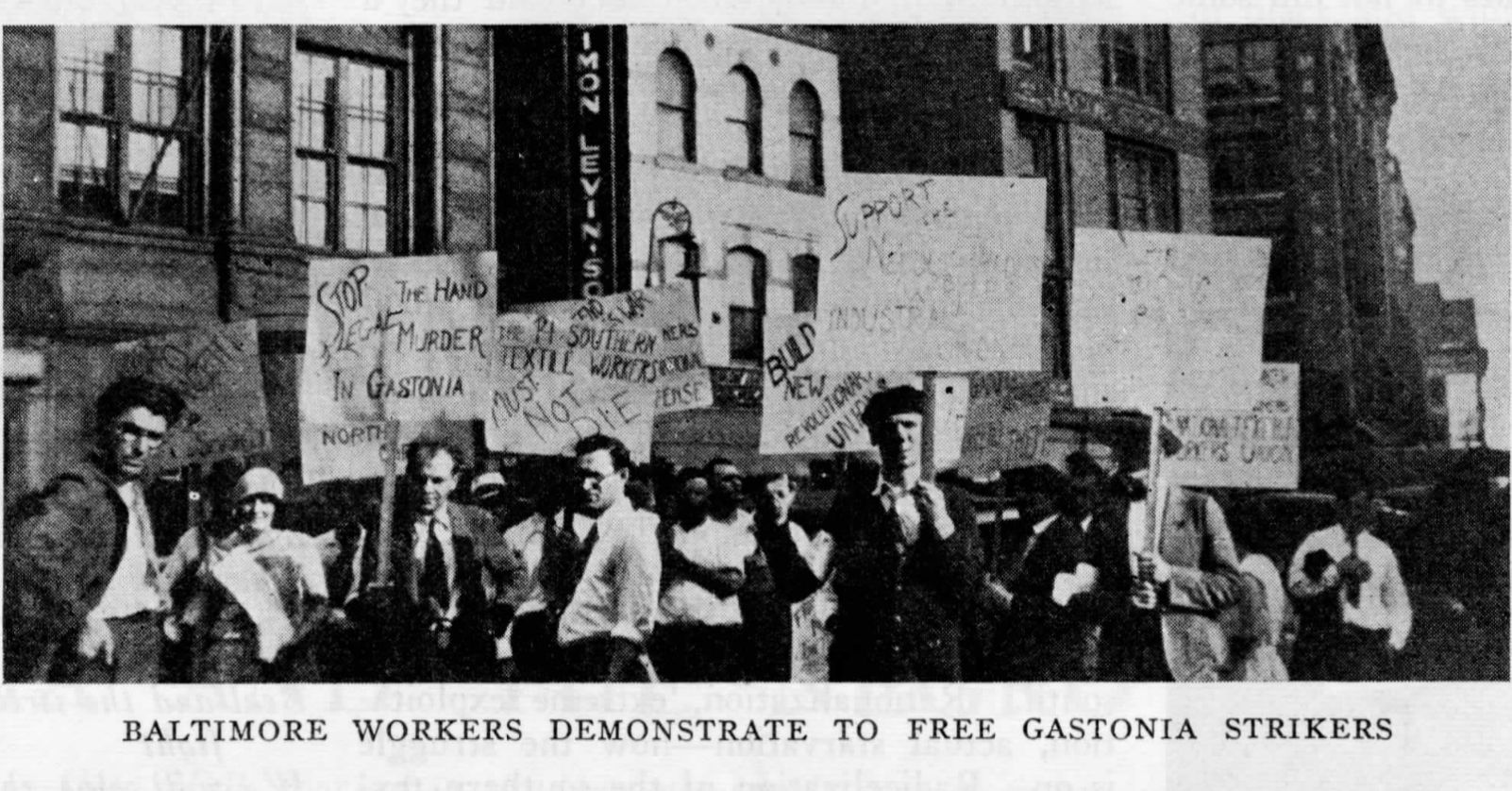
Those that constantly harp about ‘law and order’ are always the first abandon it for extra-legal, lynch-law, gun-thug rule. The case of North Carolina’s Gastonia strike in 1929 being just one bloody example.
‘In The Gastonia Strike Area’ by Walter M. Trumbull from Labor Defender. Vol 4 No. 8. August, 1929.
GASTONIA presents a very different picture today than it did upon the first entry of our comrades into that city after the shooting at the Union Headquarters on the evening of June 7th.
On June 10th and 11th our comrades went into the field and began the work of establishing the International Labor Defense. Representatives of the National Textile Workers Union and the Workers International Relief also entered the city on the same days. All had similar experiences.
Gastonia was an armed camp and ruled by mill-owned thugs and imported gunmen. The Manville-Jenkes “Committee of One Hundred” paraded the streets and toured from one end of the city to the other in trucks and automobiles flashing rifles and shotguns.
Having failed to arouse sufficient lynch spirit on the night of the shooting and the day after, the mill crowd and Chamber of Commerce crowd, were doing all in their power to “make good”. They had failed in their plans for a quick lynching of Fred Beal and had failed in getting a mob together to “run all them strikers out of town”. Now they were wearing the cloak of “Law and Order” and were set up as “the Law” in Gastonia and environs. All trains, busses and automobiles entering or leaving Gastonia were carefully watched and every “stranger” entering the city was haled before the Police for questioning.
Juliet Stuart Poyntz, National Secretary of the International Labor Defense was arrested and gave the police a bad half hour. As the saying is here in the south, “She got them told plenty!”
Wagenknecht of the Workers International Relief, Reid and Dawson of the National Textile Workers Union, and Crouch, representing the Youth Section of the I.L.D. were watched from the time they entered the city. The houses of strikers and sympathizers were being searched time after time within a few hours and every method possible was used to keep things “stirred up”.
Paul Crouch, Ellen Dawson and I went into the worker’s section of the city to reach, if possible, all of those who had been released from the jail. Our task was to form the basis for a large Defense Committee. We found that the terroristic tactics of the bosses had not been absent in the treatment of these workers. They had been released on the condition that they “tear up their Union book” and in most instances of active strikers, “leave town as soon as possible”.
In some instances we found that the workers were in doubt as to whether they should stay in town but in almost every case, the demand to tear up their Union Books was steadfastly ignored. Upon our appearance, they were reassured that the Union and the I.L.D. were on the job and meant to stick with them. They immediately began plans for entrenching themselves.
Now, after four weeks have elapsed since the shooting, Gastonia presents a very different picture. True, the case against Beal, McLaughlin, Buch, McGinnis and the others is being manufactured diligently. A certain Mr. Lumsden, notorious detective and strike breaker, was in charge for a time of manufacturing evidence against the imprisoned workers. He is the same person who failed to get evidence against the persons responsible for the destruction of the former Union headquarters. The evidence which his trained army of evidence manufacturers gather for this case will probably be more efficient.
The county health officer has tried unsuccessfully to find some excuse for declaring the tent colony “unsanitary.” These and other petty annoyances are, for the moment, the only attempts of the authorities to interfere with our work there.
In spite of alarms, rumors and wild tales of impending doom to the W.I.R. tent colony, meetings of the I.L.D. Gastonia Strikers Defense Committee are held regularly at the colony on Thursday and Sunday afternoons. A branch of sixty-five members has been formed in Gastonia and one of thirty six members in Bessemer City. Workers in Charlotte are joining the I.L.D. and a Branch is organized.
At the meetings in Bessemer City, workers, untrained except in the struggle for better wages and working conditions which they have been conducting, take the rostrum and speak to their fellows on the issue of the defense of their leaders in jail. Meetings at Paw Creek and the Rex Mill discuss the defense of their leaders. Activity is the key word in the strike area.
Instead of “throwing a scare into them” the activities of the bosses have strengthened the morale of the strikers. Other workers have taken up the struggle for better conditions and wages and are determined that the jailing of these leaders shall be answered by more intense work for organization. “We will organize, and, by our organization at this time, issue a challenge to the bosses that they cannot very well answer.”
This is the general sentiment among the workers in Gastonia and vicinity as well as in Charlotte and vicinity. The defense has been offered the services of many workers in the work of organizing distribution of literature and “Jimmy Higgins” work. Strikers are preparing to take the road to get in touch with outside towns. Requests are made daily for Union speakers from surrounding mill towns. The first issue of the “Gastonia Labor Defender”, a four page Bulletin, has been distributed in and around Gastonia.
Far from being scared, the Gastonia strikers are strengthened for better fighting and are more confident because they have been tried.
Labor Defender was published monthly from 1926 until 1937 by the International Labor Defense (ILD), a Workers Party of America, and later Communist Party-led, non-partisan defense organization founded by James Cannon and William Haywood while in Moscow, 1925 to support prisoners of the class war, victims of racism and imperialism, and the struggle against fascism. It included, poetry, letters from prisoners, and was heavily illustrated with photos, images, and cartoons. Labor Defender was the central organ of the Scottsboro and Sacco and Vanzetti defense campaigns. Not only were these among the most successful campaigns by Communists, they were among the most important of the period and the urgency and activity is duly reflected in its pages. Editors included T. J. O’ Flaherty, Max Shactman, Karl Reeve, J. Louis Engdahl, William L. Patterson, Sasha Small, and Sender Garlin.
PDF of full issue: https://www.marxists.org/history/usa/pubs/labordefender/1929/v04n08-aug-1929-LD.pdf
 Revolution's Newsstand