Clarissa S. Ware, perhaps the most senior women of the Communist Party in its first years and the Party’s spokesperson on immigrant and immigration issues, on the essential role of foreign-born workers in the U.S. economy.
‘Makers of America’ by Clarissa S. Ware from The Liberator. Vol. 6 No. 5. May, 1923.
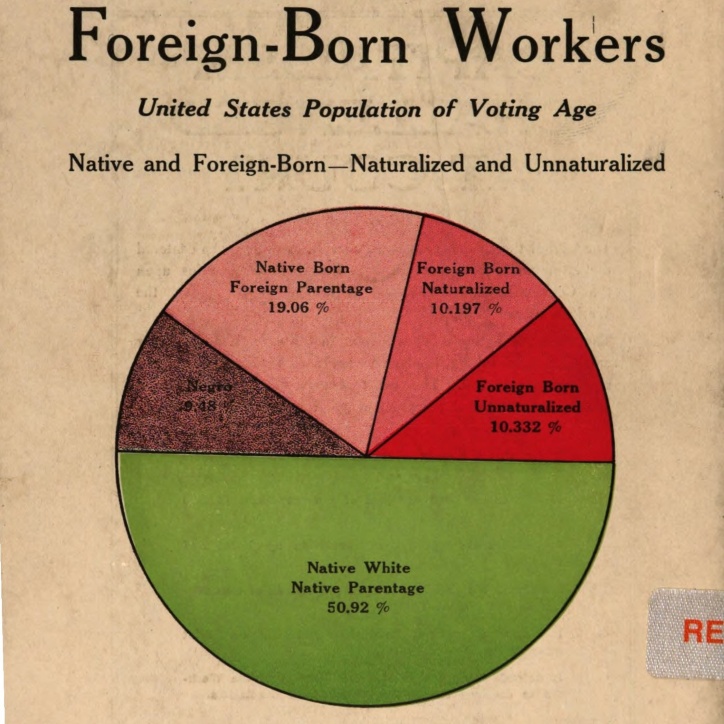
WHO are Americans? Are they the Scottish-born Carnegies and the German-born Schiffs, whose Americanism has paid them in hundreds of millions of dollars? Or are they the millions of workers who have come from far lands, who have dug the coal, moulded the steel, laid the railroad tracks, and run the textile mills; who with their brawn and sweat and blood have built up the gigantic industries of America? Well, here are some facts to ponder over: There are today in the United States almost fourteen million foreign-born men, women and children. These constitute a little over thirteen percent of the population. Over thirty-four percent of all the people living in the United States are foreign-born stock; that is, either they or their parents were born abroad. The 17,816,181 citizens of foreign stock make up twenty-nine percent of the potential voting population of America. Fifty-eight percent of all the workers employed in American industries are of foreign stock. In the basic industries such as mining, iron and steel, meatpacking and clothing–the number of foreign-born workers is as high as sixty to seventy percent.
These figures tell an important story. They fairly shout that foreign-born workers make up the most vital element of American industry. And yet to the lot of these foreign-born American workers has fallen the longest hours and lowest wages, the rottenest housing condition, and the poorest schooling; and on top of all these stand sinister state and national laws discriminating against them. This brutal and desperate life has been the lot of over thirty-four million human beings who came to America seeking liberty and the pursuit of happiness. The employing class of this country has piled up fabulous profits out of the crushing toil of these foreign-born workers; yet it is against these very workers that the employing class is launching a new offensive. The capitalists aim to intensify and perpetuate the artificial division among workers along the lines of nationality. By playing off the native-born workers against the foreign-born workers the employers hope to exploit and oppress more intensely both the native and the foreign-born. It is the centuries-old policy of exploiters: divide and conquer.
National divisions in the ranks of the workers are false” everywhere; in America they are preposterous. Even that spokesman of one-hundred-percenters, James A. Emery, of the National Association of Manufacturers, has admitted that “we are a nation of immigrants; within a hundred years we have admitted to the United States some thirty-four- and three-quarter millions of immigrants.”
These immigrants have come from every part of the world. From the countries of northwestern and central Europe came the first great stream of workers. About half of our foreign stock came over during this first period from England, Scotland, Wales, Ireland, Canada, Norway, Sweden, Denmark, the Netherlands, Belgium, Switzerland, France and Germany. These early immigrants easily adapted themselves to their new environment. In this they were aided by several factors. They came from industrial countries, they spoke chiefly English or German; their traditions, customs and habits resembled those of the people who were already living here. For these reasons, and because of the rapid development of American industries during this period, they soon passed out of the ranks of unskilled workers.
The need for the unskilled–but indispensable–work of railroad-building and ore-mining was supplied by the second mighty tide of immigration. From 1890 until the World War, South Central Europe, Southern Europe and Eastern Europe poured workers into the United States; and the United States not only used these workers; the development of industry, agriculture, transportation and mining became absolutely dependent upon this tide of immigrant laborers. The census figures of 1920 show that over forty-six percent of our workers of foreign stock came over during this period from Poland, Austria, Czechoslovakia, Hungary, Jugoslavia Russia, Lithuania, Finland, Roumania, Bulgaria, Greece, Italy, Spain and Portugal.
The immigrants from these countries differed greatly from the first group. They were chiefly peasants from agricultural countries. They knew little or nothing about modern industrial methods. Many of them had never seen a modern machine. They were cut off from the other workers by differences of language, custom, and religion. Their isolation made them an easy prey to the rising employing class. Today it is these workers who form the most exploited and oppressed section of the American working class. During the world war many of these workers left the hell of American industry for the hell of European battle. The stream began to flow back to its source. But during 1920-21, 668,000 new immigrants landed in the United States. To the employers this new body of immigrants, although necessary to their industrial purposes, presented, politically, a “menace.” They feared that these workers, having learned something from the various upheavals in Europe, would bring with them a certain amount of political heresy. As a sedative for the panic-stricken Babbits, Congress passed the Three Percent Restriction Act. Since the Act was passed 356,995 foreign-born have been admissible to this country. During this last period of immigration no change has taken place in radical make-up of the American working class. It stands at the machines, the looms, the ploughs; it is down in the black bowels of the earth, a vast army of slaves recruited from every corner of the globe. They came strong and sturdy, eager to look on the face of freedom, to drink in the happy air of the promised land. They came to forget the misery and despotism of the old world in the plenty and democracy of the new. A bitter and a terrible disillusion awaited them. In the land of their desire they found themselves despised burden-bearers grinding out their lives at the most killing tasks, condemned to live in squalor, in poverty, in fear of disease and unemployment while they created wealth for their masters.
And now these masters propose to turn their slaves into prisoners. For that would be the logical consequence of the proposals to finger-print and card-index foreign-born workers as if they were criminals out on parole. The object of these measures is to rivet powerful chains to the ankles of half the working class so as to control it, oppress it, exploit it and use it as a weapon against the other half. The danger hangs over the heads not of the foreign-born workers alone; it is as great a menace to the native workers. To ward off this danger all workers, regardless of birthplace, race, or nationality, must unite to fight against the common enemy which exploits them.
The Liberator was published monthly from 1918, first established by Max Eastman and his sister Crystal Eastman continuing The Masses, was shut down by the US Government during World War One. Like The Masses, The Liberator contained some of the best radical journalism of its, or any, day. It combined political coverage with the arts, culture, and a commitment to revolutionary politics. Increasingly, The Liberator oriented to the Communist movement and by late 1922 was a de facto publication of the Party. In 1924, The Liberator merged with Labor Herald and Soviet Russia Pictorial into Workers Monthly. An essential magazine of the US left.
PDF of full issue: https://www.marxists.org/history/usa/culture/pubs/liberator/1923/05/v6n05-w61-may-1923-liberator-hr.pdf
 Revolution's Newsstand