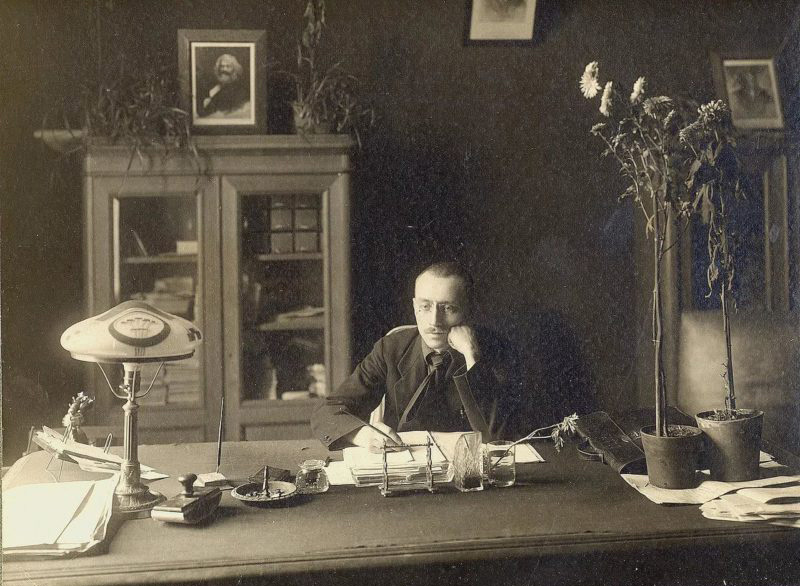
A fearlessly honest assessment of the then current state of the Soviet economy from Milyutin, who embraces the difficulties in the social transformation. Nikolay Milyutin was a Bolshevik trade unionist, architect, and soldier who, literally, stormed the Winter Palace in October, 1917. After the revolution he was engaged almost entirely in planning and economy, being the Commissar for Finances for much of the 1920s, a city planner during the Five Year Plans and then as an academic of architecture.
‘The Economic Program of the Communists’ by Nikolay Milyutin from Communist International. Vol. 1 No. 3. July, 1919.
Socialism is no longer merely a watchword for which the working class had, and, in countries with a bourgeois order, still has to struggle, in whose name the proletariat constructed its organizations, illumining their daily tasks with its light; Socialism now is a practically realizable social system.
Once the dictatorship of the proletariat is proclaimed, as it is in Russia and, Hungary, and apparently will be in the near future in other countries, the transformation on new principles of the entire social, economic order becomes unavoidable. All who have dealt in theories of scientific socialism have written on this1. The expropriation of the expropriators, the reorganization of production, exchange, distribution and of the whole intricate system of economic administration on new socialistic lines, all this is the logical consequence of a Social revolution.
This we have seen wherever authority has passed into the hands of the workers.
In Russia, Hungary land those parts of Germany where the proletariat has enforced its authority, in all the manifestations of the labour movement in other countries, we see one common system carried out with remarkable unanimity, proving that what is now going on is the result not of usual circumstances, but of a deep-lying law of social development.
Such a situation changes the very essence of the construction of a programme.
In all programmes of socialist parties prior to the socialistic revolution we see a definite division into maximum- and mininium-programmes. The maximum-programme is socialism, towards which social development is tending; it is what we must fight for, what must be attained. The minimum programme is what is absolutely necessary, in the interest of the struggle for the final object, to achieve within the bounds of the bourgeois order. The minimum programme had a relative value; its importance was determined by the best conditions of the struggle for socialism.
However, part of the socialists in bourgeois society (and an exceedingly considerable portion in some countries), exchanged the revolutionary meaning and essence of the Socialist programme (remarkably developed already by the Communist Manifesto) for the philistine bourgeois theory of evolutionary development.
The revisionists (especially the Bernsteinists) advanced this proposition: the aim is nothing; the movement is all. The minimum programme was given primary, exceptional importance. The struggle for an eight-hour day, arbitration, universal suffrage, and the like became the socialists positive policy, while socialism as such was put away for Sundays and relegated to the silver casket to be taken out only on particularly solemn occasions; on the stage figured the famous theory of patching and renovating the bourgeois order, of painless transition to the socialistic order, etc.
This liberal policy in the labour movement, produced by a whole series of objective causes, played, as we now know perfectly well, a part pernicious, fatal for the existence of the entire Second International.
A proneness to be content with small achievements, cooperation with the bourgeoisie, parliamentary cretinism, all this created in the end a definite tendency in the activity of the majority of the Second International.
The process of decomposition went on inside and showed up vividly at the moment of capitalism’s greatest world crisis, the imperialistic war of 1911-17.
Only a comparatively small group of socialists remained true to the old flag and did not forget the fundamental object of the struggle–socialism as such.
When the question: to be or not to be, was the issue, the upper stratum of the movement in the Second International proved to be blind to the problems of the historical moment and to be in a state of such close cohesion, materially and psychologically, with the essence of the capitalistic order, that it betrayed the interests of the proletariat of the world and sided with the bourgeoisie of all countries and of each individual country. The maximum programme was sacrificed, thrown overboard in favour of the positive interests of the bourgeoisie, disguised under the denomination of national interests.
Rupture between those who advocated the necessity of establishing de facto the dictatorship of the proletariat, and the inevitability, at the time of the bourgeoisie’s profound dissolution (and such a time in its essence, was the war)–of the transition to the new social order, and those who still clung to the tumbling bourgeois order and strove to stem the tide of historical movement, was not to be avoided. And the rupture took place…
It is a characteristic fact that those who, at one time–like, for instance, Kautsky–so wittily with such true aim, ridiculed Bernstein for his revisionistic enthusiasm, now adopt bis views in their entirety. For Kautsky and his followers socialism remained in the silver casket, remains a mere phrase, not a live system, demanding practical realization.
The development of social revolution is giving the contest a very definite solution, and to those for whom the scientific theory of socialism is not a dead letter, a dry, dead, cloudy scheme, but the reflection of something living and real, a matter of revolutionary practice, this solution, already sanctioned by contemporary history, is perfectly plain.
Socialism, for our time, our epoch, is a practical thing demanding daily enactment.
But, under these conditions, the division of the programmes into maximum and minimum, becomes senseless. Both are fused into one harmonious whole.
Practically, the thing was done, and is done, as follows: from the moment that power passes into the hands of the proletariat, the old minimum programme takes effect, i.e., all the demands concerning the eight-hour day, labour control, the nationalization of land, etc., are carried out.
But, simultaneously with the transfer of authority into the hands of the proletariat, entirely new demands spring up, which bad, and could have no place in the old minimum programme, adapted as it was to the conditions of a bourgeois order of things.
The first to rise are questions of administration, inevitably based on principles other than in bourgeois society. Then come the questions of the socialisation of the means of production, the organization of distribution, the organization of labour. This is already a beginning of the introduction of the socialistic order; it is not yet socialism in the full meaning of the word, only the first step, the first foundation laid. In this respect practice, immediate activity quickly begins to outrun the former theory of socialism, completing it and making it a concrete thing. The socialistic order already has the history and the stages of its development, its improvements will advance, to all intents, at a more rapid pace than was the case in anterior epochs of social life.
Under the socialist order the development of the country’s productive forces, rejecting the old capitalistic forms, necessitates a system of measures promoting the greatest possible, most intensive augmentation of production, making the best possible use of labor, giving a harmonious combination of various activities in the economic sphere and a centralized administration.
One of socialism’s most fundamental tasks is the organized satisfaction of society’s requirements. This demands a corresponding organization of production. The most searching minds did not and could not foresee what would happen to the country’s economic life at the moment of the transition to the new order of things. The attention of even such masters as Marx and Engels–and others after then–was entirely centred on the one idea that the socialistic order would call forth an unprecedented florescence and sudden development of productive forces. Instead of which, there lies between the starting point–(the end of capitalism) and the final establishment of socialism, a most painful transition period, during which the capitalistic system dissolves and falls to pieces and the new order is but shaping itself, inevitably involving a temporary but profound decay of production and disarray of the country’s economic life.
This was not taken into account by the teachers of Socialism, but had to be encountered in the practical process, and therefore the most important starting point of the new programme, is, first of all, the raising of production.
Soviet Russia was the rat country that had to face the tremendous difficulties in this particular province and to surmount them with the utmost straining of her strength, in an atmosphere of constant struggle, not with the Russian bourgeoisie alone, but also, and especially with the banditti of international capitalism.
And, nevertheless, in spite of all the prophecies of cur enemies Soviet Russia succeeded, not merely in steadying, but, to their great vexation, in some respects improving the economic situation. In this respect Soviet Russia’s example is most instructive.
If we now turn to the fun, amental branches of industry, the facts that face us are the following: in the course of the year 1918, and the first half of 1919, as many as 2,000 of the most important enterprises have been nationalized, in other words no less than 90% of the country’s tire industry. It should here be noted that the tidings of the alleged nationalization of small trade, which the bourgeois press is spreading, are without exception, founded on distortions of truth.
The majority of these enterprises has been and is working, all the time. An investigation held at the end of 1918 has shown that the number of workers had decreased, on an average, by 10% and that mostly in the demobilized enterprises, and in the average-sized and small ones. In a series of large establishments the number of workers has increased. More than that. The Supreme Council of Public Economy is organizing new enterprises: 15 large ones are in course of construction. In 1919 was completed the construction of large engine-contraction plant in the city of Podelsk: two new electric power plants are being built, with the help of which it is planned to supply electricity to the entire region around Moscow. In Saratof the construction of an immense factory for agricultural machines has just been begun.
The greatest difficulty which Soviet Russia has had to encounter is the shortage fuel, that most essential factor of production and transport. Her enemies, in their efforts to undermine her strength, are aiming their hardest blows in this direction. Fuel used to be supplied from the following localities: The Don Basin gave the largest bulk of coal (up to 1,200 million poods). The Baku region exported petroleum (up to 400 mill. poods out of a general production of 600 mill. poods). These are the very regions which, through the whole of 1918, have been cut off and separated from Soviet Russia; the Don Basin was, with the support of the French bourgeoisie, occupied by General Krasnof, who assiduously kept hanging the miners. Baku was taken possession of by the English and is still in their hands.
Soviet Russia has been living all 1918 and half of 1919 on a few inconsiderable remnants of old stores, besides 66 mill. poods of petroleum which it succeeded in evacuating from Baku; in addition to which 58 mill. poods of peat were procured, and the coal region under Moscow exploited at the rate of 2 to 3 mill. poods a month, which made about 30 mill. poods coal for 1918, besides preparing as much as 2 mill. cubic sagenes of wood. Only extreme economy in the use of fuel made it possible to keep transport and production going at all.
As regards fuel, 1919 promises to be worse than 1918, since Baku is still in English hands, and the Don Basin, though now almost entirely in ours, is a waste, after the way General Krasnof has run things there. The programme of production for 1919 includes about 60 mill. poods peat, 23 mill. poods coal (exclusive of the Don Basin) and about 5 to 6 mill. cubic sagenes wood. The Donets will yield hp to 40 mill. poods of coal.
It is easy to see how hard it is to increase production under such conditions.
Things have undoubtedly improved, compared to 1918, as regards procuring and supplying raw materials, though here again General Koltchak’s raid in the East has prevented, the timely arrival of so important an article as cotton. As much as 5 mill. poods of cotton has been bought in Turkestan for 1919. The first trains have already arrived; 4 mill. poods of tax have been got together in 1919, so with the balance on hand there are about 5 mill. poods ready for use. 2 mill. poods of flax can be freely exported for the foreign market. About 2 mill. poods of wool have been collected in the first half of 1919, the full demand for the factories being 3 mill poods for the year; so that the cloth and woolen factories will be fully supplied with raw material.
Considerable quantities of leather (hides), furs, hemp, etc., have been collected part of which might be exported.
The supply of metals is proceeding more or less normally, although here also the seizure of the Don and the Ural has had grievous consequences. Such are the conditions under which the industries have received their supply of raw material. The chief of these–such as metal, flax, wool. leather–constitute government monopolies.
Production has proceeded very unevenly, for very various reasons: shortage of food stuffs, of fuel, irregular transport of raw material, etc.
Still in certain respects, production is undoubtedly improving. The industrial statistics for 1918 shows that fully 10% of the enterprises have raised their production, as compared to 1917.
Great industries play a dominant part. In Soviet Russia State trusts have been formed in all principal branches and are gathering strength: the immense State trust in the metallurgical and machine-building lines, “Gomza,” “Contromed,” “Glavrezine,” as many as twenty so called domestic industries have been united into one great textile industry.
The utmost centralization of production in the sense of unification of the several branches and groups of branches and of concentration into the best possible units of production, with regard to the swift solution of economical problems. So says the programme.
All the measures taken, as well as the more detailed demands specified in the programme, are directed towards the realization of the above indicated sole all-embracing State plan for the development of production. This programme has in view not industry alone, but also rural economy (first and foremost the organization of socialistic farms on a larger scale) and, indeed, even the so-called “domestic industries,” to provide for the painless transition from these backward forms of production to the higher forms of wholesale mechanization of industry.
We know very well that small trade and small farming in town, and particularly in the country, will live and exist for a long, a very long time. The process of their transition to new forms will be extremely slow.
Only by experimenting, by spontaneous admission of the advantages of unification and methods of wholesale production, on no account by violent means, as the programme specially emphasizes, is this process possible. The realization of new economic tasks demands an enormous outlay of energy.
The creation of a new administrative machinery in place of the old bourgeois apparatus presented such difficulties as the theoreticians of socialism never could imagine or realize.
To begin with, all the forces of the old order, engineers, technicians, heads and managers of institutions, who were born and reared in a capitalistic sphere and had absorbed all its ways and habits,–took up an extremely hostile attitude towards the new order of things, opposed and still oppose us with open and covert resistance. It is characteristic, that even this resistance was broken after they had entered the service of the new labour government, they frequently by their rearing proved little fit for the construction of new forms of life and economic activity.
Taken in their bulk, with few exceptions, these men, after the social revolution, did not organize, did not construct or create, as, owing to their knowledge, experience and the wide possibilities before them they might have done. They only did, as becomes hirelings, what they were told to do (and often did it badly, wickedly rejoicing at every failure).
They had to be made use of, no more. Hence the enmity and distrust which the working masses naturally feel towards them. This enmity is of a complex nature: in the first place, it is based on the fact that the workers see in the specialists the devoted servants of yesterday’s masters and in the second place they feel the resistance the often covert sabotage, with which the specialists perform any kind of work.
Still, it is clear, that in the twentieth century, industry cannot do without specialists. The process of changing people’s natures and adapting them to given conditions is a slow and lengthy one. Until our own specialists grow up, who will lovingly build up socialist husbandry, we have to take what is left us by the bourgeois order. However, the question of organizers is but one aspect of the general questions of the proper construction of the machinery of economic administration. The most important, essential problem is–how to bring this machinery into organic cohesion with the proletarian masses, to rid it of bureaucratism, to place it so that the labouring masses can control its working and take part therein. Experience shows that Soviet organizations frequently and easily change into bureaucratic ones, permeated with the routine spirit of officialdom, with the latter’s habitual estrangement from life, with its red tape and narrow department interests. There is but one way out of this: to lean on the workers’ trade unions. It should be observed that the majority of the latter, even before the October revolution, were animated by the spirit of communism. The first All-Russian Congress of Trade Unions, which took place in January, 1918, consisted of communists in overwhelming majority, 273; then came 21 social-revolutionists, 66 mensheviks, 50 “non-party” men, maximalists, etc.
The first All-Russian Trade Union Congress clearly and definitely declared: that the centre of gravity of the trade unions’ work at the present moment must be transferred to economic organization. The trade unions, as proletarian class institutions, constructed on production principles, must take on themselves the main work of the organization of production and the restoration of the country’s greatly impaired productive forces. (See the minutes of the First All-Russian Congress of Trade Unions, p. 364)
Nevertheless there were found not a few comrades and workers in economic organizations who opposed this direction of the trade unions’ activity.
At the present time this dispute may be considered settled both in practice and he theory. Life has entirely confirmed the judgment of those who proposed to base economical administration on the professional unions.
The Congress of the Communist Party not only definitely confirmed the above proposition, but deepened it. The machinery of organization, it is said in the programme, “of socialized industry must rest in the first place on the trade unions. They must rid themselves more and more of geld narrowness and turn themselves into large industrial unions, embracing the majority and, by degrees, the whole of the workers in a given branch of production.”
And further: “…The trade unions must arrive at the actual concentration in their own hands of the entire administration of the whole national economy, as a single economic unit.”
By acting along these lines the organs of our economic administration will lose their pernicious bureaucratic spirit.
In order to compass our economic progress we have to keep up a fierce struggle with the expiring forces of the old capitalistic order. We cannot expect to achieve brilliant results all at once; but we cannot and must not be discouraged by temporary failures.
Our programine must take the facts of the present time into proper account and we must rest our hopes on those parts of it which have a future. The communists’ economic programme is nothing but an acting instruction given to those working masses who were the first to take the helm of economic management into their hands.
“Our doctrine,” wrote Marx, “is a guide to action.” So is the communists programme.
The social life of our time is developing with extreme rapidity.
There is much that proves possible to overcome and to realize in a comparatively short time, much that will have to be altered, rejected, replaced by new things. But there is nothing in this to be troubled at. Whoever wants to live, must go ahead.
Moscow, May 21st, 1919.
1. Thus for instance, K. Kautsky, who, more’s the pity, has forgotten much of the good things he once wrote, says: If the proletariat takes possession of political power, socialism will follow of itself as the result of this”. (“A Sketch of the Problems of International Socialism”, by Kautsky. p. 63).
 Revolution's Newsstand