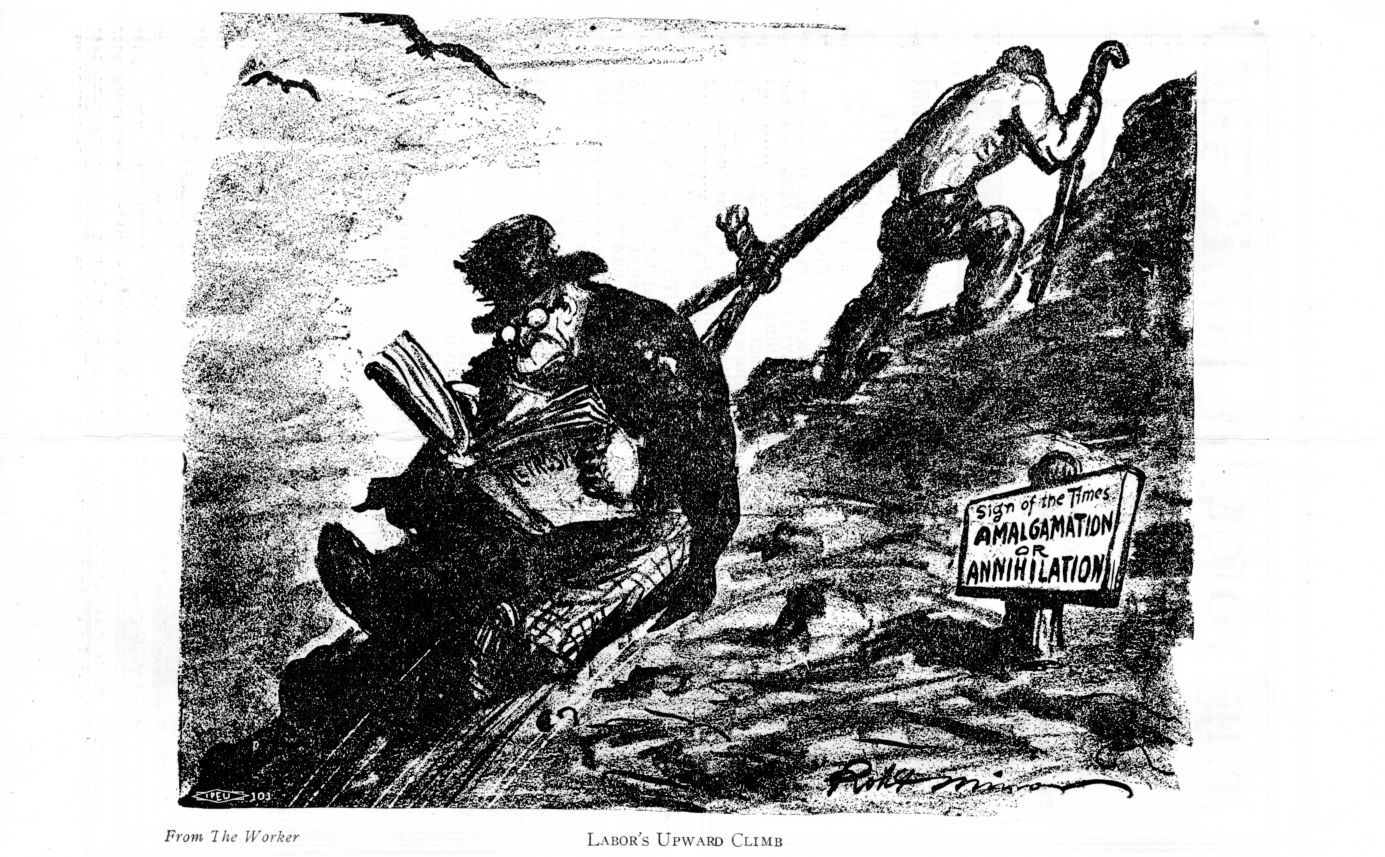
Labor’s ongoing debacle with its rail unions remains an indicator of the sorry state of the U.S. labor movement, where over a dozen unions still represent a industrially united, but organizationally fractured, workforce. Foster on the conventions of Brotherhood of Locomotive Firemen & Enginemen, the Order of Railroad Conductors, the Brotherhood of Railway Trainmen, and the Brotherhood of Railway Clerks. Within days of publishing this issue, the Great Shopmen’s Strike of 1922 commenced., involving almost 1/2 a million workers, many unorganized.
‘They Move an Inch: A Story of Four Railroad Conventions’ by William Z. Foster from Labor Herald. Vol. 1 No. 5. July, 1922.
IT is a basic law of life that all organisms, social as well as animal, when confronted with a new environment must either change to meet the new conditions or perish. That is exactly the situation the railroad unions are now up against. Their environment has changed mightily in the last few years. The employers have become enormously stronger financially and better organized; likewise they have taken on a high degree of class consciousness and are out to destroy all unionism. Unless the unions can meet these new conditions by revamping their methods, structure, and social conceptions they must die. For them it is either evolution or extinction.
The situation on the railroads, from a union point of view, is just about desperate. The companies have wiped out the national agreements. They have gutted the eight hour day, and are reintroducing piece work—that is where they do not farm out the work altogether to dummy contractors operating without the pale of the Transportation Act and company unions are being set up on various roads. All the organizations have taken cuts in wages, and now the Railroad Board is going over them the second time, clipping their salaries again. Within the past few weeks the Maintenance of Way workers, many of whom were cut to as low as 23 cents per hour, have been reduced to a starvation wage; the six shop crafts have also been slashed another 12% or so, and the latest are the Clerks, while the Telegraphers, the four Brotherhoods, and the rest are standing around waiting the convenience of the Board to guillotine them. The general consequence is demoralization among the rank and file, a demoralization which not even the strike vote can check. Many thousands have left the organizations, and many more will do so in the near future unless a way is found to stop the rout.
In such a crisis one would think that our leaders would do the necessary and logical thing; that is, call a special convention of all railroad organizations and there weld them together into a compact body able to repel the assaults of the companies. But of course nothing like that is done. The movement is too much Gompersized for such action. The best that they do is to develop a mild progressivism. In their conventions during the past month, the Brotherhood of Locomotive Firemen & Enginemen, the Order of Railroad Conductors, the Brotherhood of Railway Trainmen, and to a lesser extent the Brotherhood of Railway Clerks, failed badly to measure up to the needs of the situation. But they did move forward an inch nevertheless, and in our stagnant labor movement that is not to be sneezed at.
Facts About the Organizations
The B. of L.F. & E. opened its convention in Houston, Texas on May 1st. This was the 29th since its foundation in 1873. There were present 905 delegates representing 120,000 members. From 1881 to 1892 Debs was Secretary of this organization. At its foundation the union functioned in wage matters, but after the great, ill-starred strike of 1877 it repudiated strike action and confined itself to serving as a sick and death benefit society. The enormous upheaval in the middle ’80’s woke it up again and at its 1885 convention it readopted the strike policy. The convention of the B. of R.T., with 760 delegates, opened in Toronto, May 9th. Approximately 180,000 members were represented. The B. of R.T., originally known as the Brotherhood of Railroad Brakemen, was organized in 1883. Like the rest of the Brotherhoods, it encountered so much opposition in its early stages that it had to function merely as a fraternal order. It became a genuine labor organization in 1885. It has assets to the extent of $8,000,000. The O.R.C. opened its 37th convention in Cleveland the first week in May. The organization consisting of 60,000 members, was founded in 1868. Until 1890 it devoted itself to beneficial features; but at that time it changed its constitution so that it became a trade union. The B. of R.C. etc. held its convention in Dallas, Texas, beginning May 1st. This was the 14th since the founding of the organization in 1899. There were approximately 150,000 workers represented. The Clerks’ union lingered along from the beginning, having only a small membership. At the outbreak of the war there were only 6,500 members on its rolls. Then it underwent a tremendous growth, reporting 175,000 members in 1921.
Warren S. Stone’s Program
In the following recital of the progressive measures considered by the four conventions the name of Warren S. Stone, Grand Chief of the Brotherhood of Locomotive Engineers, constantly occurs, despite the fact that his was not one of the four organizations directly involved. The reason for this was his great activity in connection with the conventions. He has developed a definite railroad program, including closer affiliation, working class political action, recognition of Russia, co-operation in general and co-operative banking in particular, building up of the railroad paper, Labor, remodeling the convention system, etc., and he went from convention to convention to put it across. Three of them, the Firemen, Conductors, and Trainmen, he visited in person, and no doubt his influence was powerfully felt at the other, the Clerks. And when all was said and done, nearly everything progressive that was accomplished at the conventions, at least that of moment, was the result of his campaign.
Stone is not a radical, quite the reverse. He has showed time and again (lately at the Ladies Garment Workers’ convention) his hatred of revolutionists and their policies. Likewise, his conduct in holding his organization aloof from the general industrial struggles of the mass of railroad workers, thereby gravely injuring the cause of the workers and aiding that of the companies, shows conclusively that he lacks the larger vision. Nevertheless in many minor aspects of the movement he has quite a streak of progressivism. Despite his serious shortcomings he stands head and shoulder above the other leaders in the railroad industry, not only because he has some sort of a program, (while they have none), but also because he has the aggressiveness to put it through. Compared with him the static Jewell, President of the Railway Employees’ Department is a pigmy. It is safe to say that if the Brotherhood of Locomotive Engineers were affiliated to the A.F. of L. Stone would soon put Sam Gompers off watch.
Amalgamation
The question of closer affiliation cropped up all around. In this respect the Clerks took the lead and showed real understanding. They adopted one resolution, introduced by Wade Shurtleff, calling for the amalgamation of all railroad unions into one body, and another resolution, introduced by J.T. De Hunt, the one originally adopted by the Chicago Federation of Labor, demanding that the A.F. of L. proceed to fuse all the craft unions in every industry into a series of industrial organizations.
The Trainmen, besides developing a movement for closer relations with the conductors, adopted a resolution to amalgamate with the Switchmen. Should this go through, and there is every prospect it will now that the Switchmen’s Union is broke and cannot furnish good paying jobs to its officialdom, it will put an end to one of the most disastrous inter-union wars in the history of Organized Labor. The amalgamation should have been brought about and the fight stopped 20 years ago. Although the Switchmen were long the most militant craft on the railroads, their position in resisting the merger was wrong and their arguments that brakemen and switchmen cannot function in the same organization were ridiculous. The fight held the whole railroad union movement back. Moreover great harm was done to trade unionism at large by the Switchmen who, taking advantage of their A.F. of L. affiliation, systematically poisoned and estranged the body of trade unionists from the four brotherhoods.
But an even more important amalgamation project developed at the Firemen’s convention. They decided to have their general officers sit in with the general officers of the B. of L.E. to map out a plan to merge the two engine service organizations into one. When completed, the plan will be submitted by referendum to the membership of both unions for ratification. It is almost certain to carry. This scheme is pretty much the work of Stone. He went to Houston and advised the Firemen to go through with it. Immediately after he stopped talking the resolution was adopted. In explaining the advantages of the plan Stone touched on the only real obstacle to amalgamation, namely, the fear by the officials that they may lose their jobs. He said, “It would materially reduce the number of field officers, permit of having but one instead of two salaried Chairmen on each road, and all of that. Some of these salaried Chairmen may be out of a job.” “But,” he declared, “don’t legislate for your general officers, legislate for the rank and file of your Brotherhood and then you will get results. Forget your officers.”
Political Action
All four organizations declared for the political program inaugurated at the Chicago conference recently. This puts nearly all of the unions on record for that movement, which looks like a Labor Party in the making. Quite evidently the railroad workers are tired of being kept political ciphers simply because Mr. Gompers refuses to think. It will be only because of timid leadership if, before these lines get into print, they have not marched into the A.F. of L. convention and successfully demanded the abolition of the absurd policy of Labor’s “rewarding its friends and punishing its enemies.” Stone made a strong defense of the new political policy before the three conventions at which he spoke.
Recognition of Russia
Another point in Stone’s program is the establishment of peace with Russia. In some manner he has developed a sympathetic attitude towards that embattled country. In the March number of the Locomotive Engineers’ Journal there appears an editorial, doubtless with Stone’s O.K., in which Gompers is laced as seldom before because of his brutal Russian policy. In his scorching article the writer declares that Mr. Gompers, “Like the gold-braided generals of France, wants peace, but first he wants his bucket of Bolshevik blood.” He states further that the well-informed labor leaders, political economists and statesmen of Europe are agreed that Russia must be rehabilitated before normal conditions can be restored in the world. Then he says, “Opposing them are the bloodthirsty Czarist generals, the horde of ex-Russian landlords, no-account counts, ignoble nobles, and other jobless remnants of autocracy, together with a Russian propaganda bureau in New York sponsored by eminent Wall Street bankers and labor haters. Truly Mr. Gompers has chosen strange bedfellows.” Stone made no issue of Russia in his convention addresses. The Clerks were the only one of the organizations to take a favorable stand in the matter, and they demanded the recognition of Russia and the establishment of trade relations with her.
Co-operative Banking
At the various conventions Stone made propaganda for another one of his measures, namely, labor banks; but so far as the writer has learned at this time, the only organization to respond to the proposition was the Clerks. They commissioned their officials to go ahead and organize a bank to be owned and controlled by the union. Thus added impetus was given the labor banking movement initiated by Stone. Already, in addition to the original B. of L.E. institution, the following labor banks, are either in operation or being organized: the Amalgamated Clothing Workers in Chicago, the Brotherhood Railway Carmen in Kansas City, the Order of Railroad Telegraphers in St. Louis, and the joint locals of the four Brotherhood organizations in Minneapolis. The thing is growing too rapidly. We can look for a crash soon, once the well-known genus labor faker begins to take a hand at high financing.
Building the Journal “Labor”
One of the striking features of the conventions was that three of them, the Clerks, Firemen, and Conductors, subscribed their entire membership in a body for Labor, the weekly paper owned and controlled by the 16 railroad unions. This meant an immediate increase in circulation of about 300,000 per week. Rarely if ever has labor journalism experienced anything of the like. And again the hand of Stone is seen at work. The building up of Labor is one of the planks in his platform. For a long time the various organizations had backed the paper in a desultory way, issuing all sorts of pressing and even frantic calls through their respective journals urging the membership to subscribe for it. But the Locomotive Engineers, which is to say Stone, were the first to really take the matter seriously. At their last convention they subscribed the whole organization for Labor. Stone then took up the propaganda for it in the organizations, advocating it in his recent convention speeches. It now looks as though practically all the railroad unions will take the paper en masse. Within a year or two it will probably be one of the widest-read labor journals in the world. Labor represents one of the get-together tendencies now agitating the railroad workers. Unless it falls short of its true mission it will some day supplant the conglomeration of 16 railroad union journals that are now in the field. Although now cold and official, it should finally become the one great paper of the one all-inclusive industrial union of railroad workers.
Reorganizing the Conventions
Particularly demoralizing to the railroad unions is their system of holding conventions. One bad feature is the custom of having them in different cities each time. This reduces the gatherings to mere junketings and picnic parties. The habit is for the delegates to spend more time and interest in sightseeing than in considering organization business. Another bad feature is the system of allowing one delegate from each local union, with all expenses paid by the general organization. One effect of this is, in the larger unions, to make the conventions practically into mobs of 1000 to 1500 delegates apiece. Real business is out of the question. And the expense is fabulously high. At their last convention the Firemen Carmen, Conductors, Clerks, and others spent over $600,000, and the pended about the same. The result is that conventions become fewer and fewer as the delegations grow larger and the junketing spirit develops. And even when held they are practically worthless.
For some reason Stone has singled out this abuse, and during the recent conventions he broke a few lances against it. At the Firemen’s gathering he panned them (also the Conductors) for their antiquated convention system. He stated that the Engineers have reduced their delegation one-half, likewise their expenses. Besides, they now hold all their conventions in the home city, Cleveland. He declares that it took a long fight to put the thing through in the face of the opposition of the cheap delegates, ever present at conventions, who battled to get as much out of the organization as possible for their petty graft. He said, “We tried to get it through three conventions. We finally got it referred to a referendum vote of the membership, and by an 80% vote they decided in favor of a reduction of delegates. This meant the end of having conventions for the purpose of having good times and junketing trips.” The Firemen, with their convention costing them $52.06 a minute and due to last a month, saw the point and appointed a committee to work out a plan along the lines suggested.
In addition to holding all the Brotherhood conventions in one town, Stone aims to center their headquarters in one place also. At present three of them, the Engineers, Firemen, and Trainmen, are located in Cleveland. Stone invited the Conductors to move in from Cedar Rapids, Iowa, so that all might get together without much difficulty. But in this he was defeated, the old fogy Order of Railway Conductors refusing, for sentimental reasons, to leave their ancient home.
They promised however to take up this weighty matter again in their 1925 convention.
The Old Guard Re-elected
Few changes were made in the various administrations. Fitzgerald of the Clerks was reelected unanimously. Sheppard of the Conductors also got by without difficulty. Carter of the Firemen refused to run again, a fact which will help amalgamation of the two engine service organizations mightily. He has become a historian of his Brotherhood at the full salary he got as President. His successor is D. B. Robertson. Bill Lee had opposition in the Trainmen, Val Fitzpatrick running against him. But Lee won out handily. The fine spirits on his branch of the service who should have been there to fight him are now out of the organization; they quit during the ill-starred “outlaw” strike of two years ago. Lee was able to take much credit from this affair, posing as the saviour of the Brotherhood. He defeated the effort to have the “outlaws” reinstated. The railroaders of the country will be afflicted with him for another three years unless the unexpected happens.
Noteworthy was the absence of the Plumb Plan from the conventions. Though some railroaders continue to do reverence to this guild system, it is now practically a dead issue. Sam Gompers had a large share in its killing. Carter said of it in the Firemen’s convention, “The propaganda that has been spread against it by the railroad manipulators and the big financial interests has rendered it impossible to establish its principles under the name “Plumb Plan.”
Such, in the main, was the work of the conventions. A little was accomplished, but in view of the prevailing crisis it was pitifully inadequate. In one summary we have mentioned the work of Stone often, and his influence was undoubtedly great. None of the other big leaders had a thing to offer. It was the old story of the one-eyed man being king in the land of the blind. But some also felt the influence of our League in the conventions. In discussing the Clerks’ convention the Illinois Tribune said, “With a vote that left no misunderstanding this convention went on record in favor of the amalgamation plan which the Trade Union Education League has been advocating, and by the same kind of a vote recognition of Soviet Russia and the establishment of trade relations by this Government were demanded.” Such mild advances as were made will not suffice. Nor will the oncoming strike settle matters, though that must of course be fought through to victory. The only thing that can fully meet the needs of the railroad workers is the realization of the program of the Trade Union Educational League. First, the entire army of railroad workers must be fused together into one body, and then this organization must be inspired with a revolutionary purpose. Only when this is done will the railroad workers really be fitted to make progress towards their eventual goal of emancipation.
The Labor Herald was the monthly publication of the Trade Union Educational League (TUEL), in immensely important link between the IWW of the 1910s and the CIO of the 1930s. It was begun by veteran labor organizer and Communist leader William Z. Foster in 1920 as an attempt to unite militants within various unions while continuing the industrial unionism tradition of the IWW, though it was opposed to “dual unionism” and favored the formation of a Labor Party. Although it would become financially supported by the Communist International and Communist Party of America, it remained autonomous, was a network and not a membership organization, and included many radicals outside the Communist Party. In 1924 Labor Herald was folded into Workers Monthly, an explicitly Party organ and in 1927 ‘Labor Unity’ became the organ of a now CP dominated TUEL. In 1929 and the turn towards Red Unions in the Third Period, TUEL was wound up and replaced by the Trade Union Unity League, a section of the Red International of Labor Unions (Profitern) and continued to publish Labor Unity until 1935. Labor Herald remains an important labor-orientated journal by revolutionaries in US left history and would be referenced by activists, along with TUEL, along after it’s heyday.
Link to PDF of full issue: https://www.marxists.org/history/usa/pubs/laborherald/v1n05-jul-1922.pdf
 Revolution's Newsstand