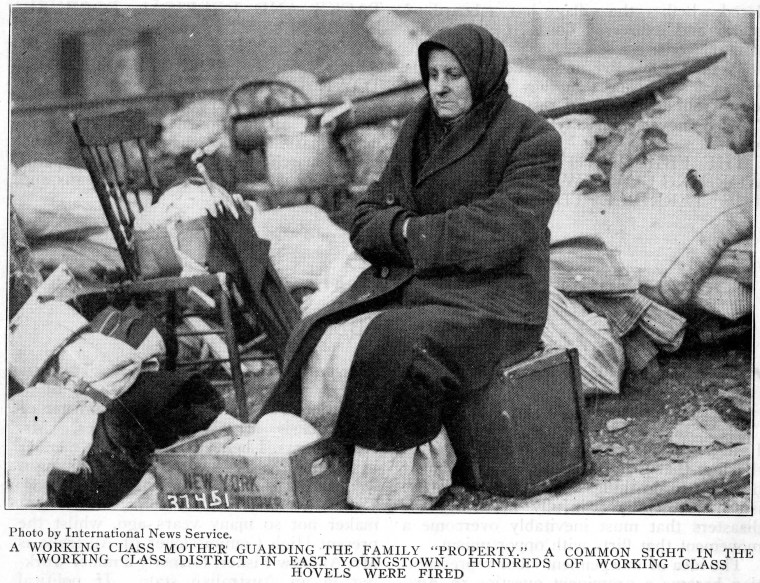
The editor of Solidarity travels to East Youngstown to investigate the circumstances behind the razing of much that town town on January 7, 1916 during a steel strike in East Youngstown (today’s Campbell, Ohio) which saw gunmen murder 3 workers and the burning of several blocks.
‘After the Youngstown Riot’ by B.H. Williams from Solidarity. Vol. 7 No. 318. February 12, 1916.
How They May Be Aided From the Outside. Some Facts On the Situation There, and the Shady Moves of the Authorities.
The editor of Solidarity was in Youngstown on Feb. 6 and had an opportunity to size up the situation there at close range. Accompanied by Attorney George Edwards, a group of fellow workers, including the editor and wife, Frank Midney and Chas. Hahn, were permitted by the sheriff to see and talk with Fellow Worker David Ingar for a few minutes at the county jail. Ingar has nearly recovered from the effects of bullet wounds he received on Jan. 7 at the hands of guards of the Youngstown Sheet & Tube Co., and wears the same cheerful smile that his friends have known so well. But he thinks the authorities intend to “frame up” on him, and try, as usual in such cases, to railroad him to the pen for a long term. The charge against Ingar is supposed to be “rioting,” a misdemeanor, which usually requires a ball of not more than $500. But in Ingar’s case the bail has been fixed at $1,500; and the district attorney has hinted at some “graver” charge, which he refuses to divulge at the present time.
To date, 99 indictments have been returned by the grand jury against East Youngstown strikers, and among these are nine “secret indictments,” which are presumed to be against workers not yet arrested, but may refer to this “graver” charge talk by which the prosecutor is trying to surround the case with mystery. All the atmosphere of the usual frame-up is apparent in Youngstown.
Attorney Edwards, both in conversation with the writer and in a speech which he made that same afternoon, pointed out how easily a frame-up may be staged. The jury is impaneled from names of qualified electors drawn on a wheel. Edwards mentioned a case that occurred in Youngstown some years ago. A professional gunman shot and killed two union pickets during a strike. It was a plain case of murder. But the corporation of course came to the defense of their tool, who happened to be at German named Wolf. Now it so happens that at least three-fourths of the qualified voters of Mahoning county are in the city of Youngstown, the remaining fourth being in the rural environs. But when the Wolf jury wheel was drawn, it was found that with some half dozen exceptions, there were the names of 210 German farmers of Mahoning county! And Wolf was acquitted. Edwards of course did not say that the jury wheel was “fixed.” But one need not be an I.W.W. to draw that plain inference from the facts. The statement is also going the rounds of Youngstown, that when the “rioters” were arrested on Jan. 7, representatives of the Sheet & Tube Co. visited the jail and pointed out certain “rioters” to be released, and that they were let go without a hearing. If true, this points to the conclusion already advanced that paid tools of the company were responsible for the dirty work in East Youngstown on Jan. 7. The company evidently wanted a good excuse for getting the militia to the strike scene, and not only used their hired assassins to fire from the bridge upon the assembled strikers, but also used others to help attract the justly angry workers away from the company’s property across the Mahoning River. The burning of East Youngstown ensued.
Now follows the necessity for a frame-up against the arrested strikers, to cover up the Sheet & Tube Co.’s criminal tracks, and also to impress the unskilled workers with the idea that it is extremely hazardous for them to revolt under any circumstances. That the militia was actually used to cow the strikers into returning to work, is well known in Youngstown. And something happened, after their return, with the militia present, that is worthy of note. The writer was told that the returning strikers were given their back pay on their return to the mill, and that their pay envelopes were short from 25 to 50 per cent. of what they had coming to them. In other words, these workers were cheated out of part of their measly wages while the soldiers were around the pay windows to “keep order.” Dave Ingar was among the strikers who were shot by the guards from the center of the bridge. He was taken to the city hospital and an I.W.W. button was discovered in his clothes. At once the authorities seized upon Ingar as a possible goat. The indictment, and the prosecutor’s suggestion of a “graver” charge than “rioting” will thus cause no surprise on the part of any I.W.W. It is well to note, however, that Ingar was shot at about 4 P.M. on Jan. 7, and the rioting did not occur until after 5 P.M., when Ingar was already in the hospital. But a little circumstance like that doesn’t make any difference, you know.
The defense of Ingar and the others is being conducted in a satisfactory manner, I think. As yet it is largely local, as far as finances are concerned. A number of good protest meetings have been held, and efforts made to enlist all the labor organizations of that immediate vicinity. The hall for the meeting last Sunday in Youngstown was too small for the crowd, and a number had to be turned away. But a collection of over $25 was taken up, with the understanding that it would be used to arrange for another meeting on Feb. 13 in a larger hall, with the further idea of getting bigger and bigger meeting places as the interest develops. A defense committee of some dozen or more members is working steadily and effectively.
The speakers at the meeting did not mince matters. They pointed out that this case against Ingar and the others was a frame-up, and was part of a bigger scheme to overawe the unskilled workers of the Mahoning valley, and keep them from revolting for higher wages and better conditions. And, since the corporation did not want any more strikes, it was the business of the workers present at this meeting to go out among their fellow workers and advise them to strike and to proclaim a general strike of all the plants in the district. That would be the most effective means possible with which to secure the release of these victims of a capitalist conspiracy. The speakers declined to apologize, they said, for any violence the workers may or may not have committed in East Youngstown on Jan. 7. They honored these 99 prisoners who had revolted against a miserable wage scale of $1.95, and were accused of “rioting” after they had been shot at by irresponsible thugs in the employ of the company. A note of defiance and high resolve was breathed throughout the meeting, and it is needless to state that the crowd showed their enthusiastic accord with that spirit. There le a splendid bunch of fighters in Youngstown, and their numbers will increase.
The defense, I say, is mainly local, as it should be in all such cases to start with. But much can be done from the outside right now. I suggest, for example, that every local of the I.W.W. at its next propaganda or mass meeting, make it a point to bring up the Youngstown affair, acquaint the audience with the facts of the strike and the Ingar prosecution, and send in a stirring resolution of protest to the district attorney of Mahoning County and to the governor at Columbus. In case an appeal for funds is made, here is a tip: Thousands of skilled workers, mostly belonging to the AF of L have gotten increases of wages, as a direct result of this revolt of unskilled workers. Give the AF of L’ites an opportunity to show their “gratitude” for this lift by contributing to the defense of these indicted strikers. They won’t strike with their unskilled brothers, but they may be shamed into contributing a few dollars for legal defense. It is true that President Voll of the Ohio State Federation of Labor helped the prosecution greatly by suggesting to Governor Willis that he (the governor) “investigate thoroughly the East Youngstown riot and see that the guilty parties were punished, whether they were company officials or strikers.” Of course Voll did not know that company officials are never indicted or questioned in such matters, and that his suggestion would only afford the prosecutors a good excuse for accusing and convicting strikers Whether there was any evidence or not. Nevertheless, there may be a different spirit among many of the rank and file of the craft union, and the above suggestion should be kept in mind.
Let Youngstown know that the rest of the country is watching and opposing its attempt to railroad innocent strikers to prison. Strengthen the hands of the local defense. “An injury to one is an injury to all.”
B.H. WILLIAMS
The Industrial Union Bulletin, and the Industrial Worker were newspapers published by the Industrial Workers of the World (IWW) from 1907 until 1913. First printed in Joliet, Illinois, IUB incorporated The Voice of Labor, the newspaper of the American Labor Union which had joined the IWW, and another IWW affiliate, International Metal Worker.The Trautmann-DeLeon faction issued its weekly from March 1907. Soon after, De Leon would be expelled and Trautmann would continue IUB until March 1909. It was edited by A. S. Edwards. 1909, production moved to Spokane, Washington and became The Industrial Worker, “the voice of revolutionary industrial unionism.”
PDF of full issue: https://www.marxists.org/history/usa/pubs/solidarity-iww/1916/v7-w318-feb-12-1916-solidarity.pdf
 Revolution's Newsstand