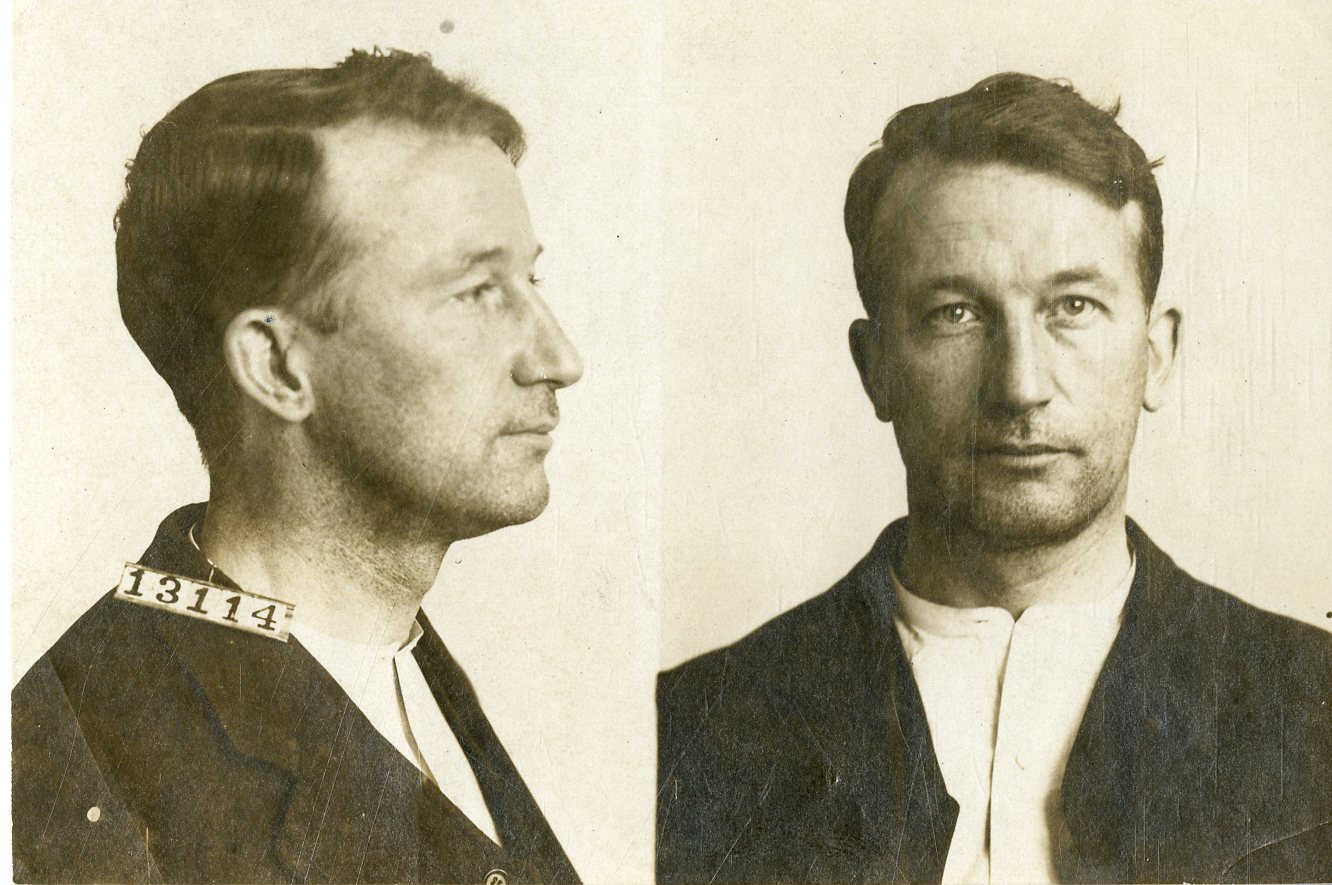
Long-time wobbly activists Sam Scarlett is arrested with Carlo Tresca and others on the frame-up charge of murder during the 1916 Mesaba Iron Range strike. Below a letter from Scarlett to fellow-workers on the outside.
‘Can the Working Class Afford to Lose Such Fighters?’ from Industrial Worker. Vol. (new) 1 No. 28. October 21, 1916.
CAN THE WORKING CLASS AFFORD TO LOSE SUCH FIGHTERS?
Below we print a letter received from Sam Scarlett, one of the fighters of the working class, writing from the jails of tire master class, forgetful of self, faced by imprisonment or death at the hands of the Steel Trusts courts, yet he is interested far more in the triumph of labor and the great labor movement than in his personal fate.
Through the letter is breathed a spirit which capitalism cannot murder, but which can and will doom capitalism.
Country Jail, Duluth, Minn.,
Oct. 14th, 1916.
Editor, “Industrial Worker” It is with mingled feelings of pleasure and shame I write you these lines. Your letter to “Socialisti” have received with your reference to wishing to hear from me. Truly, I have been very negligent in not answering your inspiring first letter. I ask you to forgive me. I only wish I had received other letters, such as yours, when the strike was red hot, as their encouraging nature would have fortified us all, when sympathy from the outside meant a whole lot. It was some experience Mac, helping conduct a strike. with warrants being served on you at every range town you entered, but it was glorious and the spirit of the miners was magnificent.
It has occasioned no surprise to me to know that the Miners’ Union is now stronger in every way since the strike was called off.
Message of Brotherhood.
These same miners got a rotten deal from the Western Federation of Miners in 1907, and were just a shade wary of any kind of unionism as a result. Our encouragement in getting the miners to handle their own funds and conduct their local business, soon won their hearts, and on every hand you could hear the most flattering comparisons drawn between the I.W.W. and the W.F.M.
You understand we just encouraged the miners to organize–and they done it, I think the most inspiring thing I have ever witnessed was the morning we initiated 500 miners in Virginia. The preamble was read in Finnish, Italian, Austrian and English and explained by five speakers. Italians and Austrians began to see beyond the trenches of Europe; tears were in many eyes as they listened to the new and true message of brotherhood. Italians and Austrians were elected on the same committee, their big hands and hearts elapsed, unrestrained fraternity out loose. In the meeting the enthusiasm of the workers beggared description. It meant something big and deep–the miners had at last found themselves. It pleased them to know it. This spirit swept the range at that moment the Steel Trust was defeated.
Never could they own these men again heart and soul, as they had done in the past.
Since the strike was called off, the most of the mines have conceded the wage demands and the abolition of contract work, which were the two main demands of the strike. Joe Ettor told me yesterday that he never witnessed before such remarkable enthusiasm for the I.W.W. as now prevails among the miners. They are in many cases paying up their dues a year ahead. Out of 300 miners in one mine at Aurora, 288 are members of the union.
Would Decide Haymarket Precedent.
The miners here in jail are true-blue, manly chaps, with a spirit that is unconquerable. They scorn the jails, as they do the Steel Trust, which railroaded them on trumped-up charges.
Of course, it is needless for me to say that we are innocent of this murder charge against us. We do not fear the outcome of a fair trial. Judge Hilton told us our case was important, as it would decide the continuation or abolition of the Haymarket precedent, which has been continually played up by all prosecuting attorneys to get a conviction in labor cases.
I hope the fight at Everett is won, and I only regret my inability to be there with my fellow workers.
How we look forward to the arrival of each issue of the “Industrial Worker” here in jail.
You have been one of the two old friends who have remembered me here in jail. You know that I was never much on correspondence, so I have no kick coming, but, O! how much your letter meant to me.
I will do my best to write an article for the Joe Hill edition. I have also told Joe Ettor and Carlo Tresca to get busy. They send all rebels their best regards. Good-by, hoping to see you soon.
–Sam Scarlett.
The Industrial Union Bulletin, and the Industrial Worker were newspapers published by the Industrial Workers of the World (IWW) from 1907 until 1913. First printed in Joliet, Illinois, IUB incorporated The Voice of Labor, the newspaper of the American Labor Union which had joined the IWW, and another IWW affiliate, International Metal Worker.The Trautmann-DeLeon faction issued its weekly from March 1907. Soon after, De Leon would be expelled and Trautmann would continue IUB until March 1909. It was edited by A. S. Edwards. 1909, production moved to Spokane, Washington and became The Industrial Worker, “the voice of revolutionary industrial unionism.”
PDF of full issue: http://iw.applefritter.com/Industrial%20Worker/1916/1916%2010%2021%20IW.pdf
 Revolution's Newsstand