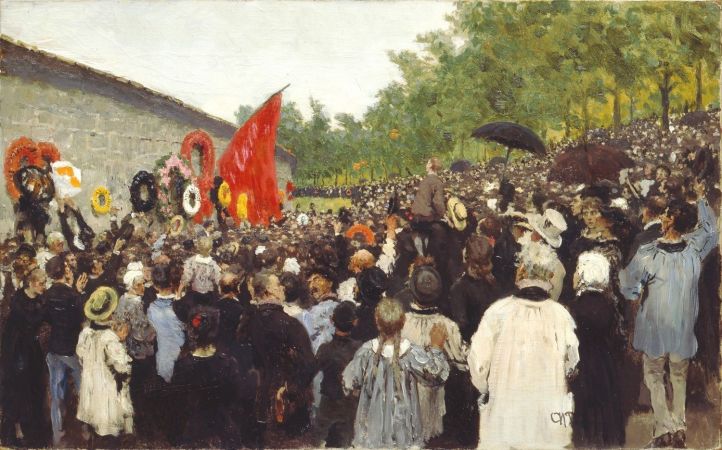
Born as he was in 1865, Austin Lewis’ entire political life, like others of his generation, was shaped, even overshadowed, by the Paris Commune. Written thirty years later, Lewis looks at the particular shadows the Commune threw over contemporary French politics, where many Communards were still active.
‘The Commune’ by Austin Lewis from The Weekly People. Vol. 11 No. 51. March 22, 1902.
America Has Reason To Join in the Observance of the Great Event Which Startled the World.
ITS SIGNIFICANCE
The Blinded and Abused Working Class, Desperate Under the Wrongs to Which it Was Subject, Fought Against Its Oppressors–The Fight, Though Apparently Lost Was Not in Vain–Means Much to Us Today When the Same Conditions Are Possible.
The approach of the anniversary of the Paris Commune and its downfall naturally calls our mind to that historic event, and not only to its actual incidents, but to the conditions of the Socialist movement up to and succeeding the horrible occurrences of the year 1871. The Commune lies like a great dividing line across the history of Socialism; it separates the movement into two essentially different parts. When the smoke of the guns had finally cleared away at the close of the Bloody Week in May, there was cleared away with it a colossal amount of smoke of quite another kind, the thunder and lightning of the guns cleared the air intellectually as well as actually, and with the disappearance of the fancy and fantastically garbed supporters of the cause of the Commune, the Hussars of Death, the Avengers of This and That, decked out in all manner of military frippery, there also vanished a tremendous amount of ornamental rhetoric and of giganitc platitude.
Socialism in the pain of the Commune felt that its real manhood had actually arrived. The Bryonic days of crazy idealism followed by equally crazy periods of depression and melancholy had worked themselves out and the real pain of defeat and at the same time the realization of all that a revolutionary movement implied in its very nature, came home to the intellect of the socialist, the “sturm and drang” was practically over and except for some few recrudescences which will be noticed later the socialist movement entered upon a course of steady and logical scientific propaganda. The appeal was no longer to sentiment, but altogether to fact. The blue-book and price-list came to the front, declamation, and rhetoric fell to the rear. Hence forth to be a socialist meant hard and persistent intellectual work and the possession of a logical equipment so complete that since that time the opponents of the movement. have ignored the later arguments and have confined their attention to the arguments of the days preceding the Commune.
It is noteworthy how frequent historic intellectual conditions solidify themselves, as it were, in the persons of individuals making these individuals types of the conditions which they illustrate. This was never more clearly shown than in the case of the Commune. The rising proper brings to light a number of types, interesting enough, it is true, but bizarre and abnormal. “Soldiers of liberty” as so many of them loved to call themselves they were born Don Quixotes with nothing to recommend them save a sort of sentimental chivalry which sent them everywhere redressing grievances as they imagined, but in reality accomplishing nothing of any moment. Chief of this type we may recall Flourens whose personality was sufficiently dazzling, and whose education and accomplishments were far above the ordinary. Brave to a fault and unrestrained in his sympathies he was ever the champion of those in distress, a veritable knight errant of the democracy. But he was without economic knowledge, possessed no political judgement and was devoid of even elementary powers of organization. He was an orator of considerable force and was the darling of the National Guards who admired him for his grace of person and his gifts of speech. In all these things he was the type of the Communist agitator, the class of men who for some of the most trying months in history was charged with the destinies of a city in revolt under peculiarly difficult conditions. It is not difficult to see that a movement led and managed by such men could not hope to accomplish its purposes even under the most favorable circumstances and least of all to steer the agitation through the maelstrom of war and intrigue which it encountered at that time. It is true that Flourens himself had but little to do with the administration of affairs, be died early in the struggle, finding his end as he would have preferred, on the field of war. But he left behind many who closely resembled him in their essential qualities and who were equally incapable with himself. The Commune produced the last of that type of men. Now and again they come to the front as in the case of the Italian volunteers in the late war between Greece and Turkey and of Villebois Mareuil in the Boer war. But as a type they are extinct. The quixotism of democracy has passed and with it the quixotic type.
But if the Commune was distinguished for its adventurous heroes it was no less abundant in journalists and orators and it must be confessed in journalists and orators of somewhat doubtful virtue and less than doubtful sagacity. Rochefort whose true character has sufficiently appeared in these later years is the most original and marked of these. His honesty was always questionable and there was not a single useless and stupid act perpetrated in the Commune of which he was not the direct instigator. The trail of Rochefort lies plainly over the whole of its acts., and it is the same old Rochefort the Boulangist and anti-Dreyfusard. Delescluze another journalist equally lacking in the elements of steady commonsense proved his devotion with his death, in the face of which we may stay carping criticism and recognize his nobility at character without at the same time committing ourselves to the notion that he was in any way suited for the executive work which he was called upon to fulfil; and which he carried out so vociferously and so ineffectively. The author of the famous placard that the bare arms of the citizens were sufficient to meet the armed force of their enemies may sleep in peace with his own placard for his epitaph.
What a clean sweep the Commune made of all of them! The types which took their models from the heroes of antiquity from the men of Ninety-three have all disappeared into the shades. No more amateur Camille Desmoulins stalk across the stage of the proletarian movement, would be Dantons are at a discount, instead we get calm discussion, peaceful association and organization. The windy rhetoric of the Buttes Montmartre has given place to strong and wise discussion of the rights of the proletariat. No speeches are so full of cogent and calm reasoning in all the debates of the French Chamber as are the speeches of the members who represent the Parti Ouvrier.
But if the Commune in its decline destroyed with itself all the survivals of the idealistic and romantic socialism which had led the proletariat by the nose to its destruction for so many years, it left behind it the germs of the future struggle which was to occupy the attention of the socialist movement for at least thirty subsequent years and which is only now nearing its final stages. And just as we find the foolishness and romanticism of the Commune mirrored in the leading actors of its drama, so we find the typical personalities of the new conflict arising from the ashes of that former struggle to continue the fight under new conditions and in new surroundings.
We may take Benoit Malon and Paul Lafargue as representative types of the post-commune movement. And they are well worth examining for they are very good representatives in their own persons, of the different influences and ideas which have assisted in the making of modern French Socialism and to a less obvious degree but none the less certainly in the making of modern universal socialism.
Malon had been a member of the Commune from the beginning to the end. He was a member of the International, of the Central Committee, held a portfolio, and discharged such duties as fell to his office with as much discretion and dignity as could be shown amid the curious and disturbing conditions in which he worked. His integrity is absolutely and completely beyond all question, a statement which unfortunately cannot be truly made of some of his associates. His sympathy with the proletariat admits of no doubt, and yet the influence of Malon since the Commune was and since his death has continued to be the most malign influence in the modern French socialist movement.
It is somewhat instructive to arrive at au understanding of how this could happen Malone, after the Commune was over and the term of exile had passed away returned to France to prosecute the propaganda. He founded the school of what is dominated integral Socialism. This school does not regard economic development as the main factor in social progress but takes a moral view of the progress of man and regards socialism as the result of growth in moral perception rather than as a necessary product of certain unavoidable economic changes.
Here was a splendid opening–for the college professors and professional speakers and writers, of which they were not slow to take advantage. The possibilities of this kind of sublimated social ethics are great and middle class audiences can be readily gathered to listen to semi-socialistic, semi-ethical addresses. Hence the Integral School made headway and soon numbered among its adherents the writers and speakers of the professional classes who had no influence nor means of procuring any with the dominant parties. Socialism thus became the means of a career and opened great chances to those possessing popular gifts and a political temperament. Jaures, the brilliant orator, soon saw the opportunity and his propaganda. tours filled the younger middle-class enthusiasts as well as large numbers of the proletarians with zeal, attached them to the movement and gave it actual as well as sentimental strength. So strong numerically did it become and so greatly did its material forces develop that it has endowed its advocates with sorts of good things in the way of political preferment, has made some cabinet ministers, has helped others like Renard to professorships, and has distributed a very large amount of political patronage broadcast over the country. It is almost pathetically funny to think that Malon’s moral propaganda should have developed such a ridiculous amount of intrigue and corruption, for the disciples of Malon are now by a curious irony of fate, Ministerialists, and the supporters of a government, which is based upon some of the most disagreeable and least moral elements in French political life. To discover how this came about we must turn to the other person under consideration–Paul Lafargue. Lafargue was also a soldier of the Commune but by no means conspicuous or distinguished, a fact which is in itself almost a recommendation. He took his turn at exile with the others, and met Marx. He came back full of vigor and determination for the propaganda and proceeded at once upon the lines laid down by the greatest master of the principles of organization in modern times. And he and his devoted companions and comrades also had their reward. Their adherents grew in numbers and in discipline and power until they developed into the Parti Ouvrier which also began to appear as a somewhat conspicuous figure in the elections and gathered slowly to itself the elements of an active and well-informed political party. In fact the workingmen who composed the party gave the present ministerialists an appearance of actual strength among the working classes which it was far from possessing. The two parties worked together as far as their political campaigns were concerned until something happened which was to show the absolute incompatibility of the two ideas and to make a breach reparable between the two factions which had up to this time been ostensibly fighting under the same banner. It will be remembered that the followers of Malon based all their propaganda upon the growth of the principle of justice in the human heart. The comrades of Lafargue considered primarily the interests of the proletariat, reckoning that all progress and all social justice were ultimately and intimately bound up with their cause. It was sufficiently evident that when an occasion should arise where a manifest and open injustice was being done that the Independent Socialists or followers of Malon would be called upon to vindicate their principles and could not refuse to do so if they were to retain their position as ethical guides and exemplars of the Higher Life as applied to politics. It was also sufficiently obvious that the proletarian element in the Party might easily consider such action on the part of the Independents ss of no value to their movement and hence would refuse to accompany them on their crusade, which would tend to create dissension and to destroy the identity of the movement.
This is precisely what happened. The Dreyfus case appealed to all sections of the radical world as a case in which gross and palpable injustice was being inflicted upon an honest man merely because he was a Jew, and in pursuit of a conspiracy of army-officers and clericals. Here was an opportunity which the advocates of the sense of justice notion dare not neglect. It also pointed to political opportunity and the chance that the Jews would help out their fellow religionist with pecuniary and political assistance. Away they went, the Independents to the rescue of Dreyfus while the Parti Ouvrier declared that it was not in the general crusading business, that the Dreyfus case was a very unfortunate affair such as was continually happening, that injustice was the every day experience of the proletarian and was so universal that he could only expect to earn a measure of justice b hard work in the direction of his own liberation and that under the circumstances he had no time to bother with Dreyfus. This settled the question. The proletarian element in a very great measure withdrew their support from the Independent Socialists and the French party was split and perhaps irretrievably. Certainly there can be no alliance upon a basis such as existed before. Such an alliance is to say the very least intolerable, for how can a compact be made with a set of men whose acute sensitiveness to a wrong done to their sense of justice, particularly when that wrong is perpetrated upon one of the middle-class, renders them liable to desert the proletarian movement at any time and to take part in the ordinary politics of the day?
So the Independents and their followers went off without the proletarian subport, and their path has since, from the point of view of the socialist proper, been marked with discredit and with more than a suspicion of dishonor. They have supported a ministry including De Gallifet, so far have they wandered from their old founder Malon, they have dabbled in all the corruption which a particularly corrupt government has forced them to wade through and the end is not yet. They have built up a political machine by the gift of offices through Millerand and imagine themselves in this way able to secure a permanent party following. But in this, time will prove them to have been mistaken. Their name was the only strength and with the loss of proletarian support they will also lose the advantage which the possession of the name brings them, for they will learn the lesson which our own Kangaroos are so slow to learn, that a Socialist party is only really strong in proportion to its proletarian following and in no other way. France in these respects has only furnished in her usual dramatic way forcible examples of what is everywhere else going on. The Commune wiped out the picturesquesness and theatrical pose of much of the earlier socialism, it destroyed the “bare arms of the people” notion effectively, and with it the individuals whose rhetoric and blague procured for them an influence much beyond their deserts. Some sentimentality has however survived, as in the case of Malon and his following, but together with this there has been a new and surprising development in scientific grasp and power of comprehension of actual conditions.
It is to the growth of this development that we must look for all the good to come forth from the present agitation. the example of the Parti Ouvrier and of the Socialist Labor Party are valuable not only so far as they actually accomplish results, but as furnishing proof of the existence of real conviction and sturdy loyalty to principle as opposed to the shifty opportunism which has discredited and still continues to discredit so many aggregations of men which all proof to the contrary, notwithstanding persist in calling themselves socialist parties. Such a party produces of necessity men who can stand the strain and remain in its service, and thus gives the proletarians a body of earnest and sober men who have been tried and have proved themselves. It means the end of the adventurer socialist in politics. So far have we come thirty years after the Commune. AUSTIN LEWIS
New York Labor News Company was the publishing house of the Socialist Labor Party and their paper The People. The People was the official paper of the Socialist Labor Party of America (SLP), established in New York City in 1891 as a weekly. The New York SLP, and The People, were dominated Daniel De Leon and his supporters, the dominant ideological leader of the SLP from the 1890s until the time of his death. The People became a daily in 1900. It’s first editor was the French socialist Lucien Sanial who was quickly replaced by De Leon who held the position until his death in 1914. Morris Hillquit and Henry Slobodin, future leaders of the Socialist Party of America were writers before their split from the SLP in 1899. For a while there were two SLPs and two Peoples, requiring a legal case to determine ownership. Eventual the anti-De Leonist produced what would become the New York Call and became the Social Democratic, later Socialist, Party. The De Leonist The People continued publishing until 2008.
PDF of full issue: https://www.marxists.org/history/usa/pubs/the-people-slp/020322-weeklypeople-v11n51.pdf
 Revolution's Newsstand