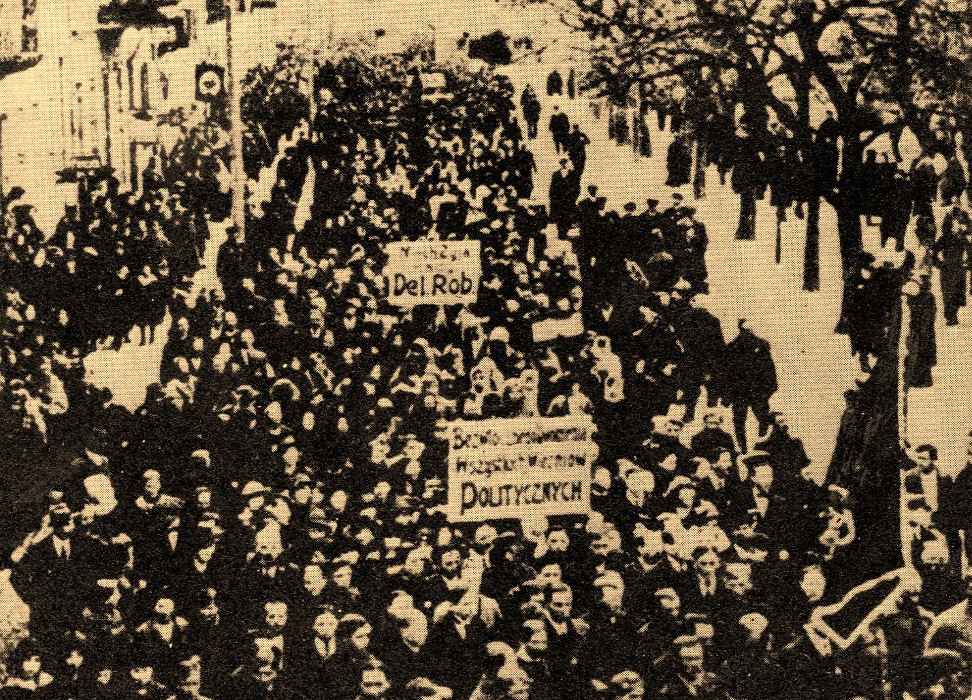
Less than a year after March, 1925’s Third Conference of the Polish Communist Party saw its Left faction under Henryk Domski come to leadership, the strong intervention of the E.C.C.I. would facilitate the reversal at the Party’ Fourth Conference as reported below. Several months after this, the Party would again be thrown into turmoil as its leadership, briefly, supported Pilsudski’s military coup.
‘The Fourth Conference of the C.P. of Poland’ by J. Leszczynski from International Press Correspondence. Vol. 6 No. 15. February 25, 1926.
The Fourth Conference of the Communist Party of Poland took place in December 1925. There is no doubt that it is one of the most important events in the revolutionary movement in Poland.
The Conference dealt, above all, with the liquidation of the ultra-Left crisis which the Communist Party of Poland went through last year. In this connection two opinions among the delegates were expressed: one, asserting that the ultra-Left deviations of the C.P. of Poland were only a series of incidents, and the others who pointed out that these deviations were the result of an ultra-Left policy with comrade Domski as its leader.
This policy resulted in the fact that the C.P.P. was placed in opposition to the Comintern. This was most sharply expressed in the resolution of the C.C. of the C.P.P. of June 1925 in which the tactics conducted by the C.P. of France in the municipal elections (understanding with the socialists against the reactionary block) as well as the “manoeuvres” of the C.P. of Germany against the social democracy (united front and support in the fight against monarchist reaction) have been condemned as a move to the Right. Even the C.P. of Bulgaria which just at that time underwent the heaviest sacrifices in the difficult and heroic fight against the hangmen’s government of Zankov, has been accused of opportunism.
The accusations which the C.C. of the C.P.P. had raised against the brother parties were so unfounded that the originators of these accusations were later compelled to withdraw a good deal. As a whole however, the attitude of the C.C. of the C.P.P. in June 1925 constituted an attempt to create an ultra-Left platform, and clearly and plainly to support the ultra-Left groupings in other sections of the Comintern, especially in the Communist Party of Germany.
Of course the E.C.C.I. repudiated these attempts in a decided manner. It ruthlessly criticised the ultra-Left views and the fractional methods of the C.C. of the C.P.P.
This criticism found the support of the overwhelming majority of the delegates of the Fourth Conference of the C.P.P. Through the experiences in their work and in the course of a lengthy discussion they became convinced that the ultra-Left policy threatened the Party with the isolation from the masses, and weakened its ability to conquer the mass organisations of the proletariat. This was the result of the carrying through of the tactics of the united front only from below, the interpretation of the independence of the Party as a separation from the workers (for instance from the workers of the P.P.S. on the occasion of the demonstration on the 1st of May 1925) the purely mechanical connection of the partial demands with the final aims.
The development of the ultra-Left deviations has been advanced by the atmosphere which had created a passive and downcast mood among the proletariat. These feelings had penetrated into the Party and had produced a tendency in favour of a “tail” policy. Thus the Party was, for instance, convinced of the necessity to conquer the trade unions. This is proved by the resolutions of their Party Conferences. But in fact they followed in the track of the masses disappointed by the trade unions and were not sufficiently persistent in the fight for the conquest of the trade unions.
As one factor which strengthened the ultra-Left deviations we must consider also the difficult conditions of the illegal existence of the Party which created a doctrinaire, inflexible and phraseological treatment of the daily tasks of the Party. These conditions make it difficult for the rank and file to become acquainted with the ideological achievements and the tactical experiences of the Comintern. Finally the ultra-Left deviations were a reaction of a peculiar kind to the opportunism of the “Right policy” which formerly had ruled in the Party and had been condemned by the V. Congress of the Comintern and the III. Party Conference of the C.P.P.
The overwhelming majority of the Conference condemned the ultra-Left deviations, as they threatened the Party with the isolation from the masses. The Conference adjusted the tactical line of the Party in pointing out the necessity of applying the tactics of the united front (from below and above) as the best means of mobilising the masses for the fight for their daily needs, in the course of which it is best possible to expose the reformist leaders and to win them over to our side. The political independence of the Party ought not to consist in isolated actions but in keeping the political initiative and the leadership in the mass struggles. Always with the masses and at the head of the masses, that is the unchangeable slogan of the Party.
The Conference which thus armed the Party against the ultra-Left danger and at the present time has placed this fight in the centre, has at the same time emphasised the necessity to overcome completely the Right deviations in order to guard the Party against the possibility of a reversal.
Besides the liquidation of the ultra-Left deviations the Conference also stated the chief tasks of the Party in connection with the Polish crisis and especially in the sphere of the trade union and peasant movements.
In the first question the Conference set up a large-scaled programme for the overcoming of this crisis by revolutionary means. For the realisation of this programme the Party proposed a revolutionary alliance of workers and peasants for the purpose of the daily struggle for their most urgent needs. The uniting of the fight of the working class, the peasantry and the suppressed nationalities is the way which leads to the victorious fight for the power, for the workers’ and peasants’ government in Poland.
In the sphere of the trade union movement the Conference resolved to conduct an energetic campaign for increasing the membership of the trade unions and for their unity on а national and international scale. In addition to this the Conference worked out a broad programme of demands that touches the burning needs of the working masses. The Conference devoted special attention to unemployment and the methods for linking up the unemployed organisations with the trade unions for the purpose of uniting the actions of the whole working class. Based on the general tactics of the united front the Conference determined the tactics of drawing the trade unions into the fight and conquering them. As the best means for this the formation of a Left mass opposition in the trade unions was considered. The daily growing discontent of the masses with the compromising attitude of the reformist leaders, for which even the last Party Conference of the P.P.S. serves as a proof is good soil for this mass opposition.
In the sphere of the peasant question the Party Conference furnished a thorough analysis of those economic and political processes which had gone on in recent times among the peasantry and laid down the tasks which confront the Party as a result of this.
Through the resolutions and the whole course of the discussion the Conference proved that, in spite of some tendencies to deviations in the ranks of the Party, the C.P.P. contains a healthy, revolutionary body which will carry out the correct policy of the Comintern. This also explains the fact that, in opposition to the ultra-Left policy of the former C.C., the Party had conducted a series of mass campaigns and strikes during the last year, which have increased confidence in the Party among the working class and the peasantry. It suffices to point to the mass strike of metal workers in Warsaw, in the course of which the Party even succeeded in leading the workers from the National Workers’ Party and from the Christian Democrats: to the mass campaign against the reactionary agrarian “reform”, a campaign which has created the basis for the revolutionary alliance of workers and peasants; to the fight against the white terror etc.
The C.P.P. which has laid down its immediate tasks and has strengthened the unity of its ranks can encounter the approaching fights full of confidence as the conscious advance guard of the proletariat of Poland.
International Press Correspondence, widely known as”Inprecorr” was published by the Executive Committee of the Communist International (ECCI) regularly in German and English, occasionally in many other languages, beginning in 1921 and lasting in English until 1938. Inprecorr’s role was to supply translated articles to the English-speaking press of the International from the Comintern’s different sections, as well as news and statements from the ECCI. Many ‘Daily Worker’ and ‘Communist’ articles originated in Inprecorr, and it also published articles by American comrades for use in other countries. It was published at least weekly, and often thrice weekly.
PDF of full issue: https://www.marxists.org/history/international/comintern/inprecor/1926/v06n15-feb-25-1926-inprecor.pdf
 Revolution's Newsstand