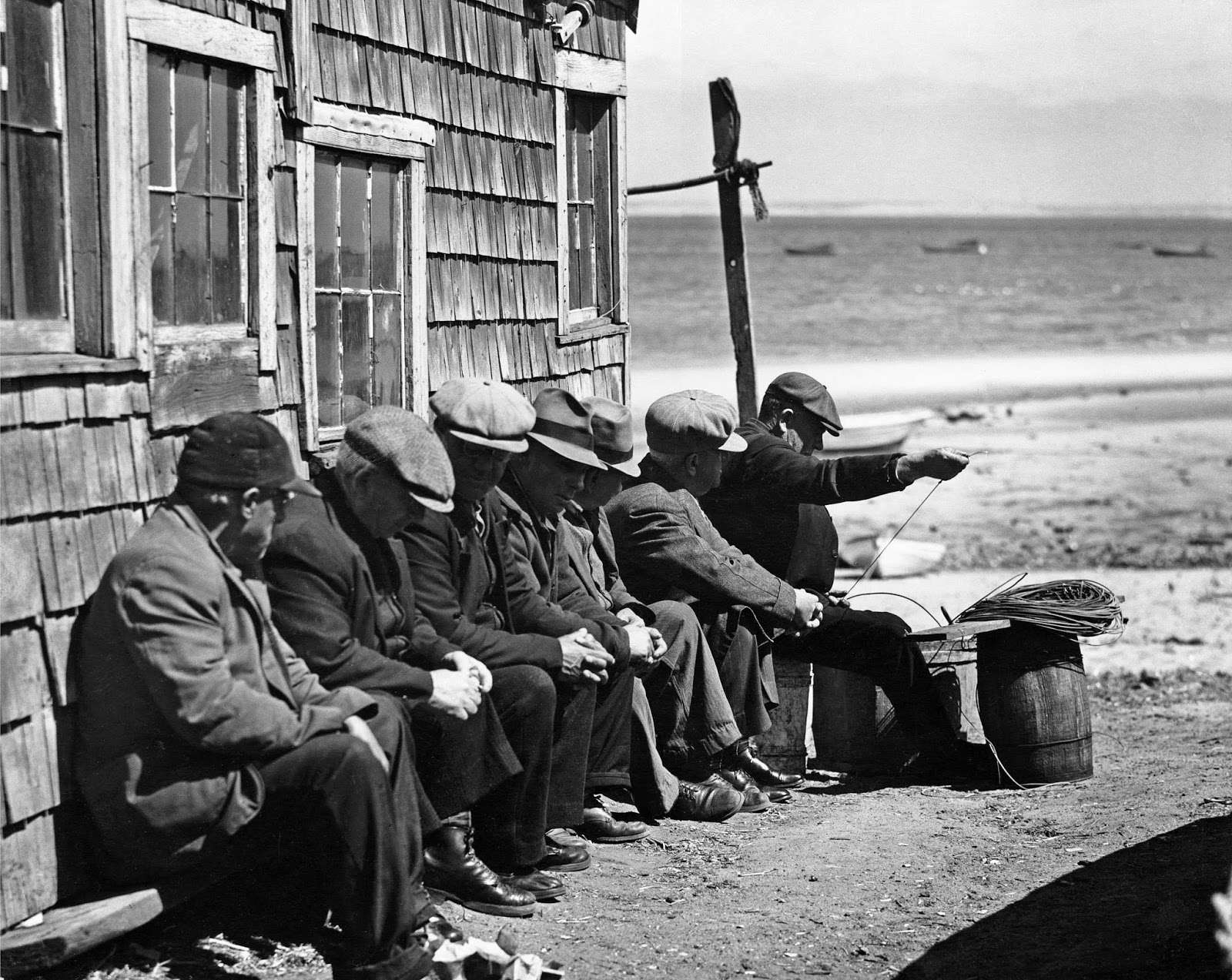
Portuguese fishing families of Provincetown live in shacks and suffer chronic unemployment in the midst of the vacation cottages and pleasure crafts of wealthy New England W.A.S.P.s during the Great Depression.
‘Cape Cod Fishermen Face Fourth Desolate Winter’ by Marguerite Young from The Daily Worker. Vol. 10 No. 227. September 21, 1933.
1,500 Cape Cod Fisherman, Many Permanently Jobless, Face Fourth Desolate Winter–Descendants of Early Portuguese Settlers Eke Out Miserable Existence Within Sight of Anchored, Luxurious N.Y. Yachts
PROVINCETOWN. Mass. On an evening when 20-odd magnificent racing boats of the New York Yacht Club squadron lolled haughtily at anchor in the harbor here, Jose Vassos sat beside the crucifix in his lamplit sitting room and said, “I wonder how we’re gonna get through next winter?”
Jose Vassos (which is not his name) is one of the 1,500 unorganized fishermen who are exploited and terrorized by four cold-storage factories located in Provincetown, but owned chiefly by New Yorkers and Bostonians. Once the fishing industry supported hundreds of sturdy, independent colonists, but now:
“Sometimes we really have to pay the companies for taking our catch to market,” Jose Vassos said. “The companies own the boats and the traps. We work for them. They send our fish to market, they take out their expenses and they take out their profit, and the rest they let us share. Many times they tell us the fish didn’t pay expenses. We’ve got to cough up.”
300 to 400 Always Jobless
Between 300 and 400 of the fishermen are permanently unemployed—and there is no such thing as public relief in Provincetown. Many of the 1,500 are part-time workers, “on call” to be summoned by the factory to go out to net, to seine, to handline, at 2 or 3 or 4 a.m. A few inside workers earn $15 to $18 a week—two to four in each factory. Most of the employed feel lucky if they earn $10 this week, $5 next, and then nothing for two or three weeks.
“They ain’t doing nothing down here about the N.R.A.,” Jose Vassos responded when asked about that. “Food’s gone up, but not wages. The factories still have two firemen and two engineers only, each working 12 hours a day.”
Like all the other fishermen, Jose Vassos is a Portuguese, one of the descendants of those proud colonists who came from Lisbon and the Azores, to fish in America, not so very long after the Pilgrims put in at Provincetown on their way to Plymouth. But now the Provincetown descendants of the English colonists will advise a stranger seeking lodgings, “Rooms cost $5 to $10 a week—unless you want to live among the Portuguese. Of course it’s less—if you’re willing to live with the Portuguese.”
Crisis Has Increased Hardships
Most of the middle-class tourists and artists who make a summertime Greenwich Village of this bright little community that rests on the very end of Cape Cod—curiously, the Cape is exactly like a militant worker’s arm, stretching out into the sea from Massachusetts, with the elbow bent and the fist clenched!—do not want to live among the Portuguese fishermen.
There is more race-consciousness in the fisher families. Once only they tried to organize and failed because of the attitude of the factories. But they are better prepared for organization now than they ever have been before; each of the last three years has brought them increased hardships.
This was evident in Jose Vassos, as he sat there, his face bronzed and seamed, his muscles thick from 30 years’ fishing, his dark and fiery glance turning occasionally toward the rooms where his wife and five children prepared for bed.
How to Live Next Winter
“Thirty years ago there were over 100 vessels owned in Provincetown,” he said. “Today there’s exactly one, the Mary P. Goulart, that pretty four-masted schooner anchored down by the main wharf. Twenty-seven men had the Mary P. Goulart last year, and in the twelve months they earned, altogether, $180.”
“How did they live?”
“Well, how did they live?” Vassos countered. “That’s what we’re all wondering. And we’re wondering how we’re gonna live next winter.
“The factories make money, though: the Cape Cod Storage Company ain’t paid no taxes in three years.”
“How do they get by with it?”
“Well, you know, when you got money, you can do anything. The Cape Cod is owned by Robbins and Robbins, in New York. For us Provincetown fellows things’ve got worse and worse. When my father came to this country, they could go in rowboats to fish. They’d go along the Cape to Truro, spring and fall, and fish with a pole. Today I’ve got to go out forty or fifty miles if I want to make a dollar, and it’s damn dangerous.”
“Curse of the Fishing”
For since Vassos’ father fished in sight of his little cottage, the Cape Cod, the Consolidated Cold Storage, the Provincetown and the Fishermen’s Cold Storage companies have taken over the industry. Worse, they have introduced a hulking, tremendous new kind of vessel, the beam-trawler.
“Them beam-trawlers is the curse of the fishing.” Vassos explained. “Ripley says there’s 2,300 kinds of fish and I reckon at least half of ’em you can find right around the Cape, here. But them beam-trawlers go along as near shore as possible, and they don’t leave nothing behind. They scoop the bottom, spawn and all. Little fish and big. The little ones the men throw back dead. I’ve seen ’em throw away 40,000 pounds of fish to save 4,000.”
And when the machinery of mass production injures the exploited fisherman, when he gets a finger mashed or goes down with pneumonia from exposure?
“Compensation, But…”
“They got compensation laws in this state, but we don’t get much of it. We don’t put in for it because we’re fearful of our jobs. There’s mighty little difference between one factory and another, but Frank Rowe, the manager at the Cape Cod, is a mighty hard boss. The other day a couple of the boys were coming in, wet and cold and shivering. Rowe saw ’em and laid ’em off—said they were drunk.”
On the table in the fisherman’s living room, full of crucifixes and religious pictures, a newspaper lay, spread open, showing a photograph of the yachts that rode at anchor in the bay. The newspaper held a glowing, romantic account of the trim squadron with its flagship carrying Junius S. Morgan, son of the head of the house that epitomizes finance capitalism. The newspaper reported how Harold Vanderbilt, “sailing” the yacht Weetamoe, led the squadron in their Cape Cod run.
Jose Vassos gave it a glance of pure disgust and said, “Them fellows know about sailing, all right: they got Scandinavians aboard. Vanderbilt don’t sail his boat all the time. Oh, he takes it once in a while, but each of them big boats ships a captain. I ain’t got much education, but I can handle a boat a damn sight better than that crowd.”
The Daily Worker began in 1924 and was published in New York City by the Communist Party US and its predecessor organizations. Among the most long-lasting and important left publications in US history, it had a circulation of 35,000 at its peak. The Daily Worker came from The Ohio Socialist, published by the Left Wing-dominated Socialist Party of Ohio in Cleveland from 1917 to November 1919, when it became became The Toiler, paper of the Communist Labor Party. In December 1921 the above-ground Workers Party of America merged the Toiler with the paper Workers Council to found The Worker, which became The Daily Worker beginning January 13, 1924.
PDF of full issue: https://www.marxists.org/history/usa/pubs/dailyworker/1933/v10-n227-sep-21-1933-DW-LOC.pdf
 Revolution's Newsstand