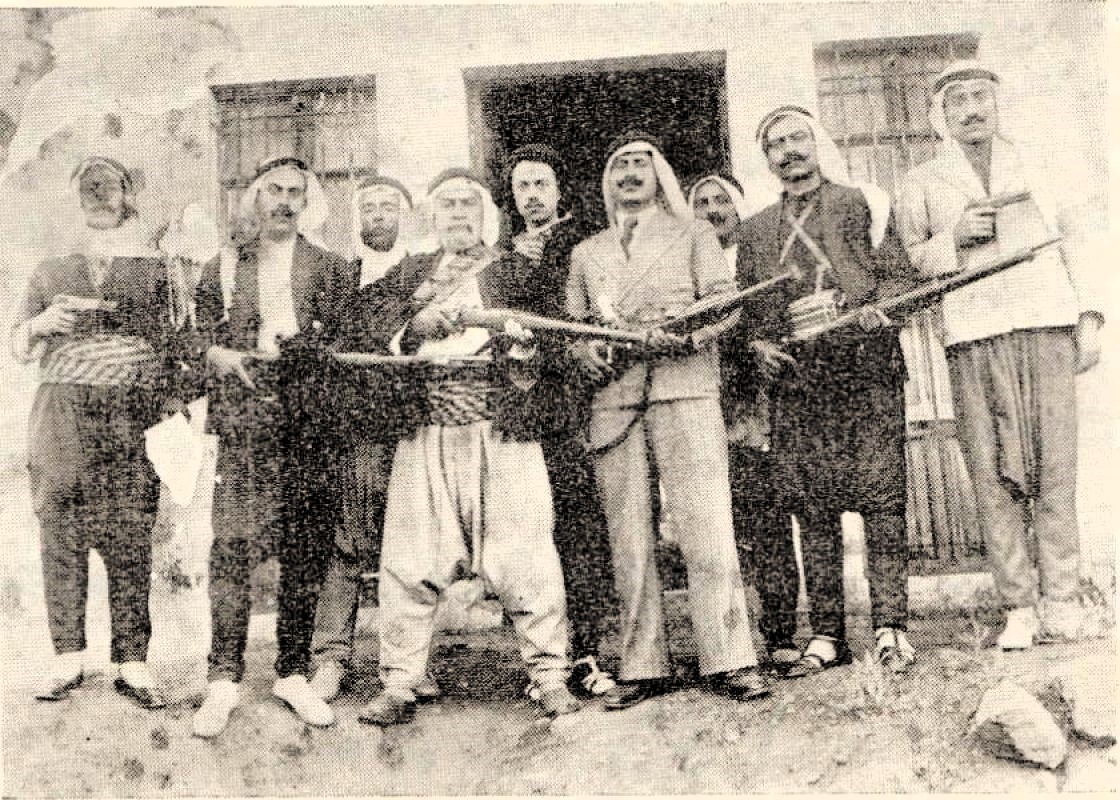
A report on the emergence of the anti-sectarian Communist Party leading a labor movement rooted in the small, urban working class of French occupied Mandatory Syria in the year after the Great Syrian Revolt, largely rural and beginning among the Druz, was defeated, in part, by religious and ethnic division.
‘The Forces of Revolution in Syria’ by Abusiam from International Press Correspondence. Vol. 6 No. 61. September 9, 1926.
Beyrut. After a pause, the Syrian revolutionaries have resumed their advance, and have gained a number of victories over the French. In the Hot district the French lost over 700 men, in Djebel Drus the French were obliged to evacuate Sueida for the third time.
The question arises of the forces behind the Syrian revolution; how can the vitality of the Syrian revolution be explained?
Up to about the end of 1925 the flame of revolution has seized upon only a limited sphere in Syria. Geographically the revolution was limited by the mountains of Djebel Drus. The free Druses, the inhabitants of the mountains, were the first to begin the struggle against Imperialist violence. The mighty caves in the mountains hid them from the sharp eyes of the French aeronauts. This movement was carried on by the peasant population only, mainly by the mountain dwellers, and partly by the shepherd tribes of Bedouins. The movement did not touch the strata of town and village dwellers. The French secret police, the Sûreté, took care of this. Not only the inaccessible mountains, but the everlasting national and religious schism and hate have helped to isolate the movement.
After the lapse of eight to nine months, and after repeated defeats for the French, the French generals finally succeeded in ending their campaign victoriously in Djebel Drus.
The French soldiery have exterminated, in the most brutal manner, that part of the population which had remained quietly in the villages. The fields are desolate, the houses burned down, the wells filled up, the herds scattered. But now comes the un expected. The French army, marching in triumph through the country, itself carried the fire of revolution in every direction. The greater the victories of the French generals, the greater the devastation following in the wake, then the broader and deeper the wave of revolution pouring across the country. From the mountains of Djebel Drus the wave has dashed across the Syrian steppes, from here to the southward and westward, to the great cities, to Damascus and Hot, Aleppo and Beyrut. But in the cities the wave of revolution has broken against the resistance of the Christian population, against the acute religious antagonisms. The wave of revolution has had to struggle long against the traditions of centuries, against the distrust and schism sown by the artifices of French capital. The national excitement and the protests raised by the people after the severest blows, for instance after the bombardment of Damascus, have been dammed back. Every movement has broken on the rock of religious schism, and has ebbed away.
The memory of the cruel massacres in the last century, in 1880 and 1881, is still too fresh. It has seemed as if Libanon is truly an impregnable fortress of French imperialism. It was this indeed so long as the movement was confined to the Fellah peasantry. But what was unattainable for the Fellah movement has proved to be well attainable for the revolutionary working class.
The Communist Party of Syria comes on the scene. The Party, born on the eve of revolution, was forced by the raging fire of the enemy to reorganise its ranks, to create an illegal apparatus, and to accomplish its tasks by subterranean means.”
It could not do much by taking an immediate part in the revolution. But it accomplished much towards the fraternisation of the quiet city population with the tempestuous and insurgent rural population. It has been eminently successful in bridging over the eternal religious antagonisms. It is interesting to note that Musselmen, Druses, and Maronites, have all begun to regard the Communist Party as the guarantee of joint action against imperialism.
The labour movement is beginning to make progress in the cities. The Syrian labour movement differs from the European and American labour movements in having excellent and purposeful leadership from the beginning. The Communist Party, as faithful guardian of revolution, has stood by the cradle of the labour movement of Syria. This is a fact which has to be reckoned with. The labour movement in Syria has come into being as a communist movement, and it will develop further as such, or it will not develop at all. This is in itself easily comprehensible: a labour movement whose goal is the defeat of foreign imperialism, is inevitably bound to tread the path of revolutionary struggle, for it allies itself to the movement for national emancipation, that is, the sole path open to it is the broad path of Leninism.
Reformism, the compromise with Imperialism, would be synonymous with open treachery, with the blackest corruption, under the conditions of the present struggle in Syria.
Thus reformism cannot struggle into existence in the glowing temperature of the revolutionary East.
The labour movement is growing. The proof of this lies not only in the arrests of dozens of revolutionary workers, or in the suppression of revolutionary newspapers and appeals. but in the wave of strikes which has spread all over the country. We may here mention the most important of these: the strike in the great furniture factory in Beyrut (150 workers), the strikes among the dock labourers, the leather workers, and the typo graphic workers, the railway strike in Aleppo, etc. We must first have an idea of the backwardness and unenlightenment of the Syrian workers who are on a lower level than the Fellahs, if we are to appreciate the enormous energy and unwearying effort required by the Communist Party achieving such results.
The first period, the period of purely political activity on the part of the Party, was artificially hampered by the reprisals of the French secret police. And even now the French government does not shrink from terrorising as one of the means taken to crush the strike wave. Twelve workers on strike have been arrested, and three of the strike leaders, members of the Organisation Committee, sent to the Island of Ruad.
The result has however been very different to that expected by the imperialists. We can repeat Lenin’s words without exaggeration: However insolent and arrogant French imperialism has been, this insolence and arrogance has only swelled the ranks of our allies.
At one time the Druses struggled alone; then the Fellahs and Bedouins of the other villages joined them; now the city population is coming to their aid, headed by the proletariat. Within the last few days there have been bloody conflicts in Aleppo and Homsa, during the protest demonstrations against the French agent Ahmed Ali Bey.
The forces of Syrian revolution are growing and developing With only a little help from the international proletariat, the revolution in Syria will be victorious.
International Press Correspondence, widely known as”Inprecorr” was published by the Executive Committee of the Communist International (ECCI) regularly in German and English, occasionally in many other languages, beginning in 1921 and lasting in English until 1938. Inprecorr’s role was to supply translated articles to the English-speaking press of the International from the Comintern’s different sections, as well as news and statements from the ECCI. Many ‘Daily Worker’ and ‘Communist’ articles originated in Inprecorr, and it also published articles by American comrades for use in other countries. It was published at least weekly, and often thrice weekly.
PDF of full issue: https://www.marxists.org/history/international/comintern/inprecor/1926/v06n61-sep-09-1926-Inprecor.pdf
 Revolution's Newsstand