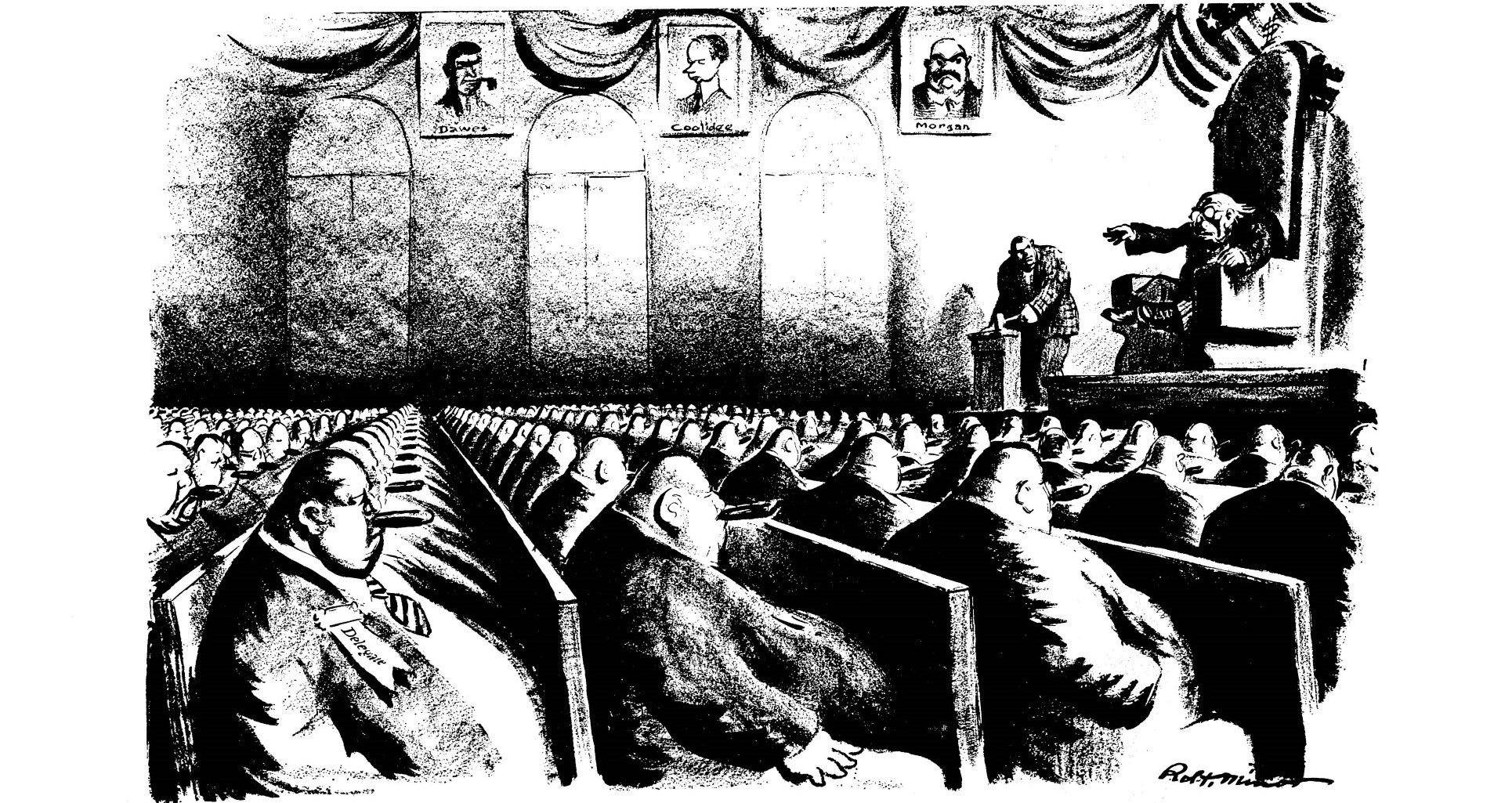
So much of the class struggle is within the working class itself. When our own organizations and institutions are in the hands of class-collaborationist bureaucrats who tie our interests to the boss’, they must be removed or there will be no forward motion.
‘Reactionary Leadership Must Go’ by Jay Fox from Labor Herald. Vol. 1 No. 11. January, 1923.
A FRIEND of mine, connected with the University of Washington, has been trying to get a line on the American labor movement. After reading the labor journals, the constitutions, convention proceedings and Brother Gompers’ speeches of the last forty years, he was still without light on the most vital phases of its progress. Reasoning that every movement of an intelligent character must have a goal that it is striving to attain, he was puzzled at his inability to ferret out that of organized labor. Meeting him recently, his first question was: “What are you labor men driving at, anyway, what is your aim?”
“My dear fellow,” I said, “it is with much distress of mind and heart that I must answer you: ‘We are not driving anywhere; we are standing perfectly still. And as for aim, we are not aiming at anything. We are just standing around with our eyes shut waiting for the next wage cut’.”
At the moment I thought I was putting it pretty strong; but after reflection I am inclined to think I didn’t put it strong enough. Indeed, I feel that I lack the language with which to adequately characterize the American labor movement’s blind do-nothingness.
The Fair Day’s Pay Ideal
When the movement was young it had an aim of a sort; a very indefinite one, to be sure, but still an aim. Then the leaders used to say that the drive was for a fair day’s pay for a fair day’s work; without any definition of what would be fair in either case. However, as a beginner it wasn’t so bad. Weak and timid unions could not be expected to make strong demands. But what amazes the student is the fact that the movement grew in strength and knowledge till it has reached the four million mark without amending its original meaningless demands. One can search in vain thru the history of organizations for a parallel case. Universally institutions and organizations demand and gain power in proportion to their numerical strength.
The growth of organized labor evidently means nothing to its leaders. They stand pat for the fair day’s pay for a fair day’s work. They mosey along from convention to convention, moving not an inch forward, holding fast to the old traditions in the face of an ever changing environment, and opposing with all the power at their command every attempt of the progressive minority to bring union tactics and ideals up to
date so the organizations may become real implements for the freedom of the workers instead of the sickly, dying dickerers that they are.
It is a misnomer to call such men leaders. “Trailers” would be a more fitting title. “Obstructionists” better still. They stand shoulder to shoulder in battle formation across the path of progress, ready to pounce upon and bludgeon any members of the rank and file who dare to pass that way. They see the unions defeated in every contest of importance with the well organized industrial barons; still they obstruct every effort to realign the army of labor now in disorderly retreat, on industrial lines so it may recover its lost ground and march on into the enemies country. They invite us to vote for politicians pledged to impeach Daugherty, knowing as they must that Daugherty is the political business agent of the industrial barons who would replace him with an equally subservient tool were he removed. They obstruct every effort on the part of the workers to build a political party of their own. Being themselves aligned with the old capitalist parties they wish to preserve their own standing and all that goes with it by keeping the workers in perpetual bondage to these corrupt, strikebreaking political machines.
Reactionary Labor Leadership
Space will not permit of my continuing the citation of the countless ways by which our labor official bureaucracy is impeding the progress of the labor movement. On the whole our labor officialdom is the most reactionary labor body on the globe. It will tolerate no movement having the slightest tinge of radicalism. It flies into a fury at any suggestion of change. It stands rigidly for things as they are. Even so mild and practical and necessary a change as the amalgamation of the craft unions into industrial units is taboo and bitterly opposed by our official oligarchy. That singly our unions are being slaughtered by the united powers of capitalism does not seem to faze these gentlemen in the least.
But, it will be asked, why should they worry about changes that might toss some of them out of the swivel chair? They are doing nicely as things are. They draw their well filled envelopes regularly. They have no layoffs, no “liquidation,” no “back to normalcy.” Everything is “jake” with them. Their motto is: “Sit tight, fellows, and pan the radicals; them guys ‘ll get us if we don’t watch out.”
Go to an A. F. of L. convention, where they are all together, and look ’em over. “Working men?” you will think. “I must have gotten into the wrong place. This must be a meeting of the National Manufacturers’ Association,” so sleek and plump and well groomed the bunch will be. Presently you will spy out a worker, a “roughneck” delegate, of which there are a few, and approach him with your doubting. And he will most likely say: “You are in the right place alright, but these guys are national manufacturers, at that; national manufacturers of antediluvian bunk.” And if you stick around a couple of days you will go away convinced that the roughneck was right.
Gompers, the Static Type of Leader
Brother Gompers is a typical example of the stand pat type of labor man. His mind has not been affected in the least by all the changes that have taken place in our economic structure during his official life of more than 40 years. Steadfastly he adheres to ideas and tactics that were 40 years behind 40 years ago. Forty years ago he might have been excused on tactical grounds. Then he might have said with some show of wisdom: “Let us go slow for a while till we get the unions well on the way; then we will push out our educational matter and lead the workers a knowledge of their actual status in society.” Forty years have elapsed and no educational matter has appeared. He has learned nothing himself and bitterly denounced as “unprincipled radicals” those who have. He hobbles about insisting that what is is not. Like all old men he lives in the past. The future to him is dark as night. The present he dimly sees.
Such men are a positive menace to the labor movement. It is a social crime to keep them in the leadership of a young and vigorous movement that requires the utmost of activity and forward vision. The labor movement must have young men, men who live in the present and know how to grapple with its perplexing problems, while keeping a steady eye on the future, the goal, without which any handling of the labor problem leads to chaos and confusion.
While men of the Gompers type remain in control the movement will remain static. But there are hopeful signs ahead. Due to the untiring work of the “unprincipled radicals,” the workers are waking up and have begun to cast off the incubus of false leadership. They are taking the leadership into their own hands and once the rank and file gets under way the old guard will be quickly cast into the dump. Labor will then be on its way to come into its own. And its own is all. All that Labor produces shall belong to Labor. Any other formula is false.
The Labor Herald was the monthly publication of the Trade Union Educational League (TUEL), in immensely important link between the IWW of the 1910s and the CIO of the 1930s. It was begun by veteran labor organizer and Communist leader William Z. Foster in 1920 as an attempt to unite militants within various unions while continuing the industrial unionism tradition of the IWW, though it was opposed to “dual unionism” and favored the formation of a Labor Party. Although it would become financially supported by the Communist International and Communist Party of America, it remained autonomous, was a network and not a membership organization, and included many radicals outside the Communist Party. In 1924 Labor Herald was folded into Workers Monthly, an explicitly Party organ and in 1927 ‘Labor Unity’ became the organ of a now CP dominated TUEL. In 1929 and the turn towards Red Unions in the Third Period, TUEL was wound up and replaced by the Trade Union Unity League, a section of the Red International of Labor Unions (Profitern) and continued to publish Labor Unity until 1935. Labor Herald remains an important labor-orientated journal by revolutionaries in US left history and would be referenced by activists, along with TUEL, along after it’s heyday.
Link to PDF of full issue: https://www.marxists.org/history/usa/pubs/laborherald/v1n11-jan-1923.pdf
 Revolution's Newsstand