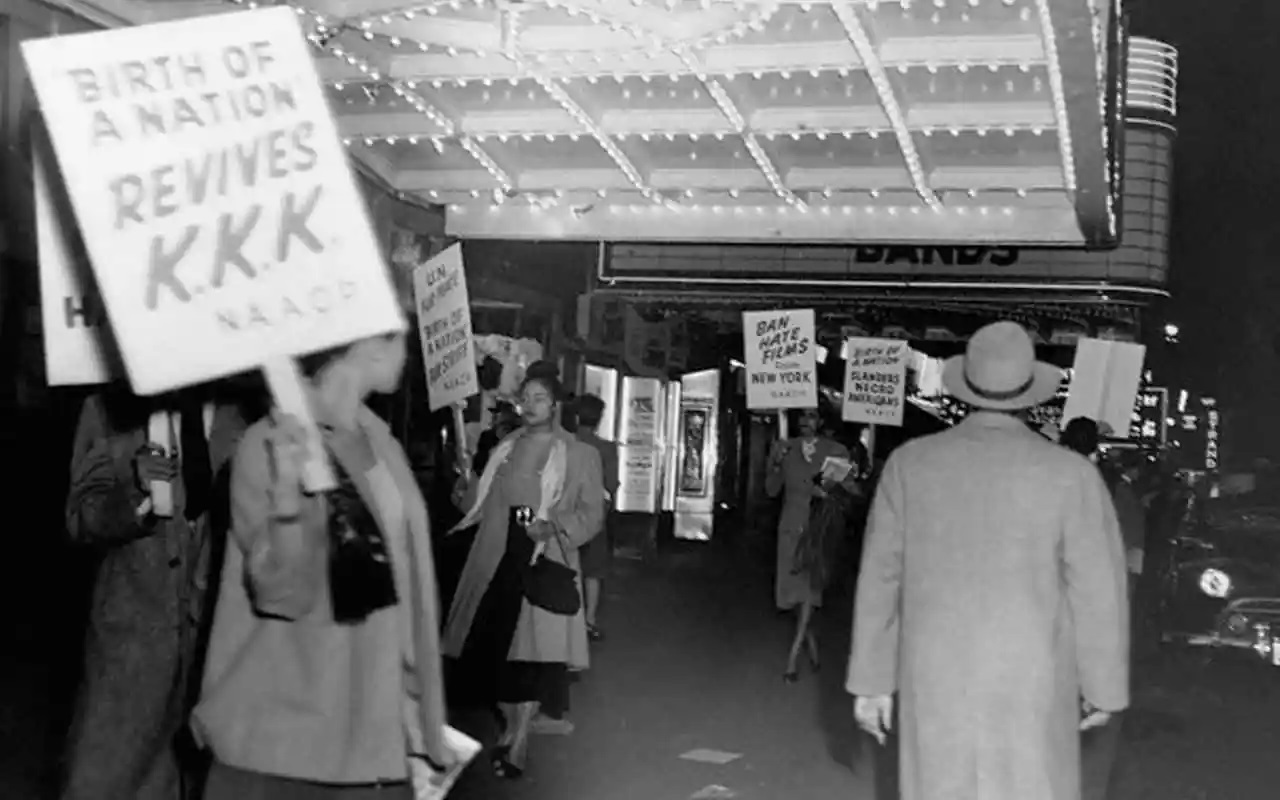
Debs grew more adamant in his later years in pronouncements on white racism, particularly after the ‘Red Summer’ events that would shortly follow this article, in which he assails D.W. Griffith’s white supremacist epic based on the novel The Clansman by (Reverend) Thomas Dixon.
‘The Birth of a Nation: An Insult to the Black Race’ by Eugene V. Debs from The National Rips-Saw. Vol. 8 No. 1. March, 1916.
Editor Post: The merits of this spectacular drama excite bitter comment whenever it is presented. There is no question that it is a wonderful production, that many of its scenes are tense and thrilling, and that there is much in the play to approve and commend, but if the author’s studied purpose was to insult the black race and to revive and intensify the bitter prejudices which grew out of the war, he could not have better succeeded, and it would be passing strange if the colored people did not protest against certain shocking features of the drama as doing them and their race grossest injustice.
If it be absolutely essential to the play to present those harrowing rape-scenes, then why not round them out. in their historic completeness and show the dissolute son of the plantation owner ravishing the black daughter before her parents’ eyes?
For every white woman raped in the south by a black fiend, a thousand black women have been seduced and outraged by white gentlemen (?) but no hint of this is given in the series of pictures composing “The Birth of a Nation.” It is only the black brute that is guilty according to this and all other stories written about the Negro by Thomas Dixon, the author who also calls himself a minister of Christ.
There are four million multatoes in this country, most of whom were born out of wedlock and all of whom have a white father or grandfather, and these white gentlemen (?) are ready to fight at the drop of the hat for “white supremacy” and against “n***r equality.”
The pretended reverence for Lincoln in the play does not at all square with the facts of history. Lincoln was hated with a savage hate by the slave owners of the south, and it was this ferocious hate that culminated in his assassination, and the reverence now shown him on the stage is a convenient mask behind which the same blind hate may vent itself upon the unoffending Negro.
Let it not be overlooked that all our histories have been written by white men and that Negroes had no hand in them. They simply had to take what was given them, but even at that there is no denying the fact that from the time the Negroes were first stolen from their native land by white slave-traders whom it were flattery to call brutes, until the last law disfranchising them in the south was put into effect and the last “Jim-crow” car put into commission to attest their standing as live stock, the whole history of the Negro race is one of shameless exploitation and degradation, for which the white race can never atone in time nor eternity. If the black people today could tell their story about “The Birth of a Nation,” it would be replete with scenes infinitely more cruel and damning than those based upon Dixon’s novel and flashed upon the screen to conceal the white man’s crimes behind the Negro’s misfortune.
The Ku-Klux-Klan are glorified in these pictures as spotless knights, the personification of chivalry and honor, and the audience applauds madly as they dash to the rescue of some imaginary white victim of a black rascal, all care is taken not to portray any of the outrages perpetrated upon defenseless, unoffending Negroes by these same lawless night-riders. The pictures showing the scenes about the polling places on election day, under Negro domination, especially calculated to subject the Negro to ridicule and contempt, and the white audience never fails to attest its appreciation by its sneers and cheers.
It’s true such election scenes with their black sluggers and their sodden corruption are disgraceful and revolting, but how much more disgraceful and revolting are they than the election scenes which have occurred in and about Terre Haute during the last few years, scenes in which the sluggers were white, instead of black, and insulted white ladies instead of black wenches; scenes unspeakably low and vile as everyone will admit, who bore witness to them. How would it do to make pictures of some of these and travel through the south with them, flashing them upon a screen to show the Negroes in that section what eminently respectable thing an election is when dominated by white men and by what pure and incorruptible methods the will of the people is expressed in a civilized white community?
If the white race has demonstrated its “superiority” in any one thing, it is in its politics and election, and if Negroes should be disfranchised, the evident purpose of Dixon’s pictures, because of their disgraceful conduct at the polls, then by the same token white men should also be stripped of the ballot and driven from the polling places.
The chief commercial statistics exhibited at the close of the play to show the progress made by the Negro race is but a weak attempt to excuse the wanton insults heaped upon that race. Intelligent Negroes will not be deceived. The progress they have made is mainly due to themselves. They owe little to the white race as a whole, save their exploitation and degradation.
Let the colored people learn how to depend upon themselves, how to do for themselves, and to win their own way in the world. When they cut loose from the grafting the grafting politicians that use them as pawns in the political game and reward one of their number with a spittoon-cleaning job in recognition of their race, and stand together; when they begin in earnest to educate themselves, to develop their minds and do their own thinking, they will then command the respect of the white race and of the world, but not before.
EUGENE V. DEBS. Terre Haute, Ind., Jan. 6, 1916.
The National Ripsaw, a Free-Thinking, Socialist magazine that, in the 1910s, included the O’Hare’s and Debs on its board. The paper under the O’Hare’s was a voice of the Party’s anti-war wing and became a main literary vehicle for Debs before it, like all of the anti-war Left press, was banned from the postal services. In it’s previous incarnation, The Rip-Saw was an openly racist, exclusionary “Socialist” magazine under editor Seth McCallen from 1903 until 1908 when the paper was taken over by Phil Wagner and the politics of the paper changed.
PDF of full issue: https://www.marxists.org/history/usa/pubs/national-ripsaw/160300-nationalripsaw-v13n01w145.pdf
 Revolution's Newsstand