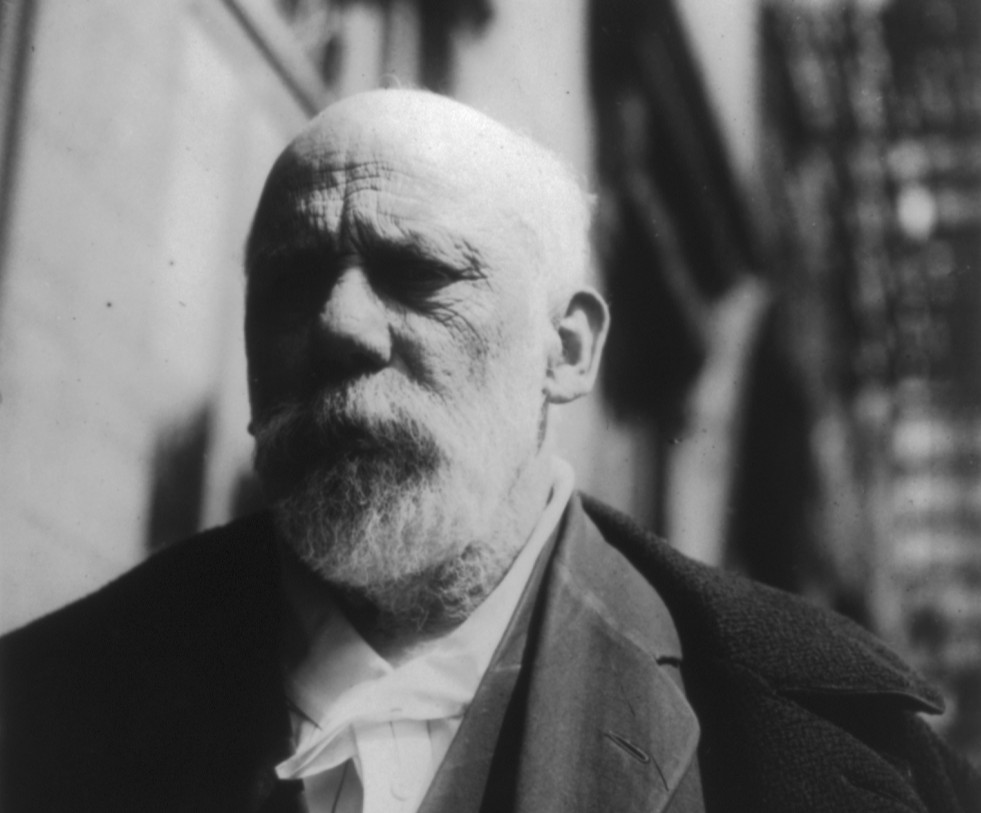
To this day, including on this site, the enormous contribution of Daniel De Leon–positive and negative–to the U.S. left is terribly underestimated by those of us who have followed. De Leon was a giant in the history of Marxism and Marxist organization on this continent. It’s fair to say, for the U.S. workers’ movement, there is a Before De Leon and an After De Leon. Debs was certainly a rival, sometimes sharply, but a respectful one. Here he pays his respects to the Socialist Labor Party leader on his death at age sixty-one.
‘Tribute to Daniel DeLeon’ by Eugene V. Debs from The National Ripsaw. Vol. 11 No. 6. August, 1914.
The death of Daniel DeLeon, editor of the New York People, and leader of the Socialist Labor party, marks the passing of a striking figure and an extraordinary character from the stage of revolutionary activity. For a full quarter of a century DeLeon has been a leader of Socialism in the United States, head and front of the Socialist Labor party, making a name for himself that is known throughout the world. Gifted with a mind of unusual depth and brilliancy and educated in the leading colleges both here and abroad, he was fitted as perhaps no other ‘American Socialist for great work in the educational propaganda of the Socialist movement.
Daniel DeLeon was a true disciple of Marx and Engels, and one of their ablest and most brilliant interpreters. His editorials in the People covered the whole range of economics, sociology, politics, history and philosophy and his versatile genius appears at its best in these columns.
He was an uncompromising champion of economic and political organization, believing that only through their economic and political solidarity could the workers emancipate themselves from wage-slavery. He fought the craft unions in and out of season, exposing without mercy their weakness and impotency, and he stood with equal insistence for revolutionary industrial organization. He was bold and pointed in his criticism, persistent in arguing his convictions, and tireless in fighting for what he believed to be right.
The speeches and writings of DeLeon evince keen insight and rare powers of analysis, clear thinking and lucid expression. He had, in a remarkable degree, the faculty of making the most involved and abstruse propositions clear and understandable to his readers. As an editorial writer of clarity, brilliancy and force he had no equal on the American Socialist press and no superior anywhere. His versatility, range of mind, and felicity of treatment were, indeed, unsurpassed, and his death leaves a vacancy that never can be filled.
There is not a doubt that Daniel DeLeon, with all his wealth of intellectual endowment and his classical education and high culture could and would have ranked high in any profession he might have chosen, but when the light of Socialism came into his life, it determined his destiny and he plunged into the propaganda with a vigor, and zeal which never abated until his vital powers were exhausted and death put an end to his activities. When the prodigious amount of work he did is taken into account, such as translating the classics of Socialism and other standard works, addressing propaganda meetings, holding debates and making speaking tours, in addition to his editorial work on the Daily and Weekly People, it is not strange that he broke down prematurely and that, sad to tell, he literally worked himself to death.
Whatever fault may be found with DeLeon, his personality, his methods or his tactics, it cannot be gainsaid that his zeal, his energy, his very heart and soul were all with the working class, and that with a singleness of purpose as exalted as it was inspiring, he consecrated himself to their emancipation. He had his faults, as all men have, but these will fade away in the light of his monumental services to the cause, He fought the good fight without flinching, to the end, and left the world a heritage of light and hope and inspiration that will keep his name bright and his fame secure through the coming ages.
With deep regret and with sincere appreciation of his masterly services and his loyal devotion to the cause we note the passing of our valiant comrade from the field of conflict to the realm of rest, and to his stricken widow and family we tender our heartfelt sympathy in their great bereavement.
The National Ripsaw, a Free-Thinking, Socialist magazine that, in the 1910s, included the O’Hare’s and Debs on its board. The paper under the O’Hare’s was a voice of the Party’s anti-war wing and became a main literary vehicle for Debs before it, like all of the anti-war Left press, was banned from the postal services. In it’s previous incarnation, The Rip-Saw was an openly racist, exclusionary “Socialist” magazine under editor Seth McCallen from 1903 until 1908 when the paper was taken over by Phil Wagner and the politics of the paper changed. Thereafter it was a leading anti-war voice, changing its name to Socialist Revolution before its banning.
PDF of full issue: https://www.marxists.org/history/usa/pubs/national-ripsaw/140800-nationalripsaw-v11n06w126.pdf
 Revolution's Newsstand