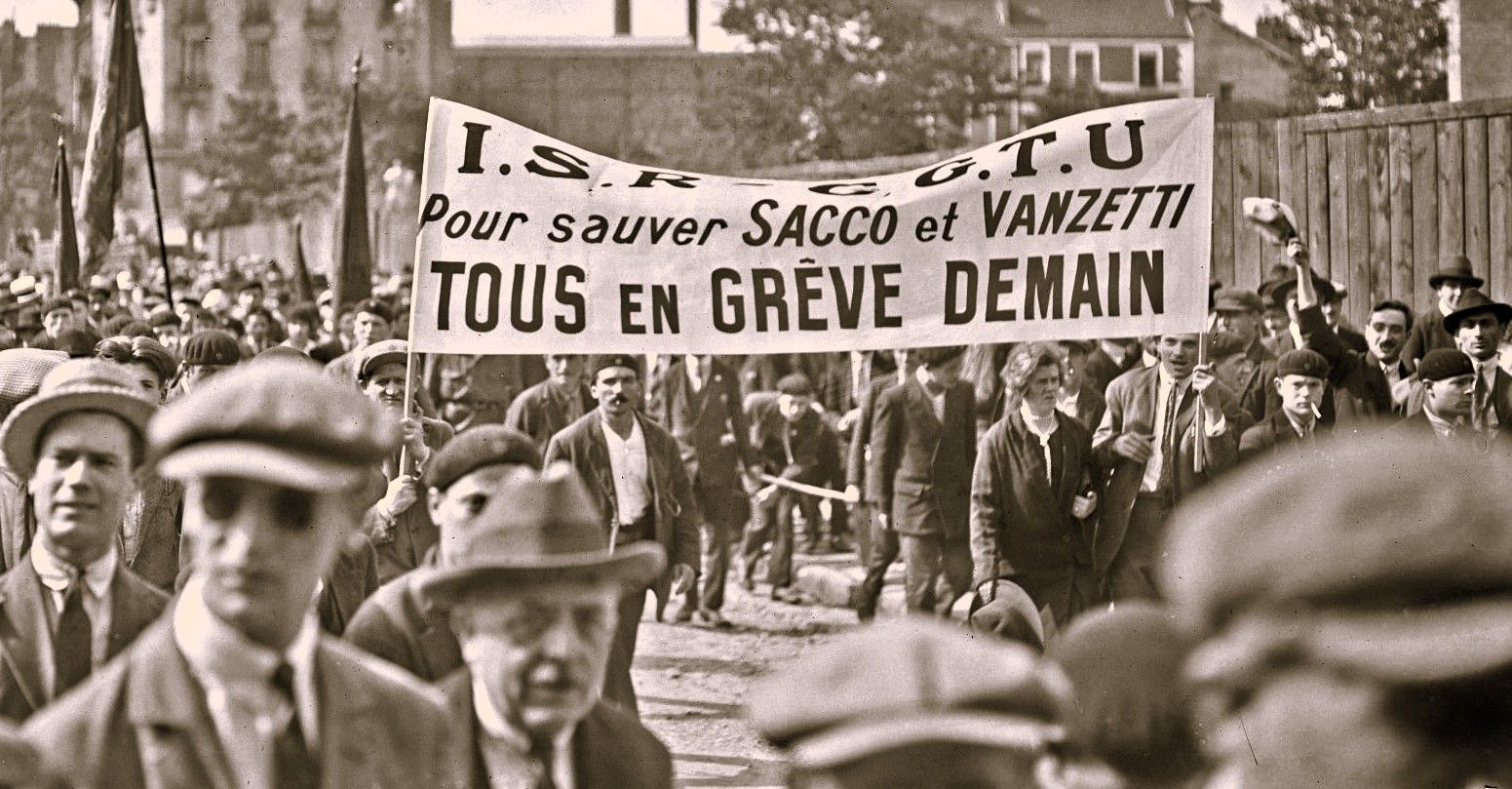
A fantastic piece of left history. The campaign to free Sacco and Vanzetti lasted years and was very much an international one, with the French working class particularly adamant in their solidarity. Peri, foreign editor of Humanite, later a Communist depute and victim of the Nazi occupation, brings us onto the streets as riots and protests accompany news of their murder in August, 1927.
‘Paris Protests Death of Sacco and Vanzetti’ by Gabriel Peri from The Daily Worker Magazine. Vol. 4 No. 235. October 15, 1927.
IT WAS at daybreak of the 23d of August that Paris learned of the crime.
Hope had ebbed during the last few hours.
A few minutes after five o’clock it was no longer possible to doubt.
The deed had been done.
By 6:30 the wild course of the horrible news had crossed Paris and the suburbs.
Electrocuted! That terrible word made the faces of the workers blench. They grew pale. Emotion governed them. They hesitated. Then, suddenly, the indignation burst forth:
“The dirty beasts! the dirty beasts!”
For a moment a movement stirred the huge incredulous throng of workers. Then anger flashed from their eyes.
On the subway stations, which vomited their daily torrent of proletarians into the gray day, the same scenes were repeated. Doubt, hesitation, stupor. And this cry of reprobation repeated a thousand times:
“The dirty beasts! The dirty beasts!”
The news of the execution passed from mouth to mouth, flew from house to house, ran from street to street. A rumor rapidly took form. The people muttered protestation.
Since 1921 the French working class had made the case of the two martyrs its own.
From now on the campaign for Sacco and Vanzetti will count as one of the most significant episodes in the struggle of labor in France.
In days to come it will be necessary to disentangle the lessons of this gigantic international combat against the most rapacious and most aggressive capitalism. Now let us limit ourselves to retracing for the American workers the last incidents of that struggle.
On August 3 while the social democratic papers were piling up the protests of the intellectual and political circles, the Communist Party decided to appeal directly to the shops, to the offices, to the factories. “Let Sacco-Vanzetti demonstrations be organized everywhere at closing time in order that protests against the crime may be. voted by hundreds of thousands,” such was the slogan of the Communist Party.
That night, the proletariat of Lyons, marshalled in a huge war front, gave its true class significance to the struggle for Sacco and Vanzetti. Even in that town, of which M. Herriot is the chief magistrate, the workers of all opinions organized two splendid meetings. Obeying the orders of the prefect of the Rhone, the police resorted to unheard. of provocation and charged the demonstrators, using arms. But the Lyons meeting found its echo throughout the whole of France.
On the day following that tragic night, the news of the decision of the governor of Massachusetts reached Paris. Fuller had ordered the crime. On the same evening the Parisian workers were informed of it in the course of a meeting called by the trade union organizations of the Paris district. “Only an immense demonstration of strength can prevent the crime,” declared Racamoni, the secretary of the C.T.G.U., and amidst reverberating applause he read the Manifesto of the C.T.G.U. calling for a general strike. This decision was enthusiastically approved.
At the close, as the crowd of workers demanding a pardon and liberation for the imprisoned men broke up, the police hurled themselves on the workers and with ferocious brutality assaulted Jacques Duclos, the Communist deputy from Paris, who had to be taken to a hospital.
The strike was to take place on Monday. Sunday a new demonstration rallied 100,000 workers around the red flags. In compact ranks, the Parisian workers filed along the streets of the great city. Huge placards carried the following inscriptions:
“Justice for Sacco and Vanzetti, condemned to be electrocuted because they are friends of the people and enemies of the American capitalists.”
“Sympathizers, without reference to opinion, you must intervene against the crime which is being prepared.”
“In America the seat of justice is the electric chair.”
“A general strike to save Sacco and Vanzetti!”
“1887-1927! Dates which illustrate American justice!”
“The Chicago tragedy must not be repeated! Long leave Sacco and Vanzetti!”
Several times, loaded automobiles, carrying the American flag, were greeted with cries of “Pardon! Pardon!” repeated a thousand times.
Thereupon the tourists from the new world made known their presence and replied: “Long Live Sacco and Vanzetti!”
Luigia Vanzetti, who arrived in Paris the same morning was the object of an endless ovation. Twenty meetings shouted to the echo cries which seemed to be uttered from the very depth of the proletarian crowd. “Down with Fuller! A pardon! A pardon!”
The same day all France responded to the demonstrations in Paris. A united front meeting took place at Roubaix, demonstrations at Havre, Dieppe, Sotteville, Tours, Toulouse, Oran.
Finally on Monday, the 8th of August, came the general strike. The C.G.T.U. had thus accomplished its slogans:
“If, in spite of the universal condemnation, the American plutocrats effect their frightful crime, it will be necessary to get at them by any means whatever: That is why, if the horrible sentence is maintained in spite of everything, the C.G.T.U. announces that the twenty-four-hour strike action must be prolonged in the following way:
“1.-Boycott by the consumers of all products, commodities, and merchandise, imported from America and of products made in American factories in France;
“2.-Refusal by the organizations of sailors, harbor-workers, railway workers to transport these products;
“3.-In the same way, boycott of the representatives of Yankee plutocracy and in particular of the members of the American Legion;
“4.-Boycott of every exhibition, play or attraction of American origin.”
The order to strike was everywhere followed with an admirable discipline. Centers like Lyons, St. Etienne, Cette, Alais, Le Boucau, Avignon, Beziers, Dunkerque, Cyonnax, Marseilles, Montpellier, Douai, Havre, etc., gave themselves completely and saw the workers rise and demonstrate their will to tear from the murderers the two martyrs who symbolize the ferocious repression unchained by the imperialists.
In the Paris district, the movement gave similar proofs that the laboring masses of the Faubourgs and the suburbs were stirred with the universal condemnation.
Numerous gatherings in the morning, enthusiastic meetings and imposing demonstrations in the afternoon, in the evening a mammoth meeting at the Paris Pantheon. That is the record of this great day.
Thursday, the 12th of August, L’Humanite announced the news of the reprieve to the Paris workers. “They Are Still Alive!” The huge headline of the Communist paper struck all eyes like a cry of victory, and so did the shouts of the crowd on the boulevards, at the halls in all the quarters an! of the newsboys bearing the thousands of copies of L’Humanite which the workers of Faris were snatching for.
But a feeling of inexpressible anguish was mingled with the joy of the masses. The grim attempt would recommence though the immense revolt remained. They could kill them yet. The reprieve was only a ghastly farce.
From daybreak of the 12th of August this presentiment haunted the spirit of the workers and from then on they were on guard.
Now we know, alas, how greatly their presentiments were justified. Eight days later, the Massachusetts courts confirmed their verdict. It was followed by an outburst of fury from the workers. Saturday, the 21st of August, fifty meetings were organized in Paris. Other demonstrations took place in the provinces. and, the following Sunday, under a pouring rain more than 20,000 workers gathered at the Butte du Chapeau Rouge near Pre-Saint-Gervais.
With soaked clothes, stamping around for hours in the rain, their faces cut by the drops, the workers turned for the last time, while there was still a chance, to the leaders of the American Legion, the guests of Paris, and beyond the Atlantic to the American capitalists, the deniers of justice and controllers of the war debts.
But the hours passed. With the precision of clock-work the news from Boston confirmed the suspicions that the worst was about to be accomplished. The C.G.T.U. without losing a moment, addressed a proposal for common action to the C.T.G. The Communist Party made a similar proposal to the socialist party, for the purpose of organizing a monster demonstration in the heart of Paris.
Then, five o’clock in the morning. Electrocuted! Two hours later, while in the rue Montmartre, the crowd of workers waited breathlessly under the windows of L’Humanite, the Party’s paper made the following appeal to the workers:
“Now that, the horrible class sentence has been executed, it is the duty of every class conscious worker in awaiting the final reckoning, to take just reprisals against the murderers.
“But it goes without saying, that in accord with the Communist International, the undersigned organizations in speaking of necessary reprisals do not in any way contemplate acts of individual terror which they have always refused to consider as a means of revolutionary action for the proletariat.
“That which you must do is organize, prepare, put in motion those collective reprisals of the international working class against the capitalism of the United States which is collectively responsible for the crime.
“1.-Defy the American Legion by preventing the American fascists from parading insolently thru the city of the Sons of the Commune. The accomplices of the murder of Sacco and Vanzetti will be received as they deserve, and will learn that the proletariat cannot be defied with impunity.
“2.-Boycott Yankee Capitalism: Practical and effective boycott measures will be immediately undertaken.
“3.-Demonstrate Tonight at 8 o’clock: Without waiting for anything further, at 8 o’clock at night let the immense crowd of workers from the old revolutionary faubourgs and from the red suburbs, descend on the boulevards and there give expression to their unanimous condemnation.
They will maintain their coolness in the face of all provocations whatsoever and will give this demonstration, which will usher in future justice, that great and calm quality that characterizes the international working class.
That night, at 9 o’clock, the workers were to march on the boulevards! In every red suburb, deep in mourning but seething with anger, the slogan ran like a lighted fuse!
A meeting of the cabinet was hurriedly called. There was a conference at the police perfecture of police. The perfect of police, Chiappe, forbade the demonstration.
But try to prevent the masses of workers from shouting their indignation!
From 8 o’clock on a seething crowd covered the sidewalks and the boulevards from the Rue Montmartre to the Porte-Saint-Martin. On the streets there were frequent tie-ups caused both by the movement of the protesting workers and the lines which the police kept increasing.
Mounted guards, foot-police and mere cops maneuvered in little bunches, their object was to see that the workers “kept moving” and to dam back the comrades in the streets crossing the boulevards. Police captains were arousing their followers. “Come on! Start that traffic there! Break all that up!” one of them shouted.
A police whistle shrieked and, obediently, the cops began their man-hunt.
Trouble was on from 9 o’clock. At the corner of the Rue Montmartre the police started the first set-to, but a part of our comrades took refuge in the cafe-bar which makes one side of the boulevard there, while several hundreds of others escaped along the Rue Montmartre. When they arrived in front of ‘Humanite they shouted:
“Long live Sacco! Long live Vanzetti! Down with Fuller!”
Suddenly, still on the same side of the boulevard, a thick column of demonstrators spread into the Faubourg Montmartre, coming from the Rue Cadet. The guardes republicans hurled themselves on them with an indescribable brutality. The police brandished their clubs. The wounded fell. The terrace of the cafe was invaded.
A charge in the Place de la Republique, another in the Rue de Lanery, another on the Boulevard Sebastopol, another on the Rue Montmartre, another at the Gymnase, another at the Gare de L’Est!
Women, children, men, sent rolling, beaten, trampled on, with unspeakable savagery. Arrests, then beatings, then firing, and blood flows.
The cafes close. The terraces, the bars shut down, the boulevards empty.
The police attack in the midst of a tangle of cars, taxis, busses. The skeletons of barricades rise. The crowd of workers reacts and counter-attacks. Driven back into the adjacent streets, it forms again, shouts its anger, hoots American capitalism.
And suddenly the inspiration of the masses breaks forth spontaneously: “To Montmartre! To Montmartre! The capital of the millionaire pleasure hunters!”
The columns of demonstrators climb towards the place Clichy, the place Blanche, the place Pigalle.
Up there, it is a night of pleasure, the nightly night of pleasure which is reaching its height–jazz, charleston, champagne at a hundred francs a bottle, and gambling deluxe.
The gay rioters affected to smile behind the [several words missing] windows sprang open. The Moulin Rouge, the headquarters of the “American Legion,” smiles and shines with all its lights, under its thousand bulbs.
The window-panes crash. Sacco! Vanzetti! Pardon!
And, buried in the depths of its cabarets, while the anger of the masses rolled on, these internationalists in orgies made the acquaintance of the real Paris, the Paris of the Sons of the Commune, on the very ground where its last barricades were raised.
One hundred and twenty-four police were wounded during the set-to. Two hundred and eleven arrests were made. The accused appeared before the courts the next day and were given severe sentences.
The same day in spite of government ban, huge demonstrations marched in Lyons, Rouen, Marseilles and Nimes. Everywhere the slogan of a boycott was acclaimed. The labor municipalities refused to vote the credits for the reception of the American Legion.
The just fury of the masses was the signal for an intense reactionary offensive. Forty-eight hours later the perfect of the Seine announced his desire to increase the police effectives.
It is clear, however, that the disorders which transpired on Thursday were entirely the result of the police brutalities. It is enough to read the appeal, which we reproduced above, to determine the character which the Party and the C.G.T.U. intended to give to this demonstration. Even several social-democratic papers, under pressure from the masses, were constrained to admit the police brutalities.
But the reactionary press was let loose. It demanded the immediate arrest of Vaillant-Couturier.
The masses of Paris were master of the pavements on Thursday night. They would not permit the American legionnaires, the accomplices of the murderers, to come to insult the workers who had felt such profound solidarity with Sacco and Vanzetti.
Here is the text of the letter addressed to the president of the Chamber of Deputies by Cachin, Doriot and Marty, the Communist deputies imprisoned at the Santé:
“Mr. President: We have the honor to advise you that it is our intention to interpellate the government on the impossibility of holding the projected national fete on the occasion of the convention of the American Legion on Sept. 19.
“The emotion of the masses, aroused by the execution of the unfortunate and innocent workers, Sacco and Vanzetti, is so profound that the organization of such a celebration in a period of mourning may, with reason, be considered as an insult to the workers of this country.
“With Communist wishes,
“M. Cachin, A. Marty, J. Doriot, the deputies imprisoned at the Santé.”
The French workers know that the dollar slaves, the representatives of the French Republic, bound to the almighty dollar, have deserved well of the Wall Street bankers. But, after the demonstration on the 21st of August, it was clear that Paris on the 19th of Sept., the national fete day and the day of American Legion Convention, Paris would not dance on the bodies of Sacco and Vanzetti.
The Saturday Supplement, later changed to a Sunday Supplement, of the Daily Worker was a place for longer articles with debate, international focus, literature, and documents presented. The Daily Worker began in 1924 and was published in New York City by the Communist Party US and its predecessor organizations. Among the most long-lasting and important left publications in US history, it had a circulation of 35,000 at its peak. The Daily Worker came from The Ohio Socialist, published by the Left Wing-dominated Socialist Party of Ohio in Cleveland from 1917 to November 1919, when it became became The Toiler, paper of the Communist Labor Party. In December 1921 the above-ground Workers Party of America merged the Toiler with the paper Workers Council to found The Worker, which became The Daily Worker beginning January 13, 1924.
PDF of full issue: https://www.marxists.org/history/usa/pubs/dailyworker/1927/1927-ny/v04-n235-new-magazine-oct-15-1927-DW-LOC.pdf
 Revolution's Newsstand