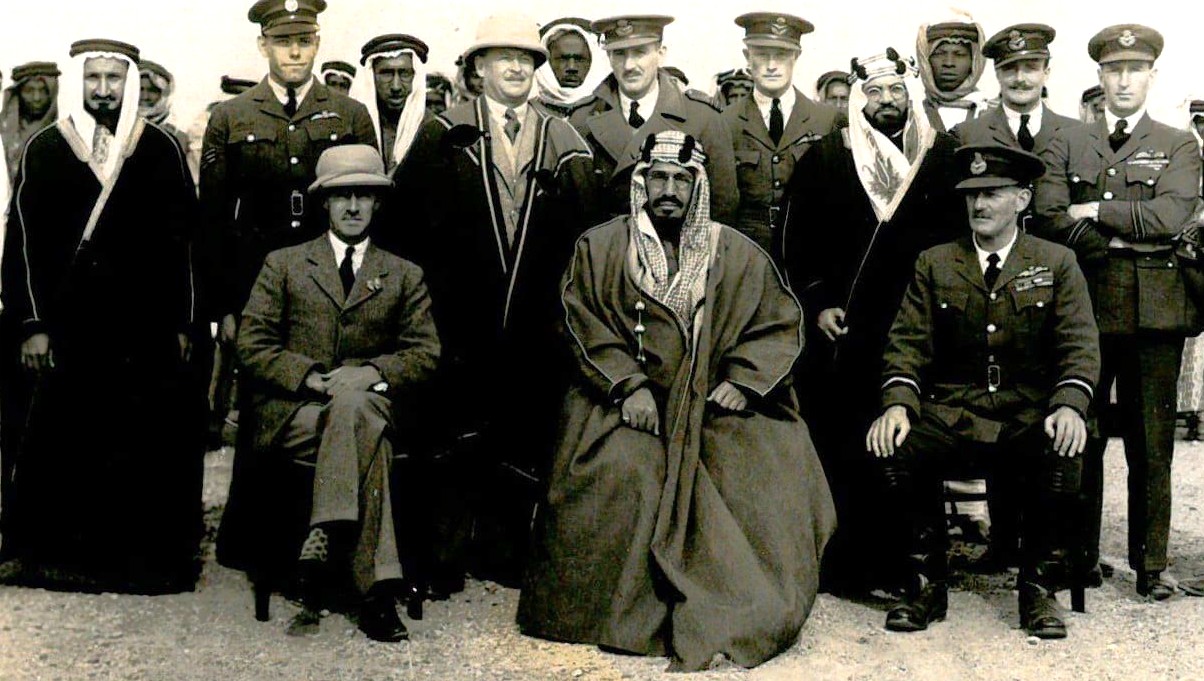
It is not possible to understand what is happening in Yemen, Iraq, and the Gulf region today without knowing the background of British imperialism’s many machinations in the region in the period of World War One and its aftermath. Below an analysis of Britain’s relationship with the House of Saud.
‘Great Britain and Arabia’ by A. Shama from Communist International. Vol. 5 No. 11. June 1, 1928.
ALTHOUGH relatively near Europe, Arabia is still what may be called an unknown country in the full sense of the word. There are reports from time to time in the European press about the inroads made by “wild” Bedouins into territory under British protection, wars between various States and the bombs dropped by “cultured” British airmen. Let us endeavour in this article to enquire into these apparent contradictions, created by European civilisers in this enormous peninsula.
At the present time there are only two actual independent States in Arabia: Yemen and the united Hedjaz-Nejd.
Already before the world war Yemen had practically gained independence in the struggle with the Turkish oppressors, and during the war this agricultural territory was of little interest to the imperialist powers. Therefore, during the war Yemen was able to strengthen its independence still further. The Emir, Imam Yekie, was the only Arabian Emir who did not receive a subsidy from Great Britain; he assisted Turkey to a certain extent. Recently this State has come under the influence of Italy, having concluded an agreement in September, 1926 (which was renewed by a treaty in July, 1927) to render mutual support. Italy is to supply Yemen with arms and military instructors. The growing strength of Yemen constitutes a certain danger to British control in Arabia, especially on account of its proximity to the British fortress at Aden. In connection with the reports about the attacks of British airmen on the Nejd tribe, reports have been circulated to the effect that air expeditions are being sent from Aden against the Yemen tribes.
Hedjaz. The situation in Hedjaz is absolutely different. This State is considered by the Moslems as the most important Arabian State. During the war the Sheriff Hussein received several millions as a subsidy from England, and in consequence dragged Hedjaz into the war. The Arabian army under the leadership of his sons helped the Allies to occupy Palestine, Syria and Iraq. Since that time the Hussein family have been nothing but the hirelings of Great Britain. His sons, Feisal and Abdulla, were made the kings of Iraq and Trans-Jordania, and Hussein himself continued to demand endless subsidies in order to rehabilitate himself before the Arabian national movement, which was directed against England. Great Britain then had no more use for him and permitted Hedjaz to be conquered by Ib’n-Saud in 1924.
Nejd. When the world war broke out Emir Ib’n-Saud was one of the weakest rulers in Arabia. Like other Arabian Emirs he received financial aid and arms from the British, and in 1915 he signed an agreement, which, “de facto,” put Nejd under the protection of Great Britain. In accordance with this agreement, Ib’n-Saud undertook not to enter into any kind of political relations with other powers without the knowledge of Great Britain, nor to grant them any concessions. Furthermore, he agreed to refrain from attacking any territory under British protection.
Instead of waging war on the Turks, Ib’n-Saud is concentrating on expanding his territory and strengthening his State internally. He has made it possible for the warlike tribes to take up agriculture and settle on the land; he is developing gardening and introducing a number of model administrative measures and reforms. As a result of all this at the close of the world war, Nejd had become one of the strongest emirates. In 1921, Ib’n-Saud subjugated Shammar and in 1924 Hedyjaz.
The lightning successes of Ib’n-Saud, who in a short time had united two-thirds of Arabia, raised the hopes of the Arabian nationalists, who visualised Ib’n-Saud as the man to unite all the Arabians throughout the world. On the other hand these successes made it clear to the British what a danger the strength of Ib’n Saud was, and they concluded that there was no doubt that he intended to march on Iraq, Trans-Jordania and Palestine in order to dethrone Hussein’s sons.
A tough struggle between Ib’n-Saud and Great Britain ensued. The armies of the mandate States were increased, and in order to compromise Ib’n-Saud the IQIS agreement was made public. A campaign was organised against pilgrimages1 in an attempt to undermine the economic position of Hedjaz. Throughout the Moslem world “reliable information” was circulated that Ib’n-Saud’s armies destroyed the tombs of holy people and burned all the decorations in “sacred places” (it is generally known that the Wahabis—puritan Moslems— fought against all kinds of “idolatry”). The Persian, Egyptian and Indian Governments organised a formidable blockade of Hedjaz and practically forbade pilgrimages. Finally, Great Britain and also Italy worked up an intrigue to bring about war between Ib’n-Saud and the Imam Yekie of Yemen. The basis of the struggle was actually the emirate of Asir, where Anglo-Saxon oil had already secured a petroleum concession.
The situation which ensued compelled Ib’n-Saud to refrain from further conquests for the time being and to concentrate on strengthening his newly-created State.
The European press occasionally calls Ib’n-Saud the Arabian Napoleon. Paradox as it may seem, Ib’n-Saud never adhered to the Arabian nationalist movement, which often serves as a screen for reactionary dreams about the creation of a powerful Arabian empire, governed by some direct descendant of Mahomet, or simply utilises different policies in the service of one or other. of the competing imperialist powers. Ib’n-Saud never was a pan-Arabian, he was only intent on the territory immediately surrounding his State and on spreading the doctrines of the Wahabis.
Certain devotees christened the religious movement Wahabism, or “Moslem Puritanism,” whereas Wahabism is a movement of extreme interest, not from the point of view of the development of Islam, but in connection with the development of the struggle for the liberation of the Arabian East.
Islam has never had a shortage of prophets, who call for a return to the early “pure” form of religion and Wahabism received special support from such. The Wahabi movement began in the second half of the eighteenth century. The supporters of this movement were zealous advocates of the “cleansing” of Islam from heretical rites and the return to the customs of the austere Bedouin life. The objective political consequences of this movement lay in the opposition to the penetration of European power into Arabia. Wahabism went the way of all religious movements; its development was not on the lines of the inner logic of religious teaching, but rather that of economic and political development. Wahabism, without the conscious wish of its leaders, became the weapon for the political centralisation of Arabia.
The New Conditions in Arabia
The objective demands of the State which Ib’n-Saud created included the establishment of conditions favourable to the development of agriculture and trade. Caravan trade, which Riyadh and other Nejd settlements carried on with Egypt, Damascus and Bagdad, flourished under the rule of Ib’n-Saud. His envoys began to preach the necessity of the transfer from nomadic life to a settled mode of living and agriculture. The first settlement of former nomads was made in 1914 near Artaria in the territory of the Sheikh Feisaled-Dervish, now in the limelight on account of his struggle with Iraq. At the present time the number of settlements is about 70, some of which have a population of about 10,000. The Bedouin settlers and others supported Ib’n-Saud in all his campaigns and helped him to conquer Hedjaz.
The conquest of Hedjaz raised a number of new problems for Ib’n-Saud. Last century the Wahabis conquered the “sacred” towns of Mecca and Medina, where they destroyed all the holy things, hating them as objects of idolatry. But the leader of the Wahabis in our time could not permit such behaviour. He rightly concluded that the preservation of holy objects and the encouragement of pilgrimages might be more profitable than their destruction. Customs, telephone and telegraph were introduced although the Koran makes no mention of these heretical innovations. Ib’n-Saud also introduced automobile traffic. He considered this a means to induce pilgrims to come to Hedjaz; the auto company recently founded has a sinking fund of £50,000, £20,000 of which belong to Ib’n-Saud himself.
Ib’n-Saud’s dominions are quickly becoming modernised. The improvements include: membership of the world postal service, abolition of customs on the importation of machines and agricultural instruments, development of education, special health service, the establishment. of five hospitals in Mecca and a factory for the preparation of quinine, and also a bacteriological institute in Jedda. The most important item of modernisation was the arming of the tribes with European arms, which have helped him to extend his territory.
Ib’n-Saud’s dominions are entirely surrounded by the British spheres of influence and this fact forces the leader of the Wahabis to be on his guard against a conflict with England. Up to 1923 Ib’n-Saud received an annual subsidy from Great Britain, which according to the statement of Mr. Amery in the House of Commons, amounted to a total of £542,000. In 1923, Ib’n-Saud on his own initiative declined to accept the subsidy any longer and last year an agreement signed with Great Britain recognised the complete independence of Ib’n-Saud’s dominions, which include Hedjaz, Nejd, Asir and certain annexed territory.
Ib’n-Saud through his great power has been able to secure that the 1927 treaty recognised “de jure” the independence of the Wahabis and forced Great Britain to remove the embargo on the import of arms and implements of war into Arabia.
During the negotiations Great Britain demanded of Ib’n-Saud the recognition of the present boundaries of Iraq and Trans-Jordania. This meant agreeing to the loss of Maan, the most important point on the Hedjaz railway, and Akbah, the only port on the northern part of the Red Sea; but Ib’n-Saud did not agree to this He held out for the frontiers in accordance with the status quo and despite all the force brought to bear by Sir Gilbert Clayton, the British representative, the treaty contains only an obscure indication to the effect that “the final decision of the question regarding the boundaries of Hedjaz and Trans-Jordania is considered impossible under conditions prevailing at present.”
After this agreement had been signed Ib’n-Saud gave asylum to Sultan Atrash, leader of the insurgent Syrians, who had been driven out of Syria by the French troops and then out of the El-Azrak oasis by the British. Ib’n-Saud is preparing a number of congresses, not satisfied with the all-Moslem Congress held in Mecca in 1926, which was in itself a clear anti-imperialist demonstration. He is recognised as the greatest force in Arabia and relations between him and the leaders of the Arabian nationalist movement have become closer; his supporters are continually increasing amongst the Moslem population both in British India and the Dutch Indies. In self protection, Ib’n-Saud has avoided any conflict with the British, knowing only too well that he would not be the victor in any such encounter and that all the attainments of his 25 years’ work for the unification of two-thirds of Arabia would be reduced to nought. Great Britain on her part also preferred to negotiate with Ib’n-Saud, since a treaty to a certain extent binds the leader of the Wahabis, and furthermore, she contemplates using Hedjaz in the struggle against the other Arabian forces.
An Unstable Peace
The peace between Great Britain and Ib’n-Saud is a very rotten sort of peace. The fact that England has not already infringed it and declared war simply implies that she expects to attain her ends by some other means. For Great Britain has no intention of giving up the struggle for the control of the Middle East, or of desisting from the usual methods and intrigues; one thing is certain and that is that Great Britain neither wants to nor can live at peace with a powerful and independent Arabian State.
The territory of Ib’n-Saud is surrounded on all sides by the vassals of Great Britain, with one exception, that of Yemen. Of all these countries the most precious for Great Britain is Iraq; the oil-springs there constitute a strong incentive to hold this mandate territory. Iraq in the hands of the British has become a military basis against Turkey and Persia. It is clear that Iraq feels the burden of its position as a mandate country under King Feisal, who was foisted upon it. The Iraq parliament had the idea of reforming the Iraq army and introducing conscription, and it is also striving for the inclusion of Iraq in the League of Nations as an independent country. England turned down the first demand categorically and postponed the consideration of the second to the far distant future. England prefers to “protect” Iraq herself with the help of her aerodromes. British aeroplanes, which cast bombs on the population are a guarantee not only against any attack on Iraq, but also a guarantee against Iraq’s secession from the British Empire.
Trans-Jordania by the very fact of its existence is committed to the British plan to dismember and parcel out Arabia. This State has a population of 300,000 semi-nomadic Bedouins, incapable of self-support, but it weakens the national movement in Palestine. Just now Trans-Jordania has even been offered a constitution, but there is discontent in the ranks of the nationalist party, both with the Emir Abdulla, who was appointed by the British, and with the separation of the country from Palestine.
The extension of Trans-Jordania at the expense of Hedjaz is still contemplated by Great Britain, which continues to cherish the idea of building a port in Akabah and linking this port up by rail with Maan and Basra in Iraq on the Persian Gulf.
Concentration of British Forces
British air bases are being constructed both in Koweit and Oman; the Koweit population gravitates towards Nejd and is only kept under British rule by force. The fact of British supremacy over Koweit isolates Nejd from the Persian Gulf and the Koweit traders from Central Arabia. Koweit is an important centre on the Persian Gulf and on the road to India, and at the same time serves as a basis for the development of military preparations against Nejd. These are the reasons why Koweit was annexed in 1926, against which annexation at the time Ib’n-Saud made an unsuccessful protest.
The frontiers between Trans-Jordania, Iraq and Hedjaz are not definitely marked out. The British are trying continually to extend these frontiers southwards; on the Iraq-Nejd frontier, there is a neutral zone of about 70 miles on which the inhabitants of Iraq (the British) undertake not to carry on any military operations. Last year the British High Commissioner in Iraq informed Ib’n-Saud that along the whole frontier 23 forts would be erected. Ib’n-Saud protested, but received no reply; the construction of the forts was begun. Feisal-Ed Dervish destroyed one of these forts and thus began the last Iraq-Nejd conflict. The Bedouins from the localities over the borders of Trans-Jordania and Iraq repeatedly crossed the Hedjaz frontiers, driving cattle, killing, and laying waste whole districts. It is quite clear that the marionette kings—Abdulla and Feisal would hardly have permitted this continuous provocation to war had it not been that Great Britain was behind them. The destruction of Hussein’s army is still very fresh in our memory. The inroads into Hedjaz on the part of Trans-Jordania and Iraq have been encouraged by Great Britain and cause confusion in both Hedjaz and Nejd. Great Britain does everything to force on a war between Ib’n-Saud and the Imam Yekie of Yemen. In view of this policy every recognition should be given to the firm resolve of Ib’n-Saud to preserve friendly relations with Yemen.
The question of the Hedjaz railway is a cause of conflict between Great Britain and Ib’n-Saud. The Moslem congress in Mecca in 1926 expressed the wish that this railway, which had been built entirely at the expense of the Moslems to facilitate pilgrimages to Mecca and Medina, be given to Hedjaz. In reply to Ib’n-Saud’s request to this effect, Great Britain pointed out that it would be necessary to consult France on this question; this attitude aroused the just criticism of the Arabian press, which said that Great Britain remembers and carries out to the letter only those treaties which serve her own purpose.
Ib’n-Saud’s State does not fit in with the plans of the British Colonial Office, and the leaders of British policy in Arabia are trying to provoke war. Great Britain supports Iraq and Trans-Jordania in the conflicts with Ib’n-Saud. British aeroplanes fly over the Nejd territory and throw bombs, killing hundreds of people. New reinforcements are being brought from India to Iraq, and in Koweit the British forces are also being strengthened. Great Britain is forcing Ib’n-Saud to war. When the question was asked in Parliament whether it was not possible to warn Ib’n-Saud, the Colonial Secretary, Amery, replied that it was “difficult to do so with a government with which there was no telegraphic communication.” At another session of the House of Commons, Amery stated that in November, 1927, two-and-a-half million cartridges had been sold to the Hedjaz Government and in March two million. In order to reassure the House, he added that this fact merely shows that Ib’n-Saud did not help the Nejd tribes or supply them with arms.
Great Britain is utilising the confusion of the border tribes of Nejd in order to conciliate the Iraq nationalists who are opposing the new Anglo-Iraq treaty. The method is an old one: to rouse the Arabians and incite them against one another. But the strange thing is that the Arabian press shows that the people do not desire war, despite all the machinations of the protectors of Iraq and Trans-Jordania. The Egyptian “Mokatta,” for instance, which is somewhat more independent than the press in the mandated countries, writes: “In all Arabian countries the Wahabis are being attacked and represented as highwaymen and robbers; but we ask why was it that the Wahabis were hitherto peaceful people and that only just recently are they considered bandits? Simply because the two brothers (Abdulla and Feisal) are all the time organising and supporting attacks on the Nejd tribes.”
During the past few weeks it seems to have become as it were, “peaceful” in Arabia. There are no telegrams about Ib’n-Saud’s “holy wars” and the mobilisation of thousands of troops to attack Iraq and Trans-Jordania. But Sir Gilbert Clayton, the best authority on the Near East in the Colonial Office, has been in Jedda negotiating with Ib’n-Saud, and rumours are circulated about the suspension of military preparations prior to his arrival.
Of course, there is the possibility that Ib’n-Saud may agree to Clayton’s requests and return Maan and Akabah in exchange for a loan. In this case Ib’nSaud becomes one of the many British vassals, and if Great Britain should find him superfluous, as was the case in 1924 with Hussein, she can find a means of removing him. But still it is possible that the pressure brought to bear by the tribes will prevent Ib’n-Saud from falling into this snare. Then he will play for time, assuring Great Britain of his “friendly intentions and goodwill,” but war is unavoidable, for new ways of communication must be built through northern Arabia (railways, airways, autos), to India, which means that the Nejd tribes must be driven back further into the desert.
No matter what Ib’n-Saud, who as king of Hedjaz has curtailed the revenue from pilgrimages, does, he cannot avoid a conflict with the strongest “Moslem State,” Great Britain. The very fact of the tribes taking up agriculture is an obstacle to the “civilising methods” of the British. And this is the reason why every few months there is some report or other about the attacks of the Nejd tribes on Iraq and the cultural work that Great Britain is directing there. If there is one point in Arabia where the supremacy and power of the Royal Air Force might be demonstrated, even to sceptics, that point is the Iraq-Nejd frontier. The Royal Air Force airmen bomb the Wahabi population, kill women and children, thereby increasing the hatred of the Nejd population for the British and the strength of their resistance.
Furthermore, in spite of Ib’n-Saud’s repeated declarations about his neutral attitude to the struggles of other Arabian countries, his country is being drawn more and more into the orbit of British imperialism and the struggle of his and of other Arabian countries for independence is being linked up with the struggle of the masses. As the only independent State, except. Yemen, his State becomes one of the most important centres for the Arabian national revolutionary movement.
Great Britain had caused a network of contradictions in Arabia: the antagonism between her mandate territories and Ib’n-Saud, between Ib’n-Saud and Yemen, between Yemen and the British possession of Aden. Italian and British interests are at cross-purposes in Arabia, and now American capital is turning its attention to Arabia.
Great Britain first armed Arabia and made it acquainted with the technique of European warfare. The policy of London has forced. Arabia to turn these arms against Great Britain herself. The general disturbances in the Arabian countries and the incitement to fratricidal struggles by the British are already beginning to find expression. The Arabian national revolutionary movement is striving towards the liberation of these countries from the tutelage of Great Britain and France. This movement will attract all the best elements from amongst the many millions of Arabians, and also all the revolutionary elements from amongst the west European workers, even from amongst the British.
1. The greater part of the income of the population of this”‘holy land” accrues from the reception of pilgrims. Over and above this, Hedjaz continued to get a subsidy, at one time from Turkey and then from Great Britain.
The ECCI published the magazine ‘Communist International’ edited by Zinoviev and Karl Radek from 1919 until 1926 irregularly in German, French, Russian, and English. Restarting in 1927 until 1934. Unlike, Inprecorr, CI contained long-form articles by the leading figures of the International as well as proceedings, statements, and notices of the Comintern. No complete run of Communist International is available in English. Both were largely published outside of Soviet territory, with Communist International printed in London, to facilitate distribution and both were major contributors to the Communist press in the U.S. Communist International and Inprecorr are an invaluable English-language source on the history of the Communist International and its sections.
PDF of full issue: https://www.marxists.org/history/international/comintern/ci/vol-5/v05-n11-jun-01-1928-CI-grn-riaz.pdf
 Revolution's Newsstand