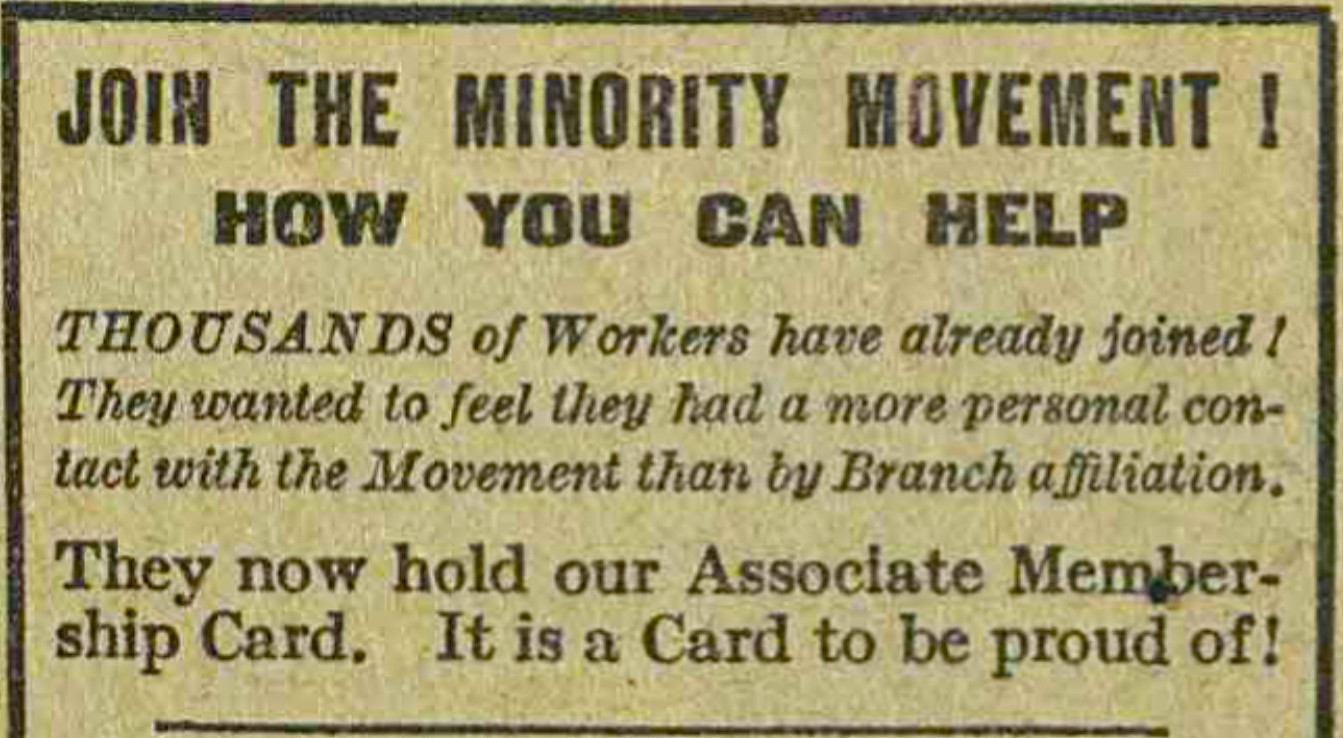
Foster is the Profintern representative to it’s British affiliate’s, the National Minority Movement, conference held in August, 1928 where the main topic of discussion of ‘Mondism’, Britain’s post-General Strike class-collaborationist movement which saw ‘efficiency’ cooperation in the shop and industrial disputes adjudicated by government arbitration.
‘Conference of the British Minority Movement’ by William Z. Foster from Labor Unity. Vol. 2 No. 9. October, 1928.
IN Shoreditch Town Hall, London, on August 25 -26, the National Minority Movement, which is the left-wing of the trade unions and the British section of the Red International of Labor Unions, held its Fifth Annual Conference. Present were 825 delegates coming from all the principal industries, unions, and localities, and representing at least 750,000 organized workers. The conference was presided over by the veteran, Tom Mann.
The conference had an extended order of business, dealing with “Trade Union Democracy and Reorganization,” “The War Danger,” “Rationalisation,” “Strike Strategy,” “Industrial Peace” “The Colonial Question,” “The Cooperative Movement,” “Unemployment,” organizational matters, etc. But the central question, which colored and shaped all the business of the conference was the struggle against “Mondism,” or the so-called industrial peace movement.
The Rationalization Movement
In order to comprehend the struggle over Mondism it is necessary to understand the industrial difficulties in which Great Britain now finds itself. Because of backward technique, antiquated organisation, its load of war debts, the rise of new and powerful competitors such as the U.S. 9 the colonial countries, etc., England has been driven out of its position as leading world industrial country. Many of its great industries are stagnant or even declining. This is especially true of the basic coal, metal, and textile industries, in each of which production is now lower than in 1913. From one to two million workers constantly are unemployed. This situation marks the decline of England as the greatest imperialist power.
Confronted with this deep crisis, the British employers are engaging in a desperate campaign to cut production costs, probably hoping that thereby they can accomplish the impossible task of overcoming foreign competition in the world market, and of re-establishing Great Britain’s industries on a flourishing basis. Although seeking to arrive at this end also by a general modernising of their industries, their main objective is to cut production costs and to rationalize the industries at the expense of the workers: by speeding up the workers, by slashing wages, lengthening hours, and destroying the militancy and power of the unions. To serve this purpose of the employers is the function of Mondism, or the “industrial peace” movement.
Mondism
Mondism is the development in England of tendencies long familiar to American workers. On the one hand, it proposes that the workers collaborate with the employers to increase production (similar to the B. & O. Plan, union-management cooperation, etc.), and on the other, the establishment of a quasi-compulsory arbitration (similar to the Watson-Parker railroad law) to put an end to strikes. Mondism means to abandon all struggle by the workers, to surrender them to the speed-up, war-mongering plans of the employers. It is the company-unionisation of the trade unions.
Mondism takes its name from Sir Alfred Mond (now Lord Melchett), head of the Imperial Chemical Companies, the chemical trust, which employes 40,000 men. Mond is a kind of British Mitten. In his plants he has works councils (company unions), employee stock buying, welfare work, and the rest of such methods of demoralising the workers. He openly praises the Italian Fascists and they in turn have lauded his program as akin to their own. Mondism is a beginning of Fascism in England.
Mond came forward with his plan in December, 1927, when on behalf of 23 of the biggest British capitalists he asked the trade union leaders to come into conference for the purpose of establishing industrial peace on the basis of the unions accepting the rationalization, speed-up, compulsory arbitration program of the employers. Thus the employers’ offensive took another step forward. First, it was the great assault on the unions in the general strike; then it was the attempt to smash them later with the Trade Union Act; now it’s an effort to devitalise them by a process of company unionization.
Union Leaders Treason
The reactionary British trade union leaders, the Thomas’, Turners, Bevins, et al, were quick to accept Mond’s proposals. Thus they are true to their role of betraying the workers. It was they who broke the general strike; they also made no real fight against the Trade Union Act and now, as agents of the employers in the ranks of the workers, they naturally become the champions of Mond’s company-unionization scheme. The rationalization drive of the employers for cheaper production is world-wide, and so is the surrender of the reactionary leaders in it. In France they are accomplishing this surrender through the National Economic Council; in Germany through schemes of “industrial democracy,” labor courts, and arbitration councils; in the United States through Capitalist Efficiency Socialism, the new wage policy, etc.; in Italy they have surrendered to Mussolini and his Charter of Labor. Now, in England, the same tendency develops in Mondism.
Mond with his capitalists came together in conference with the union leaders in July 1928, the latter totally without” rank and file authorization. As a result of its deliberations the conference put forth a plan for the formation of a National Industrial Council, to be composed of representatives of employers and union leaders. This council is to have the double purpose of speeding up the workers and of eliminating strikes.
This scheme was greeted joyously by the capitalist press. They saw in it a knife for the exploiting employers to hamstring the working class, and the end of revolutionary dangers. The labor leaders, reflecting the moods and interests of the employers, were no less jubilant. They declared that not only were the workers on the way towards capitalist prosperity, but towards Socialism as well. So they hope to blind the workers to this latest scheme of exploitation. In the Daily Herald, Aug. 28, Citrine, secretary of the General Council of the Trade Union Congress, strikes the keynote when he says: “We believe rationalization can be made a step towards Socialism.”
The Left Wing Fights Mondism
Immediately upon Mond’s proposals, the National Minority Movement took up the cudgels against this new menace. Great meetings were held in all the industrial centers. Many pamphlets and leaflets were issued. The Shoreditch conference was but the latest step in mobilizing the workers for the battle against Mondism.
Meanwhile other elements not directly in the Minority Movement but sympathetic, also joined in the fight. A.J. Cook, Secretary of the Miners Federation, is waging a militant campaign, together with Maxton of the I.L.P. Among the vast masses of workers there is a developing much opposition to this latest attack by the employers.
Terrorism In The Union
Confronted by the growing opposition, the reactionary leaders, at all costs determined to put across Mondism, are abolishing democracy in the unions. They know that their only hope of holding on to the masses and to herd them into the Mondist trap is by breaking the power of the left wing. Hence, seeking to accomplish this, they are introducing into the unions methods of autocracy and terrorism familiar this past few years to American workers. Expulsions, convention packing, vote stealing disfranchisement, etc., are becoming increasingly the order of the day.
And this is only the beginning. We may look for a great sharpening of these terrorist tactics in the near future. The employers are in a difficult position. They will make greater and greater demands upon the workers for more production and for lower wage rates The left wing is powerfully organized and will lead the masses in resisting these demands. Then the union leaders, to get a free hand, will go to even greater autocratic extremes. They will recklessly split the labor movement if necessary. They will not hesitate to slough off vast masses of the semiskilled and unskilled, if thereby they can retain a base of skilled workers over whom to manipulate and bargain with the bosses. Such a split now actually menaces he British labor movement. The Swansea trade union congress, just held, practically gave the signal for it by expelling Communist delegates from the congress, and by initiating this as a line for the whole labor movement. Simultaneously, the capitalist government also intensifies its offensive against the left wing.
Fruits Of Mondism
Already the British organised workers are harvesting the dead sea fruits of Mondism and similar tendencies, by the worsening of their conditions and the wrecking of their labor unions. The report to the Minority Movement Congress shows that since 1921 British workers have suffered wage reductions totalling $3,500,000,000, and the wage tendency is still downward. The railroad workers, thanks to their Mondist leaders, have just suffered a 2 1/2% cut and similar slashes are in prospect for other trades. The Mond scheme which it is claimed will do so much for the workers starts out by slashing the workers’ wages and fattening the capitalists’ profits. The working day is also gradually being lengthened. Since 1921 an additional 211,000,000 hours are being worked annually by the workers, while unemployment is being stabilized on a mass scale.
The trade union movement is also rapidly declining in numbers, being reduced 2,000,000 workers in the past few years. The miners’ federation is being sapped and shattered, having lost about 300,000 members in three years. In “The Labor Monthly” of Sept. 1928, R.R. Dutt well says that “The Swansea trade union congress meets at a time when trade unionism is in greater danger than at any previous period in its history.” In England, as in the United States, the slogan “Save the Trade Unions from the employers’ offensive and the reactionary union bureaucracy” touches a life problem of the workers.
Mondism must make the English trade union crisis deeper. It sacrifices the struggle for higher wages and shorter hours, it liquidates union working conditions, it devitalises and company-unionises the unions, it increases unemployment, it degenerates the leaders into Fascist agents of the bosses, it leaves the workers demoralized before the war plans of the employers, and it increases the war danger by intensifying the struggle for world markets. Finally, it confronts the movement with the menace of a split.
Shoreditch and Swansea
The Shoreditch conference of the Minority Movement declared war to the finish against Mondism. As against a system of surrender, it outlined a policy of militant struggle for improved wages, hours and working conditions, for social insurance, and organization of the unorganized against the speed-up and all forms of collaboration with the employers, against all forms of company unionism, sliding wage scales and co-partnership, against the blacklist, espionage, and victimization. The conference launched an aggressive campaign to restore democracy in the unions, to consolidate them into industrial unions, to organize the unorganized, to oust the reactionary leaders, and to build one great trade union international.
The Swansea congress of the trade unions met a week after the Minority Movement conference. It endorsed Mondism by a vote of 3,075,000 against 560,000. This was to be expected. Like the A.F. of L. congress, that of the British unions is made up almost completely of trade union bureaucrats. They are overwhelmingly in favor of collaboration with the bosses.
Thus Shoreditch and Swansea stand in violent contradiction to each other. Shoreditch, the left wing, the intelligent rank and file, determined to develop the unions into fighting organizations and to lead a policy of struggle against the bosses. Swansea, the right wing, the trade union leadership, determined to drop all fight against the bosses and to turn the unions practically into company unions. The developing struggle between these two opposing elements will decide the fate of British trade unionism. Although they have the backing of the employers and the government, the right wing leaders will never be able to force the masses of British workers to accept Mondism and the intensifying slavery that it involves. Whole sections of them will revolt irretrievably against the Mondist system of company unionization. The next year will be highly crucial in the life of the British working class. The left wing have a terrific fight to make against the degeneration and the splitting of the labor movement by the right wing leaders, who are typical misleaders of the Amsterdam International type.
Other Business of the Conference
While concentrating heavily its attack on Mondism in Great Britain, the conference also paid much attention to the world situation. It exposed the war maneuver of British imperialism; warned the workers of the growing war danger; and called upon them to repel that danger. It pledged the most hearty support of the Soviet Union.
Much attention was given to the colonial question. The conference declared militantly for the closest cooperation between the European and colonial movement. The attempts of the British labor leaders to draw the Indian trade union movement into the trap of reformism were denounced. Support was voted the Chinese revolution, to the Indian labor movement, and the Pan-Pacific Secretariat.
The conference endorsed the decisions of the 4th Red International of Labor Unions World Congress. The writer was the delegate from the Red International of Labor Unions to the conference.
Special conferences were held of all the important industrial groups of delegates and plans of campaign laid out for their respective industries. Plans were adopted for building up the minority movement organisationally and for strengthening and revolutionising of its cooperatives. The present leaders, Mann, Pollitt, Watkins, Hardy, Hannington, etc. were re-elected.
The conference was marked by a glowing enthusiasm and militancy. The fighting spirit of the splendid body of delegates augurs well for the Natl Minority Movement in its great fight to save the British trade unions from the machinations of the Mondist leaders and to turn these labor bodies into a real fighting organisation, capable of defending the workers’ interests now and of playing a real role in the final struggle for working class emancipation.
Labor Unity was the monthly journal of the Trade Union Educational League (TUEL), which sought to radically transform existing unions, and from 1929, the Trade Union Unity League which sought to challenge them with new “red unions.” The Leagues were industrial union organizations of the Communist Party of the United States (CPUSA) and the American affiliate to the Red International of Labor Unions. The TUUL was wound up with the Third Period and the beginning of the Popular Front era in 1935.
PDF of full issue: https://www.marxists.org/history/usa/pubs/labor-unity/v2n09-w28-oct-1928-TUUL-labor-unity.pdf
 Revolution's Newsstand