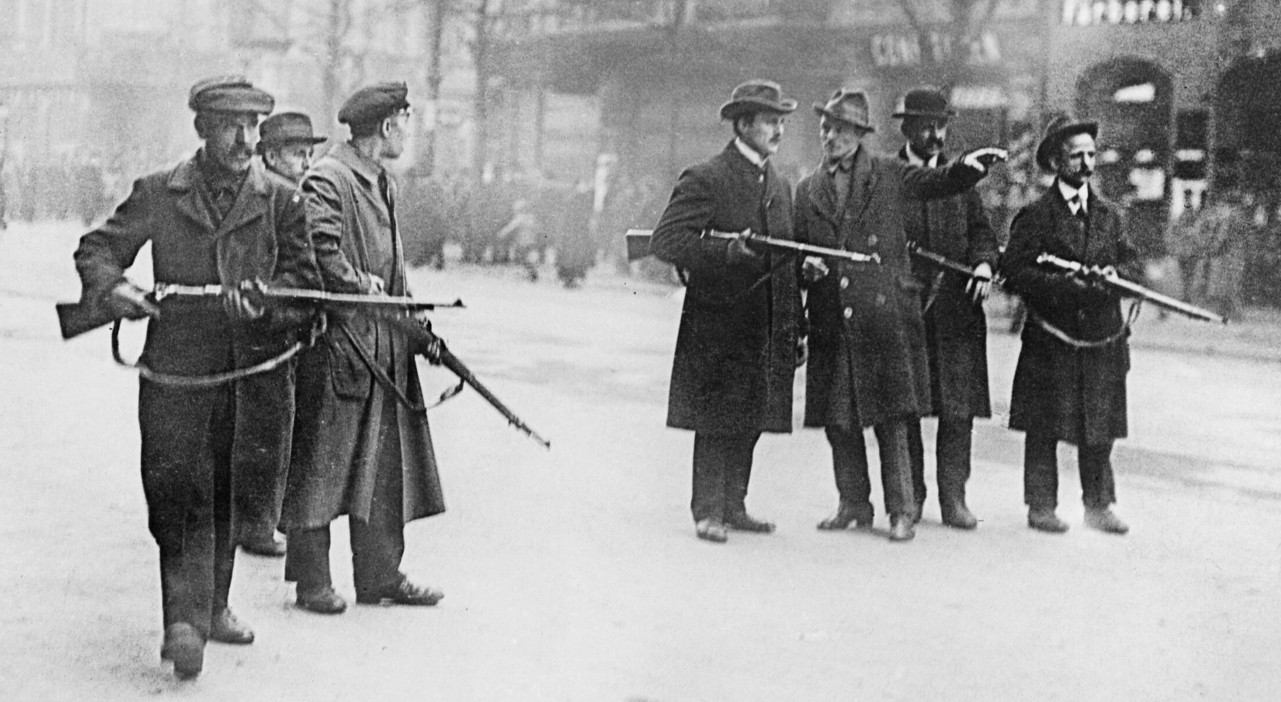
Lenin with an open letter dismissing the demand of a Constituent Assembly by Kautsky and others as the German Revolution unfolded. Written, unbeknownst to Lenin, as the Spartacist Rising began in Germany.
‘”Democracy” and Dictatorship in Germany’ by N. Lenin from Revolutionary Age. Vol. 1 No. 26. April 12, 1919.
THE few issues of the Berlin Red Flag [the Spartacan-Liebknecht organ] and the Vienna Clarion, the organ of the Communist Party of German Austria, that have reached Moscow show that the betrayers of Socialism who during the war supported the governments of the imperialistic brigands, all the Scheidemanns, Eberts, Austerlitzes and Renners, have been denounced by the true representatives of the revolutionary proletariat of Germany and Austria. We cordially greet these two organs of revolutionary Socialism, testifying to the vitality and the growth of the Third International.
Apparently the main issue of the revolution both in Germany and Austria is now this: a Constituent Assembly versus all power to the Soviets. The representatives of the bankrupt Second International–all of them, beginning with the “majority Socialist” Scheidemann and ending with the “Independent Socialist” Karl Kautsky–are favoring the Constituent Assembly, calling their attitude a defense of “democracy.” I shall try, briefly, to state the substance of the controversy which has now become a practical issue for all advanced capitalist countries.
The Scheidemanns and Kautskys are speaking about “pure democracy,” or “democracy” in the abstract, in order to deceive the masses and conceal from them the bourgeois character of modern democracy. Let the bourgeoisie continue to hold in its hands the whole apparatus of the state; let a handful of exploiters continue to control the existing bourgeois state machinery–of what avail is “democracy?” The bourgeoisie, naturally, likes to describe the elections conducted under such conditions as “free,” “equal,” “democratic” and “popular.” But these words serve to conceal the truth that the ownership of the means of production and the political power remain in the hands of the exploiters, and that genuine freedom and equality for the exploited, that is, for the overwhelming majority of the people, are therefore impossible. It pays the bourgeoisie to conceal from the people the bourgeois character of modern democracy, and it is forced to speak of democracy in the abstract, or “pure democracy.” And the Scheidemanns and Kautskys, repeating these bourgeois arguments, actually renounce the proletarian standpoint and desert to the bourgeoisie.
When Marx and Engels signed the last preface to the Communist Manifesto (in 1872) they deemed it necessary to impress upon the workers particularly and emphatically that the proletariat cannot simply seize the existing (that is, bourgeois) state machinery and employ it for its own ends; that the proletariat must break this machinery. The renegade Kautsky has written a whole brochure on The Dictatorship of the Proletariat, but failed to mention this important Marxian truth, and fundamentally distorted Marxism. The Scheidemanns, naturally, generously praised this brochure–praise which was well deserved, for one who deserts to the bourgeoisie ought to be praised by the agents of the bourgeoisie.
Now, when the workers and all toilers are starving, when they are in rags, ruined and worn out not only by capitalistic wage slavery but also by four years of the imperialistic war, while the capitalists and speculators continue to own the “property” they have plundered and the existing state apparatus–now, in particular, it is sheer mockery of the exploited to speak of democracy as an abstract idea, of equality, freedom and popular rule in general. It means a complete repudiation of the fundamental Marxian truth which taught the workers: you must utilize bourgeois democracy as a real step forward in history in comparison with feudalism, but do not for a single moment forget the bourgeois character of this “democracy, its historical basis and limitations; do not share the “superstitious faith” in the “state,” do not forget that the state, not only in a monarchy but in the most democratic republic, is nothing else than a machine for the suppression of one class by another.
The bourgeoisie forced to play the hypocrite, speaks of a democratic (bourgeois) republic as the “rule of the people,” of an abstract or “pure” democracy, whereas this democratic republic is in reality the dictatorship of the bourgeoisie, the dictatorship of the exploiters over the toiling masses. The Scheidemanns and Kautskys, the Austerlitzes and Renners (and now, unfortunately, with the aid of Friedrich Adler) support these lies and hypocrisy. The Marxists, the Communists, on the contrary, expose this and tell the workers the plain truth: in reality a democratic republic, Constituent Assembly and popular elections, etc., are nothing but the dictatorship of the bourgeoisie, and there is but one road to the emancipation of labor from the tyranny of capital to replace the dictatorship of the bourgeoisie by the dictatorship of the proletariat. Only the dictatorship of the proletariat is capable of liberating humanity from the oppression of capital, from the lies and hypocrisy of bourgeois democracy–which is a democracy for the rich. Only the dictatorship of the proletariat can establish a democracy for the poor, and make the blessings of democracy actually accessible to the workers and poorer peasants; at present (even in the most democratic bourgeois republic) these blessings are practically inaccessible to the majority of the toilers.
Let us take, for example, the freedom of assemblage and the freedom of the press. The Scheidemanns and Kautskys, the Austerlitzes and Renners, assure the workers that the present elections to the Constituent Assembly of Germany and Austria are “democratic.” This is a lie. For, in reality, the exploiters–the capitalists, landlords and speculators–control nine-tenths of the best buildings which are fit for meetings, and nine-tenths of the paper supply, printing shops, etc. The workers in the city and the farm laborers in the villages are in reality denied these democratic rights by means of the “sacred right of private property,” which is protected by the Kautskys and Renners, as well as by the bourgeois state apparatus, that is, by bourgeois government officials, bourgeois judges and police, etc. The present “freedom of assembly and press” in a “democratic” (bourgeois-democratic German republic) is a lie and fraud. For, in reality, it means freedom for the rich to buy and to bribe the press, to corrupt the minds of the people with the lies of the bourgeois press. It means freedom for the rich to “own” manor-houses, the best buildings, etc. The dictatorship of the proletariat will take away from the capitalists, for the benefit of the toilers, the manor-houses, the best buildings, the printing shops and the stores of paper. But–shout the Scheidemanns and Kautskys, the Austerlitzes and Renners, as well as the Gomperses, Hendersons, Renaudels, Vanderveldes, etc.–this means that “popular,” “pure” democracy will be replaced by the “dictatorship of one class.
Our reply is: it is not true. It means that what is actually a dictatorship of the bourgeoisie (hypocritically veiled by the forms of a bourgeois democratic republic) will be replaced by a dictatorship of the proletariat. A democracy for the poor will replace a democracy for the rich. Freedom of assembly and the press for the minority, the exploiters, will be replaced by freedom of assembly and the press for the majority of the people, the toilers. This will mean a colossal extension of democracy, of universal historical significance, its transformation from a lie into truth, the liberation of humanity from the fetters of capital, which distort and crush even the most “democratic” bourgeois republican democracy. It will mean that the bourgeois state will be replaced by a proletarian state, and this change is the only way to the gradual disappearance of the state.
But why is it not possible to achieve this end without the dictatorship of one class? Why can’t we directly and immediately obtain “pure” democracy?–ask the hypocritical friends of the bourgeoisie or the naive petty bourgeois and philistines deceived by the bourgeoisie.
Our reply is because in every capitalist society the decisive factor is either the bourgeoisie or the proletariat, while the small capitalists inevitably remain hesitating and impotent, foolish dreamers of “pure” non-class or super-class democracy. Because à society wherein one class oppresses another class cannot be abolished otherwise than by the dictatorship of the oppressed class. Because only the proletariat can conquer and overthrow the bourgeoisie, for the proletariat is the only class which is disciplined and united by Capitalism. Because only sentimental petty bourgeois and philistines can dream of overthrowing the power of the capitalists without prolonged and difficult suppression of the resistance of the exploiters, thus deluding themselves and the workers. In Germany and Austria this open resistance has not yet become manifest, since the expropriation of the expropriators has not yet begun. But there will be fierce and desperate resistance when this expropriation begins. Concealing this from themselves and the workers, the Scheidemanns and Kautskys, the Austerlitzes and Renners, are betraying the proletariat. At the most critical stage they renounce the standpoint of the class struggle aiming at the overthrow of the bourgeoisie, for the standpoint of co-operation of the proletariat with the bourgeoisie, of “social peace,” of reconciliation between the exploiters and exploited.
Revolutions, said Marx, are the locomotives of history. Revolutions enlighten people in a short time. The city workers and farm laborers of Germany and Austria will quickly learn that the Scheidemanns, Kautskys, Austerlitzes and Renners have betrayed Socialism. The proletariat will push aside these “social” traitors, these Socialists, in words and traitors to Socialism in deeds, just as the proletariat of Russia pushed aside the petty bourgeois and philistines, the Menheviki and “Social-Revolutionists.” The proletariat will learn–and the more complete the supremacy of these “leaders,” the more quickly–that only by replacing the bourgeois state, though it be of the most democratic bourgeois republic, by a state of the type of the Paris Commune about which so much was said by Marx, which is distorted and betrayed by the Scheidemanns and Kautskys), by a state of the type of the Soviets, can they open the road towards Socialism. The dictatorship of the proletariat will deliver mankind from the yoke of Capitalism and from wars.
The Revolutionary Age (not to be confused with the 1930s Lovestone group paper of the same name) was a weekly first for the Socialist Party’s Boston Local begun in November, 1918. Under the editorship of early US Communist Louis C. Fraina, and writers like Scott Nearing and John Reed, the paper became the national organ of the SP’s Left Wing Section, embracing the Bolshevik Revolution and a new International. In June 1919, the paper moved to New York City and became the most important publication of the developing communist movement. In August, 1919, it changed its name to ‘The Communist’ (one of a dozen or more so-named papers at the time) as a paper of the newly formed Communist Party of America and ran until 1921.
PDF of full issue: https://www.marxists.org/history/usa/pubs/revolutionaryage/v1n26-apr-12-1919.pdf
 Revolution's Newsstand