Kruse on a topic he would return to again and again in his activists and working life, the creation and showing of films by, for, and in the interests of the working class.
‘Movies for the Workers’ by William F. Kruse from The Daily Worker. Vol 2 No. 169. October 6, 1924.
TWENTY thousand motion picture theatres in this country pull fifty million Americans into their doors every week. This audience is made up mainly of workers, for the movie is essentially the theatre of the poor. In addition 80,000 churches, clubs, schools and other organizations are equipped to show films to their own more restricted audiences, and do so on a weekly or monthly basis. The tremendous propaganda power of the hundred thousand projectors outshines all the newspapers, magazines, pulpits, lecture platforms, and public libraries put together. To paraphrase a famous saying: “Let me make the movies and I care not who writes the sermons.”
It takes a lot of pictures to supply all these machines. The program must be ever interesting, ever changing. Hundreds of producing and distributing companies are kept busy supplying it. Seven hundred full length pictures and 1500 short subjects are produced annually at an estimated cost of $200,000,000. The film industry is “Big Business,” with a pay roll of seventy-five millions, and five millions annual appropriations for newspaper advertising, three millions for printing, two millions for lithographs, and another two for cuts, photos, slides and other accessories.
Film “Fact” Mostly Fable
The kind of stuff shown at the theatres is known to our readers-sloppy, sentimental gush, cut to a standard cheap pattern, and teeming with anti-labor, race prejudicial, pro-capitalist propaganda. But low as is the character of most theatrical film, the non-theatrical sinks lower still. Very few pictures are made directly for this field because the profits therein are much smaller. So only those films too poor and uninteresting to make the grade are given non-theatrical “first run.” The bulk of the pictures available for the use of clubs, churches, etc., are those that Noah brought with him on the Ark. Advertisement film and government departmental productions finish the list of non-theatrical film sources.
If the regular theatre program is loaded with anti-labor propaganda the non-theatrical program is saturated with it. A catalog of a film house which appeals principally to colleges and churches starts with the announcements that its pictures were “made by Thos. A. Edison, Inc. according to a definite plan.” What it really means is that an old film company once graced with Edison’s name, went out of business and turned its junk over at some low price. But the school or church program selector imagines that Edison himself spent some of his sleepless nights picking out and planning out these particular pictures. The catalog goes on to say that its listings “can be safely placed before any audience in church or school without censorship.” When the workers of America achieve power that statement will certainly no longer be true.
Enter the “Patriotic.”
The suggested program generally include one or two short features, a comedy, a scenic, and a “patriotic.” The last named is an undisguised effort to foster a servile spirit of capitalist militarism–for instance a picture of the Military School at West Point is guaranteed to “arouse patriotism and inspire alike the boy who will be a man and the man who has been a boy.” “The film is strengthened with appropriate and patriotic sub-titles,” a further recommendation. Another picture shows a boys’ military school, and the bait here is: “The boys being trained and hardened and taught to live healthy and cleanly lives, will grow up to be men worthy of the name ‘American.'” Still another picture shows the Marine Corps which is guaranteed to “arouse in the observer a feeling of pride in those of our boys who revel in the slogan, “The First to Fight'”–no matter for whom or against whom or why or where–just “First to Fight.” Great stuff for our imperialist masters, and so appropriate for a church program!
The features are just as rotten and more dangerous because of their subtlety. The poor boy comes to college and ‘makes the team’ despite the rivalry of his rich and experienced fellow student. Who says there’s no chance for the poor but honest? Jimmy, the Boy Scout, after making several blunders thru his overzealousness takes his trusty gun and captures a German spy making maps of Podunk Corners. The Noble Prince finds that the Secret of Happiness consists of “Work and Deeds, not possessions. harmony of thought and action.” The old fiddler gets his sight back and is so depressed by the ugliness of the world that he wants to remain blind, therefore “doesn’t that all go to prove that contentment is the best thing in life?” And of course the strike theme is not neglected: “A gang of laborers, incite by Tony, one of their number, who has been discharged, overpower Hennesy, their foreman, and plan to wreck an incoming train which is said to be bringing strike-breakers.” Anti-strike. Anti-foreign born worker. And right in line with the violence charges heaped by the capitalist press upon every effort of workers to better their conditions.
Poisoned Film Is Plute Gas Attack
These are facts that we must face. We do not lament over the wickedness of the capitalist class in poisoning the minds of the workers against their own interests. The struggle for the mind of the masses is basic in the class war today. Only by holding it can the masters retain their privileges, and to hold it they use every possible means–certainly not over-looking such effective machinery as the motion picture. Poisoned film in the churches is merely a capitalist gas attack upon the labor movement.
The only answer to artillery is counter artillery. The only answer to capitalist film in the church is working class film in the labor temple. As in every other field of battle our enemy has an enormous advantage over us in wealth and experience. But that should not deter us. The enemy has thousands of papers to our handful, but we battle on just the same. Against his resources we match our determined class spirit, and our wits to do miracles with little.
Only Effective Answer: Workers’ Film.
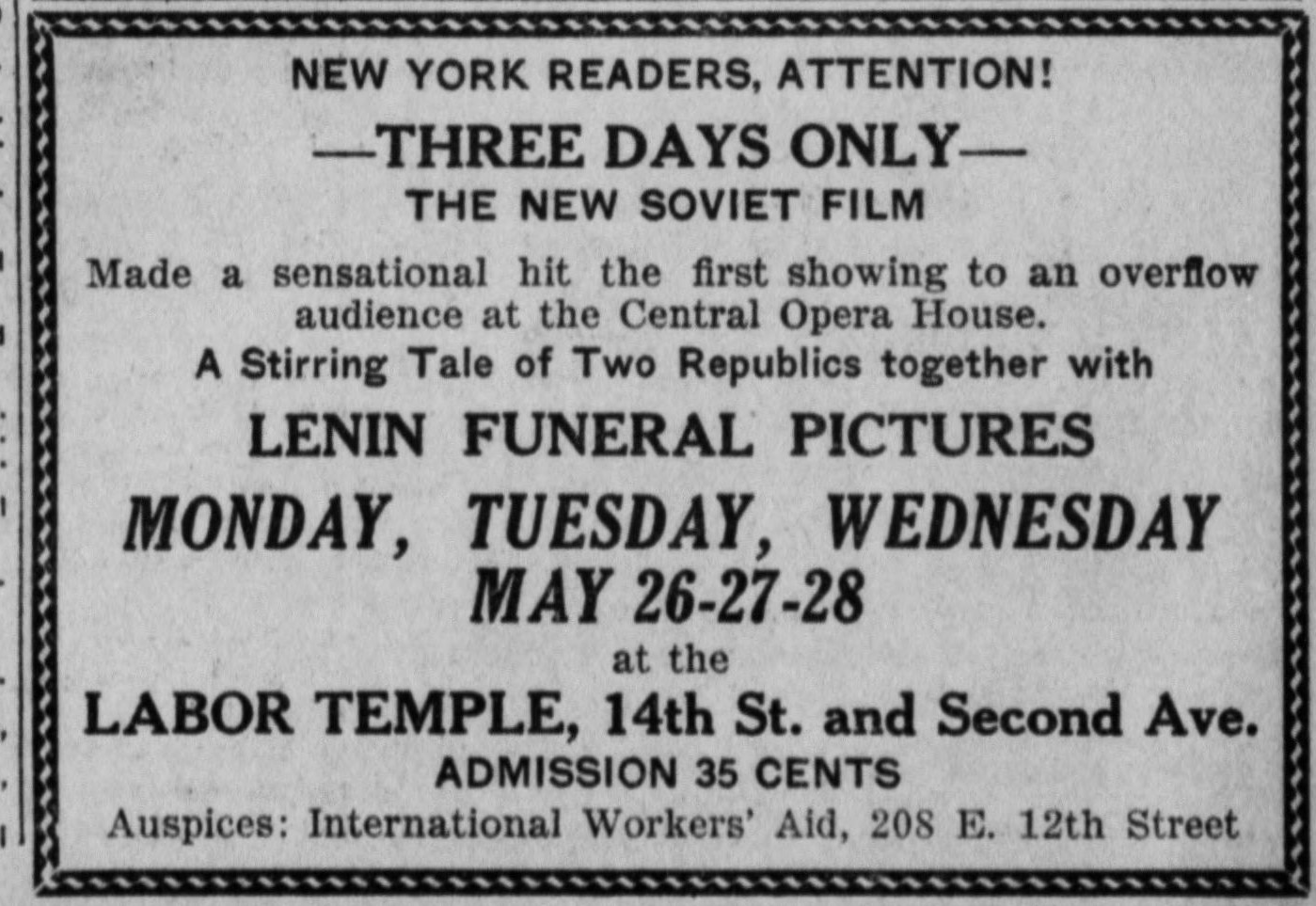
The greatest contribution to labor films throughout the world has been the work of the International Workers’ Aid. Its headquarters in Berlin sent pictures of the Russian struggle to all parts of the globe, and thru credit connections made enough foreign film available to Russia to start the film industry on its feet there. In return they now get the best Russian productions and send them broadcast. The American section of this organization has been the most active in making full use of these pictures. Hundreds of showings reaching many hundreds of thousands of American workers have been held in all parts of the country.
Any film capitalist will readily agree, that to make a picture is one thing, but to get it shown throughout the country is quite another. Only since the organization of the film trust have even big commercial producers begun to market their own pictures, until then the distribution involved entirely separate machinery: Yet with our limited resources we have produced and distributed right from the start. Available Working Class Pictures Thus far the pictures produced and distributed by the I.W.A. include six news films and three dramatic pictures. The news films, in the order of their appearance were:
“Russia Through the Shadows,” six reels, showing actual revolutionary battles scenes, the famine, and American relief efforts culminating in the F.S.R. tractor unit which sought to help kill the cause of famine introducing machine farming.
“The Fifth Year,” eight reels, showing all phases of Russian life during the fifth year of the Soviet Republic, parades, warfare, treason trials, fighting famine, building industry, travel, Comintern Congress, sports, and other events.
“Russia and Germany,” eight reels, mostly photographed by the writer, showing Russia steadily improving under working class government, while the German workers were sinking to desperation under capitalist domination.
“Russia Today,” one reel, showing how the Russian workers actually live, and at the same time illustrating a very instructive industrial process, the mining of asbestos.
“Lenin Memorial,” one short reel, showing events of the life of the greatest working leader of our time.
“Russia in Overalls,” three reels of Russian life, particularly interesting to American workers because it shows their contributions thereto thru the Amalgamated Clothing Workers’ factories in Russia, the “Kuzbas” coal mines and the I.W.A. tractor units.
Fiction Films Also
The three fiction films thus far offered by the I.W.A. include:
“Polikushka,” made from Tolstoy’s immortal tragedy, by the Moscow Art Theatre, with Ivan Moskvin as the star. It won the highest praise from American critics, but would not go over with the distributors because it was, “too artistic and too sad.” They wanted something called “Her Latest Sin,” or “Bedroom and Bathroom Beauties.”
“Soldier Ivan’s Miracle,” a two reel comedy, went with the above to round out an interesting all-Russian program, and sometimes a single news reel was also shown.
“The Beauty and the Bolshevik,” the newest and best feature film brought from Russia, modern in every respect. It is a romance of Red Army life, well-acted, cleverly titled and directed, and excellently photographed. It compares favorably with really good American pictures. This is just beginning to tour the country after a phenomenal two weeks run in New York. It is combined with “Russia in Overalls” to make a complete program.
In addition plans are under way to use Upton Sinclair’s “The Jungle,” together with a two-reeler showing the “Life and Deeds” of our paper, The DAILY WORKER, to further enrich the list of labor films available to the American workers.
Small Locals Can Succeed
These pictures are here now. Some have been shown in many places, but none of them have had full runs to which they are entitled. The greatest difficulty has been the limited number of cities with a labor movement large enough to support a showing of our pictures. The cost of single showing has been too high, sometimes hundreds of dollars had to be paid for a theatre, to say nothing of advertising. In large cities this is easy, a big theatre draws a big crowd, and success is assured. But in smaller cities the costs mounts so high that in many cases the profits hardly pay for al. the energy put in. Thus far, while commercial producers hope for 20,000 showings for their product, we have only been able to get less than 200 per picture.
To remedy this situation smaller cities the I.W.A. is offering the films on a basis now that will permit their showing in labor temples or other low cost halls, thereby placing the picture show within the reach of the smallest locals of our organization. In this way it is also expected that pictures which have already been showing once in big theatres of big cities, can be shown again and again in the outlying sections of town, especially in the foreign language “colonies.” Very attractive terms can be offered for showings, especially of the older pictures.
Can Rent Films.
Then there are many second and third run movie theatres in working class districts that would be willing to run these films if properly approached. If the manager were guaranteed an organized support of a movement such as ours he would be willing to pay a little more than the trifle he buys his junk films for. Or we run on a percentage basis, sometimes he gives us the returns on all tickets we sell in advance, sometimes a percentage of his gross receipts, sometimes a direct rental. Where the manager is not willing to run a full length picture he may take on the “shorts”–in addition to those listed. “The Fifth Year” has been divided into seven short subjects that could be run once a week. In this way no risk is undertaken and our pictures are shown at least to some small profit.
In writing to the International Workers’ Aid, 19 S. Lincoln St., Chicago, Ill., for particulars, you should also give as much information as possible about the conditions under which you expect to show the film. State whether a regular motion picture theatre or only a hall is to be used, and if it is a hall state whether motion pictures have ever been shown there before, whether the hall has the necessary machine, screen, etc., for the showing. If pictures have never before been shown there, find out whether they are being shown in your local churches and clubs, and what sort of equipment is used there for the showing. This information is necessary to see whether hall showings are permitted by fire laws. Sometimes you can rent a machine and hire an operator from such a source.
Running Movies Easy, Sure Success
The actual running of a picture show is easier than the running of a meeting. It is easier to sell more tickets and at a higher price. And once you have the audience the picture does the rest. It is entertainment and propaganda put together in the most attractive form.
But there are details of arrangements on a picture show that are entirely different from those of arranging a lecture. So don’t hire a hall and write us: “Please send us a picture.” Give us details and await our suggestions. Of course every reader is interested in getting a show in his town. The C.E.C. of the Workers Party has again called the attention of the Party membership to the importance of supporting the work of the International Workers’ Aid-and on no field can this support be given as easily and effectively, with as little interruption of regular work, than on the pictures. If you are interested write us in detail about your local conditions. What kind of hall have you in mind, what day or season it can be had, how much it will cost, what kind of audience you hope to attract and how large, what is the employment situation, what sort of local administration have you, and anything else that may help us, out of the experience of other places that have run the shows, to suggest the proper arrangements for you. Address all communications on pictures to the writer, 19 S. Lincoln St., Chicago, Ill.
The Daily Worker began in 1924 and was published in New York City by the Communist Party US and its predecessor organizations. Among the most long-lasting and important left publications in US history, it had a circulation of 35,000 at its peak. The Daily Worker came from The Ohio Socialist, published by the Left Wing-dominated Socialist Party of Ohio in Cleveland from 1917 to November 1919, when it became became The Toiler, paper of the Communist Labor Party. In December 1921 the above-ground Workers Party of America merged the Toiler with the paper Workers Council to found The Worker, which became The Daily Worker beginning January 13, 1924. National and City (New York and environs) editions exist
PDF of full issue: https://www.marxists.org/history/usa/pubs/dailyworker/1924/v02a-n169-oct-06-1924-DW-LOC.pdf
 Revolution's Newsstand