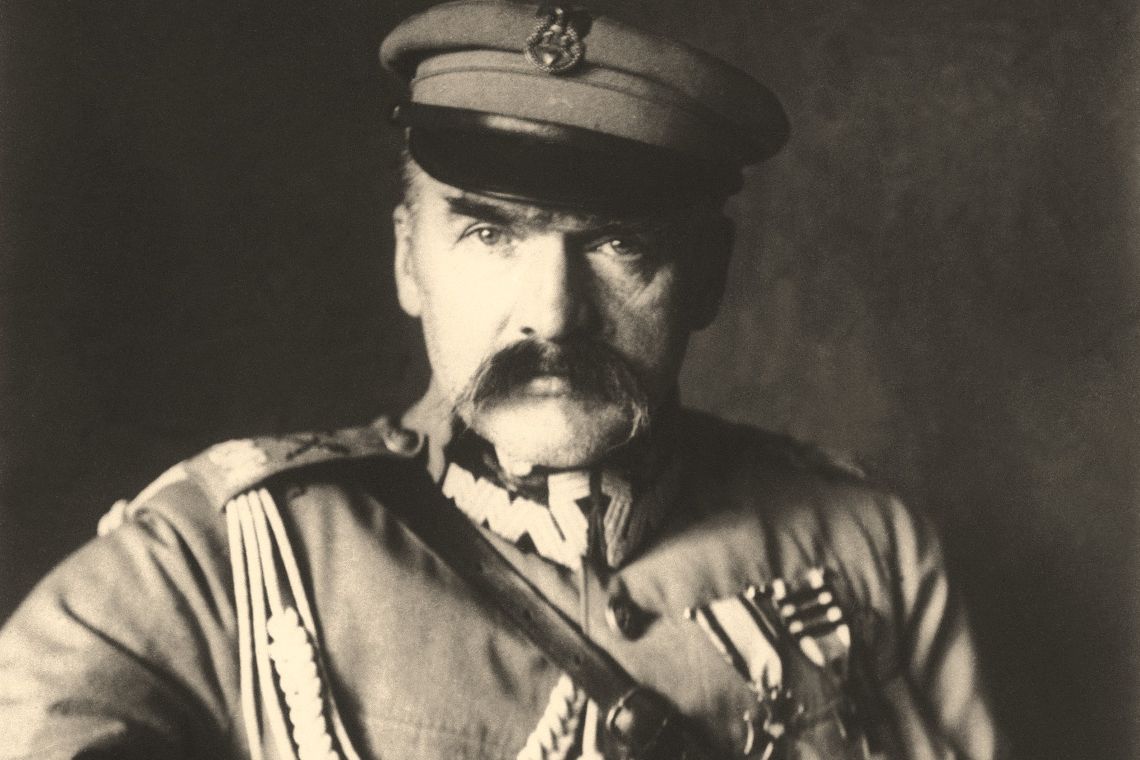
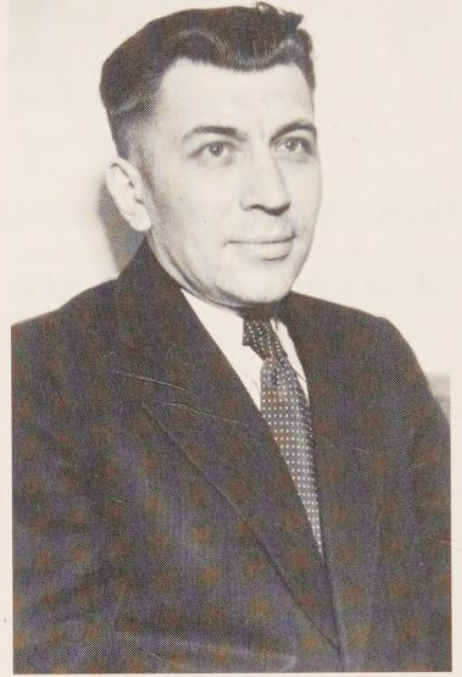
Gebert with his initial analysis of the coup that brought Pilsudski back to power in Poland, which was greeted with more than a little confusion in parts of the Left. Polish-born Boleslaw ‘Bill’ Gebert, a future official of the Polish People’s Republic, was based in Chicago and long an editor of the Polish language Socialist and Communist Press, later as an important ‘secondary leader’ in the Communist Party, among his roles being being the important Chicago area’s District Organizer, particularly heading its turn to Black workers, in the 1930s. In 1924 the Polish Section of the Workers (Communist Party) began the paper, ‘Trybuna Robotnicza’ as the Party moved from underground to legal status with Gebert as editor. One of the smaller party language groups, that year the Polish Section had around 200 dues paying members in 31 branches in cities, the majority in just three: Cleveland, Detroit, and Chicago. ‘Trybuna’ ran until 1979, with some name changes, and at its height had a circulation of around 15,000.
‘Pilsudski’s Coup and the Crisis in Poland’ by B.K. Gebert from the Daily Worker. Vol. 3 Nos. 112 & 114. May 22 & 25, 1926.
I. Who is Pilsudski?
JOSEPH PILSUDSKI got the inspiration become a Polish edition of Napoleon and Mussolini at the same time. He is well known to us in this role. Joseph Pilsudski comes from the Polish nobility. He is himself the owner of an estate in the Vilna district. Today he is the ruler of a large part of Poland with the ambition to rule the whole of Poland and to carry his ambitions even further. His dream of dreams is to “unite” Poland with the Ukraine, where the workers and peasants are now living freely, having gotten rid of the landlord and capitalists, many of whom were of Polish nationality. He dreams of a Poland “from sea to sea,” from the Baltic to the Black Sea.
Pilsudski’s program is his own personality, the army, the general staff, and war. He looks upon the people as a butcher does upon a poor lamb. He is a militarist and imperialist much of the type of the 18th century. He tries to give birth to Polish romanticism, to revive old Polish glory.
Whom does Pilsudski represent? First, the petty bourgeoisie, the intelligenzia, part of the rich peasantry and those of the military who are looking for victories on the battlefields. Pilsudski is the inspiration of militant, middle-class nationalism.
On the international field Pilsudski believes that there is hope for him there. England would be glad to have a man like him in Poland, because, when she decides to wage war against the Soviet Union, Pilsudski would be ready to serve. Pilsudski is dreaming of war against the Soviet Union. He is a militarist who believes he has many grievances against the terrible bolsheviks.
He wants “glory” for Poland. In his latest lecture he says: “The chief of the army must produce victories in order to raise the prestige of bis country.”
This Is Pilsudski’s program.
He came into prominence from the Polish socialist party, which he joined early in his youth, in 1892. In 1894 he became the editor in chief of the central organ of the Polish Socialist (P.P.S.) “Robotnik,” in which he propagated not Marxism or Socialism, but “unity of the Polish nation against the czar.” He was arrested and exiled to Siberia for five years. Following that he was again arrested and spent some months in the famous tenth pavilion in the Warsaw fortress. There he simulated insanity and was sent to Petersburg to an asylum, from where he escaped with the aid of a friendly doctor.
In the revolution of 1905 Pilsudski, for the first time, showed what he was really fighting for. He went to Toklo to ask the Mikado of Japan for financial assistance to organize the struggle in Poland against the czar. On the day he reached Japan the Polish Socialist Party organized a protest against participation in the Russian war against Japan. Pilsudski failed to get support from the Japanese government because the latter had no confidence hi him. Pilsudski always fought against the unity of the Polish workers with the Russian revolutionary organizations.
After the revolution of 1905 Pilsudski went to Galicia, Austria. There he sought, with the aid of the government of Francis Joseph, to organize a “Polish army” tor future war against the czar. He succeeded in this and fought in the world war under the imperialist flags of the central European powers.
With the birth of the Polish republic Pilsudski became the head of the “people’s government.” This government, composed of reformist-socialists (Moraczewski, leader of the P.P.S., was premier) and rich peasant party leaders, first of all, turned against the workers. The then existing Workers’ Councils were outlawed. The workers’ press was suppressed. The “people’s” militia fired on workers’ demonstrations. Workers were dragged to jail. The strike of the railroad workers was answered by the militarization of the railroads. The mission of the Soviet Red Cross, then in Poland, headed by Brontela Wesolowski, prominent leader of the revolutionary socialists in Poland, together with his comrades, were murdered by the Pilsudski-Moraczewski political police. Many other revolutionists who re- turned to “free Poland” met the same fate.
When Paderewski succeeded Moraczewski to the premiership, Pilsudski remained the marshal of Poland and head of the army.
In 1920 Pilsudski led the war against the Soviet Republic.
Pilsudski’s present revolt must be looked upon as an attempt to establish a military dictatorship of left wing fascism. Pilsudski is fighting the right wing fascist element headed by General Haller, also a famous butcher of the Polish workers and peasants, who is supported by the big landlords. His headquarters are in Posen, formerly the German part of Poland.
Pilsudski’s revolution has nothing in common with the workers. On the contrary, Pilsudski’s uprising was made for the purpose of preventing a workers’ revolution, which is fast maturing in Poland. The workers will take power in their hands, not with Pilsudski, but against him, against his colleagues from the right wing of the Polish Socialist Party and the so-called Workers’ National Party. The workers will establish their rule un-der the leadership of the Communist Party of Poland in alliance with the poor peasantry and the oppressed national minorities.
II. The Pilsudski Coup and the Crisis in Poland
Seven and a half years’ regime of bourgeois, socialist and peasant parties has brought Poland face to face with complete disaster. Industry is all but wrecked. The “stabilized” Polish Zloty has dropped from 23c. to 7c. and continues lower. The masses of the workers find themselves in unbelievable misery. 400,000 workers are unemployed. The peasant population of ten millions is confronted with starvation.
To the demands of the workers and peasants for work and bread, the only answer of the various Polish governments has been lead, poison gas and prison. Fear of the workers has caused the white terrorists to crush out all worker organizations of a class character—-even of a cultural nature.
In the midst of all this ruin a small circle of exploiters has managed to accumulate vast wealth. This was tone, not only at the expense of the workers and peasants—-but the small owners as well.
Taxes for Poor Only.
The minister of finance in the last coalition government, himself representing big capital, presented a program to stabilize the budget for this year. He proposed a ten per cent increase of all taxes with the exception of taxes on industries and large land holdings. He further proposed the dismissal of thousands of the lower category of government officials, including 25,000 railroad workers—thus swelling the already large army of unemployed with no provision for adequate doles. All this is done in the face of the fact that 50 per cent of the Polish budget is distributed among the army, police force, prisons and bureaucracy.
Workers Awakening.
Among the laboring masses hostility to the bourgeois regime grows apace, The Communist slogan of “Land for the peasants without compensation” has become the slogan of the mass of land workers. The belief that parliament and the government will give them this necessity of peasant existence has been shattered. To this must be added the enmity of the present government to be found among the nine million Ukrainians and White Russians along the Eastern frontier.
Fascism Rampant.
The ruling class of Poland realizes the danger it is in. They prepare to meet the dangers coming from below with fascism. Fascist and monarchist organizations are growing like mushrooms in May. They openly proclaim their intention of setting up a Mussolini dictatorship The last coalition government that contained two socialist, ministers took no action against this movement. They answer that there is no danger of fascism in Poland. Communist Party is legal. The only party genuinely opposing fascism in Poland is the Communist Party. While fascism is allowed an easy rein, the Communist movement is declared illegal.
In this situation came a government crisis. After the collapse of the coalition government. President Wojciechowski asked Witos, leader of the rich peasants to organize a government. He failed. The Socialist Marek also failed. Former Premier Grabski, representing big capitalist interests, could not form a cabinet. Then Witos tried again and succeeded in getting together a cabinet composed of representatives of landlords, rich peasants and bourgeoisie.
The Coup.
Against this government, Pilsudski, the old army marshal, raised his voice. Pilsudski was hailed as a savior by the “left” bourgeoisie including the Polish Socialist Party. They leaked to him to get Poland out of its “hell.”
A group of hooligans attacked Pilsudski’s home. He called upon the army for protection. The troops rallied and on the next day, May 13th, they occupied Warsaw. But this was not so sudden as it appears, Pilsudski had previously prepared for this. He had maintained his hold on the army
Strange Bed Fellows.
Pilsudski has now organized a government composed of his followers. At the head of the government as premier is Charles Bartel, a leader of tie “Workers’ National Party.” This party was born in the revolution of 1905–but on the wrong side of the barricades. It was organized by Polish bourgeoisie and patriots to maintain “law and order” in Poland and to fight the revolutionists who were at war with the Czar’s regime. At that time, although for other reasons, he fought against the Czar’s government.
Today these two are in the same camp. Pilsudski proclaims that his purpose in seizing the government Is to reform Poland, so get rid of corruption, to reorganize the army and institute land reform. This is pure bunk.
Pilsudski Will Fail.
Pilsudski will not rebuild the country. He will not give work to the unemployed or land to the peasants. His will be a Stolypin rule, and the national minorities will remember him. It was Pilsudski who occupied their territory and ruled over them with a mailed fist. He will not win the White Russians and Ukrainians.
And what of the Polish Socialist Party? It was the socialists who in 1923 helped the government of “Chjeno-Piast,” a government of capitalists and rich peasants, to crush the workers’ revolution in Cracow because, as their leaders said, “they wished to avoid civil war.” In 1918 the socialists willingly agreed to give the government to the bourgeoisie who imported Paderewski for their premier. The socialists in 1920 sup-ported Pilsudski in his war upon Soviet Russia. Today the socialists again supported the militarist, Pilsudski, by calling a general railroad strike on his behalf against another section of the bourgeoisie—represented by Witos.
The real purpose, however, was to help Pilsudski save Poland from a workers’ revolution. We have now a repetition of 1918, the socialists joining hands with Pilsudski against the workers’ rule.
The only party in Poland that clearly shows the way out for the workers and peasants is the Communist Party. This party does not wish to “Save” Poland for its own and the international capitalists, but for the workers who will organize a Soviet government and join with its sister Soviets.
Right Danger.
The danger from the right is still large. The extreme reaction is mobilizing its forces. They are preparing to fight against Pilsudski it is true. But in reality they are preparing to fight against the workers and peasants. While Pilsudski, ruler now of Warsaw, pretends to rule in the name of the “people,” in the X Pavillion and in the Citadel where Pilsudski himself was imprisoned by the Czar, there are hundreds of workers and peasants rotting in cells. Pilsudski keeps them there—where they were put by the coalition government and by Witos. These are but a few of the 7,000 political prisoners who are in jail in Poland for fighting for a workers’ and peasants’ government.
The illusion that Pilsudski in any way represents the interests of the workers and peasants will very soon be exploded in the mind of the last illusioned worker and peasant. The peasants and workers will soon learn that their only hope lays in the slogan of the Polish revolutionists, “FREEDOM, LAND AND THE FACTORIES FOR THOSE WHO TOIL.”
The Proletarian Revolution.
The present war between what can only be called two rival fascists groups may yet be the signal for a struggle to establish the Polish Soviet Republic under the leadership of the only party that represents the interests of the workers and peasants, The Communist Party of Poland.
III. Pilsudski Wars on Polish Labor
In the writer’s last article in The DAILY WORKER, it was pointed out that in Poland “We have now a repetition of 1918—the socialists joining hands with Pilsudski against workers’ rule.” This statement has been doubly confirmed by the latest news from Warsaw. Pilsudski’s political representative, Colonel Wieniawa-Diugiszewski, declared, “The object of Marshal Pilsudski’s coup was to prevent a BIGGER REVOLUTION that would have swallowed the whole of Poland.”
Pilsudski armed thousands of volunteers who aided him in his insurrection against the Witos government.
Now that he has accomplished his purpose Pilsudski is disarming them. To achieve this, rumors were spread in Warsaw saying that volunteers who engaged in the insurrection were to report to barracks to receive a sum of money. When they reported, officers took away their guns and said they knew nothing about money for volunteers. But a number of thousands did not go to the barracks. They still have their arms. They have put them away with the chance that they may soon have to be used against the bourgeoisie. It is plain that Pilsudski fears the armed workers.
Vilna Revolt.
Pilsudski crushed a revolt of workers in Vilna where one hundred workers were put in jail following a demonstration that resulted in an armed clash between troops and workers. While Pilsudski thus carries on a veritable war against the workers, he permits the extreme reactionaries to mobilize in Posen. In the city of Posen, under the flag of a workers’ butcher, General Haller, the big bourgeoisie and rich landlords are setting up a government in western Poland with the double intention of either overthrowing Pilsudski or failing that of establishing a separate government. In this they are looking to France for aid.
Pilsudski Seeks Compromise.
Pilsudski is looking for a compromise with General Haller and his extreme reactionaries. This is a sign that he is weaker than they, Pilsudski knows enough about insurrection to understand that it is dangerous to allow opposition forces to mobilize to begin with. But Pilsudski does nothing about the gathering of the landlord army in Posen. Why? Pilsudski sees in General Haller and his followers an element much closer to him than workers and peasants. In other words, Pilsudski is fighting the workers and peasants while allowing the extreme reaction to make the ground ready for setting up a fascist dictatorship. Pilsudski, in this, is rendering the reaction a great service.
“King Joseph.”
Pilsudski is not alone in doing this. Attached to his tail are the leaders of the P.P.S. (the Polish Socialist Party), the N.P.R. (the National Workers’ Party) and the peasant parties, “Wyzwolenie” and “Radykalne Stronnictwo Chlopskie” These parties are performing the task of making way for fascism. These leaders it was who came to the support of Pilsudski’s flag. They demanded that he make himself president, dictator or even king. Do not laugh, Pilsudski supporters in Vilna arranged a demonstration under the slogan “Long Live King Joseph I—Pilsudski.”
This is no accident. The above quoted political representative said to a correspondent: “The Polish army will not betray loyalty to the king—I should have said chief.” A slip of the tongue, but significant.
The Communists.
While the leaders of the P.P.S. and the other above mentioned parties gave their full support to Pilsudski as against the movement of the revolutionary workers and peasants, these latter have by no means been eliminated from the picture. A recent press report stated, “Pilsudski is very much afraid of the growing Communist movement in Poland, seeing in this Poland’s greatest danger. More radical factions are joining with the Communists under the slogan, “Form Workers’ and Peasants’ Councils” as happened in Russia before the revolution.”
There is also news of peasants demanding division of the rich landowners’ land without compensation.
Pilsudski’s coup has also hastened the collapse of Polish industry. The Polish zloty goes lower and lower. This of itself, with and starvation and misery is teaching the workers that their liberation will not come through Pilsudski— but in spite of him.
Fascist Danger.
There is genuine danger of fascism in Poland. The Communist Party knows this and has warned the Polish workers. Monarchist organizations, landlord and bourgeois parties are openly advocating a fascist regime. There is only one object in this: to crush the trade unions and further enslave the Polish workers, taking from them even their simple political rights. For the peasants it means a terrorist rule of landlords. For the national minorities it means complete abolition as national groups. And Pilsudski, who may be characterized as a “left” fascist, is helping to “bring this situation about.
The Communist Farty of Poland said in its May Day Manifesto: “Who but Pilsudski is a symbol of war against the Soviet Union? Who but Pilsudski militarized the railroads during the strike of 1921? Who but Pilsudski permitted the land workers to be defeated in their own blood in their strike? Who but Pilsudski has shown himself to be a tool of foreign imperialists, aiding the anti-Russian plans of England?
Polish Soviet Republic.
“Never in the last seven years have the toiling masses found themselves in so critical a situation. It is not merely a fight with the old or the new government, this or that lackey of the bourgeoisie like Pilsudski. It Is now a straight-out struggle for the Polish Republic.”
When this was written the situation was already such that it was possible to see what was coming. The Communist Party issued a call to the soldiers to stand by the workers and peasants and to refuse to be the tools of the bourgeoisie.
Left Swing of Masses.
In the official organ of the C.P., The Red Flag, It Is stated that In Cracow, Lublin, Silesia and other sections there is growing up in the P.P.S. itself a strong opposition. The leaders who are really in touch with the masses are going to the left.
Although the press censorship makes it hard to come to any definite conclusions, we are sure that the masses are travelling to the left at a rapid pace and are preparing for a fight that will end in the Polish Soviet Republic.
The Daily Worker began in 1924 and was published in New York City by the Communist Party US and its predecessor organizations. Among the most long-lasting and important left publications in US history, it had a circulation of 35,000 at its peak. The Daily Worker came from The Ohio Socialist, published by the Left Wing-dominated Socialist Party of Ohio in Cleveland from 1917 to November 1919, when it became became The Toiler, paper of the Communist Labor Party. In December 1921 the above-ground Workers Party of America merged the Toiler with the paper Workers Council to found The Worker, which became The Daily Worker beginning January 13, 1924. National and City (New York and environs) editions exist
PDF of full issue: https://www.marxists.org/history/usa/pubs/dailyworker/1926/1926-ny/v03-n112-NY-may-22-1926-DW-LOC.pdf
PDF of issue 2: https://www.marxists.org/history/usa/pubs/dailyworker/1926/1926-ny/v03-n115-NY-may-26-1926-DW-LOC.pdf
 Revolution's Newsstand