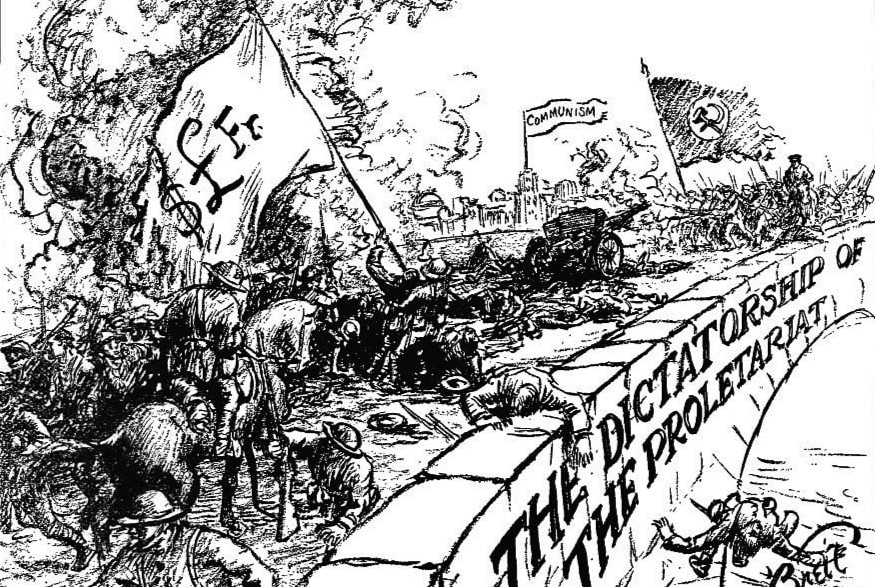
One of the groups to emerge out of the 1919 fracturing of the Socialist Party, with a real local influence in the Detroit-area, was the Proletarian Party associated with John Keracher. The Proletarians would last for decades, taking over the Charles H. Kerr publishing company with several splits leading to other formations like the Paul Mattick’s Council Communists. Here is a report on their 1921 National Convention and the Manifesto and statement On Tactics that came from the meeting. While idiosyncratic, the P.P.A. nevertheless was home to a number valuable activists and thinker who produced works and commentaries of lasting interest.
‘Our Convention’ from The Proletarian. Vol. 3 No. 11. December, 1921.
Our Convention
On November 12 the second convention of the Proletarian party opened in Detroit. Many were anxious as to what the decisions were going to be on certain fundamental questions which they knew would come before the convention. In fact, everyone realized that the whole future of the party hung upon the decisions that were to be made there. Our delegate had returned from Russia with the information that the party had been ignored by the Third International. In view of this, what was to be done? Had our party in the eighteen months of its existence shown vitality? Had it performed a real function? Was its future existence justifiable? Could it exist? All these questions came before the convention and were decided.
Had our party shown vitality? A view of the convention removed all doubt of an affirmative answer to that question. We had unquestionably demonstrated that, in spite of the small numbers, we were capable of carrying on a great deal of propaganda work. In such cities as Rochester, Buffalo, Detroit, Chicago and Los Angeles our local organizations were taking the lead in carrying on revolutionary propaganda and education. This was being done to such an extent that other organizations, alleged to be revolutionary, were very little heard of. New locals had been formed and others were in the process of formation. Elements that had wavered in the trying times, through which we had passed, and joined the “subway” had come to their senses and reorganized their locals. In the course of our existence, as shown by the report of the secretary and delegates, we had been able to establish a very good contact with the labor unions which can be developed into an indissoluble bond furnishing the basis for future mass movements. In all, the reports showed an unsuspected vitality which promised well for the future of the organization. As to performing a real function there could be no question of that. Our existence had forced other elements to be better than they naturally were inclined to be and we had succeeded in carrying the message of communism to many workers. Above all, we had succeeded in keeping abreast of the times and correctly interpreting current history. Our membership was improving its understanding and making itself more fit to carry on the work of teaching the working class.
Could our party exist in the future? That was another question that was easily settled. With the vitality shown in the past and the enthusiasm that animated the delegates to the convention there was no question as to our ability to go on successfully in our work. The question as to whether we justified in continuing our existence was one that consumed considerable of the time of the convention. The delegates were desirous of examining every alternative and being sure of every step, for after all, it wasn’t merely a question of being able to continue the party. The effect upon the revolutionary movement in America was of much more importance. After a lengthy discussion the convention finally arrived at the opinion that there was no group in America other than the Proletarian party that was capable of correctly applying the revolutionary principles of Marxism to current events and functioning in the interest of the working class. It was therefore decided that the future existence of the Proletarian Party of America was not only justifiable but absolutely necessary.
The question of unity with other revolutionary elements was also discussed and the convention adopted the following resolution:
“The Proletarian party stands at all times for the unity of all revolutionary working class elements on the basis of a correct application of Marxian principles to the class struggle in America. The convention authorizes the National Executive Committee to appoint representatives of the party to negotiate with any elements to achieve unity. Any agreement for unity shall not be binding until approved by the membership of the party.”
The delegates were unanimous in their opinion that the party should not hold itself aloof from any effort that had for its aim the achievement of a united revolutionary party in America.
The convention also considered a definite unity proposition submitted by the American Labor Alliance. The American Labor Alliance submitted a call for a convention to be held in New York on December 23. Seven organizations, the Workers’ Council, Finnish Socialist Federation, Hungarian Workers’ Federation, Italian Workers’ Federation, Jewish Workers’ Federation, Jewish Socialist Federation and the Arbeiter Bildungs Verein (Workers’ Educational Association), had affiliated themselves with the American Labor Alliance and signed the call. They requested the Proletarian party to do the same. Keeping in mind the experiences of the “Left Wing Conference” and the “Communist party conventions” in 1919, and that the excuse for holding this convention was to organize a party to function openly and legally for Communism, a thing we have been doing for eighteen months as the Proletarian party, the convention refused to indorse the call but decided to send delegates to the convention. The convention indorsed the following reply to the American Labor Alliance:
American Labor Alliance,
E.T. Allison, Secretary,
201 W. 13th Street, New York, N.Y.
Dear Comrade: Your communication of Nov. 14, 1921, was received and submitted to the national convention of the Proletarian party in session at Detroit on Nov. 16, 1921. The convention approved the following reply concerning the position of the party upon the matter contained in your communication:
The Proletarian party views with surprise your efforts to organize a party based upon a position which our party has advocated officially for a year and a half. The party fails to see why a new party should be organized to function in the same capacity as one that already exists. Certainly then, one must seek the reason for this new organization somewhere else than in the principles set forth in the copy of the call that you submit for the Proletarian party’s consideration.
The Proletarian party sees in the elements represented by the signatures already affixed to the document you submit nothing to be optimistic about. The amount of confusion represented there does not indicate that the convention being called will result in a revolutionary workers’ party capable of functioning.
The Proletarian party does not see how a convention, called as this one is, can be really representative, with the meeting place in such a non-central position as New York City. If there is a sincere desire to secure a revolutionary party as a result of a convention representing all revolutionary groups in America, the Proletarian party cannot understand why New York should be selected as the seat of the convention.
The Proletarian party is prepared to unite with any party that adheres to the principles of the Communist International. The Proletarian party is prepared to be represented at any convention which attempts to organize a Communist party. The party will appreciate notification of any change of date or place of your convention so that we may be represented.
However, the Proletarian party cannot assume any responsibility for the calling of this convention. The Proletarian party desires to make it clear that it will not allow its name to be used in connection with this call. While the party is willing to be represented at the convention, its position must not be construed as endorsing the convention, the call or the alleged organizations, and organizations signing it.
Trusting that a unity of all Communist elements may be achieved, but failing to see the possibilities in the present effort, we remain,
D.E.B.-S.
THE PROLETARIAN PARTY OF AMERICA, By DENNIS E. BATT, National Executive Secretary.
We shall send delegates to the convention and hope that the other delegates present will be more representative of real organizations than those present at the organization of the American Labor Alliance where Caleb Harrison represented the Industrial Socialist League, an organization of which he was not a member, and had no authority to represent. In all, there isn’t much to hope for from this effort, but nevertheless we must endeavor to unite all revolutionary elements.
Quite a number of constitutional changes were made at the convention. The most important were the ones forbidding other than party members to be present at the business meetings of the locals and the abolition of automatic party referendums. In the future party executives will be elected by the convention which will be the supreme authority in the party. Referendums may be had upon a demand of 15 per cent of the membership. Experience has taught that the referendum is no more representative of opinion than the convention and a referendum upon demand of the membership protects them from any abuses by the convention or the N.E.C.
It was decided that district organizations should be formed in New York, Michigan, Illinois and upon the Pacific Coast. An intensive organization campaign is to be launched in these districts and there is great promise of success. We already have good locals in all of these places and within a few months we will undoubtedly have good district organizations there. The editorial policy of The Proletarian, as well as its finances, came in for considerable discussion. It was finally decided to reduce the price of the paper to 10 cents and make up the deficit by levying an assessment upon each local. It was pointed out that the editorial policy of the paper could not be changed and the only way out of our present publicity difficulties was to start a weekly propaganda paper and a party bulletin. It was decided to take all of the necessary steps to start a weekly paper.
Finances occupied a great deal of the time of the convention, as it is always a pressing problem to the national office. Organization work has been hampered in the last year by lack of funds to send organizers over the road. If we had had a greater income we would have had a greater growth. We can congratulate ourselves on being able to accomplish as much as we have with such a small income. This is especially true when we look at what other organizations have been able to accomplish with many times the amount of money at their disposal. The delegates decided that there was only one way out of this and that was to raise two thousand dollars before the first of the year, and they went back home to do it. Two thousand dollars by the first of the year! That is the mark we have set for ourselves. Every party member and those that sympathise with our organization must get on the job now. Get to work at once and send your money either to this office or to the local organization in your city. The new year holds great possibilities for our organization. Opportunity knocks at the door. Get busy and grasp it by the forelock!
Manifesto and Program of the Proletarian Party
World capitalism is breaking down! International trade is shattered! Masses of unemployed suffer hunger and want throughout the world. The great powers are struggling to restore their former stability. We see society divided into two warring camps. On one side the World Proletariat, inspired by the victorious workers of Soviet Russia, holding high the banner of proletarian revolt, while on the other, world capitalism makes strenuous efforts to rebuild its shattered structure.
The industrial boons that accompanied the world war– and in some countries survived it for a time–has given way to an industrial crisis that threatens to engulf civilization. With all the boasted progress, the triumph of science and invention; with the marvelous system of machine production in the highly developed countries, capitalism cannot respond to the demands of the people who inhabit this society. We see millions underfed or starving in close proximity to mountains of stored-up foodstuffs. In some parts of the world millions are dying, while in other parts enormous quantities of wheat are left to rot in the fields because of the profit system that prevents it from being harvested to feed the starving masses.
What is the cause of this calamity? Why are people hungry while food exists in superabundance? Why are they underclad while clothing industries stand idle and stocks of clothing are held in storage? And why are people homeless while building workers are unemployed and building material remains unused? The Proletarian Party proclaims that the cause is to be found in the capitalist system itself–in the social productivity of labor and the private ownership of the machinery of production.
The present social order, capitalism, had its birth in the handicraft production and trading activities of the towns of the Middle ages. With the discovery of America and the opening of the Chinese and East Indian markets the handicraft system of production was superseded by manufacture to supply this world market. The rising capitalist class came into conflict with the dominant class, the feudal aristocracy. As a result the development of the capitalist system was accompanied by a prolonged struggle against the feudal barons for political supremacy. The Cromwell revolution in England, the American revolution, the French revolution and the Napoleonic wars were the outstanding conflicts which strengthened the power of the capitalist class. The invention of machinery and steam propulsion made possible world exploitation on the part of the capitalists, and the development of the modern representative state for destroying the last remnants of feudal control on the one hand and holding in check on the other hand the aspirations of a new class rising within the capitalist system–the modern proletariat.
The political power thus completely in the hands of the bourgeoisie, its problem has been to conserve its supremacy. All institutions have been brought under its domination; the schools, the press, the church and other public and semi-public institutions, as well as numerous hidden secret societies and agencies, converted to, or brought into existence for the purpose of perpetuating its rule.
The incessant competition within the capitalist system has compelled the capitalists to continually improve their machinery, speed up production and place upon the world market huge quantities of products. When there were but few nations engaged in supplying this world market, with less efficient methods of production, there was still much room for the development of the capitalist system. Today, however, capitalist production is practically universal and the world market is stocked beyond its capacity. Thousands of industries in every country have had to be closed down because they were not yielding a profit to the class that owns them.
In the United States, heretofore the much-lauded land of opportunity, where the vast expanse of Western plains offered an outlet to those workers unable to survive in manufacturing centers, capitalism has forever destroyed such opportunity. The gigantic trusts have extended their tentacles to the most remote parts of the nation. The necessity for disposing of an ever-increasing surplus in the form of investment capital is crushing the small businessmen and hurling them into the ranks of the proletariat. The former free farmer is fast becoming a victim of the money moloch—the American banking system–until from a nation comprised of a large majority of farm owners, the agricultural population is being reduced to farm tenants who are absolutely at the mercy of the money lords.
Hundreds of thousands of agricultural workers flock to the industrial centers to become a part of the industrial proletariat. This condition and the constant flow of European immigration has transformed the United States from an agricultural country into a nation where the majority of the population inhabits the industrial and commercial centers.
The opportunities so plentiful the first century of the existence of the United States have vanished and today, as a result of the gigantic development of American imperialism, the American wage-slave, the tenant farmer and the mortgage burdened small farm owner alike find themselves crushed under the capitalist juggernaut.
No longer can the American proletariat escape from the conditions of capitalist production by following the advice to “go west and grow up with the country.” Today the workers cannot escape, but must face the stern reality of the class struggle against a ruling class that readily copies and amplifies the brutality of the governments of Old Europe in its ferocious assaults against any action on the part of the proletariat.
Thus we see that the cause of the present deplorable conditions is the capitalist system, with its inherent contradiction–social production and capitalist class appropriation; that is to say, the class that owns the industries today does not use them, yet gathers in huge fortunes, while the class that uses the industries does not own them and, therefore, gathers in none of the fruits of industry. In fact, the workers are enslaved more and more by the machine system of production itself.
The great war was simply the logical outcome of the struggle on the part of the capitalist powers for control of the world markets and sources of raw materials. The war hastened the breakdown of the social order, as war production still further expanded the productive capacity of social labor. Today we see around us what appears to be a universal famine arising from over production. At the same time capitalism appears unable to recover its former secure position.
Present Aspects of the Proletarian World Struggle.
The breakdown of capitalist society has not only brought about starvation and suffering; it has given birth to the Proletarian Revolution, which is the gateway to the solution of the problem.
In 1917 the Russian proletariat overthrew their exploiters and set up the soviet state power. The great victory of the Russian masses stirred the whole world proletariat. The workers of Germany overthrew the relics of absolute monarchy and nearly succeeded in conquering their bourgeoisie as well.
The Hungarian workers also triumphed and for a time held complete political power, but the forces of reaction on all sides, together with certain weaknesses within, brought about their downfall. Likewise in Finland the workers were defeated because of their failure to solidify the proletarian dictatorship and meet the forces of reaction within and those brought against them from without.
The struggle of the Italian workers, their seizure of the factories and the treacherous actions of their leaders is now a matter of history. In all countries the workers, for the time being, are held in check chiefly because of the strengthening of the bourgeois state power and the throwing off of the mask of democracy–the use in all its nakedness of the power of coercion, the bourgeois state and partly because of the lack of experience and conservative character of their leaders.
While the workers have met with defeats, today they are gathering strength. They are engaged in the great struggle to win the broad masses to their side. Out of what thus appears at first sight a hopeless chaotic condition the proletarian forces are marshalling and drilling for the coming struggle for power.
The Proletarian Movement in America.
The triumph of the proletariat in Russia in 1917 was at first incomprehensible to the majority of workers in America, but as victory solidified itself and the soviet state took form, as it fought back the counter revolutionary forces of capitalism, that struggle reflected itself in the minds of the more advanced workers, chiefly elements within the Socialist party.
The Socialist Party of America was dominated by an ideology similar to that of the Menshevik party of Russia and the Social Democratic party of Germany, but within the ranks of the Socialist party were certain groups that were at variance with the official policy. In the West, where the Industrial Workers of the World were strongest, the anarcho-syndicalist ideology expressed itself within the Socialist party. In the eastern cities strong anti-parliamentary tendencies and minority action concepts dominated the opposition group there. In the states bordering on the Great Lakes, chiefly in Michigan, still another group, whose official expression was “The Proletarian,” vigorously opposed and fought the officialdom of the Socialist party and its reformist policies.
Spurred by the Russian revolution these several groups gathered sufficient strength to prove to the reactionary officials that they had lost the support of the overwhelming majority of the party membership.
To prevent the revolutionary elements from dominating the party the officials expelled, first the Michigan state organization and then suspended many language federations, thus continuing to control the party that they had reduced to less than 50 per cent of its former strength.
Out of this situation developed the Left Wing Conference, which again split into two groups; those who sought to capture the party from which they were expelled, or suspended, and those who wished to go forward to organize as speedily as possible a Communist party. With this latter group were the elements that later organized the Proletarian party.
The outcome of the split in the Left Wing conference was the organizing at Chicago in September, 1919, of two “Communist” parties. These parties were known as the Communist Party of America and the Communist Labor Party of America. We, who are now in the Proletarian party, although a part of the Communist party, found ourselves in disagreement with the program and tactics of both parties. But as our aim, and certain fundamental methods of attaining that aim, were the same, we decided to remain within, hoping that time would demonstrate to the rank and file of that party the unsoundness of their tactical theories. We were in agreement upon the necessity of the soviet form of government, and the proletarian dictatorship. We voted to affiliate with the Communist International and agreed in other tactical matters.
Our chief points of disagreement with the tactical policy of both parties were their implied minority action, their strong anti-parliamentary tendency and their proclaimed policy of splitting away from the existing trades unions.
For a time the Proletarian group continued as an opposition minority within the Communist party, but ultimately were expelled without any specific charge. It is fair to say that the rank and file of the C.P. were not to blame for the expulsion, as they had little or nothing to say in the matter, owing to the form of centralized authority.
Just at the time the Proletarian group was preparing to organize another party to propagandize majority action, full participation in parliamentary activity, working within the major labor unions, etc., the notorious Palmer Red raids occurred in January, 1920. Many of our most active workers were thrown into prison and several months passed before we could gather the necessary funds and material to call the new party into being.
The Proletarian Party of America came into existence in June, 1920, firmly convinced that the objective conditions in America called for an open party that would influence the masses, especially of organized labor, participate fully in election campaigns, and, in fact, act just as the Communist International now demands that the Communist party must do here. From its inception the Proletarian party has indorsed the principles of the Communist International.
Our Relation to the Communist International
Fully agreeing with the principles and program of the Communist International and indorsing unreservedly the conditions for admission to that body, the Proletarian Party of America sent a delegate to the Third Congress at Moscow in June, 1921. Our delegate was admitted to the congress as a visitor only. He was denied a seat owing to the fact that the Communist International had already recognized another party in America. Appreciating the fact that the recognition by the Communist International of but one party in each country is tactically correct, the Proletarian party will continue its work of organizing and teaching the principles of Communism and welcome the time when there will be but one revolutionary mass party in the United States of America. The failure to recognize the Proletarian party or give our delegate a hearing, is without doubt due to the gross misrepresentations that have been made from time to time to the Communist International by people who were suffering from such an acute form of “infantile sickness of leftism” that a correct tactical position appeared to them as centrist.
The Proletarian Party of America cannot accept this mistaken attitude of the Communist International in regard to the revolutionary movement in America and considers it as detrimental to the best interests of Communism. We, therefore, must maintain our separate existence until the Communist International is represented in America by a real Communist party.
That a mass party of Communism does not now exist in America is undeniable, owing to the widespread confusion fostered by various so-called Communist parties that have appeared since 1919. The Proletarian party will strain every effort to keep itself worthy of being the revolutionary vanguard of the proletariat of the United States.
Our Relation to the Red Trade Union International.
The classic function of the trade unions is to participate in the everyday struggle against the encroachments of the capitalist class. They have heretofore functioned mainly as organs of resistance, without taking the offensive against the dominant class. It is necessary that the trade unions develop from mere instruments of struggle within capitalism to instruments for the emancipation of the working class. The dominant unionism in the United States has been the craft form of organization; a form of organization that doomed the workers to impotency except for the most meager resistance against capitalism. The division of the workers into crate organizations had some justification in the early days of capitalism, but the development of huge industrial enterprises has rendered the craft unions incapable of functioning for the workers in the present struggle. Experience in industrial struggles impels the workers toward organization in ever larger units. In order to secure effective co-operation in large industries the loose affiliations of craft unions already existing must be developed into amalgamation so that actual organic unity can be achieved. In relation to trade unions the Proletarian party insists that all members capable of holding membership in unions maintain such membership. By their self-sacrificing devotion to the cause of the workers they must win the confidence of their co-workers and wield a decisive influence in the organizations. All opportunities must be used for propaganda and educational work through a merciless criticism of the reactionary officialdom, the defects in the structure of organization and the failure to take advantage of opportunities to strengthen the ranks of the organized workers.
Against the propaganda of the reactionary craft union leaders, who declare that there shall be no politics in the unions, the Proletarian party must constantly emphasize the fact that such an attitude is hopelessly reactionary and plays directly into the hands of the apologists of capitalism, because it serves to keep the workers prostrate before the fetish of bourgeois democracy and ignores the class struggle on the part of the workers against the capitalist class. In opposition to that, we must proclaim that the class struggle is a political struggle and that the masses of organized workers, once conscious of this struggle, must enter it under the revolutionary banner of the vanguard of the working class in the United States–the Proletarian Party of America.
The capitalist class, or at least the more alert of its defenders, see in the trade union movement the germs of a challenge to the supremacy of their rule. They see in the ever widening activity of the unions the rise of an institution that has the potentialities of managing the affairs of the nation and carrying on the production and distribution of wealth independent of the capitalist organ of class domination the bourgeois state. They fear the rise of a proletarian state within their own state. They see these organizations elect their own officials, form their national, state and city councils. They see the extension of trade union activity into every sphere of life and they realize that the workers are learning to take their affairs into their own hands. The Proletarian party must endeavor to sharpen the workers’ understanding of the struggle and constantly emphasize the fact that the organized workers furnish the basis for the mass movement in the struggle for emancipation.
The participation of the organized workers in the political struggle for supremacy of the working class changes form after the conquest of political power. Whereas in the actual process of the revolution the unions function for the annihilation of the supremacy of the capitalist class and its institutions, after the revolution the reconstruction of society upon a communist basis must be the burden of the organized workers in industry. The Proletarian party disdains to attempt to draw a blue print of the structure of the next stage in social development, leaving such schemes to the utopians and romanticists in the labor movement. Our duty is to enlist the support of the most intelligent elements of the working class in a general study of the technique of industry so that they will be capable of handling any situation that may confront us in the future. It is the duty of all members of the Proletarian party to constantly agitate within the organized labor bodies for the principles of the Red Trade Union International. This agitation must not take the form of dual organizations with a mythical membership that strive by deception to impress the world movement with the ultra-revolutionary character of its membership, but must be a consistent propaganda in an endeavor to secure endorsement of the International on the basis of already existing labor bodies, i.e., local unions, central labor bodies, state federations of labor, international unions, etc. Only in that manner can there be any definite organization of the workers in America, or any other country, that will be of benefit to the Trade Union International. We must insist that the unions themselves make the endorsement and not mechanical groups organized within the various unions, for the simple reason that such groups easily become the prey to the same sort of revolutionary adventurers that have for years vitiated the labor movement and arrested any militant expression on the part of the workers.
TACTICS.
Our Attitude Toward the State.
The Proletarian party agrees with the Marxian definition that “The state is the public power of coercion.” That the state came into existence because of the irreconcilability of class interests. That the state does not exist to reconcile classes but is an instrument in the hands of one class for the suppression of another class.
In the present epoch, the state is exclusively in the hands of the capitalist class. Its present democratic form, the modern representative state, is the form par excellence for the ruling bourgeoisie in highly developed capitalist society. The Proletarian party proclaims that the use of the present parliamentary state has its limitations, that in the period of revolution such a state form will not function for the liberation of the proletariat. A new state form must be set up, the proletariat, the immense majority, organized as ruling class, must constitute the new state form.
This organization must more and more embrace the broad masses taking on a council or, to use the now well known term, soviet form. This last form of state is the dictatorship of the proletariat.
The Dictatorship of the Proletariat.
This form that the state takes during the transition period between capitalism and communism is not a permanent political institution, in fact, it grows less and less political in its administrative functions, ultimately becoming entirely economic. When there is no longer any counter-revolutionary class to suppress, the state will exist no more. There will be but the administration of affairs in the interest of the whole people in a classless society–THE COMMUNIST SOCIETY.
The Revolutionary Use of Parliaments.
When it becomes known, or felt, that parliament is a bourgeois institution, when honest workers observe so-called representatives of labor, “feathering their nest” in political office, when they see the amount of fraud and corruption that goes with parliamentary elections, they become at first disgusted and turn away and take up an anti-parliamentary stand. As parliament and political action are inseparably connected in the minds of many workers, they are driven to deny that the class struggle is a political struggle.
The desertion of parliamentary action plays into the hands of the ruling class, but the majority of the working class still vote and elect parliamentary representatives, therefore it behooves a revolutionary organization to make full use of parliament. The Proletarian party will nominate where possible, candidates for all political offices, for the purpose of using elections as a means of conveying to the masses our conception of the state and its function. The Proletarian party will use its elected representatives, not merely to keep out representatives of the bourgeoisie, but to expose the shallowness, corruption and fraud of bourgeois democracy from within the parliamentary bodies, to hasten the downfall of the capitalist class, who use the state as a means of perpetuating their rule.
Conditions for Joining the Proletarian Party.
Upon an indorsement of the principles and tactics enunciated in this manifesto, the Proletarian party welcomes into its ranks all individual workers or groups now unaffiliated. The Proletarian party calls upon all who are convinced of the necessity of building up such a party in all parts of the United States, to now enter its ranks.
The past two years have demonstrated beyond a doubt that the Proletarian party is sound in principle and correct in its tactical policy, that it is capable of developing the necessary strength to reach the great masses of the workers of this country. The Proletarian party is now going forward with that work. All conscious revolutionists must join with us in the great task of winning the American masses to the standard of the Proletarian revolution.
The monthly organ of the Proletarian Party of America, The Proletarian originally served a left wing faction in the Socialist Party of Michigan led by John Keracher, and was printed in Detroit and Chicago from May, 1918 until July, 1931. The Proletarian Party then published Proletarian News, from 1932 until 1960. Part of the early Communist movement, the Proletarian University and the Proletarian refused to join with others in going underground after the Palmer Raids, though it eschewed electoral politics. The Proletarian Party attempted to gain admittance to the Third International to no avail. The Party eventually took over the left wing publishing house Charles H. Kerr & Co.
PDF of full issue: https://hdl.handle.net/2027/msu.31293104393339?urlappend=%3Bseq=315%3Bownerid=13510798903054990-335
 Revolution's Newsstand