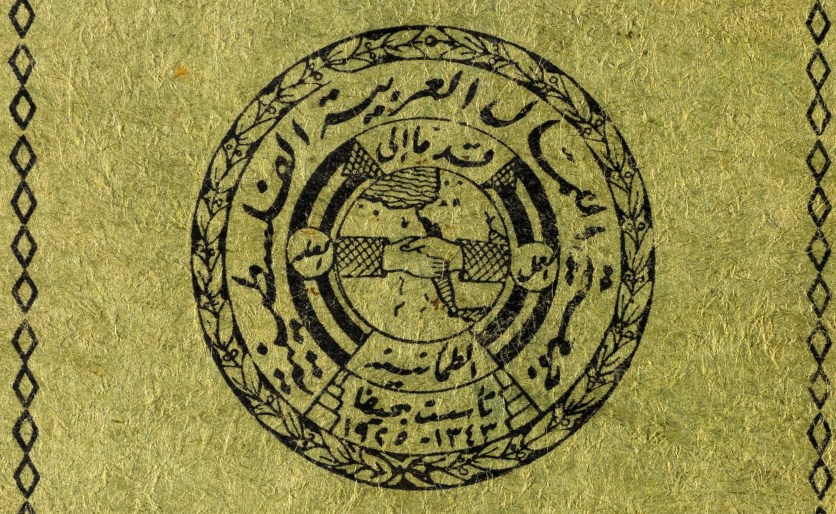
While formed on 1925, it wasn’t until sixty delegates gathered for the 1930 congress that the Palestine Arab Workers Society was really founded. Held in Haifa during January, 1930 in the period of radicalization after the 1929’s revolt, P.A.W.S. would grow to 50,000 members at its height, organizing 1936’s General Strike against British rule. Opposed to the partition, P.A.W.S., aside from its Nablus branch, did not survive 1948’s Nakba. Below is a letter from Palestine on the eve of the gathering explaining its background and a greeting to delegates from the League Against Imperialism.
‘Before the First Congress of the Arab Workers of Palestine’ from International Press Correspondence. Vol. 10 No. 2. January 9, 1930.
Letter from Palestine.
For several years past a growing movement has been observable among the Arab workers in Palestine. The number of the Arab proletariat in town and village is constantly increasing: on the huge orange and banana plantations, which have begun to develop at a rapid pace, thousands of Arab wage workers are employed, while in the towns a number of factories (cigarette, soap factories, etc.) have arisen, where likewise thousands of Arab workers (including women) are employed. In addition there are the workers engaged in the transport industry (before all the railway workers and dock workers).
When it is remembered that the capital brought into Palestine by the Zionists does but accelerate the pauperisation and proletarianisation of the poor Arab peasants, as well as of considerable strata of the artisans while Zionist industry absorbs only a very trifling percentage of the Arab workers, then the growth of Arab capitalism and of the Arab working class becomes plainly obvious.
One can only estimate the number of Arab workers. But if we were to put their number at 50-60 000, this estimate would be too low rather than too high. And this means very much for a country in which up to the time of the war there were at the most only a few hundred wage workers, and in which the total number of Arab inhabitants is, in round figures, 700,000. It should also be added that in the neighbouring countries, particularly in Syria, Lebanon, and Iraq, not to mention Egypt, in which a considerable industry is developing, the number of proletarians is likewise growing from year to year.
The Arab proletariat possesses no rights whatever and is subjected to unbounded exploitation. The lot of the young Arab proletarian class, whether in the service of the young Arab bourgeoisie, which exploits the workers up to the last possibility makes use of women and child labour without any restriction, pays starvation wages, and does not recognise any working time other than from sunrise to sunset and often long after: whether in the service of the young planters, or finally whether under the heel of the British mandatory government, which converts its workers on the railways and on roadmaking into simple wage slaves is a terrible one.
The competition on the labour market, caused by the wholesale impoverishment consequent on the Anglo-Zionist policy in Palestine, had become so great that the Arab worker was glad if he was able to earn only his piece of bread, and thus the wages were pushed down to a minimum. The worker could be ill-treated and beaten without his venturing any protest, for at the first word he could be flung into the street. There exists no labour protection and no workers’ insurance law, for the law issued by the government in 1927 can only be regarded as a mockery of a workers’ compensation law.
At the Histadruth Congress (Histadruth is a Jewish trade union under Zionist leadership and affiliated to the Amsterdam International) held in the summer of 1927, a delegation of 2000 Arab workers appeared in order to propose common organisation but met with the answer. “The Histadruth is a Jewish organisation and does not accept any Arabs as members.” The only thing which the Histadruth Congress promised was to help in the organisation of a separate trade union bloc, but it must not be in the Histadruth.
But even this promise was broken in the most shameful manner. Instead of helping the Arab workers to organise, they combated in the most despicable way every attempt at organisation. If an Arab strike took place, as for example the strike of the bakers in Jerusalem, then the Histadruth “took it over” in order to betray it and to find jobs for Jewish workers in place of the striking Arab workers. If a Conference of Arab workers took place organised by the “Ihad” Unity Chub. then it was calumniated and denounced as Communist by the Histadruth organ until the government stepped in and dissolved it.
In spite of everything Arab workers associations have arisen in Palestine; but they came under the influence of the Arab nationalists. Nevertheless there exists in Haifa an Arab Workers’ Association, numbering a few hundred workers, and there also exists a sort of workers’ party in Nablus, as well as some individual trade unions in Jaffa and Jerusalem. In the year 1929 the Arab workers exhibited an increased desire to organise.
The August revolt of the Arabs in Palestine showed with remarkable clearness how fatal is the lack of organisation of the Arab working masses is for the revolutionary movement of the country. The Histadruth leaders made use of the August events in order to conduct an even more savage, chauvinistic, anti-Arab incitement. These leaders, who are mainly responsible for having driven the Arab working class into the arms of bourgeois Arab nationalism, now venture to designate the Arab workers as “pogromists”, “murderers”, and the extreme “Left” wing of the Zionist “Labour Party”, the Poale Zion, even demanded that the Jewish workers be armed against the Arabs.
On the other hand, the Arab workers feel that the time has come to convene their Congress and to raise their class voice. The Arab nationalists feel instinctively that, while they have been easily able to “lead” all other congresses (of the students, peasants, merchants, and journalists), the working class can become for them, a dangerous rival in regard to the leadership of and the hegemony of the people’s movement. Hence the nationalists endeavoured to postpone the workers’ congress as long as possible, if not to annul it completely.
But the spontaneous drive of the working class proved to be stronger. Under the pressure of the masses the leaders of the Haifa Arab Workers’ Association were compelled to convene for the 11th of January, 1930 a general Palestinian Arab Workers’ Congress for the purpose of founding an Arab Workers’ Federation. Not only are all existing Arab workers’ organisations to participate in this Congress, but also the unorganised workers shall have the right to elect delegates. Moreover, representatives of workers’ organisations from the neighbouring countries–Egypt, Syria and Iraq–have been invited to send representatives. The idea of the Congress is being taken up with enthusiasm by the Arab workers. Whoever sees the eagerness with which the Arab workers speak of the necessity of the Congress and of founding their own union, will realize how false and lying are the sarcastic remarks of the Histadruth organ, which tries to represent the Congress as a “nationalist affair”. These agents of Amsterdam do not see the awakening of the Arab These working class, do not understand that with this Congress it comes forward for the first time as an independent factor.
At the same time it would be a mistake to underestimate the efforts of the Arab bourgeoisie to make use of this movement of the Arab workers for their own purposes and prevent the workers from putting forward their own fighting and class slogans. With this object in view the Arab bourgeois press already developing a comprehensive incitement against the Communists, and is endeavouring to convince the workers that they can best realise their demands with and not against the other sections of the population.
But the awakening Arab workers must find forces within themselves to overcome this bourgeois and reformist influence. and in this connection also the Arab workers’ Congress represents an important stage in the Arab workers’ movement. It will be the task of the revolutionary workers organised the R.I.L.U. section, “workers’ fraction”, to raise the Arab workers’ Congress to a level enabling it to fulfil its revolutionary and class tasks.
For the Independence of the Arab Countries!
Message of Greetings from the League Against Imperialism to the Congress of the Arab Workers of Palestine.
In the name of the Executive Committee, of the General Council and of the affiliated and associated organisations of the International League Against Imperialism, we send most cordial greetings to the first general Congress of Arab Workers of Palestine.
In the great movement of revolt of the oppressed and exploited peoples for the overthrow of imperialism and attainment of complete freedom and independence, the heroic struggle of the Arab nation is of the very greatest importance.
The events of the last few months in Palestine and the brutal methods that have been adopted by the MacDonald-Government to maintain Britain’s imperialist exploitation, have roused among all friends of freedom in the whole world the desire to stand by the militant Arab masses and to support them by effective international solidarity. The League Against Imperialism which unites in an international organisation the anti-imperialist elements in the imperialist and colonial countries, has been following the struggle of the Arabs with admiration and has already undertaken all possible steps to combat and expose the imperialist propaganda of Great Britain and of the Zionists. The League will continue to perform its obvious duty by mobilising international support for the emancipation movement of the Arab nation.
But we should be wanting in our duty to the Arab workers if we failed to draw attention to a great danger that threatens them–namely that the heroic struggle, in which the broad masses of the Arab people have made such great sacrifices, might be prematurely broken off from within before full national independence and federal unity have been achieved. It has become clear during the last few months that there are certain Arab groups that are not interested in carrying on the struggle against imperialism to its logical conclusion. Proofs of this are supplied by the attitude of the Arab Executive and the feudal and clerical leaders during the General strike in Palestine, by the negotiations of certain Arah leaders in London, by the evidence given before the Imperialist Enquiry Commission, and by the expressed desire of the landlords and the reformist leaders to come to an agreement with the Zionist agents of imperialism.
It is our opinion, therefore, that in the struggle for the overthrow of imperialism it is by no means sufficient to fight only against the Balfour Declaration and against Zionism. The broad masses of workers and peasants must be on their guard against their reformist national leaders who are seeking compromise with British Imperialism at their expense and who will then carry on a fight against the masses struggling against imperialist exploitation, for the independence and unification of the Arab countries and for the social emancipation the Arab workers and peasants. This danger must be kept constantly in view.
Your Workers’ Congress is a proof that the Arab workers have begun to realize the historic task which devolves upon them in the great struggle for national liberty. The union of the organised workers with the organised peasant masses will ensure the overthrow of imperialism and the final victory your great ideals.
Long live the Arab working class!
Long live the revolutionary united front of the workers, peasants, fellaheen and Bedouins!
Down with imperialism, its Zionist agents and the Arab traitors!
Long live the free and independent Federation of Arab Countries!
League against Imperialism, International Secretariat.
International Press Correspondence, widely known as”Inprecorr” was published by the Executive Committee of the Communist International (ECCI) regularly in German and English, occasionally in many other languages, beginning in 1921 and lasting in English until 1938. Inprecorr’s role was to supply translated articles to the English-speaking press of the International from the Comintern’s different sections, as well as news and statements from the ECCI. Many ‘Daily Worker’ and ‘Communist’ articles originated in Inprecorr, and it also published articles by American comrades for use in other countries. It was published at least weekly, and often thrice weekly.
PDF of full issue: https://www.marxists.org/history/international/comintern/inprecor/1930/v10n02-jan-09-1930-inprecor-Virginia.pdf
 Revolution's Newsstand