At the height of the struggle, articles and notices from one issue of Western Worker on the Trade Union Unity League’s Agricultural Workers’ Industrial Union harvest-time, strike of cotton workers in the San Joaquin Valley. Thousands of multi-racial, multi-lingual lived together in an encampment after evicted from company homes. Sheriffs handed out guns and permits to the white ranchers and their employees; the ‘Pixley Massacre’ saw strikers, Dolores Hernàndez, Delfino D’Ávila, and another, Pedro Subia killed, and many more wounded. Below is a update from the picket lines, the demands of the strikers, a Communist Party appeal to the workers, a report on funerals of those killed, and an eyewitness account, as well as notices of solidarity actions across the state.
‘Cotton Strikers! Huelgistas Algodoneros!’ from Western Worker. Vol. 2 No. 43. October 23, 1933.
Cotton Strikers! Huelgistas Algodoneros!
Comrades! You are engaged in the most bitter struggle that has yet been waged in the agricultural fields. You are fighting for a wage that will at least keep you and your families above the starvation point.
The strike has demonstrated what a great power your united action is. The entire boss press and all tools at their command are stricken with horror at the splendid show of solidarity.
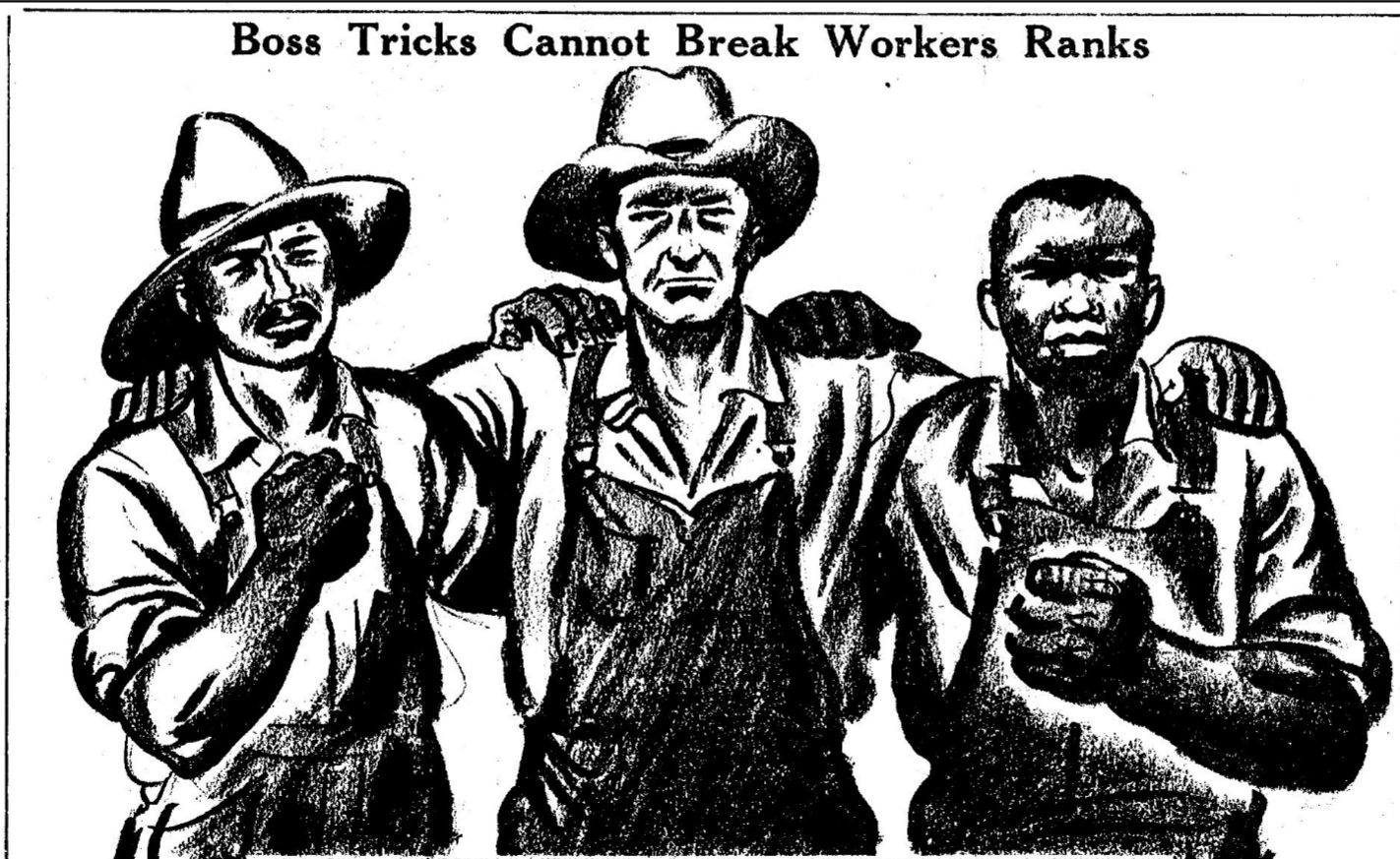
Two capitalist governments have united to smash the strike ranks. The government of the American bosses arms hundreds of deputies to murder strikers, while the government of the Mexican bosses sent its consul in order to fool you into going back to work at any price. They know that if they could break the solidarity between the white, Negro and Mexican workers then they could drive you back into the fields on a starvation wage.
What is it that was able to bring into the ranks of the workers that spirit of solidarity, and determination to fight? Who exposed all the tricks and maneuvers of the bosses? Who organizes the support for the strike among the workers in the other industries? Who publishes the only newspaper that fights for the needs of the strikers? IT IS THE COMMUNIST PARTY. IT IS THE ONLY PARTY OF THE WORKERS.
You can see that the members of the Communist Party are the most active in the struggle. That is why the main fire from the bosses is directed against it. They lead the Agricultural Workers Industrial Union, which is your only protection against the exploiters.
During the strike many of the speakers have told you what the Communist Party stands for. They told you that just so long as we have the present capitalist system, workers will be subjected to starvation conditions, and the worst brutality. Our fight now will only teach us how to eventually put an end to this miserable system altogether, so we can establish a social order in which children will not die of malnutrition, in which workers will not be clubbed, in which all shall have a guarantee of a happy livelihood. We, the workers, will be the masters.
But that means that a strong Communist Party must be built up. That means that you should join its ranks, Build a unit in every town in the cotton district. A strong Party organization will be. your greatest weapon against the big growers and their tools in the government.
The address of the Communist Party district office in California is at 37 Grove street, San Francisco. Notify us and we will send you all the applications you want.
Companeros trabajadores: Udes. estan comprometidos en una de las mas amargas luchas en la historia del estado de California, en los campos de la agricultura. Uds. estan en la lucha por el sueldo que a lo menos los mantenga arriba, de las bases de hambre. Udes. pueden ver lo que la fuerza de la organizacion significa. Uds. pueden ver que atraves de la prensa y todas las herramientas asalariadas de los amos horrorosamen to quieren descargarse sobre la solaridad de la huelga.
Dos gobiernos se han unido para aplastar la fuerza de la huegla el gobienero del imperialismo Americano y el los capitalista Mexicanos el gobierno Mexicano ha mandado a su consul para enganar–los que regresen al trabajo con un precio vergonzoso que a el no le sirve ni para cambiarse calzetines.
El gobierno Americano ha armado a cientos de civiles para asesinar a Udes. y sus familias. Ellos saben que si pudieran romper la unidad entre Americanos, Mexicanos y negros trabajadores, entonces si pudieran empujarlos de vuelta al campo con un sueldo miserable.
De quien es la habilidad de tracer a las masas de trabajadores el espiritu de solaridad y la determinacion de lucha? Quien es el que arrostra todas las canalladas y las Quien es el que va al frente recibiendo los primeros golpes de la huelga? Quien es el que manda auxilio para los huelguistas scando socorro de otras industrias? Quien es el publico el unico periodico ese que lucha por las nesecidades de huelguista? ES EL PARTIDO COMUNISTA! ES EL UNICO PARTIDO DE LA CLASE TRABAJADORA!
Udes. son testigos oculares que los miembros del partido Comunista estan siempre subriendo con Udes. frio calor hambre y sed, por el mejoramiento del nivel de vida. Ellos organizando la union de agricultores trabajadores, industriales que es la unica que proteje a Udes. contra los explotadores.
Durante la huelga muchos de los oradores les han dicho a Udes, el programa del partido Comunista. Y tambien les han dicho que mientras tengamos el sistema presente del capitalista los trabajadores estaran sujetos a las miserables condiciones de hambre. y las mas horrorosas brutalidades. Este pleito nos ensena eventualmente como podremos ponerle un fin a este miserable sistema, y como podremos establecer un orden, social en que nuestros hijos no mueran por mala-nutricion y ent que los trabajadores no sean golpeadoson fin, un sistema en que todos tengamos garantia, felicidad y abundancia. Nosotros trabajadores debemos de ser los amos. Esto significa que el partido Comunista debe levantarse fuerte. Que tu debes ingresar a sus filas. Organiza una unidad en cada pueblo, y en cada distrito de la region algodonera. Una fuerte organizacion significa vuestra mejor arma contra los patrones grandes y contra las maniobras del govierno.
No se olviden que la union hace la fuerza y que la fuerza empleada en las cosas buenas es consuelo justicia y bienestar.
La direccion del partido Comunista es en California. 37 Grove Street, San Francisco, California.
Notifiquenos y le mandaremos una carta de solicitud.
***
Strike Solid.
Workers Unanimous For More Intense Picketing, Spread Strike to North–Number Out Nearing 20,000; Federal Relief Offer if Workers Return, Rejected
Hundreds of dollars, many trucks of food have already reached the strikers, but far more is needed if the cotton strikers are to win. Rush Food! Money! Send thru the Workers International Relief, 1223 Fillmore street, San Francisco.
TULARE, Oct. 17. A special meeting of the strike committee with representatives from all locals north of Arvin to Visalia met under heavy guard, reviewed the entire strike situation and decided that workers will remain on strike and for the intensification of picketing as the best strategy, while the arbitration board is considering the strike demands. The proposals for settlement by the strike committee were adopted unanimously. (See statement at bottom of this page).
It was further decided to spread the strike to the northern area, to involve ten thousand more. Already many walked off fields in Madera and Fresno region, as number on strike is approaching the figure of 20,000. There will be a mass conference in that region next Thursday, when the season will get into swing.
The Mexican Consul, who is still attempting to break the ranks of the workers, is traveling from camp to camp, but is everywhere denounced by the workers as a scab-herder. The government is having its highway patrolmen distribute leaflets in English and Spanish urging the workers to return.
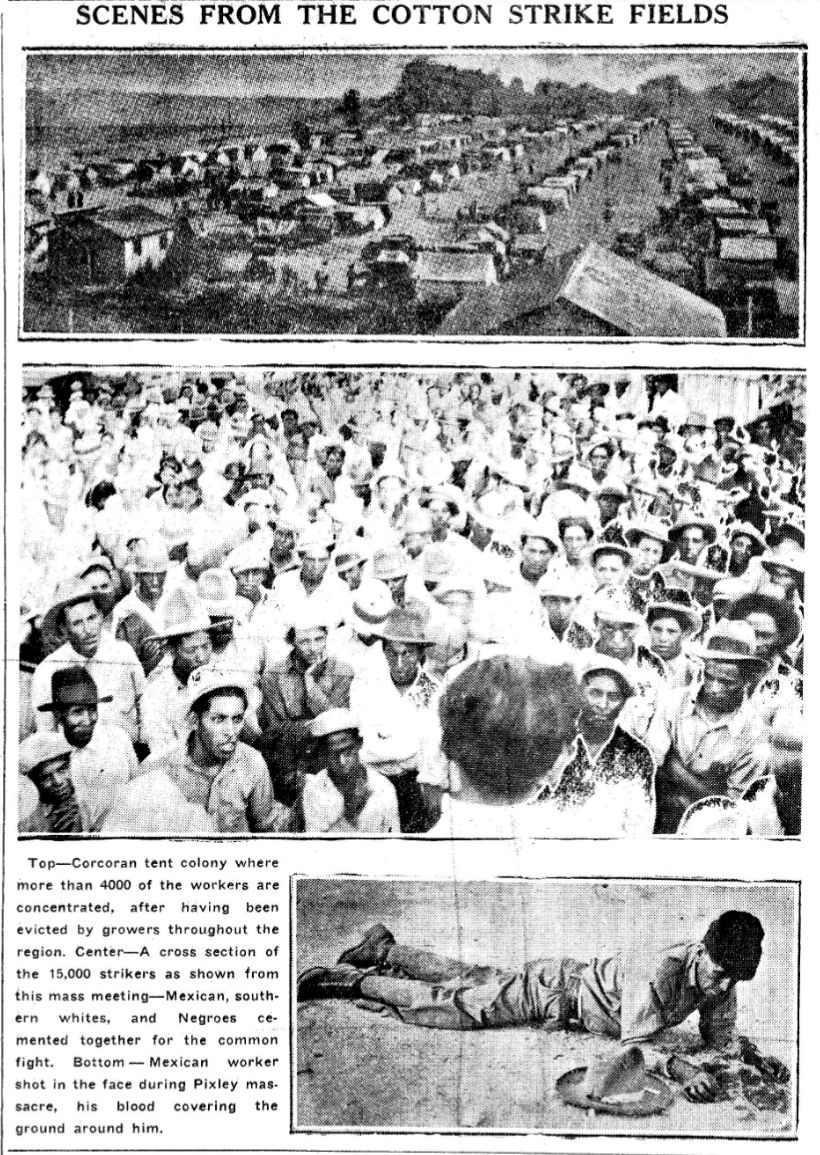
The federal government offers the strikers relief if they return, but it was promptly rejected by the workers who say they would “Rather starve than go back for the miserable wage.” Workers are tightening their belts, and relief is sorely needed. The government is threatening to evict the workers from the Corcoran camp, which now shelters 4000.
BAKERSFIELD, Oct. 16. Six thousand strikers from Arvin, Wasco, Shafter, McFarland, Delano and Buttonwillow, took part in a meeting at the city hall to protest the murder of Pedro Subia and to demand the release of the arrested strikers. Then in a mile long parade they marched to the union hall, and later to the cemetery. They pledged unanimously to stay out till victory is won.
TULARE, Calif., Oct. 16. Despite the murderous attack of cotton growers, and efforts of the NRA and Gov. Rolph to break the strike, the 15,000 striking cotton pickers of San Joaquin valley are 100% solid in their determination that “Not An Ounce of Cotton For Less Than $1.00 per 100 pounds” shall be picked. As the crop began to ripen in Madera and Fresno Counties the workers there came out on strike. The $10,000,000 crop is tied up completely.
A great demonstration of the strikers’ determination was given here Friday, when more than 5000 strikers accompanied the body of Dalorez Hernandez, murdered by growers at Pixley, and formed a procession to Tulare in a mass funeral. It was voted unanimously to continue the strike to a successful end. The capitalist papers at that very moment came out with big lying headlines that strikers are returning.
The murders at Pixley occurred Tuesday when, following the arrest of 17 pickets at a ranch nearby, the strikers held a mass meeting and returned to their hall. 50 growers opened fire on them. Hernandez and D’Avila were killed there and fifteen wounded.
At Arvin, the same day, police attacked the picket lines and fired 11 shots into Pete Subia, while they kept his comrades away with teargas.
BIG MARCH
Next day 2000 strikers marched on Visalia, county seat of Tulare, demanding the arrest and conviction for first degree murder of all farmers implicated in the attack on the unarmed strikers. L.J. Santens, E.C. Krueter, Clarence Murray, Hiram May and three others, all big growers, are being held for first degree murder. Other demands were for immediate safe release of all arrested strikers, $5000 for strikers’ relief for Tulare County, to be administered by a workers’ committee, immediate cash relief for the families and widows of the killed and wounded strikers, and for disarmament of the growers or the right of the strikers to defend themselves.
The Supervisors replied that they would do nothing for the strikers. The deputy sheriffs of King, Kern and Tulare Counties had openly called on the farmers to “take the law in their own hands” and to “run out the Communist agitators.” But despite this the mass picket lines still continue and the workers were not intimidated. The strikers evicted have erected a tent colony at Corcoran, where 4000 are living. Here, with relief cut off, four babies have died of malnutrition, bringing the total of deaths to seven. The land was donated by a sympathetic farmer, and attempts to evict them on grounds of “unsanitary conditions” have failed. The strikers have thrown their own guard around the camp.
The coroners inquest on massacre, held in Tulare, indicates that the murderers will be white-washed.
First, the autopsy surgeon brought in his report that the man had met his death from “Hemhorage and some shock.” I.L.D. Attorney A.L. Wirrin of Los Angeles, who is putting up a splendid fight in behalf of the strikers, protested vigorously against this whole procedure.
After a half dozen witnesses at Wirrin’s insistence positively identified the men who had committed the cold blooded murder, the hand-picked jury brought in a verdict of “death as a result of gunshot wounds inflicted by persons unknown.”
Failing completely to break the ranks of the workers, the growers brought in Enrique Bravo, Mexican Consul. He came to Visalia Friday and addressing the strikers in Mexican, called upon them to return at the old rate pending arbitration. He failed completely in his strikebreaking effort, and had to be escorted out under protection of friends.
SOLIDARITY
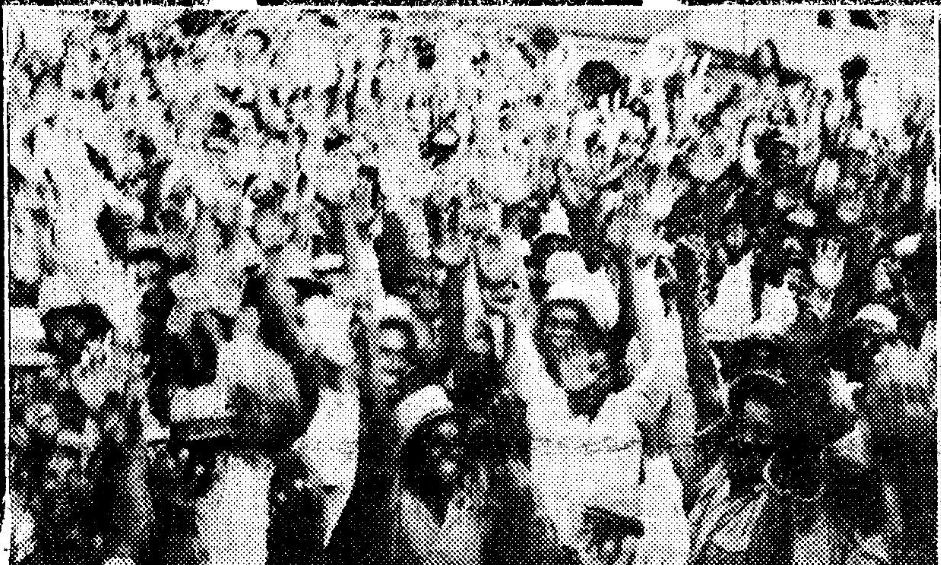
The solidarity of the workers, who are composed of Mexicans, southern whites and Negroes, hardly finds an equal in any previous strikes. Many small farmers are helping the workers, especially with food. Donations, such as calf, sacks of vegetables, etc., are no exceptions. About five truckloads of relief through Workers International Relief, and several hundred dollars collected from workers in many cities helped greatly to cheer the hungry strikers.
The Mediation Commission, appointed by Gov. Rolph, after conferring with Geo. Creel, consists of Archbishop Hanna, Prof. McMurray of the University of California (which recently got heavy subsidies from the Bank of America, one of the large finance groups in the cotton area), and Dr. Knoles of the College of the Pacific. Meanwhile, Edward Fitzgerald, conciliator of the Federal Labor Board, in an effort to break the strike, has sent out pleas to the strikers to return at the growers terms, while they wait for this anti-labor board to make its decision. They have refused.
Tuesday Pat Chambers, organizer of the Agricultural Workers Industrial Union, and chairman of the strike committee, was arrested and charged with Criminal Syndicalism. Bail was set at $10,000. Attorney Wirrin has begun habeas corpus proceedings to get Chambers and the 17 others out.
At Madera Louis Bradley, organizer of the A.W.I.U., recently convicted on riot charges arising out of the grape pickers strike, was arrested with four others while speaking to a group of workers.
***
Settlement Proposals of Strike Committee.
To Governor Rolph, George Creel, NRA director, and the cotton strike arbitration board:
The Strike Committee, representing all striking workers in the cotton area of San Joaquin Valley, do again reiterate our real desire (in the name of the strikers) for a settlement of the cotton strike immediately.
In this connection, we submit the following proposals, which, after long and due deliberation–and in consultation with all locals of cotton strikers in the cotton areas of San Joaquin Valley–is considered by the Strike Committee and all strikers involved to be a necessary measure for the settlement of the cotton strike.
1. That the federal government, though its authorized agencies, immediately cancel all cotton contracts between farmer growers and finance corporations, cotton gins, or other agencies who are now financing cotton growers in the cotton areas of the San Joaquin Valley.
2. That, in conjunction with the cancellation of above mentioned contracts, the federal government through the proper agencies, establish a minimum price for cotton to the farmer growers of not less than 12c a pound.
3. That a minimum scale of wages for all cotton pickers be established and set at not less than $1.00 a hundred pounds of cotton picked.
4. That the cotton grower recognize the Cannery & Agricultural Workers’ Industrial Union.
5. The immediate unconditional release of Pat Chambers (Chairman of Strike Committee), and all other strikers arrested in connection with the strike. That food and relief be immediately issued to all strikers until settlement of strike.
In connection with these above proposals for an immediate settlement of the cotton strike, the Strike Committee, with the approval of all strike locals concerned, wish to make the following statement:
That the price for cotton of 72c to 8c forced on the growers, through contract by the finance corporations, cotton gins, etc., while at the same time the finance corporation sells cotton on the market at prevailing prices from day to day, represents an inadequate and miserable low price to the farmer growers for their cotton.
And that these same finance corporations, gins, etc., by forcing such a low price for cotton on the farmer growers, at the same time, in connection with these low prices, forces the farmer growers into the position of paying the cotton pickers the starvation wage of 60c a hundred pounds of cotton picked.
It is a well established fact that throughout the cotton season, pickers average approximately 200 pounds of cotton per 10-hour day at 60c per hundred for picking, a worker is left with the low wage of $1.20. Further out of this miserable wage, the pickers are forced to buy their own picking sacks, costing as high as $1.85 each. These sacks wear out and must be renewed, again at the expense of an average of four times during the season. Also the pickers clothes are cut from his back by the cotton stalks approximately once every two weeks. In the short cotton, all pickers must wear knee pads, furnished at their own expense. This is aside from traveling expenses–gas, oil, etc.–from job to job.
Therefore in reiterating our demands, including the wage of $1.00 per hundred pounds, which with high and continually rising prices for all necessities, does not even guarantee a decent standard of living, we consider them an absolutely necessity at this time, and certainly not excessive.
The responsibility for the extreme low price for cotton to farmer growers, miserable low wages to pickers—and for this strike–must be placed rightfully upon the shoulders of the Finance Corporations, Cotton Ginners, etc.
We, the Strike Committee, with the unanimous opinion of all strikers, declare that the Federal Government, on the basis of and by carrying out our just proposals submitted above, can and should settle this strike immediately.
STRIKE COMMITTEE.
***
PAT CHAMBERS SPEAKS FROM HIS CELL.
Pat Chambers, cotton strike leader, jailed on Criminal Syndicalism charges, held on $10,000 bail.
VISALIA, Oct. 16. Pat Chambers, leader of a San Joaquin Valley cotton pickers’ strike, speaking from his cell, stated:
“No other political party has, by any action, shown it is for the worker.”
“This fight of starving cotton pickers is a fight against starvation wages and for recognition of their union.
“The workers will not be misled by charges of Communism. In every strike, the charge of ‘agitator’ is made by those serving the interests of the bosses.
I am agitating against starvation wages.
“Communists are the only ones fighting in the interests of the worker.”
***
5000 At Bier of Martyrs Pledge To Fight Till Demands Are Won.
(By Our Special Correspondent)
“To Whom It May Concern:
“This Poor Comrade Died That We Might Live For a Living Wage in the C.A.W.I.U. in Pixley.”
Scrawled on pink wrapping paper with misspelled words, this slogan on a home-made banner, was car ried proudly by the comrades of Hernandez and Davila in the funeral procession at Tulare.
Five thousand men, women and children paid their last respects to the dead workers. But they did more than that. They demonstrated their solidarity in the fight for the demands for which these Mexican workers were shot down in cold blood.
On foot and in rickety cars from a radius of 75 miles, Mexicans, Negroes, Americans. Americans from Georgia, Mississippi, Alabama, Oklahoma, Tennessee, Texas and California. Little children toddling along or carried in the arms of parents. Old women so feeble that they walked this mile to the cemetery leaning on the arms of younger comrades.
A priest officiated at the cemetery.
He talked in Spanish of the “departed brother…resurrection–eternal peace.”
He was followed by workers, one from each camp. Different talk. “Class struggle…fight for the union…capitalist murderers…workers solidarity…carry on the fight.”
As the bodies of the two dead workers were lowered into the grave, their living comrades mounted the back of a truck to urge the workers on to continue the struggle. It was unanimously voted to fight to a finish.
The murder of Davila and Hernandez did not demoralize the strikers.
Nothing illustrated better the spirit of the workers at the bier of their dead comrades than the funeral oration by a young strike leader.
“In these 10 days, comrade, we have faced hunger and starvation, we have faced the brutality of the armed thugs and growers, we have lost four comrades in the battle! Today at this mass meeting we must raise a monument to our comrades, we must pledge ourselves to carry on the fight for which they died, the fight against starvation. We must not tolerate in our ranks stool pigeons who are attempting to get us quarreling with one another. We must not fall for the betrayal methods of the Mexican Consul who represent the bosses of Mexico, who are controlled by the bosses of America, he does not represent the Mexican workers any more than the agents of the Ameri can bosses represent the American workers! There is only one agency which represents the workers–that is our fighting working class organization which has in its ranks all workers without discrimination as to race, color, sex or creed. “Back to our local! All concentration on mass picket lines! The strike is ours! Organize ourselves for self-defense. They have arrested 27 comrades! But they cannot break our spirit or our strike! All power to the union!”
***
SOLIDARITY WITH STRIKERS MEETINGS THROUGHOUT STATE.
San Francisco Workers. March To Waterfront; 2000 in Oakland
SAN FRANCISCO, Oct. 14. In San Francisco 1000 workers demonstrated on the waterfront to protest the murder of three strikers and wounding of 30 others, while in Oakland 2000 gathered in Jefferson Park to add their voices denouncing the murders. A collection of $30 was taken to be sent the strikers.
SACRAMENTO. While more than 100 workers were marching in a protest funeral procession through the streets, Friday, the committee of six strikers, elected from Pixley, Delaney and McFarland, with five more from the local I.L.D., went to Gov. Rolph with demands for the disarming of the vigilantes, immediate state relief, and other demands. The governor referred them to the “arbitration board.” The delegation reported to 500 workers at the protest mass meeting in the park which followed the funeral march.
SAN DIEGO. At Newtown Park, Friday, 350 workers protested the San Joaquin murders, and 100 at a second mass meeting that night added their protest. At 3 a.m. Friday morning Stanley Hancock was arrested in the vicinity of the city’s tallest flagpole and charged with attempting to raise a 6 by 12 foot red flag, said to have been inscribed, “Newtown Park today, 4 p.m. Demand death sentences for murderers of three cotton strikers.”
***
Evidence Shows Police, Growers Planned Pixley Massacre.
Tells Eyewitness Judge, Police Refused To Disarm Growers
(By Our Special Correspondent). An ever-growing pile of testimony of eye witnesses of the massacre of unarmed strikers of Pixley conclusively proves that the murderers had the support of Judge Swanson, Sheriff Robert Hill and the police officers.
Dozens of affidavits by eye-witness and participants that establish these facts are now in the possession of the strikers and their attorneys.
Piecing together the facts connected with the shooting, the following story is what actually happened.
For more than a week before the shooting the more reactionary farmers and the town hooligans had been arming themselves for this attack on the strikers. The workers had been making demand after demand that the farmers be disarmed. These were absolutely ignored.
Less than an hour before the shooting another insistent demand was made of Judge Swanson in the Pixley court house in the presence of Sheriff Robert Hill of Tulare County, that warrants be issued against the armed men. The judge in refusing the request said, “I am not issuing warrants either way.”
JUDGE INFORMED
Even while these demands were being presented a worker rushed excitedly into the court house stating that a group of armed farmers were in the vicinity, and demanding that they be disarmed. Sheriff Hill requested two officers that were present to go out and investigate. In about 15 minutes they came back bringing in 17 men under arrest. These 17 were not farmers but strikers, including the worker who had just notified the judge and sheriff about the armed farmers. Judge Swanson, who had refused to issue warrants for the armed farmers held these workers on charges of “rioting” and set bail at $1000 each.
The workers asked the judge if he was not issuing warrants either way how could he explain the arresting of these workers. The judge said, “They are charged with a misdemeanor, but to arrest the farmers for carrying concealed weapons would be a felony charge.” The workers pointed out that these were not concealed weapons but were being carried openly and they would not insist on a felony charge, but should be arrested for “disturbing the peace.” The judge said he would consult the district attorney. While this argument was in progress carload after carload of armed farmers passed by the courthouse. The arrested worker who shortly before had brought in the information about the armed farmers jumped up and pointed at the farmers and said, “There goes the bunch now.” The judge and sheriff both looked and observed the procession. Therefore it is an indisputable fact that can be corroborated by the 18 workers who were in the court room that the armed farmers had arrived with the full knowledge of the judge and sheriff who did nothing about it.
At the same time a meeting of the strikers, addressed by Pat Chambers, was taking place almost across the street from the courthouse, about 100 feet away. The strike headquarters is on the same side of the street as the courthouse and about a half block away. The armed vigilantes after passing the courthouse stopped on the same side of the street as the meeting, opposite the strike headquarters.
At this time two officers came into the courthouse and whispered something to Sheriff Hill. The sheriff went out for a moment, came back and whispered to the officers and they left the courthouse. He then went over and whispered to the judge who quietly disappeared from the scene.
In the meantime the strikers had concluded their meeting and crossed the street to enter their headquarters. Some of the workers had already entered when three Vigilantes who had been identified as Stark, Santen and Kruger, started to enter the workers hall with guns in their hands.
Their path was blocked by Hernandez the heroic Mexican worker who doubtless figured correctly that the vigilantes had come to carry out their threat to lynch Pat Chambers who had entered the hall. Hernandez was knocked on the head with the butt of a gun and as he fell forward a cowardly vigilante fired into his stunned body. The Davila representative of the Mexican Consulate, acting in his official position, came forward with his hand raised in a peaceful gesture to prevent further violence. He was also knocked to the ground with a gun and like Hernandez had lead pumped into his body as he fell. Then the “brave vigilantes” from across the road poured a veritable hail of lead into the mass of unarmed workers.
POLICE STAYED AWAY
In the meantime the workers in the courtroom hearing the shooting demanded that the sheriff who was in the courtroom with two of his men with the shooting was going on refused to act. Sheriff Hill stated he did not have enough men to handle the situation and said he would send for help to Tulare 16 miles away! His officers went out as if to go to Tulare. In two or three minutes police officers began to arrive, indicating that they had been close to the scene during this whole procedure and had deliberately stayed away!
With the arrival of the officers the sheriff triumphantly announced his men had returned with help.
In other words, according to the sheriff, his men had made the trip to Tulare and back, a distance of 32 miles, in about 3 minutes.
The police arrived after the shooting, with dead and wounded strikers lying on the highway. The police refused the use of their cars to convey the wounded strikers to the hospital with the flimsy pretext that they had to wait because the farmers might come back! Furthermore a physician who was present refused to give first aid.
After the shooting a number of farmers who had participated in it, started to drive away from behind a nearby warehouse where they had been hiding. Police were seen to stop the farmers’ cars, take away some rifles, and then tell the farmers to go home.
An affidavit has also been se cured which proves that a policeman was on hand when the farmers secured rifles from a cotton gin in Earlimart from where they advanced on Pixley. The officer led the procession for a time, but left before it arrived on the scene of the massacre.
Western Worker was the publication of the Communist Party in the western United States, focused on the Pacific Coast, from 1933 until 1937. Originally published twice monthly in San Francisco, it grew to a weekly, then a twice-weekly and then merged with the Party’s Daily Worker on the West Coast to form the People’s Daily World which published until 1957. Its issues contain a wealth of information on Communist activity and cultural events in the west of those years.
PDF of full issue: https://www.marxists.org/history/usa/pubs/westernworker/1933/v2n43-oct-23-1933.pdf
 Revolution's Newsstand