A rare U.S.-published article from the Belfast labor leader and republican Socialist, later to serve as an MP for West Belfast, urging a ‘return to Connolly’ and an end to the competing Irish and British unions on the island, especially after the betrayal of 1926’s General Strike.
‘A Plea for Industrial Solidarity’ by Murtagh Morgan from The Daily Worker. Vol. 3 No. 299. January 4, 1927.
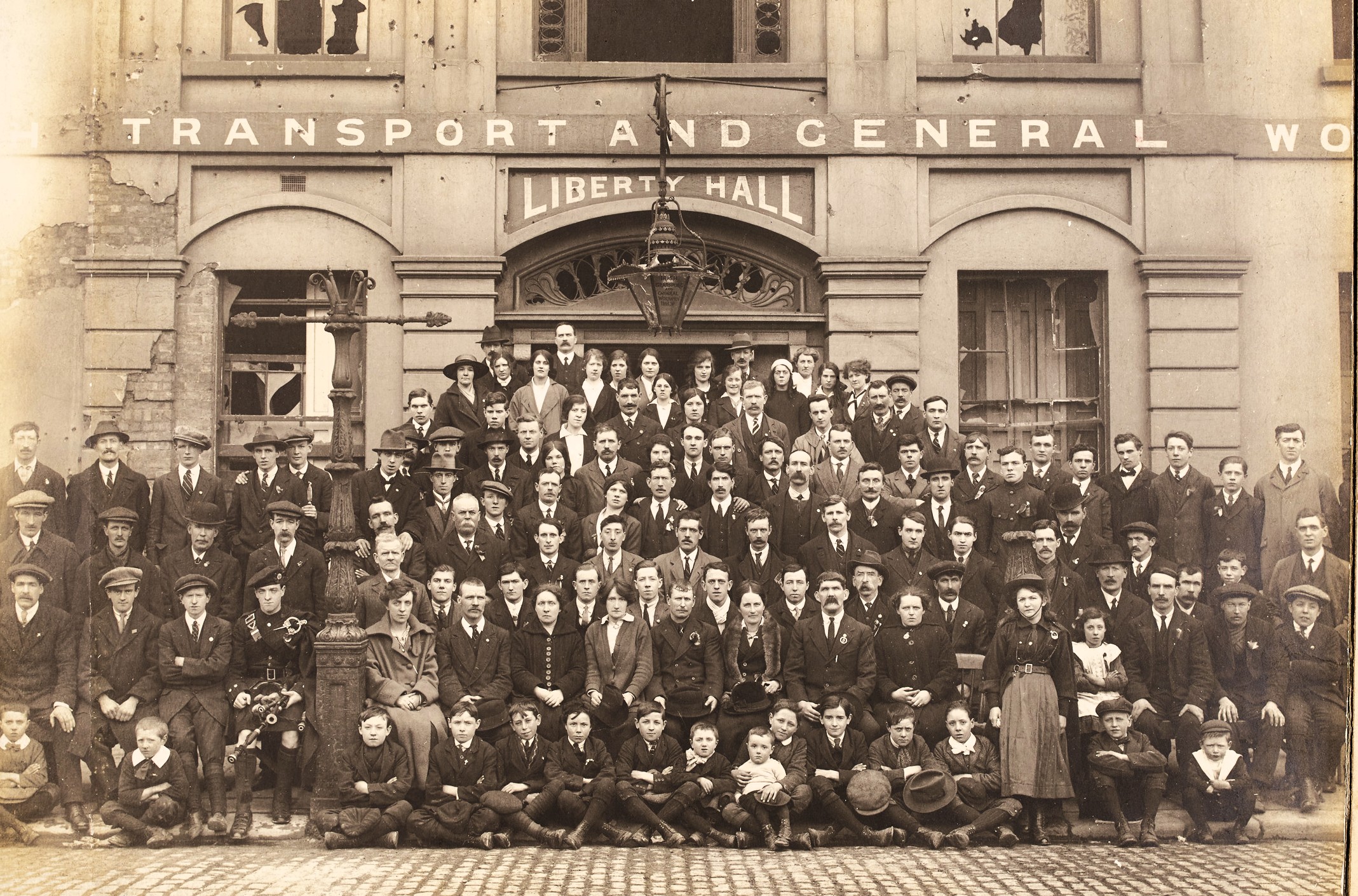
The following plea for industrial solidarity thru industrial unionism as from the Voice of Labor, official organ of the Irish Transport and General Workers’ Union. It should be understood that the writer of the article is not pleading for O.B.U.-ism along the lines of the Canadian experiment. He wants to bring about the same result that American radicals seek to accomplish by the amalgamation of craft unions into industrial unions and the linking up of all such unions into a national organization with a general staff which would be in a position to bring the entire power of the labor movement to bear in a given situation. The reference to “English trade unionism” relates to the existence in Ireland of branches of British unions. This system has all the vices of dualism. Ed.
***
Is trade unionism in Ireland an integral and virile part of the working class movement? Is it effective for welding together and consolidating the forces of labor? Does it fulfill its function as an instrument for resisting attacks upon wages and conditions? Is it an organic whole, capable of expressing a clear and convincing lead upon all the questions affecting the workers thru the class struggle?
Is It Failure?
Only an imbecile would say that trade unionism in Ireland does, or is capable of, any of these things. It is not by any means an integral or virile element of the labor army; it is, rather, a disjointed and remote part contented in its unconscious impotency. As a means of unification it is incongruous; it is difficult to conceive of a more disconnected body. Its inability to defend wages and conditions is daily becoming more apparent, and instead of leading it is inclined to lag. On its existing basis trade unionism in this country is about as useful a weapon to the Irish workers in their struggle with capitalism as the bow and arrow would be to Iraq villagers attacked by bombing aeroplanes. Craft unionism, sectionalism, disunity, “poaching,” jealousy, recrimination–these are all common features of that feeble and inert thing we are stupid enough to call trade unionism. Yet leaders mount platforms and naively prate to working class audiences about “our trade union movement,” while, as a matter of fact, a movement, in the real sense of the term, does not exist.
Its Day Is Past.
When a wage slave is no longer able to perform the duties demanded of him by the capitalist system he is instantly “fired.” So it is with our trade unionism; for a considerable time now it has been unable to deliver the goods. No verve is manifest anywhere, and initiative or desire to march with the times is entirely absent. The old-fashioned conception of trade unionism has become a veritable old man of the sea to us, and unless we make a supreme effort and chuck him off he will, assuredly, strangle “the new departure” necessitated by the changing situation. The “crinoline” has passed; this is the age of “Eton crop” and “wireless.” Rip Van Winkle unionism is only compatible with a flourishing capitalism. It worked fairly well when England could boast of being the “workshop of the world”; it is useless today, when European capitalism is being beaten to its knees by the trustificated and concentrated power of American big business. The more intense the competition for world markets and fresh fields of exploitation, the more severe will become the attacks upon the organized workers.
Our problems are multitudinous, and the sooner we get down to solving them the better for the Irish working class. Multiplicity of unions is a deterrent to progress; it’s more than folly–it’s fatal. The whole situation is complex. Each tin-pot organization jogs along in its own stupid, desultory way, sublimely oblivious of any other interest but its own–and often absolutely too ignorant to see its own futility to protect even its own interest.
The Recent General Strike.
There is no point of contact visible anywhere except, perhaps, during a crisis–when the improvised “unity” achieved becomes nothing more than a sham. Take, for example, the incidents in Ireland during the general strike, and we find that while lip-service in abundance was given to the cause of solidarity, things happened that would make even a fascist trade unionist blush. Intrigue and deceit marked the whole course of events. When it was no longer felt safe to further prevent the strike reaching Ireland desperate efforts were made to “confine” its ramifications to certain specified areas. Now what did that mean? In the case of a general strike it means this: that at some particular point in the line of battle you are prepared to co-operate with “scab” or “black-leg” labor. Why should a state of affairs such as this be allowed to exist, and what is the cause of all these troubles? I have mentioned one–multiplicity of unions–and there are many minor causes, yet there is, perhaps, a greater.
The English System.
There are two distinct, and in many ways opposed, forms of organizational structure in Ireland–both Irish and English unions operate in this country. Here is a difficulty that must be surmounted. It has proved a source of discord and a bone of contention for a long time. Now is English trade unionism advantageous to the workers? No matter whom it offends, I am firmly convinced that very recent events have conclusively proved otherwise. The English unions take their orders from the other side, and attempt to make an external policy fit a purely Irish situation. English trade unionism in Ireland is almost as destructive to Irish working-class interests as was the enforcing of English feudalism upon a native Irish living under clan-ownership, and the Brehon laws. Apart from the many differences of policy, methods and tactics, it creates an impregnable barrier between the man in the English union and the man in the Irish union, and thus veils the common interest in a welter of dissension.
Disadvantages of “Benefits.”
The elaborate system of benefits is another factor which assists materially in confusing the real issue, and it tends to make the union huge administrative concerns rather than active participants in the struggle for emancipation. This benefit idea is exploited to the full. Men are urged to join the union, not because it is their duty to their class, but because of the munificent pecuniary advantages to be derived by so doing. As I heard one man remark who was invited to secede from his own union and join another: “They’ll offer you heaven and earth for nine-pence.” This benefit business, with all its attendant evils, is more pronounced in the English unions.
Back to Connolly.
The application of some of Connolly’s principles is wanted, and wanted badly. Years ago, in the face of violent opposition, he thundered out he grand philosophy of the O.B.U. All he said then, denunciatory of constituted unionism, has been completely vindicated by the events of the past two months. His most vindictive enemies were the class of people who turned a general strike into a general rout.
“’Fanatic’! the insects hissed, till he taught them to understand
That the highest crime may be written in the highest law of the land.”
Connolly’s Union.
The organization he helped to found has at least this to recommend it: It has proved itself capable of fighting the capitalists on each and every occasion that working-class interests have been in jeopardy. His lightning strike–that sudden rapier-thrust by which he won so many battles–I have seen in action, and have marvelled at its efficiency.
But, then, Connolly was a leader as different from the type that haunted Downing street and slobbered over the Samuel memorandum as day is from night. They loved the “constitution;” he fought for the workers. They respected established institutions and conventions; he respected the cause of labor and reckoned little of all else. A difference, yes, and one that has meant much to the workers of Great Britain, and especially the still struggling miners.
New Bottles and New Wine.
New policies and new methods must be devised to meet the entirely new set of circumstances if we are to justify our existence as trade unionists. A complete transformation is imperative if we are to leave the present state of chaos, and a preliminary step should be the abolition of the heterogeneous collection of unions that at the present make concerted action impossible. This will be opposed. Naturally. Because it may also mean the abolition of quite a number of salaries. Most of the big amalgamations and linkings in the past have been created more or less as business propositions–men have received “guarantees” and sinecures, and the real work has been neglected. Let this be the real thing, the solidification of working-class energies is a matter of paramount importance, the salaries of officials is but of minor consequence. Petty considerations must be submerged in the more immediate aim. The rank and file of the unions must realize that the present effete structure cannot remain; they imply segregation, the O.B.U. implies solidarity.
The Irish labor party and trade union congress is the responsible agent, and it must, therefore, set about this transformation. The trade unions will become the determining factor in the final inevitable clash between capital and labor. It is, therefore, necessary to perfect a machine capable of controlling production as well as direct the general policy within the capitalist system.
The ideas of a past generation must go. They fail completely to fit into the present scheme of things. Were the great pioneers of trade unionism alive today–Owen, Doherty and the rest–they would readily perceive the need for change, and the best way we can honor their work and perpetuate their memory is to do as they did–evolve new methods and adapt ourselves to the changed situation. Connolly says: “The younger accepts the achievements of the old, but gradually acquires strength to usurp its functions until the new generation is able to abandon the paternal household and erect its own.” Sheer economic pressure is compelling us to erect that new trade union household. We cannot remain static. We must go forward. Let us remember that—
Mankind is a marching army, with a broadening front the while:
Shall it crowd its bulk on the farmpaths, or clear to the outward file?
Its pioneers are the dreamers who fear neither tongue nor pen
Of the human spiders whose silk is wove from the lives of toiling men.
The Daily Worker began in 1924 and was published in New York City by the Communist Party US and its predecessor organizations. Among the most long-lasting and important left publications in US history, it had a circulation of 35,000 at its peak. The Daily Worker came from The Ohio Socialist, published by the Left Wing-dominated Socialist Party of Ohio in Cleveland from 1917 to November 1919, when it became became The Toiler, paper of the Communist Labor Party. In December 1921 the above-ground Workers Party of America merged the Toiler with the paper Workers Council to found The Worker, which became The Daily Worker beginning January 13, 1924. National and City (New York and environs) editions exist
PDF of full issue: https://www.marxists.org/history/usa/pubs/dailyworker/1927/1927-ny/v03-n299-NYE-jan-04-1927-DW-LOC.pdf
 Revolution's Newsstand